UNITED NATIONS
What is the UN?
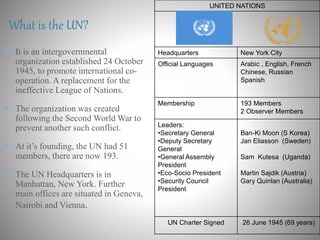
 It is an intergovernmental
organization established 24 October
1945, to promote international co-
operation. A replacement for the
ineffective League of Nations.
 The organization was created
following the Second World War to
prevent another such conflict.
 At it’s founding, the UN had 51
members, there are now 193.
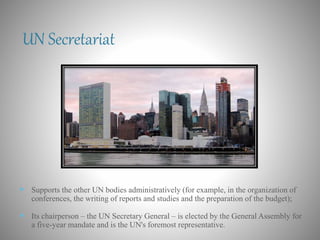
 The UN Headquarters is in
Manhattan, New York. Further
main offices are situated in Geneva,
Nairobi and Vienna.
UNITED NATIONS
Headquarters New York City
Official Languages Arabic , English, French
Chinese, Russian
Spanish
Membership 193 Members
2 Observer Members
Leaders:
•Secretary General
•Deputy Secretary
General
•General Assembly
President
•Eco-Socio President
•Security Council
President
Ban-Ki Moon (S Korea)
Jan Eliasson (Sweden)
Sam Kutesa (Uganda)
Martin Sajdik (Austria)
Gary Quinlan (Australia)
UN Charter Signed 26 June 1945 (69 years)
Early History
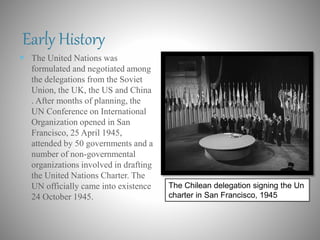
 The United Nations was
formulated and negotiated among
the delegations from the Soviet
Union, the UK, the US and China
. After months of planning, the
UN Conference on International
Organization opened in San
Francisco, 25 April 1945,
attended by 50 governments and a
number of non-governmental
organizations involved in drafting
the United Nations Charter. The
UN officially came into existence
24 October 1945.
The Chilean delegation signing the Un
charter in San Francisco, 1945
Aims of the UN
 Peacekeeping and security
 Human rights
 Economic development and humanitarian assistance
 Others (UN Environmental Programme, World
Meteorological Organization, Intergovernmental
Panel on Climate Change)
Peacekeeping and security
 The UN, after approval by the Security
Council, sends peacekeepers to regions
where armed conflict has recently
ceased or paused to enforce the terms
of peace agreements and to discourage
combatants from resuming hostilities.
Since the UN does not maintain its own
military, peacekeeping forces are
voluntarily provided by member states.
UN had peacekeeping soldiers
deployed on 15 missions:
 United Nations Organization
Stabilization Mission in the Democratic
Republic of the Congo (MONUSCO),
 United Nations Military Observer
Group in India and Pakistan
(UNMOGIP)
 United Nations Truce Supervision
Organization (UNTSO)
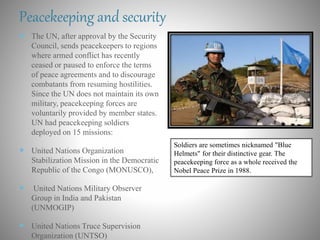
Soldiers are sometimes nicknamed "Blue
Helmets" for their distinctive gear. The
peacekeeping force as a whole received the
Nobel Peace Prize in 1988.
Human rights  In 1948, the General Assembly
adopted a Universal Declaration of
Human Rights, drafted by a
committee headed by Franklin D.
Roosevelt's widow, Eleanor, and
including the French lawyer René
Cassin. The document proclaims
basic civil, political, and economic
rights common to all human beings,
though its effectiveness toward
achieving these ends has been
disputed since its drafting. The
Declaration serves as a "common
standard of achievement for all
peoples and all nations" rather than
a legally binding document, but it
has become the basis of two
binding treaties, the 1966
International Covenant on Civil and
Political Rights and International
Covenant on Economic, Social and
Cultural Rights.
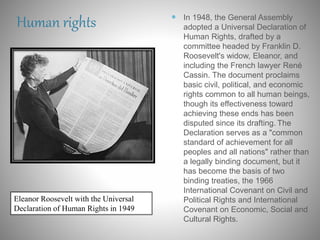
Eleanor Roosevelt with the Universal
Declaration of Human Rights in 1949
Economic development and humanitarian
assistance
 Another primary purpose of the
UN is "to achieve international
co-operation in solving
international problems of an
economic, social, cultural, or
humanitarian character".
Numerous bodies have been
created to work towards this
goal, primarily under the
authority of the General
Assembly and ECOSOC. In
2000, the 192 United Nations
member states agreed to
achieve eight Millennium
Development Goals by 2015.
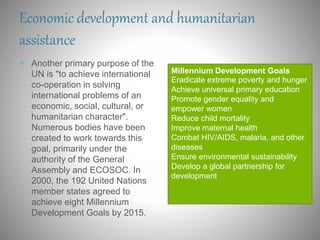
Millennium Development Goals
Eradicate extreme poverty and hunger
Achieve universal primary education
Promote gender equality and
empower women
Reduce child mortality
Improve maternal health
Combat HIV/AIDS, malaria, and other
diseases
Ensure environmental sustainability
Develop a global partnership for
development
Organs of the United Nations
The United Nations' system is based on six principal organs, those are:
 UN General Assembly: Deliberative assembly of all UN member states
 UN Secretariat: Administrative organ of the UN
 International Court of Justice: Universal court for international law
 UN Security Council: For international security issues
 UN Economics and Social Council: For global economical and social affairs
 UN Trusteeship Council: For administering trust territories (currently inactive)
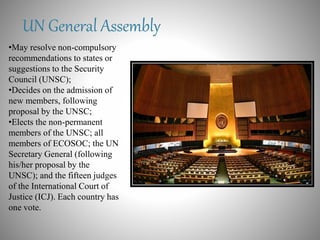
UN General Assembly
•May resolve non-compulsory
recommendations to states or
suggestions to the Security
Council (UNSC);
•Decides on the admission of
new members, following
proposal by the UNSC;
•Elects the non-permanent
members of the UNSC; all
members of ECOSOC; the UN
Secretary General (following
his/her proposal by the
UNSC); and the fifteen judges
of the International Court of
Justice (ICJ). Each country has
one vote.
UN Secretariat
 Supports the other UN bodies administratively (for example, in the organization of
conferences, the writing of reports and studies and the preparation of the budget);
 Its chairperson – the UN Secretary General – is elected by the General Assembly for
a five-year mandate and is the UN's foremost representative.
International Court of Justice
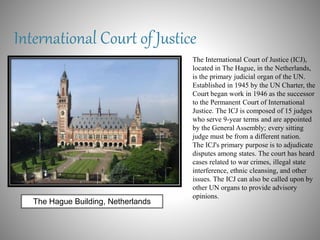
The International Court of Justice (ICJ),
located in The Hague, in the Netherlands,
is the primary judicial organ of the UN.
Established in 1945 by the UN Charter, the
Court began work in 1946 as the successor
to the Permanent Court of International
Justice. The ICJ is composed of 15 judges
who serve 9-year terms and are appointed
by the General Assembly; every sitting
judge must be from a different nation.
The ICJ's primary purpose is to adjudicate
disputes among states. The court has heard
cases related to war crimes, illegal state
interference, ethnic cleansing, and other
issues. The ICJ can also be called upon by
other UN organs to provide advisory
opinions.
The Hague Building, Netherlands
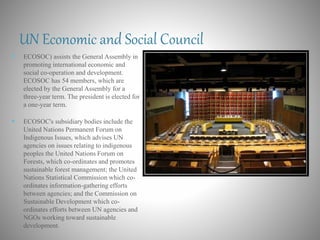
UN Economic and Social Council
 ECOSOC) assists the General Assembly in
promoting international economic and
social co-operation and development.
ECOSOC has 54 members, which are
elected by the General Assembly for a
three-year term. The president is elected for
a one-year term.
 ECOSOC's subsidiary bodies include the
United Nations Permanent Forum on
Indigenous Issues, which advises UN
agencies on issues relating to indigenous
peoples the United Nations Forum on
Forests, which co-ordinates and promotes
sustainable forest management; the United
Nations Statistical Commission which co-
ordinates information-gathering efforts
between agencies; and the Commission on
Sustainable Development which co-
ordinates efforts between UN agencies and
NGOs working toward sustainable
development.
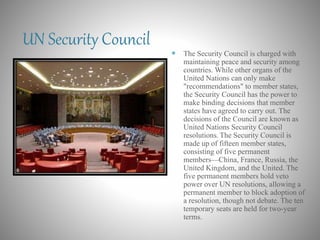
UN Security Council
 The Security Council is charged with
maintaining peace and security among
countries. While other organs of the
United Nations can only make
"recommendations" to member states,
the Security Council has the power to
make binding decisions that member
states have agreed to carry out. The
decisions of the Council are known as
United Nations Security Council
resolutions. The Security Council is
made up of fifteen member states,
consisting of five permanent
members—China, France, Russia, the
United Kingdom, and the United. The
five permanent members hold veto
power over UN resolutions, allowing a
permanent member to block adoption of
a resolution, though not debate. The ten
temporary seats are held for two-year
terms.
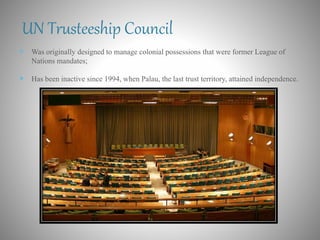
UN Trusteeship Council
 Was originally designed to manage colonial possessions that were former League of
Nations mandates;
 Has been inactive since 1994, when Palau, the last trust territory, attained independence.
Membership
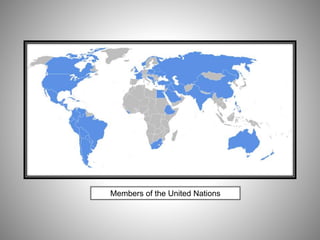
With the addition of South Sudan 14 July 2011,there are 193 United
Nations member states, including all undisputed independent states
apart from Vatican City. The UN Charter outlines the rules for
membership:
 Membership in the United Nations is open to all other peace-loving states that accept
the obligations contained in the present Charter and, in the judgment of the
Organization, are able and willing to carry out these obligations.
 The admission of any such state to membership in the United Nations will be effected
by a decision of the General Assembly upon the recommendation of the Security
Council. Chapter II, Article 4
In addition, there are two non-member observer states of the United
Nations General Assembly: the Holy See (which holds sovereignty over
Vatican City) and the State of Palestine, The Cook Islands and Niue,
both states in free association with New Zealand, are full members of
several UN specialized agencies and have had their "full treaty-making
capacity" recognized by the Secretariat
Members of the United Nations
UN in India India was among the original members of the United Nations that signed the
Declaration by United Nations at Washington on 1 January 1942 and also
participated in the United Nations Conference on International Organization at
San Francisco from 25 April to 26 June 1945.
 As a founding member of the United Nations, India strongly supports the
purposes and principles of the UN and has made significant contributions to
implementing the goals of the Charter, and the evolution of the UN's specialized
programmes and agencies.
 India is a charter member of the United Nations and participates in all of its
specialised agencies and organisations. India has contributed troops to United
Nations peacekeeping efforts in Korea, Egypt and the Congo in its earlier years
and in Somalia, Angola, Haiti, Liberia, Lebanon and Rwanda in recent years,
and more recently in the South Sudan conflict.
 India has been a member of the UN Security Council for six terms (a total of 12
years).
 India is a member of the G4 group of nations who back each other in seeking a
permanent seat on the security council and advocate in favor of the reformation
of the UNSC.

Introduction to the United Nations

  • 1.
  • 2.
    What is theUN?  It is an intergovernmental organization established 24 October 1945, to promote international co- operation. A replacement for the ineffective League of Nations.  The organization was created following the Second World War to prevent another such conflict.  At it’s founding, the UN had 51 members, there are now 193.  The UN Headquarters is in Manhattan, New York. Further main offices are situated in Geneva, Nairobi and Vienna. UNITED NATIONS Headquarters New York City Official Languages Arabic , English, French Chinese, Russian Spanish Membership 193 Members 2 Observer Members Leaders: •Secretary General •Deputy Secretary General •General Assembly President •Eco-Socio President •Security Council President Ban-Ki Moon (S Korea) Jan Eliasson (Sweden) Sam Kutesa (Uganda) Martin Sajdik (Austria) Gary Quinlan (Australia) UN Charter Signed 26 June 1945 (69 years)
  • 3.
    Early History  TheUnited Nations was formulated and negotiated among the delegations from the Soviet Union, the UK, the US and China . After months of planning, the UN Conference on International Organization opened in San Francisco, 25 April 1945, attended by 50 governments and a number of non-governmental organizations involved in drafting the United Nations Charter. The UN officially came into existence 24 October 1945. The Chilean delegation signing the Un charter in San Francisco, 1945
  • 4.
    Aims of theUN  Peacekeeping and security  Human rights  Economic development and humanitarian assistance  Others (UN Environmental Programme, World Meteorological Organization, Intergovernmental Panel on Climate Change)
  • 5.
    Peacekeeping and security The UN, after approval by the Security Council, sends peacekeepers to regions where armed conflict has recently ceased or paused to enforce the terms of peace agreements and to discourage combatants from resuming hostilities. Since the UN does not maintain its own military, peacekeeping forces are voluntarily provided by member states. UN had peacekeeping soldiers deployed on 15 missions:  United Nations Organization Stabilization Mission in the Democratic Republic of the Congo (MONUSCO),  United Nations Military Observer Group in India and Pakistan (UNMOGIP)  United Nations Truce Supervision Organization (UNTSO) Soldiers are sometimes nicknamed "Blue Helmets" for their distinctive gear. The peacekeeping force as a whole received the Nobel Peace Prize in 1988.
  • 6.
    Human rights In 1948, the General Assembly adopted a Universal Declaration of Human Rights, drafted by a committee headed by Franklin D. Roosevelt's widow, Eleanor, and including the French lawyer René Cassin. The document proclaims basic civil, political, and economic rights common to all human beings, though its effectiveness toward achieving these ends has been disputed since its drafting. The Declaration serves as a "common standard of achievement for all peoples and all nations" rather than a legally binding document, but it has become the basis of two binding treaties, the 1966 International Covenant on Civil and Political Rights and International Covenant on Economic, Social and Cultural Rights. Eleanor Roosevelt with the Universal Declaration of Human Rights in 1949
  • 7.
    Economic development andhumanitarian assistance  Another primary purpose of the UN is "to achieve international co-operation in solving international problems of an economic, social, cultural, or humanitarian character". Numerous bodies have been created to work towards this goal, primarily under the authority of the General Assembly and ECOSOC. In 2000, the 192 United Nations member states agreed to achieve eight Millennium Development Goals by 2015. Millennium Development Goals Eradicate extreme poverty and hunger Achieve universal primary education Promote gender equality and empower women Reduce child mortality Improve maternal health Combat HIV/AIDS, malaria, and other diseases Ensure environmental sustainability Develop a global partnership for development
  • 8.
    Organs of theUnited Nations The United Nations' system is based on six principal organs, those are:  UN General Assembly: Deliberative assembly of all UN member states  UN Secretariat: Administrative organ of the UN  International Court of Justice: Universal court for international law  UN Security Council: For international security issues  UN Economics and Social Council: For global economical and social affairs  UN Trusteeship Council: For administering trust territories (currently inactive)
  • 9.
    UN General Assembly •Mayresolve non-compulsory recommendations to states or suggestions to the Security Council (UNSC); •Decides on the admission of new members, following proposal by the UNSC; •Elects the non-permanent members of the UNSC; all members of ECOSOC; the UN Secretary General (following his/her proposal by the UNSC); and the fifteen judges of the International Court of Justice (ICJ). Each country has one vote.
  • 10.
    UN Secretariat  Supportsthe other UN bodies administratively (for example, in the organization of conferences, the writing of reports and studies and the preparation of the budget);  Its chairperson – the UN Secretary General – is elected by the General Assembly for a five-year mandate and is the UN's foremost representative.
  • 11.
    International Court ofJustice The International Court of Justice (ICJ), located in The Hague, in the Netherlands, is the primary judicial organ of the UN. Established in 1945 by the UN Charter, the Court began work in 1946 as the successor to the Permanent Court of International Justice. The ICJ is composed of 15 judges who serve 9-year terms and are appointed by the General Assembly; every sitting judge must be from a different nation. The ICJ's primary purpose is to adjudicate disputes among states. The court has heard cases related to war crimes, illegal state interference, ethnic cleansing, and other issues. The ICJ can also be called upon by other UN organs to provide advisory opinions. The Hague Building, Netherlands
  • 12.
    UN Economic andSocial Council  ECOSOC) assists the General Assembly in promoting international economic and social co-operation and development. ECOSOC has 54 members, which are elected by the General Assembly for a three-year term. The president is elected for a one-year term.  ECOSOC's subsidiary bodies include the United Nations Permanent Forum on Indigenous Issues, which advises UN agencies on issues relating to indigenous peoples the United Nations Forum on Forests, which co-ordinates and promotes sustainable forest management; the United Nations Statistical Commission which co- ordinates information-gathering efforts between agencies; and the Commission on Sustainable Development which co- ordinates efforts between UN agencies and NGOs working toward sustainable development.
  • 13.
    UN Security Council The Security Council is charged with maintaining peace and security among countries. While other organs of the United Nations can only make "recommendations" to member states, the Security Council has the power to make binding decisions that member states have agreed to carry out. The decisions of the Council are known as United Nations Security Council resolutions. The Security Council is made up of fifteen member states, consisting of five permanent members—China, France, Russia, the United Kingdom, and the United. The five permanent members hold veto power over UN resolutions, allowing a permanent member to block adoption of a resolution, though not debate. The ten temporary seats are held for two-year terms.
  • 14.
    UN Trusteeship Council Was originally designed to manage colonial possessions that were former League of Nations mandates;  Has been inactive since 1994, when Palau, the last trust territory, attained independence.
  • 15.
    Membership With the additionof South Sudan 14 July 2011,there are 193 United Nations member states, including all undisputed independent states apart from Vatican City. The UN Charter outlines the rules for membership:  Membership in the United Nations is open to all other peace-loving states that accept the obligations contained in the present Charter and, in the judgment of the Organization, are able and willing to carry out these obligations.  The admission of any such state to membership in the United Nations will be effected by a decision of the General Assembly upon the recommendation of the Security Council. Chapter II, Article 4 In addition, there are two non-member observer states of the United Nations General Assembly: the Holy See (which holds sovereignty over Vatican City) and the State of Palestine, The Cook Islands and Niue, both states in free association with New Zealand, are full members of several UN specialized agencies and have had their "full treaty-making capacity" recognized by the Secretariat
  • 16.
    Members of theUnited Nations
  • 17.
    UN in IndiaIndia was among the original members of the United Nations that signed the Declaration by United Nations at Washington on 1 January 1942 and also participated in the United Nations Conference on International Organization at San Francisco from 25 April to 26 June 1945.  As a founding member of the United Nations, India strongly supports the purposes and principles of the UN and has made significant contributions to implementing the goals of the Charter, and the evolution of the UN's specialized programmes and agencies.  India is a charter member of the United Nations and participates in all of its specialised agencies and organisations. India has contributed troops to United Nations peacekeeping efforts in Korea, Egypt and the Congo in its earlier years and in Somalia, Angola, Haiti, Liberia, Lebanon and Rwanda in recent years, and more recently in the South Sudan conflict.  India has been a member of the UN Security Council for six terms (a total of 12 years).  India is a member of the G4 group of nations who back each other in seeking a permanent seat on the security council and advocate in favor of the reformation of the UNSC.