United Nations 
Organization
Members: 
• Zaynub Malik 92 
• Mahanoor Saif 89 
• Faiza Nawazish 132 
• Roobash Tazein 135 
• Zahra Naeem 108 
• Mahnoor Shahid 123 
• Ruhma Yousaf 130
» Introduction 
» Administrative Bodies 
» Achievements Of UNO 
» Failures Of UNO & it’s Causes 
» Realist & Liberalist School Of Thought 
for UNO 
» Conclusion & Recommendation 
10/14/2014
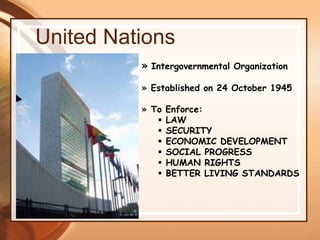
United Nations 
» Intergovernmental Organization 
» Established on 24 October 1945 
» To Enforce: 
 LAW 
 SECURITY 
 ECONOMIC DEVELOPMENT 
 SOCIAL PROGRESS 
 HUMAN RIGHTS 
 BETTER LIVING STANDARDS
10/14/2014 
HISTORY 
World War 1 & World War 2 were highly 
destructive of life as well as of material
10/14/2014
10/14/2014 
• Axis Nations— Germany, Italy & 
Japan. 
• On 26 June 1945, Representatives 
of 50 countries signed the final 
charter of the UN. 
• Officially came into existence on 24 
October 1945. 
Franklin D. Roosevelt 
32nd President of the US
Preamble Of Charter 
• To maintain international peace 
and security. 
• To develop friendly relations 
among nations. 
• To achieve international 
cooperation in solving economic , 
social, cultural and humanitarian 
problems. 
10/14/2014
PRINCIPLES 
• All Member States have sovereign equality. 
• All Member States must obey the Charter. 
• Countries must try to settle their differences by 
peaceful means. 
• Countries must avoid using force or threatening 
to use force. 
• The UN may not interfere in the domestic affairs 
of any country. 
10/14/2014
Administrative Bodies 
1. The General Assembly 
-- Main deliberative organ of the United Nations -- 
WORKING 
Discusses any matter arising under the UN Charter 
and make recommendations to Members
2. The Security Council 
— For international security issues — 
10/14/2014 
MEMBERS 
5 permanent members and 10 elected by General 
Assembly
3. The Economic and Social Council 
— For global economical and social affairs — 
• It has 54 member nations elected from all regions. 
• Responsible for co-operation between states as regards 
economic and social matters. 
10/14/2014
4. The Trusteeship Council 
— For administering trust territories — 
• Supervise the administration of dependent Territories 
• The system was created at the end of the Second World 
War. 
10/14/2014
5. The International Court of Justice 
— Universal court for international law — 
Functions: 
Settle legal disputes and 
provide advisory opinions on 
legal questions. 
Composition: 
15 judges elected to nine year 
terms by the UN General 
Assembly 
Working: 
To adjudicate disputes among 
states. 
10/14/2014
6. The Secretariat 
— For administering trust territories — 
Function 
The Secretariat is made up of an international staff working at UN 
Headquarters in New York. 
Working 
To prevent conflicts or promote peaceful settlement of disputes 
between countries.
Agencies associated with UN 
1. International Labor Organization (ILO) 
2. International Monetary Fund (IMF) 
3. United Nations Educational, Scientific and 
Cultural Organization (UNESCO) 
4. United Nations Children’s Fund (UNICEF) 
5. World Bank (WB) 
6. World Health Organization (WHO) 
7. The UN and the World Trade Organization 
(WTO) 
10/14/2014
Suez Crisis (1956) 
10/14/2014 
Achievements 
SUEZ CANAL 
• Shipping canal through the 100 miles of desert 
between Africa and Asia. 
IMPORTANCE 
• Shortest ocean link between the Mediterranean and 
the Indian Ocean. 
• Eased Commerce for Trading Nations 
• Helped European Colonial Powers to gain and govern 
their colonies 
• Short Sea Route to the Oilfields of the Persian Gulf.
10/14/2014
• 1956, Egyptian leader “Gamal Abdel 
Nasser” seized control of the Suez 
Canal. 
• Britain and France, together with Israel 
launched attacks on Egypt. 
• USSR threatened to shower the west 
with Nuclear Weapons. 
• United Nations Emergency 
Force (UNEF) 
10/14/2014
Promoting and Protecting Human Rights 
• Political, Civil, Economic, Social 
and Cultural rights. 
• Promoted Human Rights of 
Children, Women, Refugees, 
Indigenous people 
• UN High Commissioner for 
Human Rights(UNHCR) 
established by the general 
assembly 
10/14/2014
Health Care 
The Joint United Nations Programme on HIV/AIDS 
(UNAIDS) It provide universal access to HIV 
prevention and treatment services 
10/14/2014
Environmental Issues 
TREATY 
• United Nations Framework Convention on Climate 
Change (UNFCCC), International Environmental Treaty. 
OBJECTIVE 
“To stabilize greenhouse gas concentration in the 
atmosphere at a level that would prevent dangerous and 
Anthropogenic Interference with the Climate system.” 
10/14/2014
Human Activities are the primary cause for 
‘Climatic Changes’ 
10/14/2014
Ending of Apartheid 
• Apartheid: 
• Elimination of Apartheid was 
on the agenda of the United 
Nations 
• United nations took action 
against Apartheid 
1. Arms embargo 
2. Oil embargo 
10/14/2014
• Declaration on Apartheid by 
general assembly in 1989 
• The United Nations Observer 
Mission in South Africa was 
established by the Security 
Council on 17 August 1992 
• In 1994 a democratic Government 
was established. 
10/14/2014
10/14/2014
Failures 
Muammar Gaddafi (Late) criticized the 
UN 
10/14/2014
Divided Council 
• its undemocratic structure 
• Counil ability to maintain peace 
depends upon interest of big 
five 
10/14/2014
Palestine Issue 
• View of Jews for Jerusalem 
• Palestinians are deprived of 
their homeland 
• Importance of Israel for US 
10/14/2014
• US prevents UNSC 
from adopting 
resolutions condemning 
Israeli activities in 
Jerusalem 
10/14/2014
Syrian Crisis 
• Opposition of Russia and China 
over the issue of Syria 
• Interest of Russia 
Russia has a naval installation in 
Syria 
• Russia still has a bit of a Cold 
War mentality 
10/14/2014
UN as an instrument of US 
• U.S allocate funds to UN in their budget 
planning… 
• The U.S. contributes more to the UN than any 
other country . 
• -- 22 percent of the regular UN budget and 27 
percent of the peacekeeping budget 
10/14/2014
IRAQ WAR 2003 
• The war started without the consent of the 
Security Council amidst strong opposition 
from many countries. 
• Role of US and UK to use Veto and pass the 
resolution 
• France stops to introduce an other 
resolution 
• US and UK invade without the authority of 
UN 
• Later clarified the issue 
10/14/2014
10/14/2014 
• Civil war between the two 
groups of Rwanda lead to 
genocide 
• Nearly 20% of the total 
population were killed. 
• Inefficiency of UN 
peacekeeper troops 
Rwanda 
Genocide
Sri Lanka Civil War 2009 
• Long war of 26 years between the Buddhist 
Sinhalese majority and the Hindu Tamil 
minority. 
• The UN admitted its failure in Sri Lanka civil 
war to confront the government over the 
killing of separatist group members 
• The UN was failed to stop the war and to 
protect the human rights. 
10/14/2014
DURFUR: 
• The unstable nation of Sudan erupted in conflict, , 
the UN did not enter Sudan, instead urging members 
of the African Union to intervene. 
SREBRENICA MASSACRE: 
• The United Nations designated Srebrenica a safe-zone 
in 1993. 
• 1995 Bosnian War massacre was the single worst act 
of mass murder on European soil since World War II. 
10/14/2014
Realist & Liberalist School Of Thought for 
United Nations Organization (UNO) 
10/14/2014
Two Classical view points: 
• Realist view 
• Liberalist view 
10/14/2014
UN in and of itself is an “Idealist 
Forum." 
10/14/2014
UN a Liberal or Realist Organization? 
• United Nations is a liberal organization. 
• The Liberal Theory focuses on 
international institutions and systems. 
• Liberal theorists often study institutions such as 
the United Nations. 
10/14/2014
• The liberal idea that international security and 
order can develop under an international 
organization lead to the creation of the UNO. 
• International organizations, such as the United 
Nations , were calculated both to maintain a 
balance of power as well as regularize 
cooperation between nations. 
10/14/2014
10/14/2014
1. Generate a more balanced distribution 
2. Enhances coherence 
3. Pay increase attention to inter temporal 
decisions 
4. Should emphasis on transparency, 
accountability, integrity, efficiency and 
flexibility. 
5. Developing environment
CONCLUSION 
Efficient UN action was in fact stymied by superpower conflict that 
was based on both geopolitical and ideological factors. Some 
improvements towards peaceful cooperation were, made by simply 
providing a peaceful platform for global discussion. Thorough 
reforms of the UN, especially the UNSC, could work towards better 
international governance and maintenance of peace and security in 
the world, but they can only work if the Big Five are ready to give up 
their veto and engage in more democratic power-sharing. The world 
needs a truly legitimate international organization that serves the 
needs of those affected by conflicts directly, and not the interests of 
the power-hungry nations who run the show. This can only be 
achieved when there are serious diplomatic efforts to make the UNSC 
a truly “one member, one vote” system, serving the interests of all 
nations.
10/14/2014

United nations organisation

  • 2.
  • 3.
    Members: • ZaynubMalik 92 • Mahanoor Saif 89 • Faiza Nawazish 132 • Roobash Tazein 135 • Zahra Naeem 108 • Mahnoor Shahid 123 • Ruhma Yousaf 130
  • 4.
    » Introduction »Administrative Bodies » Achievements Of UNO » Failures Of UNO & it’s Causes » Realist & Liberalist School Of Thought for UNO » Conclusion & Recommendation 10/14/2014
  • 5.
    United Nations »Intergovernmental Organization » Established on 24 October 1945 » To Enforce:  LAW  SECURITY  ECONOMIC DEVELOPMENT  SOCIAL PROGRESS  HUMAN RIGHTS  BETTER LIVING STANDARDS
  • 6.
    10/14/2014 HISTORY WorldWar 1 & World War 2 were highly destructive of life as well as of material
  • 7.
  • 8.
    10/14/2014 • AxisNations— Germany, Italy & Japan. • On 26 June 1945, Representatives of 50 countries signed the final charter of the UN. • Officially came into existence on 24 October 1945. Franklin D. Roosevelt 32nd President of the US
  • 9.
    Preamble Of Charter • To maintain international peace and security. • To develop friendly relations among nations. • To achieve international cooperation in solving economic , social, cultural and humanitarian problems. 10/14/2014
  • 10.
    PRINCIPLES • AllMember States have sovereign equality. • All Member States must obey the Charter. • Countries must try to settle their differences by peaceful means. • Countries must avoid using force or threatening to use force. • The UN may not interfere in the domestic affairs of any country. 10/14/2014
  • 11.
    Administrative Bodies 1.The General Assembly -- Main deliberative organ of the United Nations -- WORKING Discusses any matter arising under the UN Charter and make recommendations to Members
  • 12.
    2. The SecurityCouncil — For international security issues — 10/14/2014 MEMBERS 5 permanent members and 10 elected by General Assembly
  • 13.
    3. The Economicand Social Council — For global economical and social affairs — • It has 54 member nations elected from all regions. • Responsible for co-operation between states as regards economic and social matters. 10/14/2014
  • 14.
    4. The TrusteeshipCouncil — For administering trust territories — • Supervise the administration of dependent Territories • The system was created at the end of the Second World War. 10/14/2014
  • 15.
    5. The InternationalCourt of Justice — Universal court for international law — Functions: Settle legal disputes and provide advisory opinions on legal questions. Composition: 15 judges elected to nine year terms by the UN General Assembly Working: To adjudicate disputes among states. 10/14/2014
  • 16.
    6. The Secretariat — For administering trust territories — Function The Secretariat is made up of an international staff working at UN Headquarters in New York. Working To prevent conflicts or promote peaceful settlement of disputes between countries.
  • 17.
    Agencies associated withUN 1. International Labor Organization (ILO) 2. International Monetary Fund (IMF) 3. United Nations Educational, Scientific and Cultural Organization (UNESCO) 4. United Nations Children’s Fund (UNICEF) 5. World Bank (WB) 6. World Health Organization (WHO) 7. The UN and the World Trade Organization (WTO) 10/14/2014
  • 18.
    Suez Crisis (1956) 10/14/2014 Achievements SUEZ CANAL • Shipping canal through the 100 miles of desert between Africa and Asia. IMPORTANCE • Shortest ocean link between the Mediterranean and the Indian Ocean. • Eased Commerce for Trading Nations • Helped European Colonial Powers to gain and govern their colonies • Short Sea Route to the Oilfields of the Persian Gulf.
  • 19.
  • 20.
    • 1956, Egyptianleader “Gamal Abdel Nasser” seized control of the Suez Canal. • Britain and France, together with Israel launched attacks on Egypt. • USSR threatened to shower the west with Nuclear Weapons. • United Nations Emergency Force (UNEF) 10/14/2014
  • 21.
    Promoting and ProtectingHuman Rights • Political, Civil, Economic, Social and Cultural rights. • Promoted Human Rights of Children, Women, Refugees, Indigenous people • UN High Commissioner for Human Rights(UNHCR) established by the general assembly 10/14/2014
  • 22.
    Health Care TheJoint United Nations Programme on HIV/AIDS (UNAIDS) It provide universal access to HIV prevention and treatment services 10/14/2014
  • 23.
    Environmental Issues TREATY • United Nations Framework Convention on Climate Change (UNFCCC), International Environmental Treaty. OBJECTIVE “To stabilize greenhouse gas concentration in the atmosphere at a level that would prevent dangerous and Anthropogenic Interference with the Climate system.” 10/14/2014
  • 24.
    Human Activities arethe primary cause for ‘Climatic Changes’ 10/14/2014
  • 25.
    Ending of Apartheid • Apartheid: • Elimination of Apartheid was on the agenda of the United Nations • United nations took action against Apartheid 1. Arms embargo 2. Oil embargo 10/14/2014
  • 26.
    • Declaration onApartheid by general assembly in 1989 • The United Nations Observer Mission in South Africa was established by the Security Council on 17 August 1992 • In 1994 a democratic Government was established. 10/14/2014
  • 27.
  • 28.
    Failures Muammar Gaddafi(Late) criticized the UN 10/14/2014
  • 29.
    Divided Council •its undemocratic structure • Counil ability to maintain peace depends upon interest of big five 10/14/2014
  • 30.
    Palestine Issue •View of Jews for Jerusalem • Palestinians are deprived of their homeland • Importance of Israel for US 10/14/2014
  • 31.
    • US preventsUNSC from adopting resolutions condemning Israeli activities in Jerusalem 10/14/2014
  • 32.
    Syrian Crisis •Opposition of Russia and China over the issue of Syria • Interest of Russia Russia has a naval installation in Syria • Russia still has a bit of a Cold War mentality 10/14/2014
  • 33.
    UN as aninstrument of US • U.S allocate funds to UN in their budget planning… • The U.S. contributes more to the UN than any other country . • -- 22 percent of the regular UN budget and 27 percent of the peacekeeping budget 10/14/2014
  • 34.
    IRAQ WAR 2003 • The war started without the consent of the Security Council amidst strong opposition from many countries. • Role of US and UK to use Veto and pass the resolution • France stops to introduce an other resolution • US and UK invade without the authority of UN • Later clarified the issue 10/14/2014
  • 35.
    10/14/2014 • Civilwar between the two groups of Rwanda lead to genocide • Nearly 20% of the total population were killed. • Inefficiency of UN peacekeeper troops Rwanda Genocide
  • 36.
    Sri Lanka CivilWar 2009 • Long war of 26 years between the Buddhist Sinhalese majority and the Hindu Tamil minority. • The UN admitted its failure in Sri Lanka civil war to confront the government over the killing of separatist group members • The UN was failed to stop the war and to protect the human rights. 10/14/2014
  • 37.
    DURFUR: • Theunstable nation of Sudan erupted in conflict, , the UN did not enter Sudan, instead urging members of the African Union to intervene. SREBRENICA MASSACRE: • The United Nations designated Srebrenica a safe-zone in 1993. • 1995 Bosnian War massacre was the single worst act of mass murder on European soil since World War II. 10/14/2014
  • 38.
    Realist & LiberalistSchool Of Thought for United Nations Organization (UNO) 10/14/2014
  • 39.
    Two Classical viewpoints: • Realist view • Liberalist view 10/14/2014
  • 40.
    UN in andof itself is an “Idealist Forum." 10/14/2014
  • 41.
    UN a Liberalor Realist Organization? • United Nations is a liberal organization. • The Liberal Theory focuses on international institutions and systems. • Liberal theorists often study institutions such as the United Nations. 10/14/2014
  • 42.
    • The liberalidea that international security and order can develop under an international organization lead to the creation of the UNO. • International organizations, such as the United Nations , were calculated both to maintain a balance of power as well as regularize cooperation between nations. 10/14/2014
  • 43.
  • 44.
    1. Generate amore balanced distribution 2. Enhances coherence 3. Pay increase attention to inter temporal decisions 4. Should emphasis on transparency, accountability, integrity, efficiency and flexibility. 5. Developing environment
  • 45.
    CONCLUSION Efficient UNaction was in fact stymied by superpower conflict that was based on both geopolitical and ideological factors. Some improvements towards peaceful cooperation were, made by simply providing a peaceful platform for global discussion. Thorough reforms of the UN, especially the UNSC, could work towards better international governance and maintenance of peace and security in the world, but they can only work if the Big Five are ready to give up their veto and engage in more democratic power-sharing. The world needs a truly legitimate international organization that serves the needs of those affected by conflicts directly, and not the interests of the power-hungry nations who run the show. This can only be achieved when there are serious diplomatic efforts to make the UNSC a truly “one member, one vote” system, serving the interests of all nations.
  • 46.