Dr. William F. Shija Secretary-General The Commonwealth, the CPA  and Parliamentary Democracy
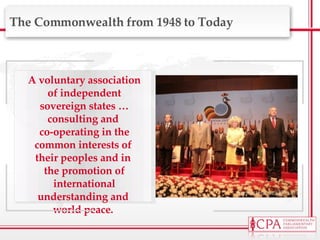
The Commonwealth from 1948 to Today A voluntary association of independent sovereign states … consulting and  co-operating in the common interests of  their peoples and in  the promotion of international understanding and  world peace.
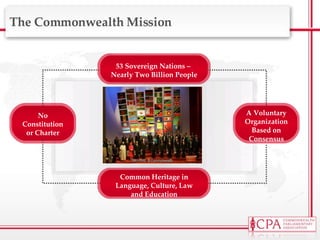
The Commonwealth Mission A Voluntary Organization Based on Consensus 53 Sovereign Nations –  Nearly Two Billion People Common Heritage in Language, Culture, Law and Education No Constitution or Charter
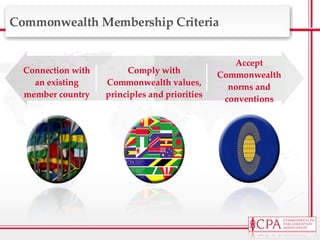
Commonwealth Membership Criteria Connection with an existing member country Comply with Commonwealth values, principles and priorities Accept Commonwealth norms and conventions
Singapore Declaration of Commonwealth Principles (1971) We believe in the liberty of the individual, in equal rights  for all citizens regardless of  race, colour, creed or political belief, and in their inalienable right to participate by means of free and democratic political processes in framing the society in which they live . We therefore strive to promote  in each of our countries those representative institutions  and guarantees for personal freedom  under the law that are our common heritage.
Harare Commonwealth Declaration (1991) Democracy , democratic processes and institutions which reflect  national circumstances ,  the rule of law and the independence of the judiciary, just and honest government;  Fundamental human rights , including equal rights and opportunities for all citizens regardless of race, colour, creed or political belief; Equality for women , so that they may exercise their full and equal rights; Promotion of sustainable development and the  alleviation of poverty We invite the Commonwealth Parliamentary Association and non-governmental Commonwealth organizations to play their full part in promoting these objectives.
Millbrook Commonwealth Action  Programme (1995) MEASURES IN SUPPORT OF PROCESSES AND INSTITUTIONS  FOR THE PRACTICE OF THE HARARE PRINCIPLES Assistance in creating and  building the capacity  of requisite institutions Assistance in  constitutional and legal matters ,  including with selecting models and initiating programmes of democratisation Support for good government, particularly in the area of  public service reform Collaboration with the Commonwealth Parliamentary Association and other bodies, to strengthen the  democratic culture  and effective  parliamentary practices.
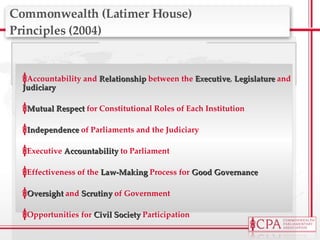
Commonwealth (Latimer House)  Principles (2004) Accountability and  Relationship  between the  Executive ,  Legislature   and  Judiciary Mutual Respect  for Constitutional Roles of Each Institution Independence  of Parliaments and the Judiciary Executive  Accountability  to Parliament Effectiveness of the  Law-Making   Process for  Good Governance Oversight  and  Scrutiny  of Government Opportunities for  Civil Society  Participation
1911: Empire Parliamentary Association 1948: Commonwealth Parliamentary Association  Parliamentary Arm of the Commonwealth Constitution adopted in 1993 Work Endorsed by Commonwealth Parliaments and Heads of Government Patron: HM Queen Elizabeth II, Head of the Commonwealth Present in 52 of the 53 Commonwealth  Countries (except Brunei).  Over  180   Branches   in National, State, Provincial and Territorial Parliaments More than  16,000 Parliamentarians The CPA: A Community of Parliamentarians
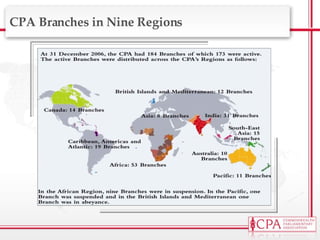
CPA Branches in Nine Regions
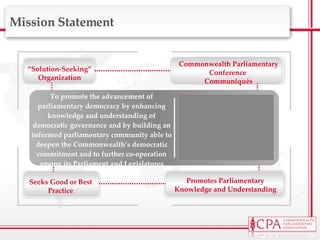
Mission Statement Promotes Parliamentary Knowledge and Understanding Seeks Good or Best Practice Commonwealth Parliamentary Conference  Communiqués To promote the advancement of parliamentary democracy by enhancing knowledge and understanding of democratic governance and by building an informed parliamentary community able to deepen the Commonwealth’s democratic commitment and to further co-operation among its Parliament and Legislatures “ Solution-Seeking” Organization
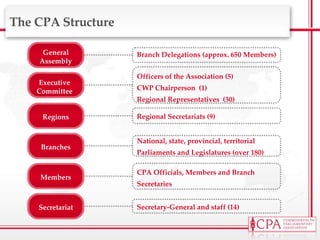
The CPA Structure Branch Delegations (approx. 650 Members)  Officers of the Association (5) CWP Chairperson  (1) Regional Representatives  (30) Regional Secretariats (9) National, state, provincial, territorial Parliaments and Legislatures (over 180) CPA Officials, Members and Branch Secretaries  Secretary-General and staff (14)  General Assembly Executive Committee Regions Branches Members Secretariat
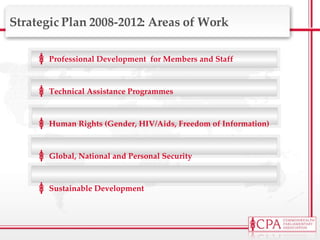
Strategic Plan 2008-2012: Areas of Work Professional Development  for Members and Staff Technical Assistance Programmes Human Rights (Gender, HIV/Aids, Freedom of Information) Global, National and Personal Security Sustainable Development
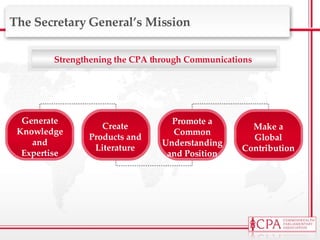
Strengthening the CPA through Communications  The Secretary General’s Mission Generate Knowledge and Expertise Create Products and Literature Promote a Common Understanding and Position Make a Global Contribution
The CPA Secretariat
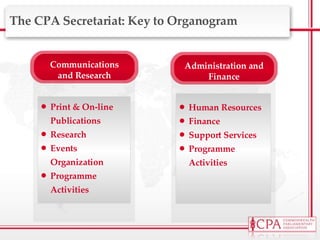
The CPA Secretariat: Key to Organogram Print & On-line Publications Research Events Organization Programme Activities Human Resources Finance Support Services Programme Activities Communications and Research Administration and Finance
CPA Finance Income, mainly from annual Branch membership fees, totaling  £ 2.2 million in 2007. Most of the fees are returned to the Branches in services. Membership fees based largely on size of Branch’s delegation entitlement to the annual conference. Central expenditure of £2.5 million in 2007.
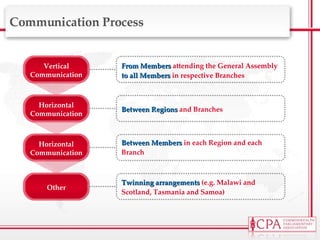
Communication Process From Members  attending the General Assembly  to all Members  in respective Branches Between Regions  and Branches Between Members  in each Region and each Branch Twinning arrangements  (e.g. Malawi and Scotland, Tasmania and Samoa) Vertical Communication Horizontal Communication Horizontal Communication Other
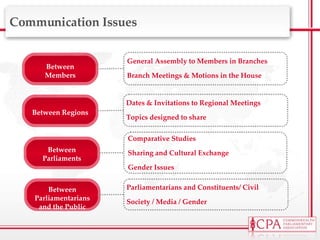
Communication Issues General Assembly to Members in Branches Branch Meetings & Motions in the House Dates & Invitations to Regional Meetings Topics designed to share Comparative Studies Sharing and Cultural Exchange Gender Issues Parliamentarians and Constituents/ Civil Society / Media / Gender Between Parliamentarians and the Public Between Parliaments Between Members Between Regions
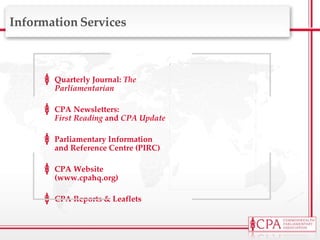
Information Services Quarterly Journal:  The Parliamentarian CPA Newsletters: First Reading  and  CPA Update Parliamentary Information and Reference Centre (PIRC) CPA Website (www.cpahq.org) CPA Reports & Leaflets
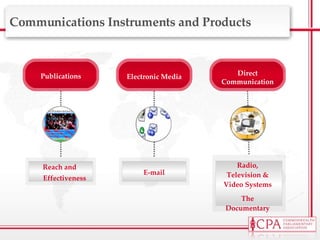
Communications Instruments and Products Reach and Effectiveness E-mail Radio, Television & Video Systems The Documentary Publications Electronic Media Direct Communication
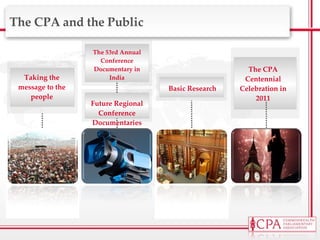
The CPA and the Public Basic Research The CPA Centennial Celebration in 2011 Taking the message to the people The 53rd Annual Conference Documentary in India Future Regional Conference Documentaries
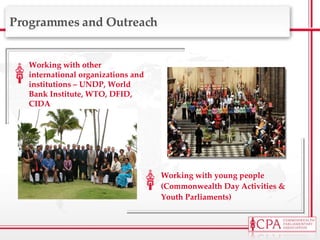
Working with other international organizations and institutions – UNDP, World Bank Institute, WTO, DFID, CIDA  Working with young people (Commonwealth Day Activities & Youth Parliaments) Programmes and Outreach
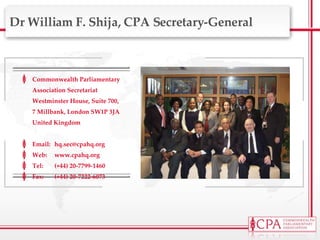
Dr William F. Shija, CPA Secretary-General Commonwealth Parliamentary Association Secretariat  Westminster House, Suite 700,  7 Millbank, London SW1P 3JA  United Kingdom  Email: hq.sec@cpahq.org  Web: www.cpahq.org Tel: (+44) 20-7799-1460  Fax: (+44) 20-7222-6073
A Community of Parliamentarians

Cpa Presentation June 2008

  • 1.
    Dr. William F.Shija Secretary-General The Commonwealth, the CPA and Parliamentary Democracy
  • 2.
    The Commonwealth from1948 to Today A voluntary association of independent sovereign states … consulting and co-operating in the common interests of their peoples and in the promotion of international understanding and world peace.
  • 3.
    The Commonwealth MissionA Voluntary Organization Based on Consensus 53 Sovereign Nations – Nearly Two Billion People Common Heritage in Language, Culture, Law and Education No Constitution or Charter
  • 4.
    Commonwealth Membership CriteriaConnection with an existing member country Comply with Commonwealth values, principles and priorities Accept Commonwealth norms and conventions
  • 5.
    Singapore Declaration ofCommonwealth Principles (1971) We believe in the liberty of the individual, in equal rights for all citizens regardless of race, colour, creed or political belief, and in their inalienable right to participate by means of free and democratic political processes in framing the society in which they live . We therefore strive to promote in each of our countries those representative institutions and guarantees for personal freedom under the law that are our common heritage.
  • 6.
    Harare Commonwealth Declaration(1991) Democracy , democratic processes and institutions which reflect national circumstances , the rule of law and the independence of the judiciary, just and honest government; Fundamental human rights , including equal rights and opportunities for all citizens regardless of race, colour, creed or political belief; Equality for women , so that they may exercise their full and equal rights; Promotion of sustainable development and the alleviation of poverty We invite the Commonwealth Parliamentary Association and non-governmental Commonwealth organizations to play their full part in promoting these objectives.
  • 7.
    Millbrook Commonwealth Action Programme (1995) MEASURES IN SUPPORT OF PROCESSES AND INSTITUTIONS FOR THE PRACTICE OF THE HARARE PRINCIPLES Assistance in creating and building the capacity of requisite institutions Assistance in constitutional and legal matters , including with selecting models and initiating programmes of democratisation Support for good government, particularly in the area of public service reform Collaboration with the Commonwealth Parliamentary Association and other bodies, to strengthen the democratic culture and effective parliamentary practices.
  • 8.
    Commonwealth (Latimer House) Principles (2004) Accountability and Relationship between the Executive , Legislature and Judiciary Mutual Respect for Constitutional Roles of Each Institution Independence of Parliaments and the Judiciary Executive Accountability to Parliament Effectiveness of the Law-Making Process for Good Governance Oversight and Scrutiny of Government Opportunities for Civil Society Participation
  • 9.
    1911: Empire ParliamentaryAssociation 1948: Commonwealth Parliamentary Association Parliamentary Arm of the Commonwealth Constitution adopted in 1993 Work Endorsed by Commonwealth Parliaments and Heads of Government Patron: HM Queen Elizabeth II, Head of the Commonwealth Present in 52 of the 53 Commonwealth Countries (except Brunei). Over 180 Branches in National, State, Provincial and Territorial Parliaments More than 16,000 Parliamentarians The CPA: A Community of Parliamentarians
  • 10.
    CPA Branches inNine Regions
  • 11.
    Mission Statement PromotesParliamentary Knowledge and Understanding Seeks Good or Best Practice Commonwealth Parliamentary Conference Communiqués To promote the advancement of parliamentary democracy by enhancing knowledge and understanding of democratic governance and by building an informed parliamentary community able to deepen the Commonwealth’s democratic commitment and to further co-operation among its Parliament and Legislatures “ Solution-Seeking” Organization
  • 12.
    The CPA StructureBranch Delegations (approx. 650 Members) Officers of the Association (5) CWP Chairperson (1) Regional Representatives (30) Regional Secretariats (9) National, state, provincial, territorial Parliaments and Legislatures (over 180) CPA Officials, Members and Branch Secretaries Secretary-General and staff (14) General Assembly Executive Committee Regions Branches Members Secretariat
  • 13.
    Strategic Plan 2008-2012:Areas of Work Professional Development for Members and Staff Technical Assistance Programmes Human Rights (Gender, HIV/Aids, Freedom of Information) Global, National and Personal Security Sustainable Development
  • 14.
    Strengthening the CPAthrough Communications The Secretary General’s Mission Generate Knowledge and Expertise Create Products and Literature Promote a Common Understanding and Position Make a Global Contribution
  • 15.
  • 16.
    The CPA Secretariat:Key to Organogram Print & On-line Publications Research Events Organization Programme Activities Human Resources Finance Support Services Programme Activities Communications and Research Administration and Finance
  • 17.
    CPA Finance Income,mainly from annual Branch membership fees, totaling £ 2.2 million in 2007. Most of the fees are returned to the Branches in services. Membership fees based largely on size of Branch’s delegation entitlement to the annual conference. Central expenditure of £2.5 million in 2007.
  • 18.
    Communication Process FromMembers attending the General Assembly to all Members in respective Branches Between Regions and Branches Between Members in each Region and each Branch Twinning arrangements (e.g. Malawi and Scotland, Tasmania and Samoa) Vertical Communication Horizontal Communication Horizontal Communication Other
  • 19.
    Communication Issues GeneralAssembly to Members in Branches Branch Meetings & Motions in the House Dates & Invitations to Regional Meetings Topics designed to share Comparative Studies Sharing and Cultural Exchange Gender Issues Parliamentarians and Constituents/ Civil Society / Media / Gender Between Parliamentarians and the Public Between Parliaments Between Members Between Regions
  • 20.
    Information Services QuarterlyJournal: The Parliamentarian CPA Newsletters: First Reading and CPA Update Parliamentary Information and Reference Centre (PIRC) CPA Website (www.cpahq.org) CPA Reports & Leaflets
  • 21.
    Communications Instruments andProducts Reach and Effectiveness E-mail Radio, Television & Video Systems The Documentary Publications Electronic Media Direct Communication
  • 22.
    The CPA andthe Public Basic Research The CPA Centennial Celebration in 2011 Taking the message to the people The 53rd Annual Conference Documentary in India Future Regional Conference Documentaries
  • 23.
    Working with otherinternational organizations and institutions – UNDP, World Bank Institute, WTO, DFID, CIDA Working with young people (Commonwealth Day Activities & Youth Parliaments) Programmes and Outreach
  • 24.
    Dr William F.Shija, CPA Secretary-General Commonwealth Parliamentary Association Secretariat Westminster House, Suite 700, 7 Millbank, London SW1P 3JA United Kingdom Email: hq.sec@cpahq.org Web: www.cpahq.org Tel: (+44) 20-7799-1460 Fax: (+44) 20-7222-6073
  • 25.
    A Community ofParliamentarians