OWASP TOP 10
VULNERABILITIES
OWASP TOP 10:
1. Injection
2. Broken Authentication & Session Management
3. Sensitive Data Exposure
4. XML External Entities(XXE)
5. Broken Access Control
6. Security Misconfiguration
7. Cross-Site Scripting(XSS)
8. Insecure Deserialization
9. Using components with known vulnerabilities
10. Insufficient logging & monitoring
#1: INJECTION
• Injections are at the head of the OWASP Top 10 and
Injection flaws, particularly
SQL Injection, are common in web applications.
• Injection occurs when user-supplied data is sent to an
interpreter as part of a command or query. The
attacker’s hostile data tricks the interpreter into
executing unintended commands or changing data.
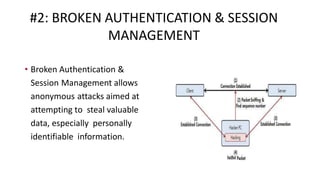
#2: BROKEN AUTHENTICATION & SESSION
MANAGEMENT
• Broken Authentication &
Session Management allows
anonymous attacks aimed at
attempting to steal valuable
data, especially personally
identifiable information.
#3: SENSITIVE DATA EXPOSURE
• Sensitive data, such as credit card numbers, health
data, or passwords should have extra protection given
the potential of damage if it falls into the wrong
hands.
• If data is stored or transferred as plain text, if
older/weaker encryption is used, or if data is decrypted
carelessly, attacker can gain access and exploit the data.
#4: XML EXTERNAL ENTITIES
• XML is a data format used to describe different data
elements.
• XML also uses “entities” to help define related data, but
entities can access remote or local content, as harmless
as pulling a current stock price from a third party
website.
• If a developer uses a common or default filename in a
common location, an attacker’s job is easy.
#5: BROKEN ACCESS CONTROL
• Access control, or authorization, is how web apps let
different users access different content, data or
functions.
• Sometimes gaining unauthorized access is as simple as
manually entering an unlinked URL in a browser, such
as http://example.com/admin
• As with other vulnerabilities, attackers can gain access
to(or modify)data, accounts and functions that they
shouldn’t.
#6: SECURITY MISCONFIGURATION
• Security Misconfiguration arises when Security settings are defined,
implemented, and maintained as defaults.
• Example #1: The app server admin console is automatically installed
and not removed
• Example #2: Directory listing is not disabled on your server
• Example #3: App server configuration allows stack traces to be returned to
users, potentially exposing underlying flaws
• Example #4: App server comes with sample applications that are not
removed from your production server
#7: CROSS-SITE SCRIPTING
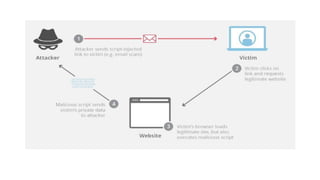
• Cross-site Scripting (XSS) is a client-side code injection attack.
• The attacker aims to execute malicious scripts in a web browser
of the victim by including malicious code in a legitimate web
page or web application.
• The actual attack occurs when the victim visits the web page or
web application that executes the malicious code.
• he web page or web application becomes a vehicle to deliver
the malicious script
to the user’s browser.
#8: INSECURE DESERIALIZATION
• It occurs when untrusted data is used to abuse the logic of
an application, inflict a denial of service (DoS) attack, or
even execute arbitrary code upon it
being deserialized.
• It’s frequently possible for an attacker to abuse these
deserialization features when the application is
deserializing untrusted data which the attacker controls.
#9: USING COMPONENTS WITH KNOWN
VULNERABILITIES
• Known vulnerabilities are vulnerabilities that were discovered in
open source components and published in the NVD, security
advisories or issue trackers.
• From the moment of publication , a vulnerability can be exploited by
hackers who find the documentation.
• The possible impact of open source vulnerabilities ranges from
minor to some of the largest breaches known.
• It’s estimated that well over 80% of all software includes, at least,
some open source components.
#10: INSUFFICIENT LOGGING AND
MONITORING
• Insufficient logging and monitoring vulnerability occurs
when the security-critical events aren’t logged properly,
and the system is not monitoring the current
happenings.
• The lack of these functionalities can make the malicious
activities harder to detect and it affects effective incident
handling when an attack happens.
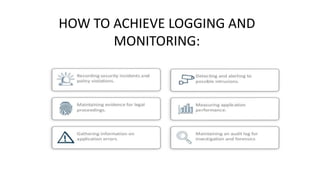
HOW TO ACHIEVE LOGGING AND
MONITORING:
owasp  features in secure coding techniques

owasp features in secure coding techniques

  • 1.
  • 2.
    OWASP TOP 10: 1.Injection 2. Broken Authentication & Session Management 3. Sensitive Data Exposure 4. XML External Entities(XXE) 5. Broken Access Control 6. Security Misconfiguration 7. Cross-Site Scripting(XSS) 8. Insecure Deserialization 9. Using components with known vulnerabilities 10. Insufficient logging & monitoring
  • 4.
    #1: INJECTION • Injectionsare at the head of the OWASP Top 10 and Injection flaws, particularly SQL Injection, are common in web applications. • Injection occurs when user-supplied data is sent to an interpreter as part of a command or query. The attacker’s hostile data tricks the interpreter into executing unintended commands or changing data.
  • 5.
    #2: BROKEN AUTHENTICATION& SESSION MANAGEMENT • Broken Authentication & Session Management allows anonymous attacks aimed at attempting to steal valuable data, especially personally identifiable information.
  • 7.
    #3: SENSITIVE DATAEXPOSURE • Sensitive data, such as credit card numbers, health data, or passwords should have extra protection given the potential of damage if it falls into the wrong hands. • If data is stored or transferred as plain text, if older/weaker encryption is used, or if data is decrypted carelessly, attacker can gain access and exploit the data.
  • 9.
    #4: XML EXTERNALENTITIES • XML is a data format used to describe different data elements. • XML also uses “entities” to help define related data, but entities can access remote or local content, as harmless as pulling a current stock price from a third party website. • If a developer uses a common or default filename in a common location, an attacker’s job is easy.
  • 10.
    #5: BROKEN ACCESSCONTROL • Access control, or authorization, is how web apps let different users access different content, data or functions. • Sometimes gaining unauthorized access is as simple as manually entering an unlinked URL in a browser, such as http://example.com/admin • As with other vulnerabilities, attackers can gain access to(or modify)data, accounts and functions that they shouldn’t.
  • 11.
    #6: SECURITY MISCONFIGURATION •Security Misconfiguration arises when Security settings are defined, implemented, and maintained as defaults. • Example #1: The app server admin console is automatically installed and not removed • Example #2: Directory listing is not disabled on your server • Example #3: App server configuration allows stack traces to be returned to users, potentially exposing underlying flaws • Example #4: App server comes with sample applications that are not removed from your production server
  • 12.
    #7: CROSS-SITE SCRIPTING •Cross-site Scripting (XSS) is a client-side code injection attack. • The attacker aims to execute malicious scripts in a web browser of the victim by including malicious code in a legitimate web page or web application. • The actual attack occurs when the victim visits the web page or web application that executes the malicious code. • he web page or web application becomes a vehicle to deliver the malicious script to the user’s browser.
  • 14.
    #8: INSECURE DESERIALIZATION •It occurs when untrusted data is used to abuse the logic of an application, inflict a denial of service (DoS) attack, or even execute arbitrary code upon it being deserialized. • It’s frequently possible for an attacker to abuse these deserialization features when the application is deserializing untrusted data which the attacker controls.
  • 15.
    #9: USING COMPONENTSWITH KNOWN VULNERABILITIES • Known vulnerabilities are vulnerabilities that were discovered in open source components and published in the NVD, security advisories or issue trackers. • From the moment of publication , a vulnerability can be exploited by hackers who find the documentation. • The possible impact of open source vulnerabilities ranges from minor to some of the largest breaches known. • It’s estimated that well over 80% of all software includes, at least, some open source components.
  • 16.
    #10: INSUFFICIENT LOGGINGAND MONITORING • Insufficient logging and monitoring vulnerability occurs when the security-critical events aren’t logged properly, and the system is not monitoring the current happenings. • The lack of these functionalities can make the malicious activities harder to detect and it affects effective incident handling when an attack happens.
  • 17.
    HOW TO ACHIEVELOGGING AND MONITORING: