

1
Essentials of Web Application Security:
What it is, Why it Matters, and How to Get Started
Chris Harget -
Product Marketing
2
What Is Web Application Security?
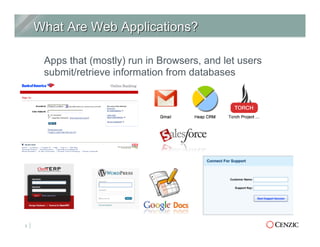
Apps that (mostly) run in Browsers, and let users
submit/retrieve information from databases
3
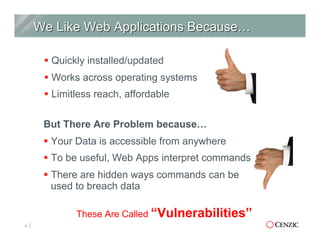
§ Quickly installed/updated
§ Works across operating systems
§ Limitless reach, affordable
4
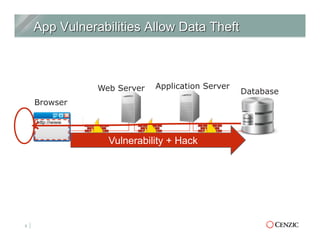
These Are Called “Vulnerabilities”
But There Are Problem because…
§ Your Data is accessible from anywhere
§ To be useful, Web Apps interpret commands
§ There are hidden ways commands can be
used to breach data
5
Database
Application ServerWeb Server
Browser
6
Database
Application ServerWeb Server
Browser
Vulnerability + Hack
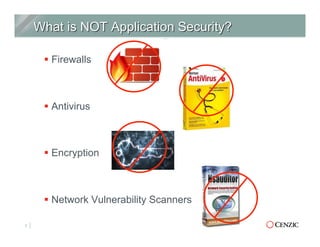
§ Firewalls
§ Antivirus
§ Encryption
§ Network Vulnerability Scanners
7
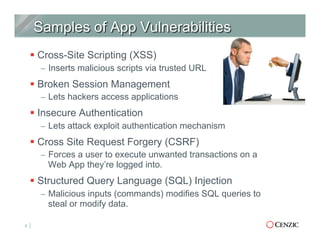
§ Cross-Site Scripting (XSS)
–  Inserts malicious scripts via trusted URL
§ Broken Session Management
–  Lets hackers access applications
§ Insecure Authentication
–  Lets attack exploit authentication mechanism
§ Cross Site Request Forgery (CSRF)
–  Forces a user to execute unwanted transactions on a
Web App they’re logged into.
§ Structured Query Language (SQL) Injection
–  Malicious inputs (commands) modifies SQL queries to
steal or modify data.
8
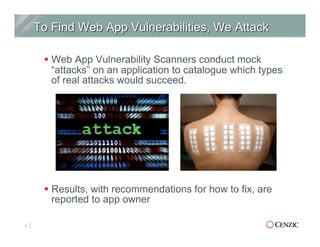
§ Web App Vulnerability Scanners conduct mock
“attacks” on an application to catalogue which types
of real attacks would succeed.
§ Results, with recommendations for how to fix, are
reported to app owner
9
§ Proactively scanning your applications
for vulnerabilities and remediating them
before the bad guys find them.
§ Measuring online risk to manage it
§ Highly automated for fast, comprehensive
response and best real-world security.
10
11
Why Does App Security Matter?
§ Today’s Economy is all about Web Apps
–  They’re your store, your product, your branding, your
infrastructure.
–  More apps with more valuable data make them a more
attractive target
§ Types of Data that can be stolen
–  Customer Identification
–  Access Controls
–  Transaction Information
–  Core Business Data
12
13
“69% of 12,000+ IT professionals surveyed
believed that in 2013 Application
Vulnerabilities are the number one
security issue.”
-The 2013 (ISC)2 Global Information Security Workforce Study
https://www.isc2.org/uploadedFiles/(ISC)2_Public_Content/2013%20Global%20Information
%20Security%20Workforce%20Study%20Feb%202013.pdf
14
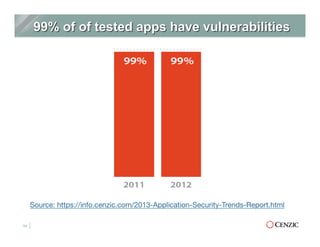
Source: https://info.cenzic.com/2013-Application-Security-Trends-Report.html
15
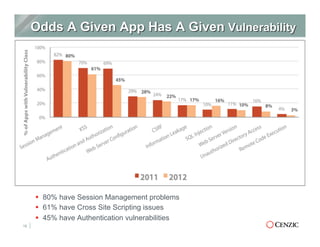
§  80% have Session Management problems
§  61% have Cross Site Scripting issues
§  45% have Authentication vulnerabilities
16
§ Jan.14, 2013: CISO, Justin Somaini left
shortly after a Cross Site Scripting (XSS)
attack resulted in an embarrassing surge
of Spam from compromised Yahoo Mail
accounts.
§ Outside security experts said Yahoo was
slow to fix the vulnerability, which may have
led to the CISO’s abrupt departure.
–  http://allthingsd.com/20130114/yahoos-chief-information-security-officer-
departs-with-more-top-execs-under-ceo-scrutiny/
–  http://allthingsd.com/20130110/that-yahoo-mail-vulnerability-not-really-fixed/
–  http://arstechnica.com/security/2013/01/how-yahoo-allowed-hackers-to-
hijack-my-neighbors-e-mail-account/?
utm_source=feedburner&utm_medium=feed&utm_campaign=Feed%3A
+arstechnica%2Findex+%28Ars+Technica+-+All+content%29
17
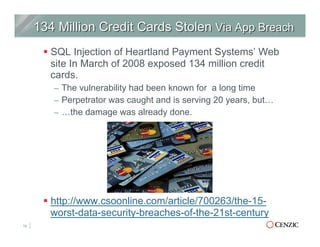
§ SQL Injection of Heartland Payment Systems’ Web
site In March of 2008 exposed 134 million credit
cards.
–  The vulnerability had been known for a long time
–  Perpetrator was caught and is serving 20 years, but…
–  …the damage was already done.
§ http://www.csoonline.com/article/700263/the-15-
worst-data-security-breaches-of-the-21st-century
18
19
Getting Started
§ How many Web applications do you have?
§ Which apps have mission-critical data
behind them?
§ Who Develops/updates them?
§ Do you want to build out a security analyst
group or retain outside experts?
§ Do you have mobile apps you want to
assess?
20
§ Security Analysts: Scan, Analyze, Coordinate
§ App Developers: Incorporate findings, fix code
§ QA: Re-run scans to ensure fixes worked
§ Governance/Risk/Compliance: Consume reports
§ Production Team: Re-run scans regularly to find
new issues
§ CIO/CISO: View Dashboard to see trends
21
§ Many vulnerabilities are relatively easy to detect,
block and fix.
§ Common tools for managing vulnerabilities:
–  Secure coding standards
–  Web security scanning
–  Intrusion/penetration testing
–  Web Application Firewalls (WAFs)
§ Security is a continuous effort
–  New developers, software and hardware are employed
–  Old vulnerabilities never go away
–  Hackers continue to generate new attacks
22
1.  Employ coding best practices during
development.
2.  Scan and remediate in pre-production test
environment (run-time is most accurate)
3.  Monitor production apps, and patch
accordingly
–  Web Application Firewalls, working with
vulnerability scanner, can use policy to “virtually
patch” some vulnerabilities
23
§ Pre-Production
–  Pros: Fixing earlier may be more efficient, more
aggressive testing may be used safely
–  Cons: Test environment may not mirror production
environment.
§ Production
–  Pros: Most accurate (real environment), Detects newly
discovered vulnerabilities, Web App Firewall virtual
patch may minimize repair time
–  Cons: Production team must buy in, care must be taken
to use only safe attacks.
§ Answer? Yes. Both. All of the above.
24
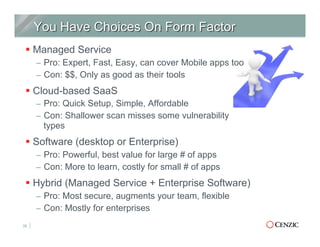
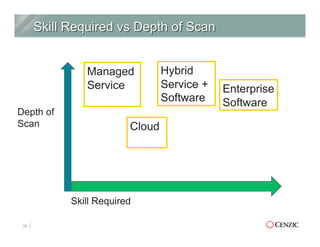
§ Managed Service
–  Pro: Expert, Fast, Easy, can cover Mobile apps too
–  Con: $$, Only as good as their tools
§ Cloud-based SaaS
–  Pro: Quick Setup, Simple, Affordable
–  Con: Shallower scan misses some vulnerability
types
§ Software (desktop or Enterprise)
–  Pro: Powerful, best value for large # of apps
–  Con: More to learn, costly for small # of apps
§ Hybrid (Managed Service + Enterprise Software)
–  Pro: Most secure, augments your team, flexible
–  Con: Mostly for enterprises
25
26
Managed
Service
Cloud
Hybrid
Service +
Software
Enterprise
Software
Skill Required
Depth of
Scan
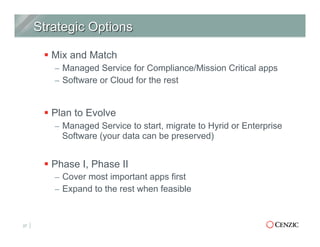
§ Mix and Match
–  Managed Service for Compliance/Mission Critical apps
–  Software or Cloud for the rest
§ Plan to Evolve
–  Managed Service to start, migrate to Hyrid or Enterprise
Software (your data can be preserved)
§ Phase I, Phase II
–  Cover most important apps first
–  Expand to the rest when feasible
27
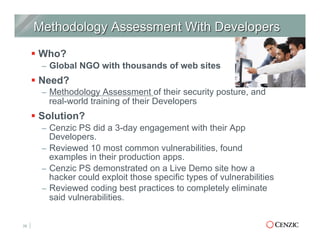
§ Who?
–  Global NGO with thousands of web sites
§ Need?
–  Methodology Assessment of their security posture, and
real-world training of their Developers
§ Solution?
–  Cenzic PS did a 3-day engagement with their App
Developers.
–  Reviewed 10 most common vulnerabilities, found
examples in their production apps.
–  Cenzic PS demonstrated on a Live Demo site how a
hacker could exploit those specific types of vulnerabilities
–  Reviewed coding best practices to completely eliminate
said vulnerabilities.
28
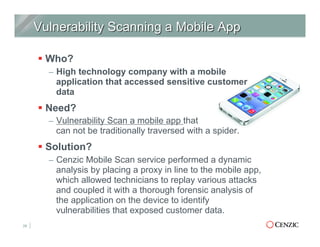
§ Who?
–  High technology company with a mobile
application that accessed sensitive customer
data
§ Need?
–  Vulnerability Scan a mobile app that
can not be traditionally traversed with a spider.
§ Solution?
–  Cenzic Mobile Scan service performed a dynamic
analysis by placing a proxy in line to the mobile app,
which allowed technicians to replay various attacks
and coupled it with a thorough forensic analysis of
the application on the device to identify
vulnerabilities that exposed customer data.
29
§ Who?
–  A Health Maintenance Organization
§ Need?
–  Deep scan of a new application on a tight development
schedule to ensure compliance.
§ Solution?
–  Cenzic PS performed Manual Penetration testing along
with the comprehensive vulnerability scanning to provide
a very thorough scan which could suffice for any
compliance or audit need.
30
31
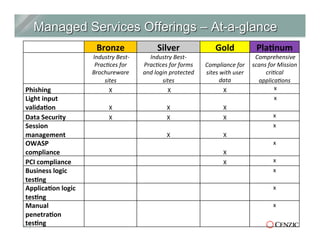
Bronze	
   Silver	
   Gold	
   Pla0num	
  
	
  Industry	
  Best-­‐
Prac0ces	
  for	
  
Brochureware	
  
sites	
  
Industry	
  Best-­‐
Prac0ces	
  for	
  forms	
  
and	
  login	
  protected	
  
sites	
  
Compliance	
  for	
  
sites	
  with	
  user	
  
data	
  
	
  Comprehensive	
  
scans	
  for	
  Mission	
  
cri0cal	
  
applica0ons	
  
Phishing	
   X	
   	
  X	
   X	
   	
  x	
  
Light	
  input	
  
valida0on	
   X	
   X	
   X	
  
	
  x	
  
Data	
  Security	
   X	
   X	
   X	
   x	
  	
  
Session	
  
management	
   X	
   X	
  
x	
  	
  
OWASP	
  
compliance	
   X	
  
x	
  	
  
PCI	
  compliance	
   X	
   x	
  	
  
Business	
  logic	
  
tes0ng	
  
x	
  
Applica0on	
  logic	
  
tes0ng	
  
x	
  
Manual	
  
penetra0on	
  
tes0ng	
  
x	
  
32
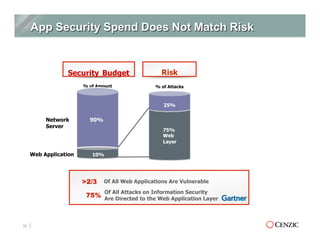
Of All Attacks on Information Security
Are Directed to the Web Application Layer
Of All Web Applications Are Vulnerable
Network
Server
Web Application
% of Amount
Security Budget
10%
90%
% of Attacks
Risk
75%
Web
Layer
25%
33
§ Justify more IT spend
§ Reallocate existing IT spend
§ Stretch existing App Sec spend
Tip: For more ideas watch
“Top 10 Ways to Win Budget For App Security”
https://info.cenzic.com/webinar-security-budget.html
§ Web App Security Trends Report 2013
–  https://info.cenzic.com/2013-Application-Security-Trends-
Report.html
§ Web Security: Are You Part Of The Problem?
–  http://coding.smashingmagazine.com/2010/01/14/web-
security-primer-are-you-part-of-the-problem/
§ Open Web Application Security Project
–  (www.OWASP.org) is a broad-based organization seeking
to make software security visible for better decision
making
34
We offer:
§ Industry-leading, patented scanning technology
§ The broadest range of managed service, cloud,
enterprise software and hybrid service solutions to
best meet your evolving needs
§ Training, consulting, and mobile app assessment
35
§  Audit your environment
–  How many apps do you have?
–  Are you subject to regulatory compliance?
–  Which app is most crucial to your organization?
§  Identify team members who need to get educated
§  Try Cenzic for Free
–  https://info.cenzic.com/evaluate-software.html
§  Let us know how we can help you succeed!
–  Consulting, Managed Services, and Training always
help http://www.cenzic.com/services-support/training/
36
www.cenzic.com | 1-866-4-CENZIC (1-866-423-6942)
Questions?
request@cenzic.com or 1.866-4-Cenzic
Blog: https://blog.cenzic.com

Essentials of Web Application Security: what it is, why it matters and how to get started

  • 1.
    1 Essentials of WebApplication Security: What it is, Why it Matters, and How to Get Started Chris Harget - Product Marketing
  • 2.
    2 What Is WebApplication Security?
  • 3.
    Apps that (mostly)run in Browsers, and let users submit/retrieve information from databases 3
  • 4.
    § Quickly installed/updated § Works acrossoperating systems § Limitless reach, affordable 4 These Are Called “Vulnerabilities” But There Are Problem because… § Your Data is accessible from anywhere § To be useful, Web Apps interpret commands § There are hidden ways commands can be used to breach data
  • 5.
  • 6.
  • 7.
  • 8.
    § Cross-Site Scripting (XSS) – Inserts malicious scripts via trusted URL § Broken Session Management –  Lets hackers access applications § Insecure Authentication –  Lets attack exploit authentication mechanism § Cross Site Request Forgery (CSRF) –  Forces a user to execute unwanted transactions on a Web App they’re logged into. § Structured Query Language (SQL) Injection –  Malicious inputs (commands) modifies SQL queries to steal or modify data. 8
  • 9.
    § Web App VulnerabilityScanners conduct mock “attacks” on an application to catalogue which types of real attacks would succeed. § Results, with recommendations for how to fix, are reported to app owner 9
  • 10.
    § Proactively scanning yourapplications for vulnerabilities and remediating them before the bad guys find them. § Measuring online risk to manage it § Highly automated for fast, comprehensive response and best real-world security. 10
  • 11.
    11 Why Does AppSecurity Matter?
  • 12.
    § Today’s Economy isall about Web Apps –  They’re your store, your product, your branding, your infrastructure. –  More apps with more valuable data make them a more attractive target § Types of Data that can be stolen –  Customer Identification –  Access Controls –  Transaction Information –  Core Business Data 12
  • 13.
    13 “69% of 12,000+IT professionals surveyed believed that in 2013 Application Vulnerabilities are the number one security issue.” -The 2013 (ISC)2 Global Information Security Workforce Study https://www.isc2.org/uploadedFiles/(ISC)2_Public_Content/2013%20Global%20Information %20Security%20Workforce%20Study%20Feb%202013.pdf
  • 14.
  • 15.
  • 16.
    §  80% haveSession Management problems §  61% have Cross Site Scripting issues §  45% have Authentication vulnerabilities 16
  • 17.
    § Jan.14, 2013: CISO,Justin Somaini left shortly after a Cross Site Scripting (XSS) attack resulted in an embarrassing surge of Spam from compromised Yahoo Mail accounts. § Outside security experts said Yahoo was slow to fix the vulnerability, which may have led to the CISO’s abrupt departure. –  http://allthingsd.com/20130114/yahoos-chief-information-security-officer- departs-with-more-top-execs-under-ceo-scrutiny/ –  http://allthingsd.com/20130110/that-yahoo-mail-vulnerability-not-really-fixed/ –  http://arstechnica.com/security/2013/01/how-yahoo-allowed-hackers-to- hijack-my-neighbors-e-mail-account/? utm_source=feedburner&utm_medium=feed&utm_campaign=Feed%3A +arstechnica%2Findex+%28Ars+Technica+-+All+content%29 17
  • 18.
    § SQL Injection ofHeartland Payment Systems’ Web site In March of 2008 exposed 134 million credit cards. –  The vulnerability had been known for a long time –  Perpetrator was caught and is serving 20 years, but… –  …the damage was already done. § http://www.csoonline.com/article/700263/the-15- worst-data-security-breaches-of-the-21st-century 18
  • 19.
  • 20.
    § How many Webapplications do you have? § Which apps have mission-critical data behind them? § Who Develops/updates them? § Do you want to build out a security analyst group or retain outside experts? § Do you have mobile apps you want to assess? 20
  • 21.
    § Security Analysts: Scan,Analyze, Coordinate § App Developers: Incorporate findings, fix code § QA: Re-run scans to ensure fixes worked § Governance/Risk/Compliance: Consume reports § Production Team: Re-run scans regularly to find new issues § CIO/CISO: View Dashboard to see trends 21
  • 22.
    § Many vulnerabilities arerelatively easy to detect, block and fix. § Common tools for managing vulnerabilities: –  Secure coding standards –  Web security scanning –  Intrusion/penetration testing –  Web Application Firewalls (WAFs) § Security is a continuous effort –  New developers, software and hardware are employed –  Old vulnerabilities never go away –  Hackers continue to generate new attacks 22
  • 23.
    1.  Employ codingbest practices during development. 2.  Scan and remediate in pre-production test environment (run-time is most accurate) 3.  Monitor production apps, and patch accordingly –  Web Application Firewalls, working with vulnerability scanner, can use policy to “virtually patch” some vulnerabilities 23
  • 24.
    § Pre-Production –  Pros: Fixingearlier may be more efficient, more aggressive testing may be used safely –  Cons: Test environment may not mirror production environment. § Production –  Pros: Most accurate (real environment), Detects newly discovered vulnerabilities, Web App Firewall virtual patch may minimize repair time –  Cons: Production team must buy in, care must be taken to use only safe attacks. § Answer? Yes. Both. All of the above. 24
  • 25.
    § Managed Service –  Pro:Expert, Fast, Easy, can cover Mobile apps too –  Con: $$, Only as good as their tools § Cloud-based SaaS –  Pro: Quick Setup, Simple, Affordable –  Con: Shallower scan misses some vulnerability types § Software (desktop or Enterprise) –  Pro: Powerful, best value for large # of apps –  Con: More to learn, costly for small # of apps § Hybrid (Managed Service + Enterprise Software) –  Pro: Most secure, augments your team, flexible –  Con: Mostly for enterprises 25
  • 26.
  • 27.
    § Mix and Match – Managed Service for Compliance/Mission Critical apps –  Software or Cloud for the rest § Plan to Evolve –  Managed Service to start, migrate to Hyrid or Enterprise Software (your data can be preserved) § Phase I, Phase II –  Cover most important apps first –  Expand to the rest when feasible 27
  • 28.
    § Who? –  Global NGOwith thousands of web sites § Need? –  Methodology Assessment of their security posture, and real-world training of their Developers § Solution? –  Cenzic PS did a 3-day engagement with their App Developers. –  Reviewed 10 most common vulnerabilities, found examples in their production apps. –  Cenzic PS demonstrated on a Live Demo site how a hacker could exploit those specific types of vulnerabilities –  Reviewed coding best practices to completely eliminate said vulnerabilities. 28
  • 29.
    § Who? –  High technologycompany with a mobile application that accessed sensitive customer data § Need? –  Vulnerability Scan a mobile app that can not be traditionally traversed with a spider. § Solution? –  Cenzic Mobile Scan service performed a dynamic analysis by placing a proxy in line to the mobile app, which allowed technicians to replay various attacks and coupled it with a thorough forensic analysis of the application on the device to identify vulnerabilities that exposed customer data. 29
  • 30.
    § Who? –  A HealthMaintenance Organization § Need? –  Deep scan of a new application on a tight development schedule to ensure compliance. § Solution? –  Cenzic PS performed Manual Penetration testing along with the comprehensive vulnerability scanning to provide a very thorough scan which could suffice for any compliance or audit need. 30
  • 31.
    31 Bronze   Silver   Gold   Pla0num    Industry  Best-­‐ Prac0ces  for   Brochureware   sites   Industry  Best-­‐ Prac0ces  for  forms   and  login  protected   sites   Compliance  for   sites  with  user   data    Comprehensive   scans  for  Mission   cri0cal   applica0ons   Phishing   X    X   X    x   Light  input   valida0on   X   X   X    x   Data  Security   X   X   X   x     Session   management   X   X   x     OWASP   compliance   X   x     PCI  compliance   X   x     Business  logic   tes0ng   x   Applica0on  logic   tes0ng   x   Manual   penetra0on   tes0ng   x  
  • 32.
    32 Of All Attackson Information Security Are Directed to the Web Application Layer Of All Web Applications Are Vulnerable Network Server Web Application % of Amount Security Budget 10% 90% % of Attacks Risk 75% Web Layer 25%
  • 33.
    33 § Justify more ITspend § Reallocate existing IT spend § Stretch existing App Sec spend Tip: For more ideas watch “Top 10 Ways to Win Budget For App Security” https://info.cenzic.com/webinar-security-budget.html
  • 34.
    § Web App SecurityTrends Report 2013 –  https://info.cenzic.com/2013-Application-Security-Trends- Report.html § Web Security: Are You Part Of The Problem? –  http://coding.smashingmagazine.com/2010/01/14/web- security-primer-are-you-part-of-the-problem/ § Open Web Application Security Project –  (www.OWASP.org) is a broad-based organization seeking to make software security visible for better decision making 34
  • 35.
    We offer: § Industry-leading, patentedscanning technology § The broadest range of managed service, cloud, enterprise software and hybrid service solutions to best meet your evolving needs § Training, consulting, and mobile app assessment 35
  • 36.
    §  Audit yourenvironment –  How many apps do you have? –  Are you subject to regulatory compliance? –  Which app is most crucial to your organization? §  Identify team members who need to get educated §  Try Cenzic for Free –  https://info.cenzic.com/evaluate-software.html §  Let us know how we can help you succeed! –  Consulting, Managed Services, and Training always help http://www.cenzic.com/services-support/training/ 36
  • 37.
    www.cenzic.com | 1-866-4-CENZIC(1-866-423-6942) Questions? request@cenzic.com or 1.866-4-Cenzic Blog: https://blog.cenzic.com