Common Programming
Errors
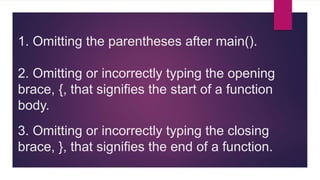
1. Omitting the parentheses after main().
2. Omitting or incorrectly typing the opening
brace, {, that signifies the start of a function
body.
3. Omitting or incorrectly typing the closing
brace, }, that signifies the end of a function.
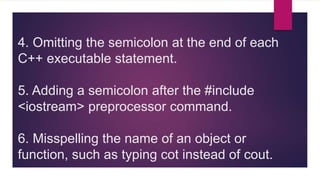
4. Omitting the semicolon at the end of each
C++ executable statement.
5. Adding a semicolon after the #include
<iostream> preprocessor command.
6. Misspelling the name of an object or
function, such as typing cot instead of cout.
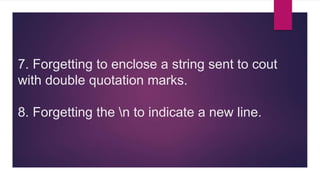
7. Forgetting to enclose a string sent to cout
with double quotation marks.
8. Forgetting the n to indicate a new line.
Chapter Summary
1. A computer program is a self-contained unit of
instructions and data used to operate a computer to
produce a specific result.
2. An algorithm is a step-by-step procedure that must
terminate; it describes how a computation or task is to be
performed.
3. A C++ program consists of one or more modules called
functions. One of these functions must be called main().
The main() function identifies the starting point of a C++
program.
4. The simplest C++ program consists of the single function
main() and has this form:
#include <iostream>
using namespace std;
int main()
{ program statements in here;
return 0;
}
This program consists of a preprocessor #include
statement, a using statement, a header line for the main()
function, and the body of the main() function. The body of
the function begins with the opening brace, {, and ends with
the closing brace, }.
5. All executable C++ statements within a function body
must be terminated by a semicolon.
6. Many functions and classes are supplied in a standard
library provided with each C++ compiler. One set of
classes, used to create input and output capabilities, is
defined in the iostream header file.
7. The cout object is used to display text or numerical
results. A stream of characters can be sent to cout by
enclosing the characters in quotation marks and using the
insertion symbol, <<, as in the statement cout << “Hello
World!”;. The text in the string is displayed onscreen and
can include newline escape sequences for controlling the
format.

Common Programming Errors

  • 1.
  • 2.
    1. Omitting theparentheses after main(). 2. Omitting or incorrectly typing the opening brace, {, that signifies the start of a function body. 3. Omitting or incorrectly typing the closing brace, }, that signifies the end of a function.
  • 3.
    4. Omitting thesemicolon at the end of each C++ executable statement. 5. Adding a semicolon after the #include <iostream> preprocessor command. 6. Misspelling the name of an object or function, such as typing cot instead of cout.
  • 4.
    7. Forgetting toenclose a string sent to cout with double quotation marks. 8. Forgetting the n to indicate a new line.
  • 5.
    Chapter Summary 1. Acomputer program is a self-contained unit of instructions and data used to operate a computer to produce a specific result. 2. An algorithm is a step-by-step procedure that must terminate; it describes how a computation or task is to be performed. 3. A C++ program consists of one or more modules called functions. One of these functions must be called main(). The main() function identifies the starting point of a C++ program.
  • 6.
    4. The simplestC++ program consists of the single function main() and has this form: #include <iostream> using namespace std; int main() { program statements in here; return 0; }
  • 7.
    This program consistsof a preprocessor #include statement, a using statement, a header line for the main() function, and the body of the main() function. The body of the function begins with the opening brace, {, and ends with the closing brace, }. 5. All executable C++ statements within a function body must be terminated by a semicolon.
  • 8.
    6. Many functionsand classes are supplied in a standard library provided with each C++ compiler. One set of classes, used to create input and output capabilities, is defined in the iostream header file. 7. The cout object is used to display text or numerical results. A stream of characters can be sent to cout by enclosing the characters in quotation marks and using the insertion symbol, <<, as in the statement cout << “Hello World!”;. The text in the string is displayed onscreen and can include newline escape sequences for controlling the format.