SOFTWARE
DEVELOPMENT
Software Development
A program is a solution developed to solve a
particular problem, written in a form that can
be run on a computer. Therefore, writing a
program is almost the last step in a process
that first determines the problem to be
solved and the method to be used in the
solution. Each field of study has its own
name for the systematic method of
designing solutions to solve problems.
In science and engineering, the approach is
referred to as the scientific method, and in
quantitative analysis, the approach is called
the systems approach. Professional software
developers use the software development
procedure for understanding the problem to be
solved and for creating an effective, suitable
software solution.
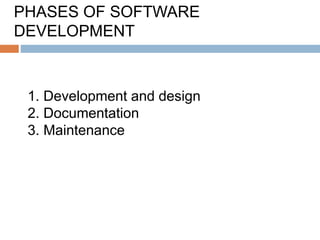
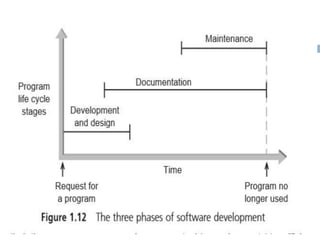
1. Development and design
2. Documentation
3. Maintenance
PHASES OF SOFTWARE
DEVELOPMENT
As a discipline, software engineering is
concerned with creating readable,
efficient, reliable, and maintainable
programs and systems, and it uses the
software development procedure to
achieve this goal.
Phase I: Development and Design Phase
It begins with a statement of a problem or a
specific request for a program, which is
referred to as a program requirement. After
a problem has been stated or a specific
request for a program solution has been
made, the development and design phase
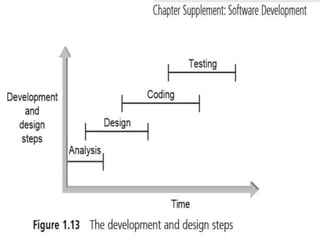
begins. This phase consists of four well-
defined steps.
Step 1: Analyze the Problem
The analysis of a problem can consist of up to
two parts. The first part is a basic analysis that
must be performed on all problems; it consists of
extracting the complete input and output
information supplied by the problems. For this
analysis, you must:
1. Determine and understand the output items
the program must produce.
2. Determine the input items.
An extended analysis simply means you must
gather more information about the problem so
that you thoroughly understand what’s being
asked for and how to achieve the result.
Step 2: Develop a Solution
Next, you select the exact set of
steps, called the algorithm, to use for
solving the problem.
This algorithm must be checked, if it
wasn’t in the analysis step, to make
sure it produces the required outputs
correctly.
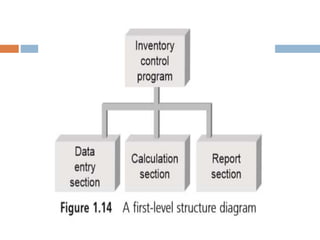
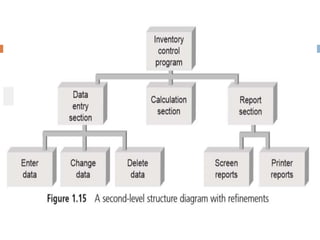
For these specifications, a designer
could initially organize the
program’s requirements into the
three sections.
Step 3: Code the Solution (Write the
Program)
These structures control how the program
executes and consist of the following
types:
• Sequence
• Selection
• Iteration
• Invocation
Sequence defines the order in which
the program executes instructions.
Specifying which instruction comes first,
which comes second, and so on is
essential if the program is to achieve a
well-defined purpose.
Selection provides the capability to
make a choice between different
operations, depending on the result of
some condition.
Iteration, also referred to as “looping” and
“repetition,” makes it possible to repeat the
same operation based on the value of a
condition.
Invocation involves invoking, or
summoning, a set of statements as it’s
needed.
Step 4: Test and Correct the
Program
The purpose of testing is to verify that a
program works correctly and actually fulfills
its requirements. In theory, testing would
reveal all existing program errors.

Software Development

  • 1.
  • 2.
    Software Development A programis a solution developed to solve a particular problem, written in a form that can be run on a computer. Therefore, writing a program is almost the last step in a process that first determines the problem to be solved and the method to be used in the solution. Each field of study has its own name for the systematic method of designing solutions to solve problems.
  • 3.
    In science andengineering, the approach is referred to as the scientific method, and in quantitative analysis, the approach is called the systems approach. Professional software developers use the software development procedure for understanding the problem to be solved and for creating an effective, suitable software solution.
  • 4.
    1. Development anddesign 2. Documentation 3. Maintenance PHASES OF SOFTWARE DEVELOPMENT
  • 6.
    As a discipline,software engineering is concerned with creating readable, efficient, reliable, and maintainable programs and systems, and it uses the software development procedure to achieve this goal.
  • 7.
    Phase I: Developmentand Design Phase It begins with a statement of a problem or a specific request for a program, which is referred to as a program requirement. After a problem has been stated or a specific request for a program solution has been made, the development and design phase begins. This phase consists of four well- defined steps.
  • 9.
    Step 1: Analyzethe Problem The analysis of a problem can consist of up to two parts. The first part is a basic analysis that must be performed on all problems; it consists of extracting the complete input and output information supplied by the problems. For this analysis, you must: 1. Determine and understand the output items the program must produce. 2. Determine the input items.
  • 10.
    An extended analysissimply means you must gather more information about the problem so that you thoroughly understand what’s being asked for and how to achieve the result.
  • 11.
    Step 2: Developa Solution Next, you select the exact set of steps, called the algorithm, to use for solving the problem. This algorithm must be checked, if it wasn’t in the analysis step, to make sure it produces the required outputs correctly.
  • 12.
    For these specifications,a designer could initially organize the program’s requirements into the three sections.
  • 15.
    Step 3: Codethe Solution (Write the Program) These structures control how the program executes and consist of the following types: • Sequence • Selection • Iteration • Invocation
  • 16.
    Sequence defines theorder in which the program executes instructions. Specifying which instruction comes first, which comes second, and so on is essential if the program is to achieve a well-defined purpose.
  • 17.
    Selection provides thecapability to make a choice between different operations, depending on the result of some condition.
  • 18.
    Iteration, also referredto as “looping” and “repetition,” makes it possible to repeat the same operation based on the value of a condition.
  • 19.
    Invocation involves invoking,or summoning, a set of statements as it’s needed.
  • 20.
    Step 4: Testand Correct the Program The purpose of testing is to verify that a program works correctly and actually fulfills its requirements. In theory, testing would reveal all existing program errors.