Introduction
In the English language there are some words that
are spelled differently but sound exactly the same,
and there are some words that are spelled the
same but are pronounced differently.
Then, there are those words that do not share the
same spelling or pronunciation but are often
confused.
These are your commonly confused words.
Varieties of
Commonly Confused Words
1. Homophones
2. Etymological / functional variations
3. Transcriptions of colloquialisms
4. Antonyms
Homophones – words that sound alike but
have different meanings
To, too, two
Their, there, they’re
Cite, site, sight
Principal, principle
Right, write, rite, wright
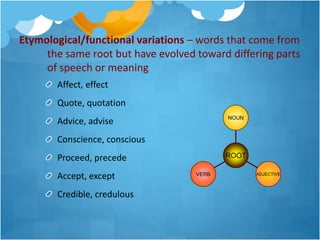
Etymological/functional variations – words that come from
the same root but have evolved toward differing parts
of speech or meaning
Affect, effect
Quote, quotation
Advice, advise
Conscience, conscious
Proceed, precede
Accept, except
Credible, credulous
VERB ADJECTIVE
NOUN
ROOT
Transcriptions of colloquialisms
Ideal for idea
Suppose to for supposed to
Use to for used to
Ever for every
Cause for‘cause (because)
Words that are spelled as they sound in oral dialect or imprecisely
but are actually spellings of different words
Antonyms
Infer for imply
Literally for figuratively
Can’t hardly for can hardly
Words that are not spelled or pronounced similarly at all but are
opposite in meaning.
Oddly enough, many speakers and writers confuse such words because
they are related in their minds but may have opposite definitions.
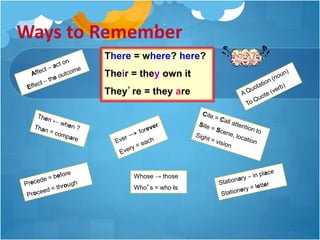
There = where? here?
Their = they own it
They’re = they are
Ways to Remember
Whose → those
Who’s = who is

Common errors

  • 3.
    Introduction In the Englishlanguage there are some words that are spelled differently but sound exactly the same, and there are some words that are spelled the same but are pronounced differently. Then, there are those words that do not share the same spelling or pronunciation but are often confused. These are your commonly confused words.
  • 4.
    Varieties of Commonly ConfusedWords 1. Homophones 2. Etymological / functional variations 3. Transcriptions of colloquialisms 4. Antonyms
  • 5.
    Homophones – wordsthat sound alike but have different meanings To, too, two Their, there, they’re Cite, site, sight Principal, principle Right, write, rite, wright
  • 6.
    Etymological/functional variations –words that come from the same root but have evolved toward differing parts of speech or meaning Affect, effect Quote, quotation Advice, advise Conscience, conscious Proceed, precede Accept, except Credible, credulous VERB ADJECTIVE NOUN ROOT
  • 7.
    Transcriptions of colloquialisms Idealfor idea Suppose to for supposed to Use to for used to Ever for every Cause for‘cause (because) Words that are spelled as they sound in oral dialect or imprecisely but are actually spellings of different words
  • 8.
    Antonyms Infer for imply Literallyfor figuratively Can’t hardly for can hardly Words that are not spelled or pronounced similarly at all but are opposite in meaning. Oddly enough, many speakers and writers confuse such words because they are related in their minds but may have opposite definitions.
  • 9.
    There = where?here? Their = they own it They’re = they are Ways to Remember Whose → those Who’s = who is