Go Figure!

  Figurative Language
       Grades 6-8
Recognizing Figurative
Language
The opposite of literal language is figurative
  language. Figurative language is language
  that means more than what it says on the
  surface.
 It usually gives us a feeling about its subject.
 Poets use figurative language almost as
  frequently as literal language. When you read
  poetry, you must be conscious of the
  difference. Otherwise, a poem may make no
  sense at all.
Recognizing Literal Language
“I’ve eaten so much I feel as if I could
  literally burst!”
 In this case, the person is not using the word
  literally in its true meaning. Literal means "exact"
  or "not exaggerated." By pretending that the
  statement is not exaggerated, the person
  stresses how much he has eaten.
Literal language is language that means
   exactly what is said.
Most of the time, we use
literal language.
What is figurative language?
 Whenever you describe something
 by comparing it with something else,

 you are using figurative language.
Types of Figurative Language
 Imagery
 Simile
 Metaphor
 Alliteration
 Personification
 Onomatopoeia
 Hyperbole
 Idioms
Imagery
 Language that appeals to the senses.
 Descriptions of people or objects
 stated in terms of our senses.
      • Sight
      • Hearing
      • Touch
      • Taste
      • Smell
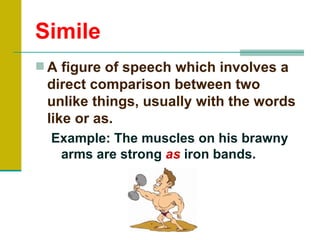
Simile
 A figure of speech which involves a
 direct comparison between two
 unlike things, usually with the words
 like or as.
  Example: The muscles on his brawny
   arms are strong as iron bands.
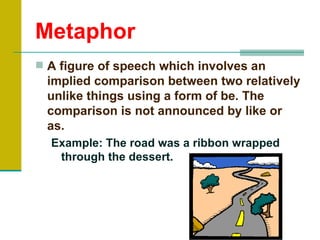
Metaphor
 A figure of speech which involves an
 implied comparison between two relatively
 unlike things using a form of be. The
 comparison is not announced by like or
 as.
  Example: The road was a ribbon wrapped
   through the dessert.
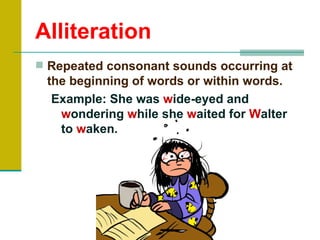
Alliteration
 Repeated consonant sounds occurring at
 the beginning of words or within words.
  Example: She was wide-eyed and
   wondering while she waited for Walter
   to waken.
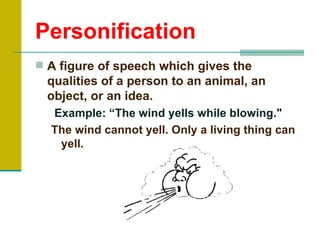
Personification
 A figure of speech which gives the
 qualities of a person to an animal, an
 object, or an idea.
  Example: “The wind yells while blowing."
  The wind cannot yell. Only a living thing can
   yell.
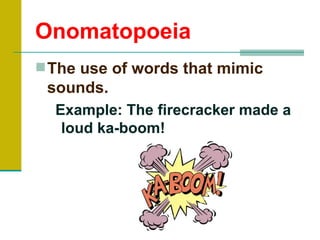
Onomatopoeia
 The use of words that mimic
 sounds.
  Example: The firecracker made a
   loud ka-boom!
Hyperbole
 An exaggerated statement used to
 heighten effect. It is not used to
 mislead the reader, but to emphasize
 a point.
  Example: She’s said so on several
   million occasions.
Idioms
 An idiom or idiomatic expression refers to
  a construction or expression in one
  language that cannot be matched or
  directly translated word-for-word in
  another language.
    Example: "She has a bee
    in her bonnet," meaning
    "she is obsessed,"
    cannot be literally
    translated into another
    language word for word.
Figurative Language Resources
 Eye on Idioms (Online PPT)
 Paint by Idioms (Game)
 Alliteration or Simile? (Quiz)
 Similes and Metaphors (PPT)
 The Search for Similes, Metaphors, and Idioms
   (PPT)
 Alliteration (PPT)
 Onomatopoeia (PPT)
 Personification (PPT)
 Hyperbole (PPT)
 Idioms (PPT)
 Simile (PPT)
Teaching Similes and Metaphors
 Alliteration Lesson Plan and Resources
    http://volweb.utk.edu/Schools/bedford/harrisms/1allitera.htm
   Hyperbole- Lesson Plans and Resources
    http://volweb.utk.edu/Schools/bedford/harrisms/10lesson.htm
   Idiom Lesson Plan
    http://volweb.utk.edu/Schools/bedford/harrisms/6lesson.htm
   Imagery- Lesson Plans and Resources
    http://volweb.utk.edu/Schools/bedford/harrisms/imagery2.htm
   Lesson Plan for Puns
    http://volweb.utk.edu/Schools/bedford/harrisms/5lesson.htm
   Onomatopoeia- Lesson Plans and Resources
    http://volweb.utk.edu/Schools/bedford/harrisms/9lesson.htm
   Personification Lesson Plans and Resources
     http://volweb.utk.edu/Schools/bedford/harrisms/7lesson.htm
   Proverbs- Lesson Plans and Resources
    http://volweb.utk.edu/Schools/bedford/harrisms/proverbs2.htm

Figurative lang-overview

  • 1.
    Go Figure! Figurative Language Grades 6-8
  • 2.
    Recognizing Figurative Language The oppositeof literal language is figurative language. Figurative language is language that means more than what it says on the surface.  It usually gives us a feeling about its subject.  Poets use figurative language almost as frequently as literal language. When you read poetry, you must be conscious of the difference. Otherwise, a poem may make no sense at all.
  • 3.
    Recognizing Literal Language “I’veeaten so much I feel as if I could literally burst!”  In this case, the person is not using the word literally in its true meaning. Literal means "exact" or "not exaggerated." By pretending that the statement is not exaggerated, the person stresses how much he has eaten. Literal language is language that means exactly what is said. Most of the time, we use literal language.
  • 4.
    What is figurativelanguage?  Whenever you describe something by comparing it with something else, you are using figurative language.
  • 5.
    Types of FigurativeLanguage  Imagery  Simile  Metaphor  Alliteration  Personification  Onomatopoeia  Hyperbole  Idioms
  • 6.
    Imagery  Language thatappeals to the senses. Descriptions of people or objects stated in terms of our senses. • Sight • Hearing • Touch • Taste • Smell
  • 7.
    Simile  A figureof speech which involves a direct comparison between two unlike things, usually with the words like or as. Example: The muscles on his brawny arms are strong as iron bands.
  • 8.
    Metaphor  A figureof speech which involves an implied comparison between two relatively unlike things using a form of be. The comparison is not announced by like or as. Example: The road was a ribbon wrapped through the dessert.
  • 9.
    Alliteration  Repeated consonantsounds occurring at the beginning of words or within words. Example: She was wide-eyed and wondering while she waited for Walter to waken.
  • 10.
    Personification  A figureof speech which gives the qualities of a person to an animal, an object, or an idea. Example: “The wind yells while blowing." The wind cannot yell. Only a living thing can yell.
  • 11.
    Onomatopoeia  The useof words that mimic sounds. Example: The firecracker made a loud ka-boom!
  • 12.
    Hyperbole  An exaggeratedstatement used to heighten effect. It is not used to mislead the reader, but to emphasize a point. Example: She’s said so on several million occasions.
  • 13.
    Idioms  An idiomor idiomatic expression refers to a construction or expression in one language that cannot be matched or directly translated word-for-word in another language. Example: "She has a bee in her bonnet," meaning "she is obsessed," cannot be literally translated into another language word for word.
  • 14.
    Figurative Language Resources Eye on Idioms (Online PPT)  Paint by Idioms (Game)  Alliteration or Simile? (Quiz)  Similes and Metaphors (PPT)  The Search for Similes, Metaphors, and Idioms (PPT)  Alliteration (PPT)  Onomatopoeia (PPT)  Personification (PPT)  Hyperbole (PPT)  Idioms (PPT)  Simile (PPT)
  • 15.
    Teaching Similes andMetaphors  Alliteration Lesson Plan and Resources http://volweb.utk.edu/Schools/bedford/harrisms/1allitera.htm  Hyperbole- Lesson Plans and Resources http://volweb.utk.edu/Schools/bedford/harrisms/10lesson.htm  Idiom Lesson Plan http://volweb.utk.edu/Schools/bedford/harrisms/6lesson.htm  Imagery- Lesson Plans and Resources http://volweb.utk.edu/Schools/bedford/harrisms/imagery2.htm  Lesson Plan for Puns http://volweb.utk.edu/Schools/bedford/harrisms/5lesson.htm  Onomatopoeia- Lesson Plans and Resources http://volweb.utk.edu/Schools/bedford/harrisms/9lesson.htm  Personification Lesson Plans and Resources http://volweb.utk.edu/Schools/bedford/harrisms/7lesson.htm  Proverbs- Lesson Plans and Resources http://volweb.utk.edu/Schools/bedford/harrisms/proverbs2.htm