T. Trimpe 2006 http://sciencespot.net/
Name __________________________
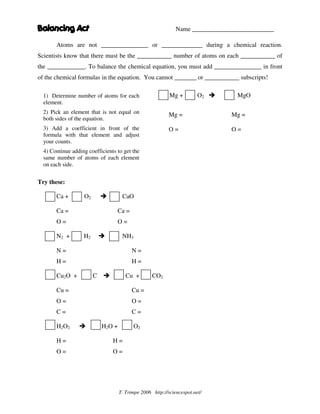
Atoms are not _______________ or _____________ during a chemical reaction.
Scientists know that there must be the ___________ number of atoms on each ___________ of
the ____________. To balance the chemical equation, you must add _______________ in front
of the chemical formulas in the equation. You cannot _______ or ___________ subscripts!
Mg + O2 MgO
Try these:
Ca + O2 CaO
Ca = Ca =
O = O =
N2 + H2 NH3
N = N =
H = H =
Cu2O + C Cu + CO2
Cu = Cu =
O = O =
C = C =
H2O2 H2O + O2
H = H =
O = O =
1) Determine number of atoms for each
element.
2) Pick an element that is not equal on
both sides of the equation.
3) Add a coefficient in front of the
formula with that element and adjust
your counts.
4) Continue adding coefficients to get the
same number of atoms of each element
on each side.
Mg =
O =
Mg =
O =
T. Trimpe 2006 http://sciencespot.net/
Balancing Act Practice Name ____________________________
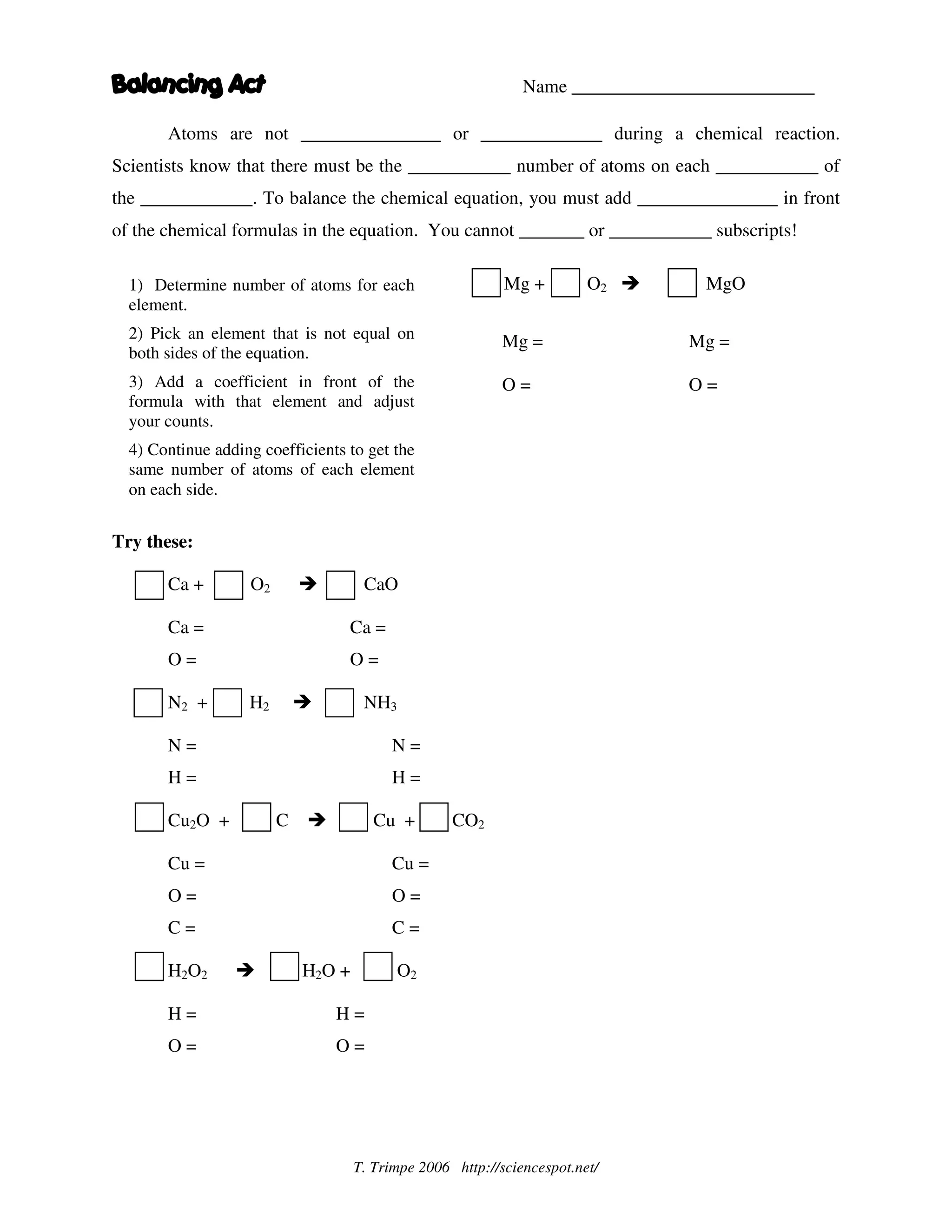
Balance each equation. Be sure to show your lists! Remember you cannot add subscripts or
place coefficients in the middle of a chemical formula.
1. Na + MgF2 NaF + Mg
2. Mg + HCl MgCl2 + H2
3. Cl2 + KI KCl + I2
4. NaCl Na + Cl2
5. Na + O2 Na2O
6. Na + HCl H2 + NaCl
7. K + Cl2 KCl
Challenge: This one is tough!
C2H6 + O2 CO2 + H2O
T. Trimpe 2006 http://sciencespot.net/
Overhead Key
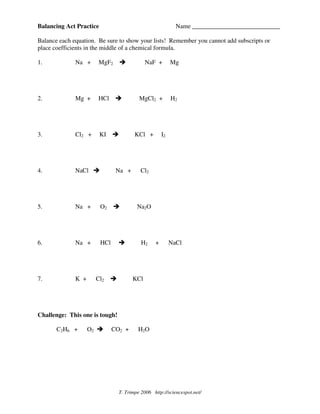
Atoms are not CREATED or DESTROYED during a chemical reaction.
Scientists know that there must be the SAME number of atoms on each SIDE of
the EQUATION. To balance the chemical equation, you must add
COEFFICIENTS in front of the chemical formulas in the equation. You cannot
ADD or CHANGE subscripts!
Mg + O2 MgO
Try these:
Ca + O2 CaO
Ca = Ca =
O = O =
N2 + H2 NH3
N = N =
H = H =
Cu2O + C Cu + CO2
Cu = Cu =
O = O =
C = C =
H2O2 H2O + O2
H = H =
O = O =
Step 1: Determine number of atoms
for each element.
Step 2: Pick an element that is not
equal on both sides of the equation.
Step 3: Add a coefficient in front of
the formula with that element and
adjust your counts.
Step 4: Continue adding coefficients
to get the same number of atoms of
each element on each side.
Mg =
O =
Mg =
O =
T. Trimpe 2006 http://sciencespot.net/
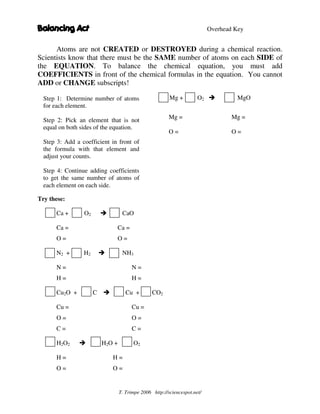
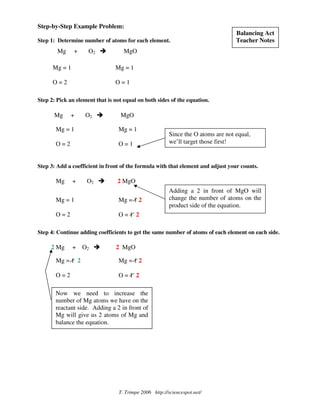
Step-by-Step Example Problem:
Step 1: Determine number of atoms for each element.
Step 2: Pick an element that is not equal on both sides of the equation.
Step 3: Add a coefficient in front of the formula with that element and adjust your counts.
Step 4: Continue adding coefficients to get the same number of atoms of each element on each side.
Mg = 1
O = 2
Mg = 1
O = 1
Mg + O2 MgO
Mg = 1
O = 2
Mg = 1
O = 1
Mg + O2 MgO
Since the O atoms are not equal,
we’ll target those first!
2 Mg + O2 2 MgO
Mg = 1
O = 2
Mg = 1 2
O = 1 2
Mg + O2 2 MgO
Adding a 2 in front of MgO will
change the number of atoms on the
product side of the equation.
Now we need to increase the
number of Mg atoms we have on the
reactant side. Adding a 2 in front of
Mg will give us 2 atoms of Mg and
balance the equation.
Mg = 1 2
O = 2
Mg = 1 2
O = 1 2
Balancing Act
Teacher Notes
T. Trimpe 2006 http://sciencespot.net/
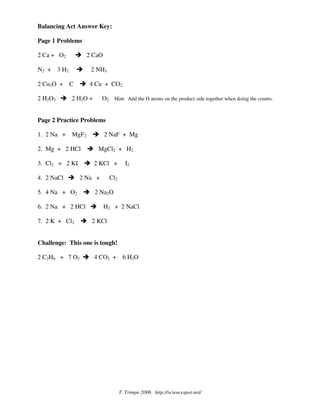
Balancing Act Answer Key:
Page 1 Problems
2 Ca + O2 2 CaO
N2 + 3 H2 2 NH3
2 Cu2O + C 4 Cu + CO2
2 H2O2 2 H2O + O2 Hint: Add the O atoms on the product side together when doing the counts.
Page 2 Practice Problems
1. 2 Na + MgF2 2 NaF + Mg
2. Mg + 2 HCl MgCl2 + H2
3. Cl2 + 2 KI 2 KCl + I2
4. 2 NaCl 2 Na + Cl2
5. 4 Na + O2 2 Na2O
6. 2 Na + 2 HCl H2 + 2 NaCl
7. 2 K + Cl2 2 KCl
Challenge: This one is tough!
2 C2H6 + 7 O2 4 CO2 + 6 H2O

Class vii hw link - balancing equation - balance act

  • 1.
    T. Trimpe 2006http://sciencespot.net/ Name __________________________ Atoms are not _______________ or _____________ during a chemical reaction. Scientists know that there must be the ___________ number of atoms on each ___________ of the ____________. To balance the chemical equation, you must add _______________ in front of the chemical formulas in the equation. You cannot _______ or ___________ subscripts! Mg + O2 MgO Try these: Ca + O2 CaO Ca = Ca = O = O = N2 + H2 NH3 N = N = H = H = Cu2O + C Cu + CO2 Cu = Cu = O = O = C = C = H2O2 H2O + O2 H = H = O = O = 1) Determine number of atoms for each element. 2) Pick an element that is not equal on both sides of the equation. 3) Add a coefficient in front of the formula with that element and adjust your counts. 4) Continue adding coefficients to get the same number of atoms of each element on each side. Mg = O = Mg = O =
  • 2.
    T. Trimpe 2006http://sciencespot.net/ Balancing Act Practice Name ____________________________ Balance each equation. Be sure to show your lists! Remember you cannot add subscripts or place coefficients in the middle of a chemical formula. 1. Na + MgF2 NaF + Mg 2. Mg + HCl MgCl2 + H2 3. Cl2 + KI KCl + I2 4. NaCl Na + Cl2 5. Na + O2 Na2O 6. Na + HCl H2 + NaCl 7. K + Cl2 KCl Challenge: This one is tough! C2H6 + O2 CO2 + H2O
  • 3.
    T. Trimpe 2006http://sciencespot.net/ Overhead Key Atoms are not CREATED or DESTROYED during a chemical reaction. Scientists know that there must be the SAME number of atoms on each SIDE of the EQUATION. To balance the chemical equation, you must add COEFFICIENTS in front of the chemical formulas in the equation. You cannot ADD or CHANGE subscripts! Mg + O2 MgO Try these: Ca + O2 CaO Ca = Ca = O = O = N2 + H2 NH3 N = N = H = H = Cu2O + C Cu + CO2 Cu = Cu = O = O = C = C = H2O2 H2O + O2 H = H = O = O = Step 1: Determine number of atoms for each element. Step 2: Pick an element that is not equal on both sides of the equation. Step 3: Add a coefficient in front of the formula with that element and adjust your counts. Step 4: Continue adding coefficients to get the same number of atoms of each element on each side. Mg = O = Mg = O =
  • 4.
    T. Trimpe 2006http://sciencespot.net/ Step-by-Step Example Problem: Step 1: Determine number of atoms for each element. Step 2: Pick an element that is not equal on both sides of the equation. Step 3: Add a coefficient in front of the formula with that element and adjust your counts. Step 4: Continue adding coefficients to get the same number of atoms of each element on each side. Mg = 1 O = 2 Mg = 1 O = 1 Mg + O2 MgO Mg = 1 O = 2 Mg = 1 O = 1 Mg + O2 MgO Since the O atoms are not equal, we’ll target those first! 2 Mg + O2 2 MgO Mg = 1 O = 2 Mg = 1 2 O = 1 2 Mg + O2 2 MgO Adding a 2 in front of MgO will change the number of atoms on the product side of the equation. Now we need to increase the number of Mg atoms we have on the reactant side. Adding a 2 in front of Mg will give us 2 atoms of Mg and balance the equation. Mg = 1 2 O = 2 Mg = 1 2 O = 1 2 Balancing Act Teacher Notes
  • 5.
    T. Trimpe 2006http://sciencespot.net/ Balancing Act Answer Key: Page 1 Problems 2 Ca + O2 2 CaO N2 + 3 H2 2 NH3 2 Cu2O + C 4 Cu + CO2 2 H2O2 2 H2O + O2 Hint: Add the O atoms on the product side together when doing the counts. Page 2 Practice Problems 1. 2 Na + MgF2 2 NaF + Mg 2. Mg + 2 HCl MgCl2 + H2 3. Cl2 + 2 KI 2 KCl + I2 4. 2 NaCl 2 Na + Cl2 5. 4 Na + O2 2 Na2O 6. 2 Na + 2 HCl H2 + 2 NaCl 7. 2 K + Cl2 2 KCl Challenge: This one is tough! 2 C2H6 + 7 O2 4 CO2 + 6 H2O