NaturalNatural
WaterWater
ChemistryChemistry
Water Quality ParametersWater Quality Parameters
Temperature - Dissolved Oxygen (DO) - pH
Alkalinity - Hardness
Nitrates and Phosphates - Turbidity
Conductivity
-
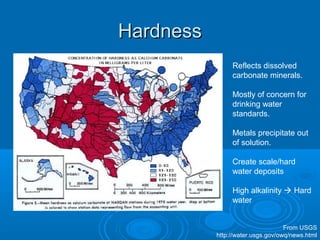
HardnessHardness
Reflects dissolved
carbonate minerals.
Mostly of concern for
drinking water
standards.
Metals precipitate out
of solution.
Create scale/hard
water deposits
High alkalinity  Hard
water
From USGS
http://water.usgs.gov/owq/news.html
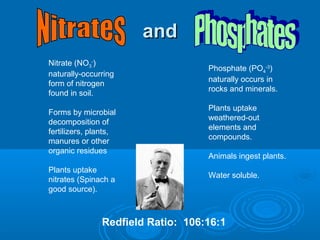
andand
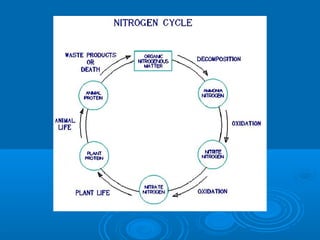
Nitrate (NO3
-
)
naturally-occurring
form of nitrogen
found in soil.
Forms by microbial
decomposition of
fertilizers, plants,
manures or other
organic residues
Plants uptake
nitrates (Spinach a
good source).
Phosphate (PO4
-3
)
naturally occurs in
rocks and minerals.
Plants uptake
weathered-out
elements and
compounds.
Animals ingest plants.
Water soluble.
Redfield Ratio: 106:16:1
NitratesNitrates
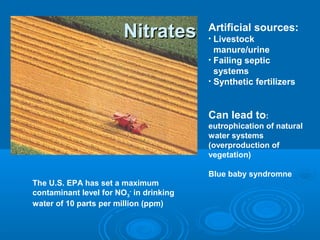
The U.S. EPA has set a maximum
contaminant level for NO3
-
in drinking
water of 10 parts per million (ppm)
Artificial sources:
• Livestock
manure/urine
• Failing septic
systems
• Synthetic fertilizers
Can lead to:
eutrophication of natural
water systems
(overproduction of
vegetation)
Blue baby syndromne
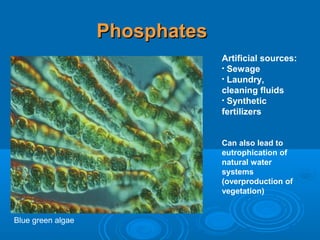
Artificial sources:
• Sewage
• Laundry,
cleaning fluids
• Synthetic
fertilizers
Can also lead to
eutrophication of
natural water
systems
(overproduction of
vegetation)
PhosphatesPhosphates
Blue green algae
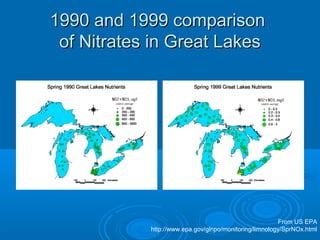
1990 and 1999 comparison1990 and 1999 comparison
of Nitrates in Great Lakesof Nitrates in Great Lakes
From US EPA
http://www.epa.gov/glnpo/monitoring/limnology/SprNOx.html
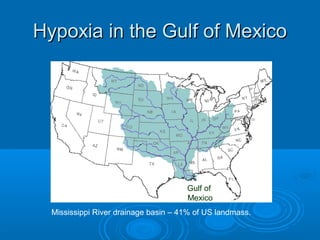
Hypoxia in the Gulf of MexicoHypoxia in the Gulf of Mexico
Gulf of
Mexico
Mississippi River drainage basin – 41% of US landmass.
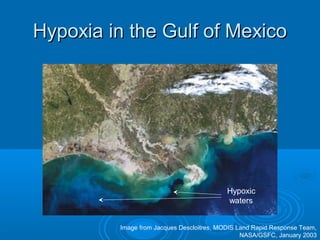
Hypoxia in the Gulf of MexicoHypoxia in the Gulf of Mexico
Hypoxic
waters
Image from Jacques Descloitres, MODIS Land Rapid Response Team,
NASA/GSFC, January 2003
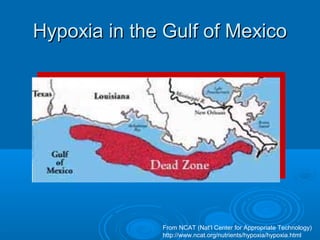
Hypoxia in the Gulf of MexicoHypoxia in the Gulf of Mexico
From NCAT (Nat’l Center for Appropriate Technology)
http://www.ncat.org/nutrients/hypoxia/hypoxia.html
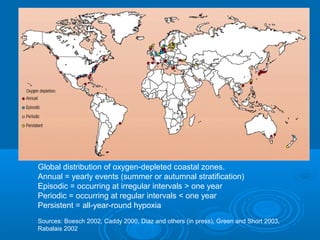
Global distribution of oxygen-depleted coastal zones.
Annual = yearly events (summer or autumnal stratification)
Episodic = occurring at irregular intervals > one year
Periodic = occurring at regular intervals < one year
Persistent = all-year-round hypoxia
Sources: Boesch 2002, Caddy 2000, Diaz and others (in press), Green and Short 2003,
Rabalais 2002
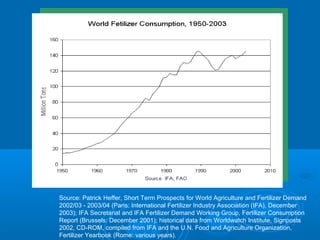
Source: Patrick Heffer, Short Term Prospects for World Agriculture and Fertilizer Demand
2002/03 - 2003/04 (Paris: International Fertilizer Industry Association (IFA), December
2003); IFA Secretariat and IFA Fertilizer Demand Working Group, Fertilizer Consumption
Report (Brussels: December 2001); historical data from Worldwatch Institute, Signposts
2002, CD-ROM, compiled from IFA and the U.N. Food and Agriculture Organization,
Fertilizer Yearbook (Rome: various years).
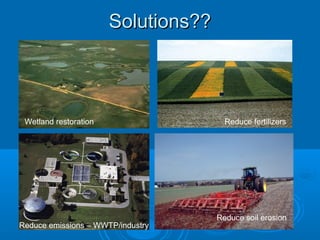
Solutions??Solutions??
Wetland restoration Reduce fertilizers
Reduce emissions – WWTP/industry
Reduce soil erosion
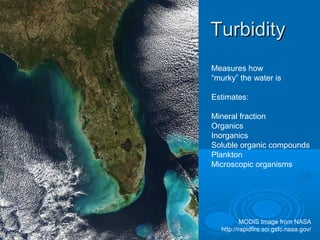
TurbidityTurbidity
Measures how
“murky” the water is
Estimates:
Mineral fraction
Organics
Inorganics
Soluble organic compounds
Plankton
Microscopic organisms
MODIS Image from NASA
http://rapidfire.sci.gsfc.nasa.gov/
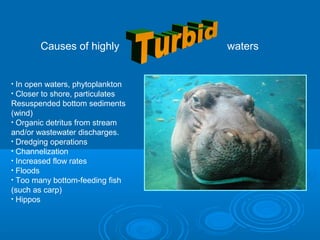
Causes of highly waters
• In open waters, phytoplankton
• Closer to shore, particulates
Resuspended bottom sediments
(wind)
• Organic detritus from stream
and/or wastewater discharges.
• Dredging operations
• Channelization
• Increased flow rates
• Floods
• Too many bottom-feeding fish
(such as carp)
• Hippos
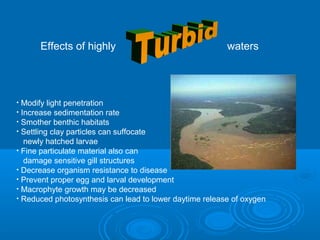
Effects of highly waters
• Modify light penetration
• Increase sedimentation rate
• Smother benthic habitats
• Settling clay particles can suffocate
newly hatched larvae
• Fine particulate material also can
damage sensitive gill structures
• Decrease organism resistance to disease
• Prevent proper egg and larval development
• Macrophyte growth may be decreased
• Reduced photosynthesis can lead to lower daytime release of oxygen
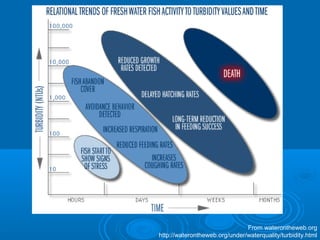
From waterontheweb.org
http://waterontheweb.org/under/waterquality/turbidity.html
ConductivityConductivity
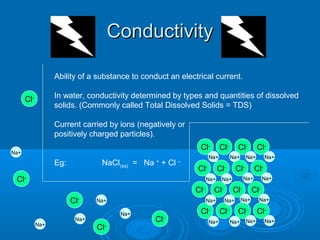
Ability of a substance to conduct an electrical current.
In water, conductivity determined by types and quantities of dissolved
solids. (Commonly called Total Dissolved Solids = TDS)
Current carried by ions (negatively or
positively charged particles).
Eg: NaCl(aq) = Na +
+ Cl –
Cl-
Na+Na+
Na+
Na+
Na+
Cl-
Cl-
Cl-
Cl-
Na+
Cl-
Cl-
Cl-
Cl-
Na+Na+ Na+Na+ Na+Na+ Na+Na+
Cl-
Cl-
Cl-
Cl-
Na+ Na+ Na+Na+
Cl-
Cl-
Cl-
Cl-
Na+ Na+ Na+Na+
Cl-
Cl-
Cl-
Cl-
Na+ Na+ Na+ Na+Na+
Na+Na+
Na+ Na+
Na+ Na+
ConductivityConductivity
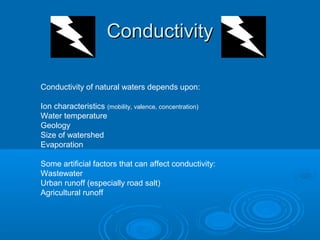
Conductivity of natural waters depends upon:
Ion characteristics (mobility, valence, concentration)
Water temperature
Geology
Size of watershed
Evaporation
Some artificial factors that can affect conductivity:
Wastewater
Urban runoff (especially road salt)
Agricultural runoff
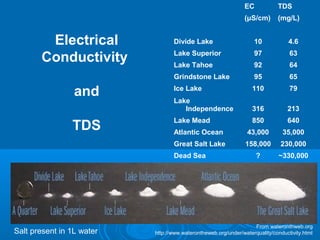
EC TDS
(μS/cm) (mg/L)
Divide Lake 10 4.6
Lake Superior 97 63
Lake Tahoe 92 64
Grindstone Lake 95 65
Ice Lake 110 79
Lake
Independence 316 213
Lake Mead 850 640
Atlantic Ocean 43,000 35,000
Great Salt Lake 158,000 230,000
Dead Sea ? ~330,000
Electrical
Conductivity
and
TDS
From wateronthweb.org
http://www.waterontheweb.org/under/waterquality/conductivity.htmlSalt present in 1L water
Water 3

Water 3

  • 1.
  • 2.
    Water Quality ParametersWaterQuality Parameters Temperature - Dissolved Oxygen (DO) - pH Alkalinity - Hardness Nitrates and Phosphates - Turbidity Conductivity -
  • 3.
    HardnessHardness Reflects dissolved carbonate minerals. Mostlyof concern for drinking water standards. Metals precipitate out of solution. Create scale/hard water deposits High alkalinity  Hard water From USGS http://water.usgs.gov/owq/news.html
  • 4.
    andand Nitrate (NO3 - ) naturally-occurring form ofnitrogen found in soil. Forms by microbial decomposition of fertilizers, plants, manures or other organic residues Plants uptake nitrates (Spinach a good source). Phosphate (PO4 -3 ) naturally occurs in rocks and minerals. Plants uptake weathered-out elements and compounds. Animals ingest plants. Water soluble. Redfield Ratio: 106:16:1
  • 6.
    NitratesNitrates The U.S. EPAhas set a maximum contaminant level for NO3 - in drinking water of 10 parts per million (ppm) Artificial sources: • Livestock manure/urine • Failing septic systems • Synthetic fertilizers Can lead to: eutrophication of natural water systems (overproduction of vegetation) Blue baby syndromne
  • 7.
    Artificial sources: • Sewage •Laundry, cleaning fluids • Synthetic fertilizers Can also lead to eutrophication of natural water systems (overproduction of vegetation) PhosphatesPhosphates Blue green algae
  • 8.
    1990 and 1999comparison1990 and 1999 comparison of Nitrates in Great Lakesof Nitrates in Great Lakes From US EPA http://www.epa.gov/glnpo/monitoring/limnology/SprNOx.html
  • 9.
    Hypoxia in theGulf of MexicoHypoxia in the Gulf of Mexico Gulf of Mexico Mississippi River drainage basin – 41% of US landmass.
  • 10.
    Hypoxia in theGulf of MexicoHypoxia in the Gulf of Mexico Hypoxic waters Image from Jacques Descloitres, MODIS Land Rapid Response Team, NASA/GSFC, January 2003
  • 11.
    Hypoxia in theGulf of MexicoHypoxia in the Gulf of Mexico From NCAT (Nat’l Center for Appropriate Technology) http://www.ncat.org/nutrients/hypoxia/hypoxia.html
  • 12.
    Global distribution ofoxygen-depleted coastal zones. Annual = yearly events (summer or autumnal stratification) Episodic = occurring at irregular intervals > one year Periodic = occurring at regular intervals < one year Persistent = all-year-round hypoxia Sources: Boesch 2002, Caddy 2000, Diaz and others (in press), Green and Short 2003, Rabalais 2002
  • 13.
    Source: Patrick Heffer,Short Term Prospects for World Agriculture and Fertilizer Demand 2002/03 - 2003/04 (Paris: International Fertilizer Industry Association (IFA), December 2003); IFA Secretariat and IFA Fertilizer Demand Working Group, Fertilizer Consumption Report (Brussels: December 2001); historical data from Worldwatch Institute, Signposts 2002, CD-ROM, compiled from IFA and the U.N. Food and Agriculture Organization, Fertilizer Yearbook (Rome: various years).
  • 14.
    Solutions??Solutions?? Wetland restoration Reducefertilizers Reduce emissions – WWTP/industry Reduce soil erosion
  • 15.
    TurbidityTurbidity Measures how “murky” thewater is Estimates: Mineral fraction Organics Inorganics Soluble organic compounds Plankton Microscopic organisms MODIS Image from NASA http://rapidfire.sci.gsfc.nasa.gov/
  • 16.
    Causes of highlywaters • In open waters, phytoplankton • Closer to shore, particulates Resuspended bottom sediments (wind) • Organic detritus from stream and/or wastewater discharges. • Dredging operations • Channelization • Increased flow rates • Floods • Too many bottom-feeding fish (such as carp) • Hippos
  • 17.
    Effects of highlywaters • Modify light penetration • Increase sedimentation rate • Smother benthic habitats • Settling clay particles can suffocate newly hatched larvae • Fine particulate material also can damage sensitive gill structures • Decrease organism resistance to disease • Prevent proper egg and larval development • Macrophyte growth may be decreased • Reduced photosynthesis can lead to lower daytime release of oxygen
  • 18.
  • 19.
    ConductivityConductivity Ability of asubstance to conduct an electrical current. In water, conductivity determined by types and quantities of dissolved solids. (Commonly called Total Dissolved Solids = TDS) Current carried by ions (negatively or positively charged particles). Eg: NaCl(aq) = Na + + Cl – Cl- Na+Na+ Na+ Na+ Na+ Cl- Cl- Cl- Cl- Na+ Cl- Cl- Cl- Cl- Na+Na+ Na+Na+ Na+Na+ Na+Na+ Cl- Cl- Cl- Cl- Na+ Na+ Na+Na+ Cl- Cl- Cl- Cl- Na+ Na+ Na+Na+ Cl- Cl- Cl- Cl- Na+ Na+ Na+ Na+Na+ Na+Na+ Na+ Na+ Na+ Na+
  • 20.
    ConductivityConductivity Conductivity of naturalwaters depends upon: Ion characteristics (mobility, valence, concentration) Water temperature Geology Size of watershed Evaporation Some artificial factors that can affect conductivity: Wastewater Urban runoff (especially road salt) Agricultural runoff
  • 21.
    EC TDS (μS/cm) (mg/L) DivideLake 10 4.6 Lake Superior 97 63 Lake Tahoe 92 64 Grindstone Lake 95 65 Ice Lake 110 79 Lake Independence 316 213 Lake Mead 850 640 Atlantic Ocean 43,000 35,000 Great Salt Lake 158,000 230,000 Dead Sea ? ~330,000 Electrical Conductivity and TDS From wateronthweb.org http://www.waterontheweb.org/under/waterquality/conductivity.htmlSalt present in 1L water

Editor's Notes

  • #5 Nitrogen is essential to all life, and most crop plants require large quantities to sustain high yields. The formation of nitrate is an integral part of the nitrogen cycle in the environment.
  • #7 The total input of nutrients varies through time, depending upon land use and other factors. During the winter, high rainfall causes increased runoff of organic matter such as leaves, twigs, grass and other debris. Because decomposition of this organic matter releases nutrients, it constitutes an important and beneficial source of nutrient loading. Phosphates and nitrates are associated with many nonpoint pollution sources, such as livestock manure and urine, failing septic systems synthetic fertilizers. (Synthetic fertilizers release their nutrients more rapidly than the slower-acting organic ones like compost and composted manure.) Excessive nutrient loads can artificially stimulate plant growth resulting in algal blooms which speed up the aging process of aquatic systems. Concern of health risks to man (cancer, Blue baby syndrome) – controversial.
  • #10 The Mississippi River drains 41 per cent of the US landmass In the United States, some of the key farming states like Ohio, Indiana, Illinois, and Iowa have drained 80 per cent of their wetlands. Louisiana, Mississippi, Arkansas, and Tennessee have lost over half of theirs. This lets even more of the excess fertilizer farmers apply flow down the Mississippi River to the gulf. Info source: http://www.peopleandplanet.net/doc.php?id=2183
  • #11 1.6 million tons of nitrogen now enter the Gulf from the Mississippi basin most of the nitrogen originates in fertilizer used in the productive Corn Belt.
  • #12 Particularly bad for fish because coastal areas is spawning grounds before moving to deeper waters.
  • #13 The 146 zones shown are associated with either major population concentrations or with watersheds that deliver large quantities of nutrients to coastal waters.
  • #15 Reiterate - key farming states like Ohio, Indiana, Illinois, and Iowa have drained 80 per cent of their wetlands. Louisiana, Mississippi, Arkansas, and Tennessee have lost over half of theirs Lots of research into how to efficiently use fertilizers Where problems is because of large metropolis…must curb emissions from WWTP, industry. Preventing erosion through conservation tillage and crop rotations
  • #16 Open water – mostly phytoplankton (microscopic floating plants) Coastal areas – eroded sediments
  • #17 Long list of how organisms affected
  • #18 Long list of how organisms affected
  • #20 Note that it doesn’t tell us what kind of TDS there are.
  • #21 Ion – more ions means more conductive Temp – higher temp means more ions Geology – more soluble rxs, increase in TDS, increase in conductivity Size – larger size, more contact water has with rx and soils. Evap – think Great Salt lake, Mono Lake Agricultural runoff – high in dissolved salts
  • #22 Divide is a softwater, acid rain sensitive lake in northeastern Minnesota; Superior and Tahoe are ultra-oligotrophic lakes; Ice and Independence are WOW lakes; Mead is an unproductive reservoir (the largest in the U.S.) but has a high TDS due to the salt content of the Colorado River which provides &amp;gt;98% of its water; the Atlantic Ocean overlies the lost Kingdom of Atlantis and possibly Jimmy Hoffa; the Great Salt Lake is an enormous hypersaline lake near Salt Lake City, Utah - it is the relict of what was once a huge inland freshwater sea that dried up, thereby concentrating the remaining salts after the water evaporated.