



Does the word
“synonym” have a
   synonym?
       Leo Selivan
      British Council

    Annual ETAI Conference
        3-4 July 2012
Outline
•   A bit of history
•   Latinate and Germanic words
•   Lexical density
•   Synonyms or near synonyms?
•   Multi-part verbs
•   Teaching implications & practical suggestions
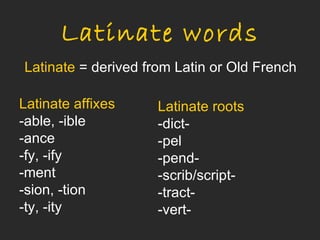
Latinate words
Latinate = derived from Latin or Old French

Latinate affixes     Latinate roots
-able, -ible         -dict-
-ance                -pel
-fy, -ify            -pend-
-ment                -scrib/script-
-sion, -tion         -tract-
-ty, -ity            -vert-
TASK 1
Look at a page from the dictionary.

• Count the number of words on the page.
• How many Latinate words can you find?
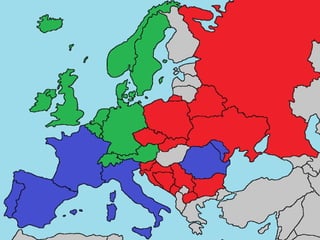
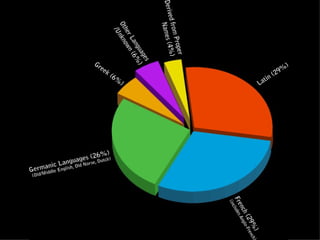
Hybrid language
English – Germanic group

              but 60% Latinate vocabulary
The Norman
 Conquest
http://www.youtube.com/v/1B8TwBrCIEY
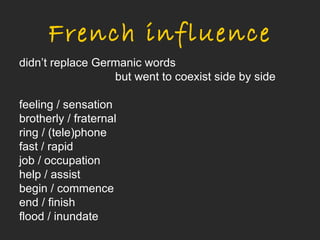
French influence
didn’t replace Germanic words
                  but went to coexist side by side

feeling / sensation
brotherly / fraternal
ring / (tele)phone
fast / rapid
job / occupation
help / assist
begin / commence
end / finish
flood / inundate
TASK 2
Make a list of 10 (near-) synonyms in English


• Most are based on Germanic/French
  distinction
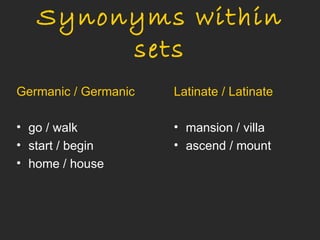
Synonyms within
        sets
Germanic / Germanic   Latinate / Latinate

• go / walk           • mansion / villa
• start / begin       • ascend / mount
• home / house
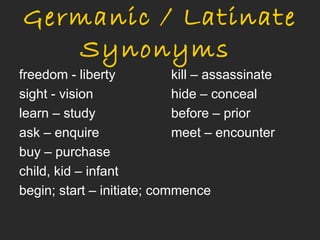
Germanic / Latinate
   Synonyms
freedom - liberty           kill – assassinate
sight - vision              hide – conceal
learn – study               before – prior
ask – enquire               meet – encounter
buy – purchase
child, kid – infant
begin; start – initiate; commence
Largest vocabulary?
    How many words are there in English?

The Global Language Monitor in 2009:
English passed 1 million word mark

Oxford Dictionaries:
250,000 at the very least
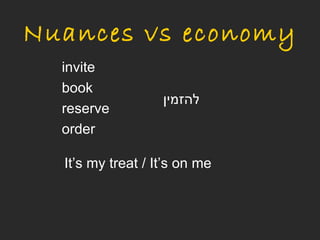
Nuances vs economy
  invite
  book
                   ‫להזמין‬
  reserve
  order

  It’s my treat / It’s on me
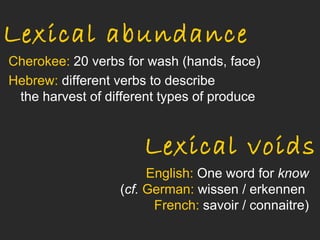
Lexical abundance
Cherokee: 20 verbs for wash (hands, face)
Hebrew: different verbs to describe
 the harvest of different types of produce


                      Lexical voids
                       English: One word for know
                  (cf. German: wissen / erkennen
                        French: savoir / connaitre)
Lexical density
Synonymy
 and near-
synonymy
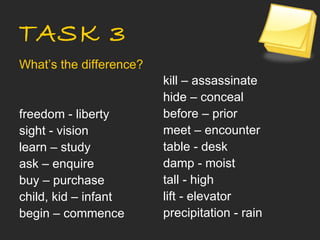
TASK 3
What’s the difference?
                         kill – assassinate
                         hide – conceal
freedom - liberty        before – prior
sight - vision           meet – encounter
learn – study            table - desk
ask – enquire            damp - moist
buy – purchase           tall - high
child, kid – infant      lift - elevator
begin – commence         precipitation - rain
What makes
synonyms different
   •   register
   •   collocation
   •   semantic prosody
   •   colligation
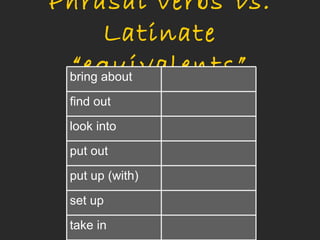
Phrasal verbs vs.
       Latinate
 “equivalents”
 bring about
 find out
 look into
 put out
 put up (with)
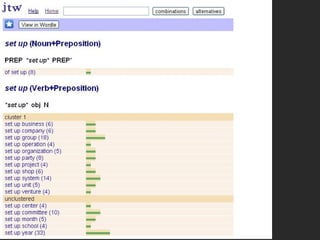
 set up
 take in
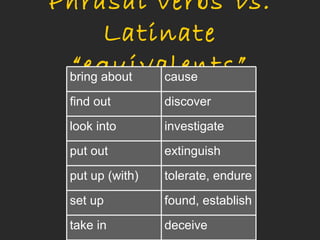
Phrasal verbs vs.
       Latinate
 “equivalents”
 bring about cause
 find out        discover
 look into       investigate
 put out         extinguish
 put up (with)   tolerate, endure
 set up          found, establish
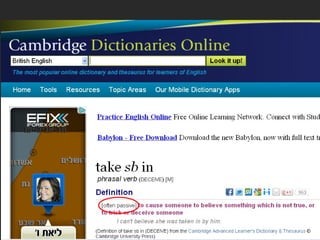
 take in         deceive
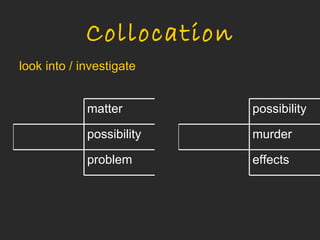
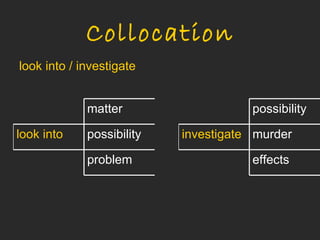
Collocation
look into / investigate


             matter        possibility

             possibility   murder

             problem       effects
Collocation
look into / investigate


             matter                   possibility

look into    possibility   investigate murder

             problem                  effects
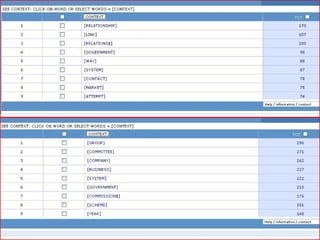
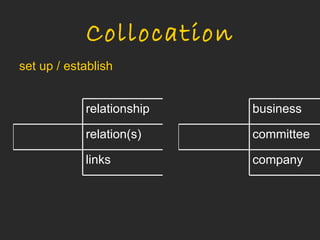
Collocation
set up / establish


            relationship   business

            relation(s)    committee

            links          company
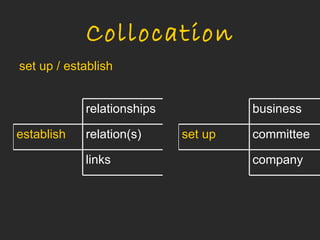
Collocation
set up / establish


            relationships            business

establish   relation(s)     set up   committee

            links                    company
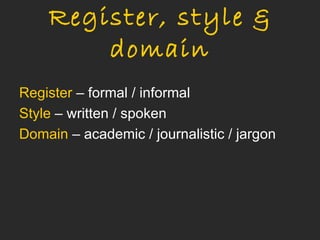
Register, style &
        domain
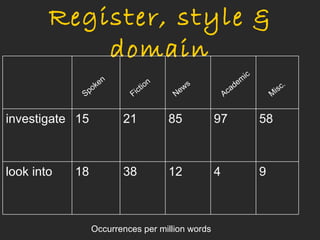
Register – formal / informal
Style – written / spoken
Domain – academic / journalistic / jargon
Register, style &
            domain
                                                             ic
                   en                n                    de
                                                            m             .
               po
                  k
                               ic tio        ws          a             isc
             S             F              Ne          Ac              M


investigate 15          21               85       97              58


look into   18          38               12       4               9


                 Occurrences per million words
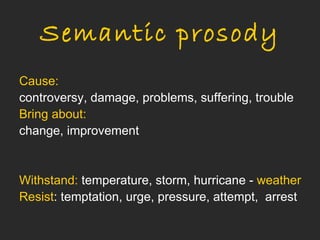
Semantic prosody
Cause:
controversy, damage, problems, suffering, trouble
Bring about:
change, improvement


Withstand: temperature, storm, hurricane - weather
Resist: temptation, urge, pressure, attempt, arrest
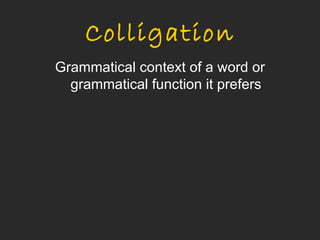
Colligation
Grammatical context of a word or
  grammatical function it prefers
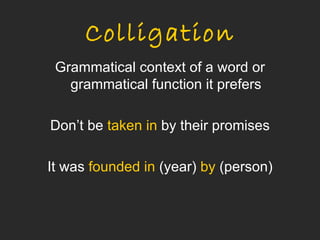
Colligation
 Grammatical context of a word or
   grammatical function it prefers

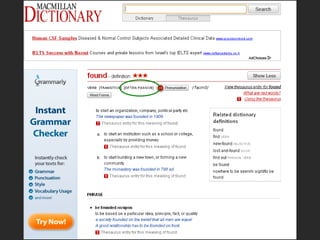
Don’t be taken in by their promises

It was founded in (year) by (person)
Pedagogical ideas &
   suggestions
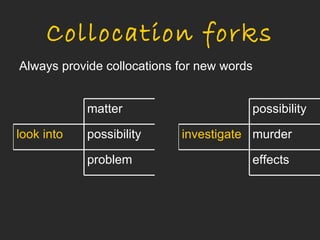
Collocation forks
Always provide collocations for new words


            matter                      possibility

look into   possibility     investigate murder

            problem                     effects
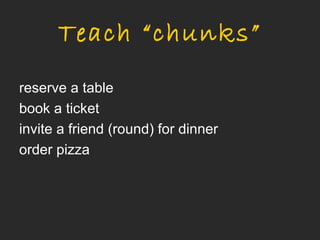
Teach “chunks”
reserve a table
book a ticket
invite a friend (round) for dinner
order pizza
 Leave used
language alone
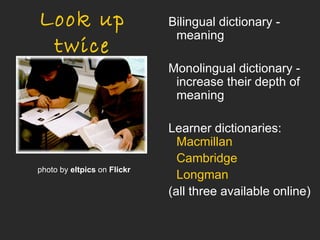
Look up                      Bilingual dictionary -
                              meaning
 twice
                             Monolingual dictionary -
                              increase their depth of
                              meaning

                             Learner dictionaries:
                               Macmillan
                               Cambridge
photo by eltpics on Flickr
                               Longman
                             (all three available online)
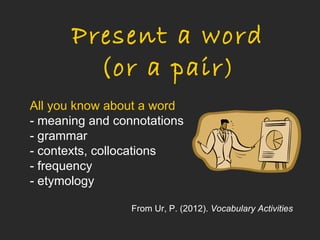
Present a word
         (or a pair )
All you know about a word
- meaning and connotations
- grammar
- contexts, collocations
- frequency
- etymology

                 From Ur, P. (2012). Vocabulary Activities
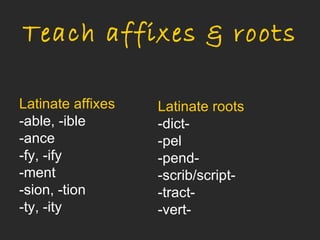
Teach affixes & roots

Latinate affixes   Latinate roots
-able, -ible       -dict-
-ance              -pel
-fy, -ify          -pend-
-ment              -scrib/script-
-sion, -tion       -tract-
-ty, -ity          -vert-
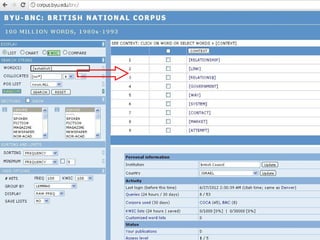
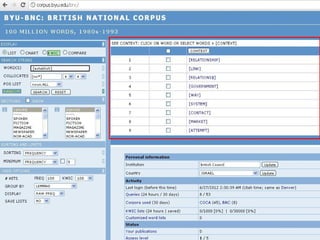
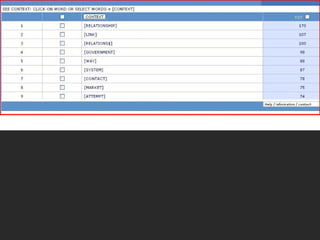
Use corpus and
         concordances
British National Corpus (BNC)
Corpus of Contemporary American English (COCA)
http://corpus.byu.edu/

Just the word - a tool for looking up collocations
www.just-the-word.com
Conclusion
“As near synonyms usually differ in their
collocational behaviour and semantic
prosodies, the traditional practice of explaining
meanings to learners by offering synonyms
should be used with caution”

                              Xiao & Mcenery (2006)
References
Barber, C. (1993). The English Language. Cambridge: CUP
Davies, M. (2004-). BYU-BNC: The British National Corpus. Available at http://
    corpus.byu.edu/bnc
Gardner, D. & Davies, M. (2007). Pointing out frequent phrasal verbs: A corpus-based
    analysis. In TESOL Quarterly 41(2), pp 339-359
Hoey, M. (2000). A World Beyond Collocation: New Perspectives on Vocabulary
    Teaching. In Lewis. M (ed.), Teaching Collocation: Further Developments in the
    Lexical Approach. (pp. 224-243). Hove: Thomson-Heinle
McCrum, R., Cran, W. & MacNeil, R. (2002). The Story of English. London: Penguin.
Schuessler, J. (2009, June 13). Keeping It Real on Dictionary Row. The New York Times.
    Retrieved from
    http://www.nytimes.com/2009/06/14/weekinreview/14shuessler.html?_r=2
Ur, P. (2012). Vocabulary activities. Cambridge: Cambridge University Press
Welcome to the World of Global English. (2010, February 24). The Global Language
    Monitor. Retrieved from http://www.languagemonitor.com/
Xiao, R. & McEnery, T. (2006). Collocation, Semantic Prosody, and Near Synonymy: A
    Cross-Linguistic Perspective. Applied Linguistics, 27(1), 103-129

Synonyms ETAI2012

  • 1.
    Does the word “synonym”have a synonym? Leo Selivan British Council Annual ETAI Conference 3-4 July 2012
  • 2.
    Outline • A bit of history • Latinate and Germanic words • Lexical density • Synonyms or near synonyms? • Multi-part verbs • Teaching implications & practical suggestions
  • 3.
    Latinate words Latinate =derived from Latin or Old French Latinate affixes Latinate roots -able, -ible -dict- -ance -pel -fy, -ify -pend- -ment -scrib/script- -sion, -tion -tract- -ty, -ity -vert-
  • 4.
    TASK 1 Look ata page from the dictionary. • Count the number of words on the page. • How many Latinate words can you find?
  • 6.
    Hybrid language English –Germanic group but 60% Latinate vocabulary
  • 8.
  • 9.
    French influence didn’t replaceGermanic words but went to coexist side by side feeling / sensation brotherly / fraternal ring / (tele)phone fast / rapid job / occupation help / assist begin / commence end / finish flood / inundate
  • 10.
    TASK 2 Make alist of 10 (near-) synonyms in English • Most are based on Germanic/French distinction
  • 11.
    Synonyms within sets Germanic / Germanic Latinate / Latinate • go / walk • mansion / villa • start / begin • ascend / mount • home / house
  • 12.
    Germanic / Latinate Synonyms freedom - liberty kill – assassinate sight - vision hide – conceal learn – study before – prior ask – enquire meet – encounter buy – purchase child, kid – infant begin; start – initiate; commence
  • 13.
    Largest vocabulary? How many words are there in English? The Global Language Monitor in 2009: English passed 1 million word mark Oxford Dictionaries: 250,000 at the very least
  • 14.
    Nuances vs economy invite book ‫להזמין‬ reserve order It’s my treat / It’s on me
  • 15.
    Lexical abundance Cherokee: 20verbs for wash (hands, face) Hebrew: different verbs to describe the harvest of different types of produce Lexical voids English: One word for know (cf. German: wissen / erkennen French: savoir / connaitre)
  • 16.
  • 17.
  • 18.
    TASK 3 What’s thedifference? kill – assassinate hide – conceal freedom - liberty before – prior sight - vision meet – encounter learn – study table - desk ask – enquire damp - moist buy – purchase tall - high child, kid – infant lift - elevator begin – commence precipitation - rain
  • 19.
    What makes synonyms different • register • collocation • semantic prosody • colligation
  • 20.
    Phrasal verbs vs. Latinate “equivalents” bring about find out look into put out put up (with) set up take in
  • 21.
    Phrasal verbs vs. Latinate “equivalents” bring about cause find out discover look into investigate put out extinguish put up (with) tolerate, endure set up found, establish take in deceive
  • 26.
    Collocation look into /investigate matter possibility possibility murder problem effects
  • 27.
    Collocation look into /investigate matter possibility look into possibility investigate murder problem effects
  • 28.
    Collocation set up /establish relationship business relation(s) committee links company
  • 29.
    Collocation set up /establish relationships business establish relation(s) set up committee links company
  • 30.
    Register, style & domain Register – formal / informal Style – written / spoken Domain – academic / journalistic / jargon
  • 31.
    Register, style & domain ic en n de m . po k ic tio ws a isc S F Ne Ac M investigate 15 21 85 97 58 look into 18 38 12 4 9 Occurrences per million words
  • 32.
    Semantic prosody Cause: controversy, damage,problems, suffering, trouble Bring about: change, improvement Withstand: temperature, storm, hurricane - weather Resist: temptation, urge, pressure, attempt, arrest
  • 33.
    Colligation Grammatical context ofa word or grammatical function it prefers
  • 36.
    Colligation Grammatical contextof a word or grammatical function it prefers Don’t be taken in by their promises It was founded in (year) by (person)
  • 37.
  • 38.
    Collocation forks Always providecollocations for new words matter possibility look into possibility investigate murder problem effects
  • 39.
    Teach “chunks” reserve atable book a ticket invite a friend (round) for dinner order pizza
  • 40.
  • 41.
    Look up Bilingual dictionary - meaning twice Monolingual dictionary - increase their depth of meaning Learner dictionaries: Macmillan Cambridge photo by eltpics on Flickr Longman (all three available online)
  • 42.
    Present a word (or a pair ) All you know about a word - meaning and connotations - grammar - contexts, collocations - frequency - etymology From Ur, P. (2012). Vocabulary Activities
  • 43.
    Teach affixes &roots Latinate affixes Latinate roots -able, -ible -dict- -ance -pel -fy, -ify -pend- -ment -scrib/script- -sion, -tion -tract- -ty, -ity -vert-
  • 44.
    Use corpus and concordances British National Corpus (BNC) Corpus of Contemporary American English (COCA) http://corpus.byu.edu/ Just the word - a tool for looking up collocations www.just-the-word.com
  • 46.
    Conclusion “As near synonymsusually differ in their collocational behaviour and semantic prosodies, the traditional practice of explaining meanings to learners by offering synonyms should be used with caution” Xiao & Mcenery (2006)
  • 47.
    References Barber, C. (1993).The English Language. Cambridge: CUP Davies, M. (2004-). BYU-BNC: The British National Corpus. Available at http:// corpus.byu.edu/bnc Gardner, D. & Davies, M. (2007). Pointing out frequent phrasal verbs: A corpus-based analysis. In TESOL Quarterly 41(2), pp 339-359 Hoey, M. (2000). A World Beyond Collocation: New Perspectives on Vocabulary Teaching. In Lewis. M (ed.), Teaching Collocation: Further Developments in the Lexical Approach. (pp. 224-243). Hove: Thomson-Heinle McCrum, R., Cran, W. & MacNeil, R. (2002). The Story of English. London: Penguin. Schuessler, J. (2009, June 13). Keeping It Real on Dictionary Row. The New York Times. Retrieved from http://www.nytimes.com/2009/06/14/weekinreview/14shuessler.html?_r=2 Ur, P. (2012). Vocabulary activities. Cambridge: Cambridge University Press Welcome to the World of Global English. (2010, February 24). The Global Language Monitor. Retrieved from http://www.languagemonitor.com/ Xiao, R. & McEnery, T. (2006). Collocation, Semantic Prosody, and Near Synonymy: A Cross-Linguistic Perspective. Applied Linguistics, 27(1), 103-129