CommonCommon
Contract TypesContract Types
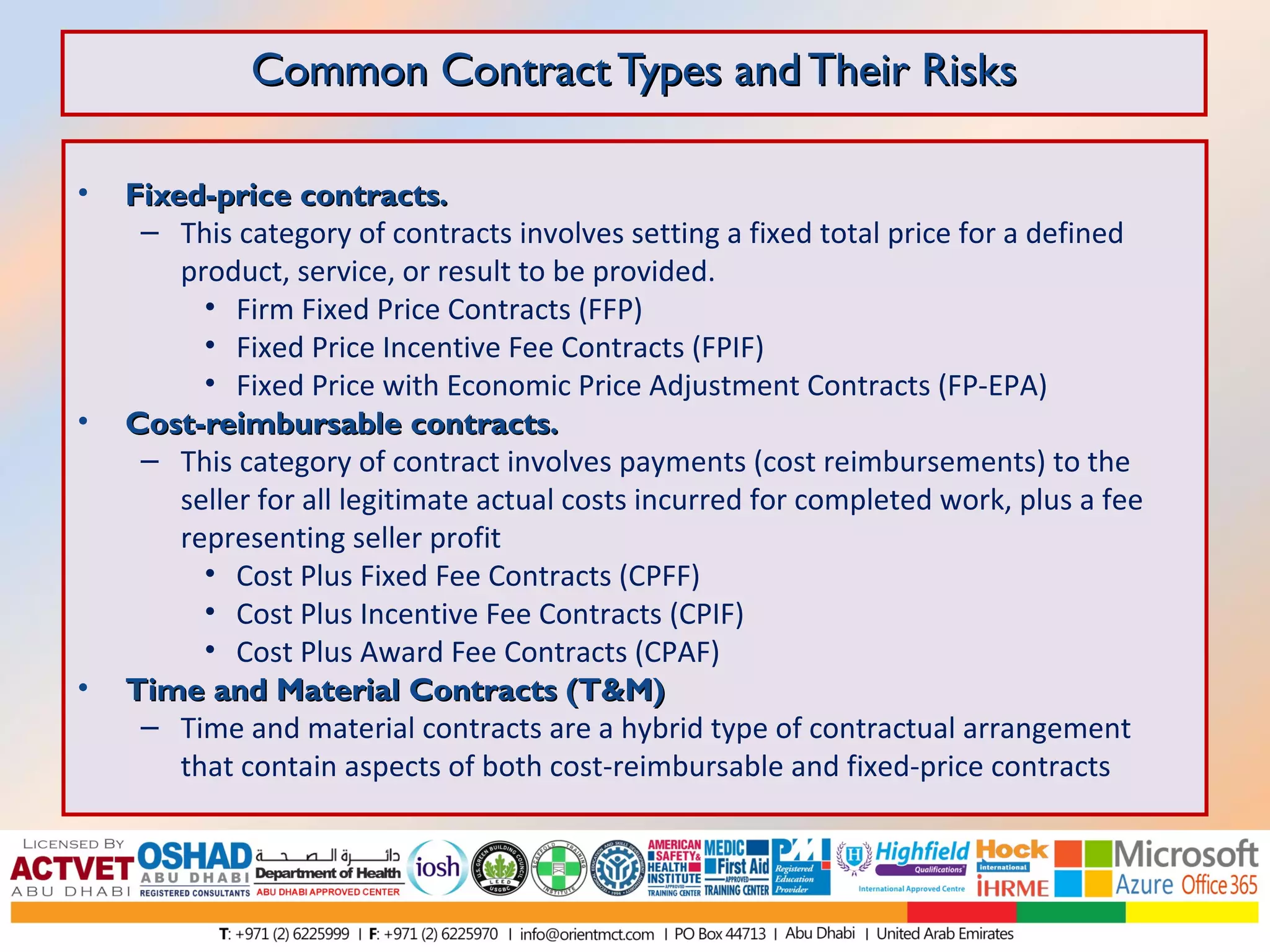
• Fixed-price contracts.Fixed-price contracts.
– This category of contracts involves setting a fixed total price for a defined
product, service, or result to be provided.
• Firm Fixed Price Contracts (FFP)
• Fixed Price Incentive Fee Contracts (FPIF)
• Fixed Price with Economic Price Adjustment Contracts (FP-EPA)
• Cost-reimbursable contracts.Cost-reimbursable contracts.
– This category of contract involves payments (cost reimbursements) to the
seller for all legitimate actual costs incurred for completed work, plus a fee
representing seller profit
• Cost Plus Fixed Fee Contracts (CPFF)
• Cost Plus Incentive Fee Contracts (CPIF)
• Cost Plus Award Fee Contracts (CPAF)
• Time and Material Contracts (T&M)Time and Material Contracts (T&M)
– Time and material contracts are a hybrid type of contractual arrangement
that contain aspects of both cost-reimbursable and fixed-price contracts
Common Contract Types and Their RisksCommon Contract Types and Their Risks
Contract
Risk for
Buyer
Risk for
Seller
Description Example
Firm Fixed
Price
(FFP) also
known as
Lump Sum
Minimal Significant
One of the most common contracts in
business today, popular because a
company can budget for a fixed price.
Because it requires detail for the seller to
estimate accurately, an FP contract is
typically used when there is a detailed
Scope of Work. The downside for seller is
cost containment. For the seller,
everything after costs are covered is
profit.
Purchasing the implementation
of a computer network at your
company from an outside vendor
for $2,000,000 after providing
the seller a detailed Scope of
Work.
Fixed Price
Incentive
Fee (FPIF)
Minimal Significant
A contract type with the fixed price
component described above; includes
incentives fees to motivate the seller to
produce at a rate greater than the
minimum required.
A FPIF is usually used to help accelerate a
buyer’s need such as a market
opportunity. It provides an opportunity
for the seller to determine what is
needed to make additional profit via the
incentive fee.
A city buying services from a
construction company to put in a
new freeway for $4,000,000. For
each week the seller finishes
before a given date, it receives
$65,000.
Common Contract Types and Their RisksCommon Contract Types and Their Risks
Contract
Risk for
Buyer
Risk for
Seller
Description Example
Fixed Price
Economic
Price
Adjustment
(FP-EPA)
Minimal Significant
A Fixed Price contract with the similar
components listed above; associated with a
multi-year contract.
To compensate for economic changes from year
to year, the Economic Price Adjustment is
factored in. The item determining the amount
of change from year to year is usually some
national economic metric not directly tied to
the buyer or the seller.
A city buys services from a
construction company to build a new
freeway for $4,000,000 over three
years. At the start of each year, the
amount varies relative to the national
cost of living or some other negotiated
standard.
Cost Plus
Fixed Fee
(CPFF)
Medium Minimal
Typically used when the buyer knows generally
what is need but lacks detail to know specifically
what is needed to built it.
The CPFF covers the costs of the seller and
includes a predefined fee for the work.
A buyer hires a vendor to produce a
video training series but is not yet sure
of all the detail needed and agrees to
pay the vendor for costs plus a
$37,000 fee.
Cost Plus
Incentive Fee
(CPIF)
Medium Minimal
Typically used when the buyer knows generally
what is needed but lacks any details to know
specifically what is needed to build it.
Generally, the buyer has some sort of need
which requires that something created as soon
as reasonably possible. The incentive fee gives
the buyer an opportunity to motivate the seller
to complete the project quicker, to higher
quality standards, or other criteria.
A buyer hires a company to write a
manual for publication and sale. Due
to a market opportunity, the quicker
to market, the higher the sales. The
buyer agrees to pay costs plus an
incentive fee of $7,500 for each week
the project is done before the
estimated completion date.
Common Contract Types and Their RisksCommon Contract Types and Their Risks
Contract
Risk for
Buyer
Risk for Seller Description Example
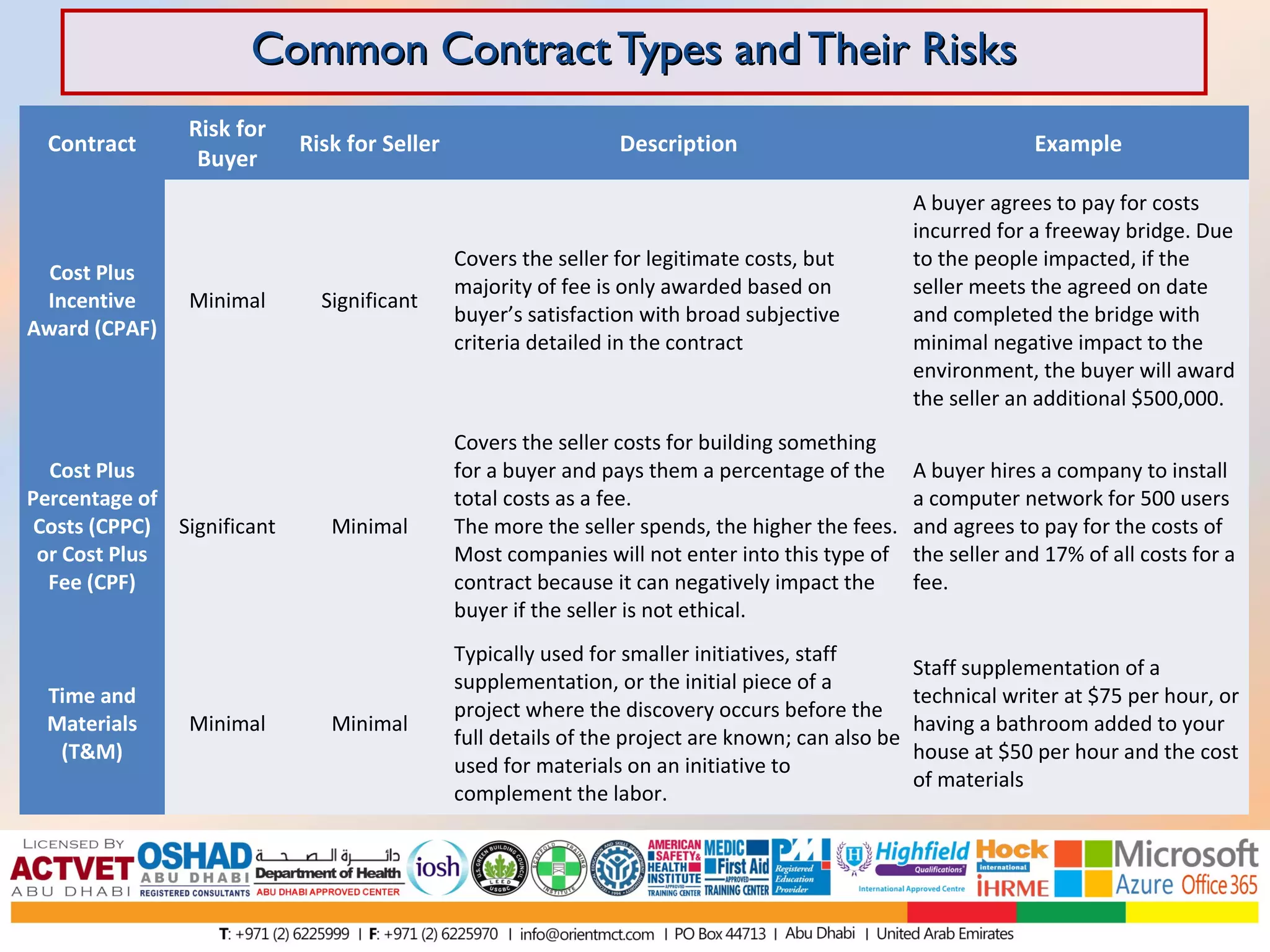
Cost Plus
Incentive
Award (CPAF)
Minimal Significant
Covers the seller for legitimate costs, but
majority of fee is only awarded based on
buyer’s satisfaction with broad subjective
criteria detailed in the contract
A buyer agrees to pay for costs
incurred for a freeway bridge. Due
to the people impacted, if the
seller meets the agreed on date
and completed the bridge with
minimal negative impact to the
environment, the buyer will award
the seller an additional $500,000.
Cost Plus
Percentage of
Costs (CPPC)
or Cost Plus
Fee (CPF)
Significant Minimal
Covers the seller costs for building something
for a buyer and pays them a percentage of the
total costs as a fee.
The more the seller spends, the higher the fees.
Most companies will not enter into this type of
contract because it can negatively impact the
buyer if the seller is not ethical.
A buyer hires a company to install
a computer network for 500 users
and agrees to pay for the costs of
the seller and 17% of all costs for a
fee.
Time and
Materials
(T&M)
Minimal Minimal
Typically used for smaller initiatives, staff
supplementation, or the initial piece of a
project where the discovery occurs before the
full details of the project are known; can also be
used for materials on an initiative to
complement the labor.
Staff supplementation of a
technical writer at $75 per hour, or
having a bathroom added to your
house at $50 per hour and the cost
of materials
Common Contract Types and Their RisksCommon Contract Types and Their Risks
THANK YOUTHANK YOU

Common contract types

  • 1.
  • 2.
    • Fixed-price contracts.Fixed-pricecontracts. – This category of contracts involves setting a fixed total price for a defined product, service, or result to be provided. • Firm Fixed Price Contracts (FFP) • Fixed Price Incentive Fee Contracts (FPIF) • Fixed Price with Economic Price Adjustment Contracts (FP-EPA) • Cost-reimbursable contracts.Cost-reimbursable contracts. – This category of contract involves payments (cost reimbursements) to the seller for all legitimate actual costs incurred for completed work, plus a fee representing seller profit • Cost Plus Fixed Fee Contracts (CPFF) • Cost Plus Incentive Fee Contracts (CPIF) • Cost Plus Award Fee Contracts (CPAF) • Time and Material Contracts (T&M)Time and Material Contracts (T&M) – Time and material contracts are a hybrid type of contractual arrangement that contain aspects of both cost-reimbursable and fixed-price contracts Common Contract Types and Their RisksCommon Contract Types and Their Risks
  • 3.
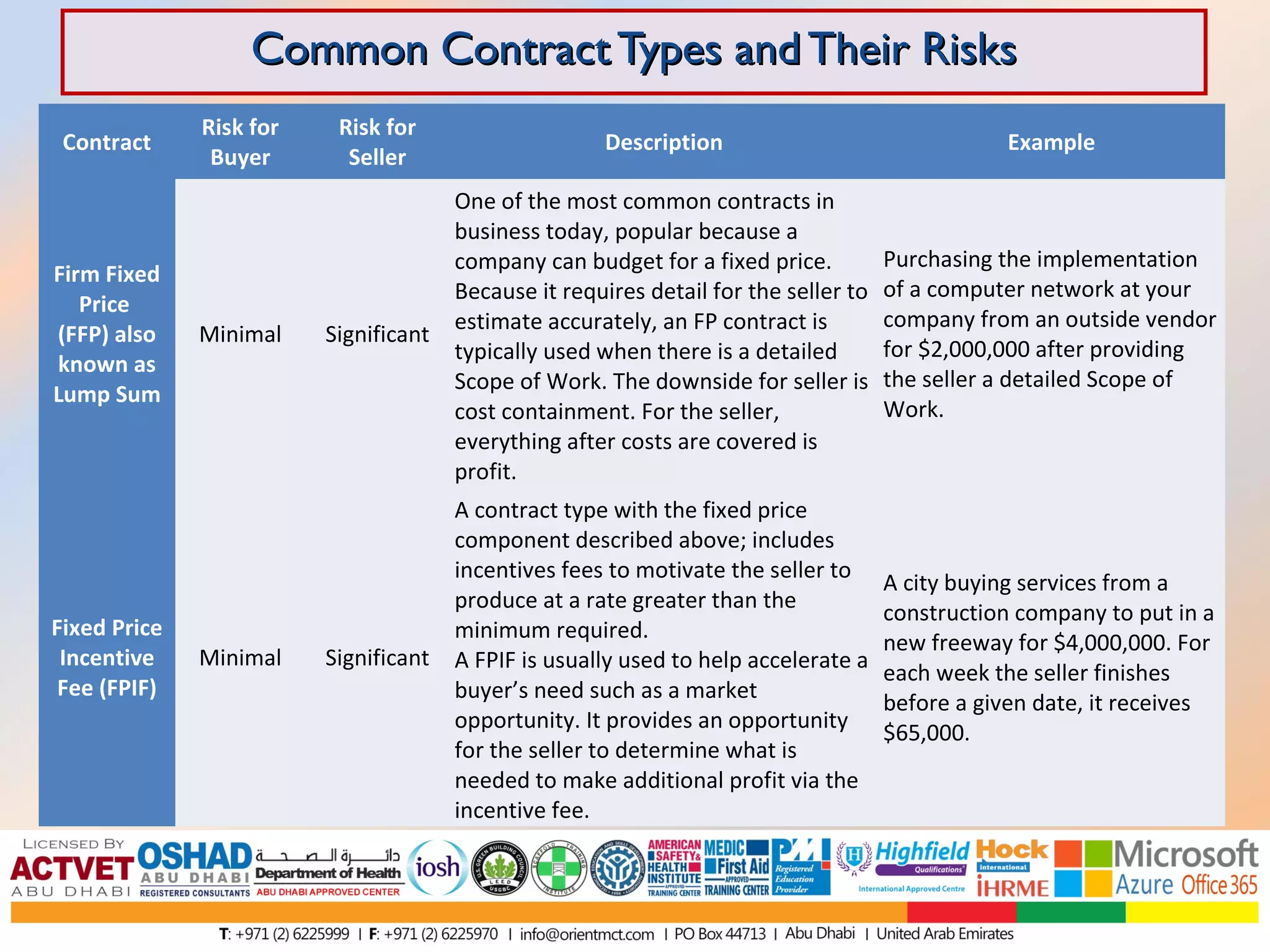
    Contract Risk for Buyer Risk for Seller DescriptionExample Firm Fixed Price (FFP) also known as Lump Sum Minimal Significant One of the most common contracts in business today, popular because a company can budget for a fixed price. Because it requires detail for the seller to estimate accurately, an FP contract is typically used when there is a detailed Scope of Work. The downside for seller is cost containment. For the seller, everything after costs are covered is profit. Purchasing the implementation of a computer network at your company from an outside vendor for $2,000,000 after providing the seller a detailed Scope of Work. Fixed Price Incentive Fee (FPIF) Minimal Significant A contract type with the fixed price component described above; includes incentives fees to motivate the seller to produce at a rate greater than the minimum required. A FPIF is usually used to help accelerate a buyer’s need such as a market opportunity. It provides an opportunity for the seller to determine what is needed to make additional profit via the incentive fee. A city buying services from a construction company to put in a new freeway for $4,000,000. For each week the seller finishes before a given date, it receives $65,000. Common Contract Types and Their RisksCommon Contract Types and Their Risks
  • 4.
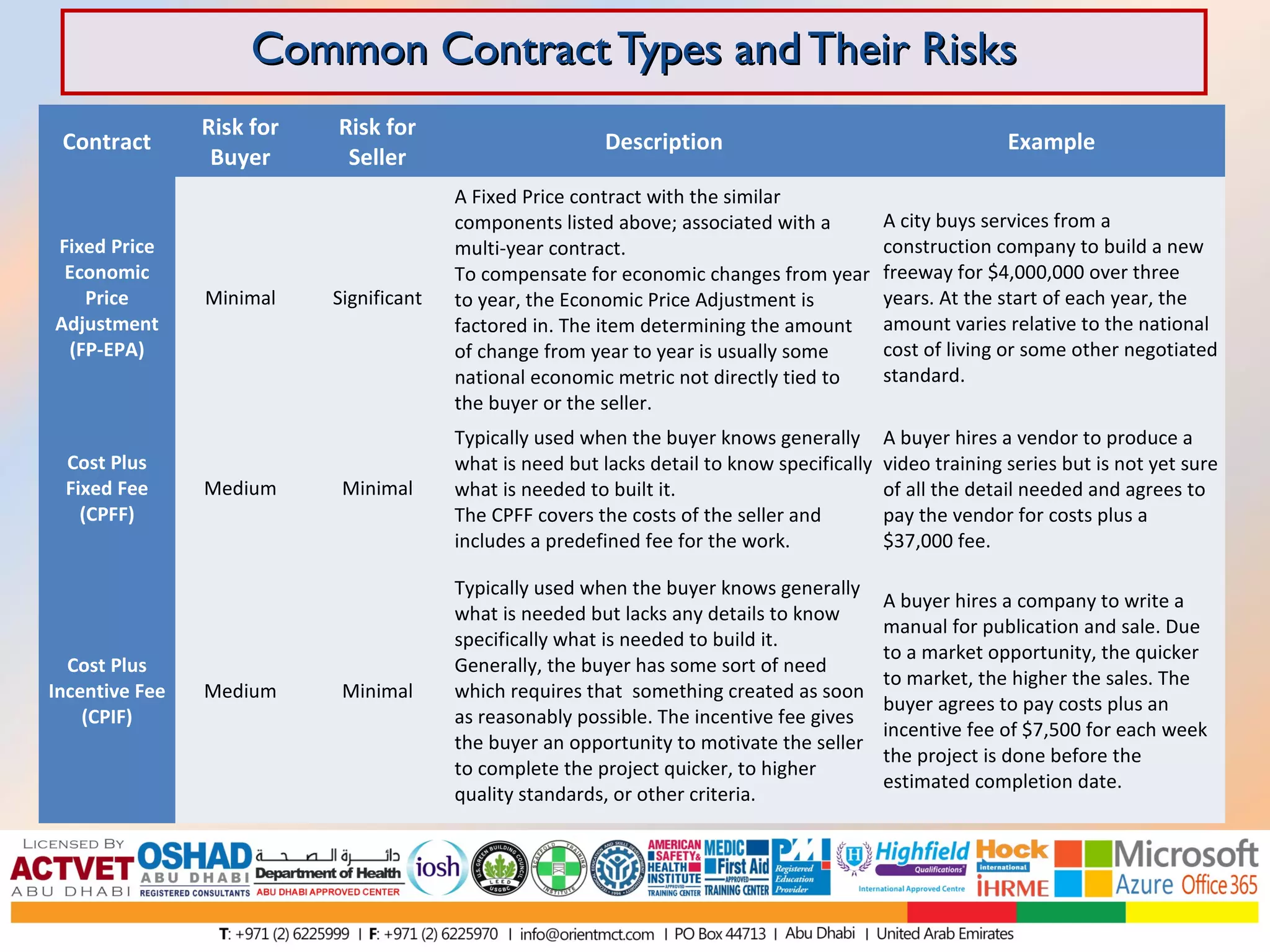
    Contract Risk for Buyer Risk for Seller DescriptionExample Fixed Price Economic Price Adjustment (FP-EPA) Minimal Significant A Fixed Price contract with the similar components listed above; associated with a multi-year contract. To compensate for economic changes from year to year, the Economic Price Adjustment is factored in. The item determining the amount of change from year to year is usually some national economic metric not directly tied to the buyer or the seller. A city buys services from a construction company to build a new freeway for $4,000,000 over three years. At the start of each year, the amount varies relative to the national cost of living or some other negotiated standard. Cost Plus Fixed Fee (CPFF) Medium Minimal Typically used when the buyer knows generally what is need but lacks detail to know specifically what is needed to built it. The CPFF covers the costs of the seller and includes a predefined fee for the work. A buyer hires a vendor to produce a video training series but is not yet sure of all the detail needed and agrees to pay the vendor for costs plus a $37,000 fee. Cost Plus Incentive Fee (CPIF) Medium Minimal Typically used when the buyer knows generally what is needed but lacks any details to know specifically what is needed to build it. Generally, the buyer has some sort of need which requires that something created as soon as reasonably possible. The incentive fee gives the buyer an opportunity to motivate the seller to complete the project quicker, to higher quality standards, or other criteria. A buyer hires a company to write a manual for publication and sale. Due to a market opportunity, the quicker to market, the higher the sales. The buyer agrees to pay costs plus an incentive fee of $7,500 for each week the project is done before the estimated completion date. Common Contract Types and Their RisksCommon Contract Types and Their Risks
  • 5.
    Contract Risk for Buyer Risk forSeller Description Example Cost Plus Incentive Award (CPAF) Minimal Significant Covers the seller for legitimate costs, but majority of fee is only awarded based on buyer’s satisfaction with broad subjective criteria detailed in the contract A buyer agrees to pay for costs incurred for a freeway bridge. Due to the people impacted, if the seller meets the agreed on date and completed the bridge with minimal negative impact to the environment, the buyer will award the seller an additional $500,000. Cost Plus Percentage of Costs (CPPC) or Cost Plus Fee (CPF) Significant Minimal Covers the seller costs for building something for a buyer and pays them a percentage of the total costs as a fee. The more the seller spends, the higher the fees. Most companies will not enter into this type of contract because it can negatively impact the buyer if the seller is not ethical. A buyer hires a company to install a computer network for 500 users and agrees to pay for the costs of the seller and 17% of all costs for a fee. Time and Materials (T&M) Minimal Minimal Typically used for smaller initiatives, staff supplementation, or the initial piece of a project where the discovery occurs before the full details of the project are known; can also be used for materials on an initiative to complement the labor. Staff supplementation of a technical writer at $75 per hour, or having a bathroom added to your house at $50 per hour and the cost of materials Common Contract Types and Their RisksCommon Contract Types and Their Risks
  • 6.
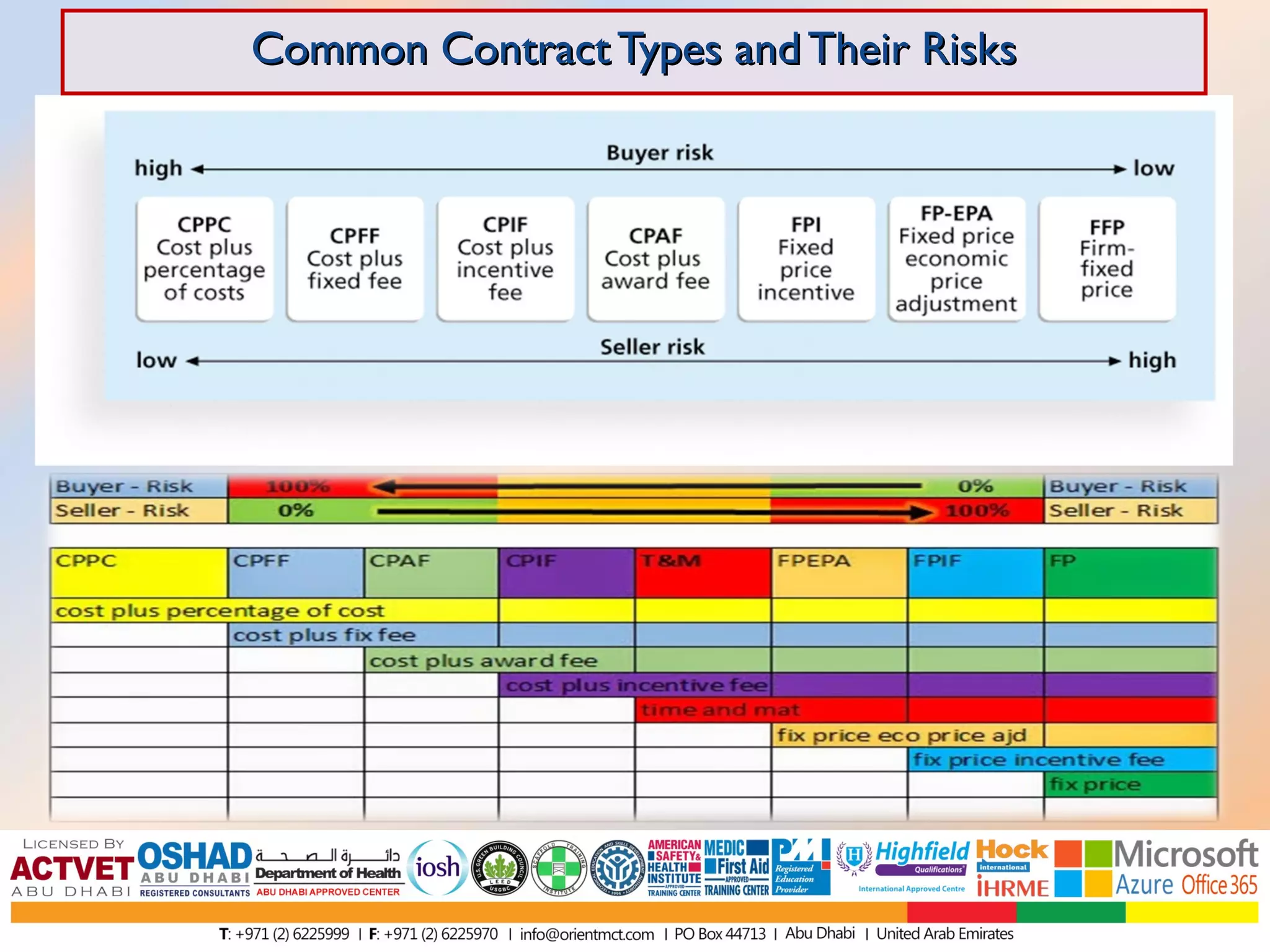
    Common Contract Typesand Their RisksCommon Contract Types and Their Risks
  • 7.