Chapter 15
Methods of
Compensation
15-1
Key Concepts
• Introduction to compensation agreements
• Contract cost risk appraisal
» Technical risk
» Contract schedule risk
• General types of contract compensation
agreements
» Fixed price contracts
» Incentive contracts
» Cost-type contracts
15-2
Key Concepts
• Specific types of compensation agreements
» Fixed price compensation arrangements:
– Firm fixed price contracts
– Fixed price with economic adjustment contracts
– Fixed price redetermination contracts
» Incentive arrangements
– Fixed price incentive
– Cost plus incentive fee arrangements
» Cost-type arrangements:
– Cost reimbursement
– Cost sharing
– Time and materials
– Cost plus fixed fee arrangements
– Cost plus award fee arrangements
– Cost without fee
• Considerations when selecting contract types
15-3
Introduction to Compensation Agreements
• The compensation arrangement
determines:
» Degree and timing of the cost responsibility
assumed by the supplier
» Amount of profit or fee available to the
supplier
» Motivational implications of the fee portion of
the compensation arrangements
15-4
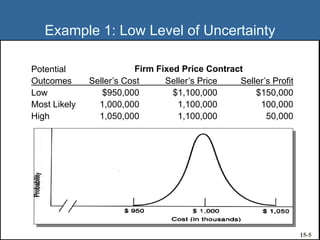
Example 1: Low Level of Uncertainty
Potential
Outcomes Seller’s Cost Seller’s Price Seller’s Profit
Low $950,000 $1,100,000 $150,000
Most Likely 1,000,000 1,100,000 100,000
High 1,050,000 1,100,000 50,000
Firm Fixed Price Contract
15-5
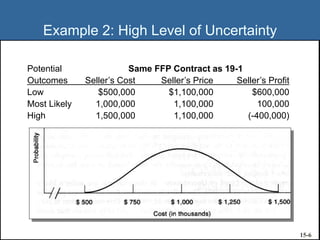
Example 2: High Level of Uncertainty
Potential
Outcomes Seller’s Cost Seller’s Price Seller’s Profit
Low $500,000 $1,100,000 $600,000
Most Likely 1,000,000 1,100,000 100,000
High 1,500,000 1,100,000 (-400,000)
Same FFP Contract as 19-1
15-6
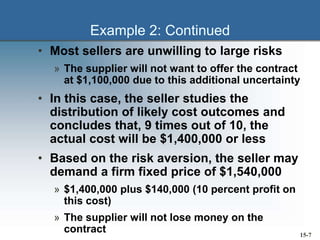
Example 2: Continued
• Most sellers are unwilling to large risks
» The supplier will not want to offer the contract
at $1,100,000 due to this additional uncertainty
• In this case, the seller studies the
distribution of likely cost outcomes and
concludes that, 9 times out of 10, the
actual cost will be $1,400,000 or less
• Based on the risk aversion, the seller may
demand a firm fixed price of $1,540,000
» $1,400,000 plus $140,000 (10 percent profit on
this cost)
» The supplier will not lose money on the
contract 15-7
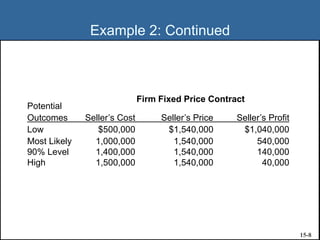
Example 2: Continued
Potential
Outcomes Seller’s Cost Seller’s Price Seller’s Profit
Low $500,000 $1,540,000 $1,040,000
Most Likely 1,000,000 1,540,000 540,000
90% Level 1,400,000 1,540,000 140,000
High 1,500,000 1,540,000 40,000
Firm Fixed Price Contract
15-8
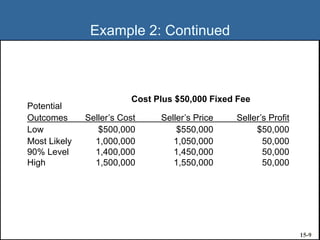
Example 2: Continued
Potential
Outcomes Seller’s Cost Seller’s Price Seller’s Profit
Low $500,000 $550,000 $50,000
Most Likely 1,000,000 1,050,000 50,000
90% Level 1,400,000 1,450,000 50,000
High 1,500,000 1,550,000 50,000
Cost Plus $50,000 Fixed Fee
15-9
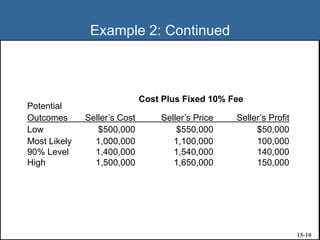
Example 2: Continued
Potential
Outcomes Seller’s Cost Seller’s Price Seller’s Profit
Low $500,000 $550,000 $50,000
Most Likely 1,000,000 1,100,000 100,000
90% Level 1,400,000 1,540,000 140,000
High 1,500,000 1,650,000 150,000
Cost Plus Fixed 10% Fee
15-10
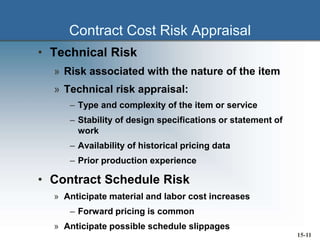
Contract Cost Risk Appraisal
• Technical Risk
» Risk associated with the nature of the item
» Technical risk appraisal:
– Type and complexity of the item or service
– Stability of design specifications or statement of
work
– Availability of historical pricing data
– Prior production experience
• Contract Schedule Risk
» Anticipate material and labor cost increases
– Forward pricing is common
» Anticipate possible schedule slippages
15-11
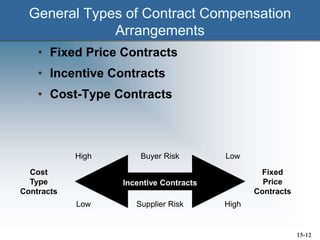
General Types of Contract Compensation
Arrangements
• Fixed Price Contracts
• Incentive Contracts
• Cost-Type Contracts
Buyer Risk
Supplier Risk
Low
High
High
Low
Fixed
Price
Contracts
Cost
Type
Contracts
Incentive Contracts
15-12
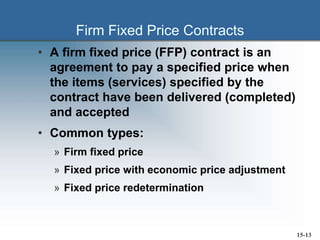
Firm Fixed Price Contracts
• A firm fixed price (FFP) contract is an
agreement to pay a specified price when
the items (services) specified by the
contract have been delivered (completed)
and accepted
• Common types:
» Firm fixed price
» Fixed price with economic price adjustment
» Fixed price redetermination
15-13
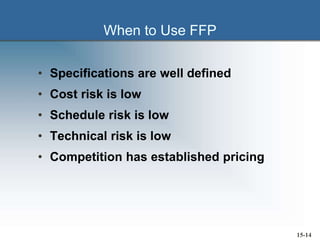
When to Use FFP
• Specifications are well defined
• Cost risk is low
• Schedule risk is low
• Technical risk is low
• Competition has established pricing
15-14
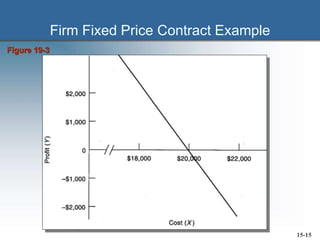
Firm Fixed Price Contract Example
Figure 19-3
15-15
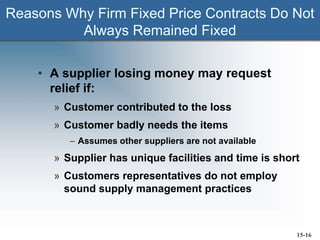
Reasons Why Firm Fixed Price Contracts Do Not
Always Remained Fixed
• A supplier losing money may request
relief if:
» Customer contributed to the loss
» Customer badly needs the items
– Assumes other suppliers are not available
» Supplier has unique facilities and time is short
» Customers representatives do not employ
sound supply management practices
15-16
Fixed Price and Economic
Price Adjustment Contracts (FPEPA)
• (FPEPA) contracts are used to recognize
economic contingencies, such as unstable
labor or market conditions
• FPEPA is an FFP contract that includes
economic price adjustment clauses
» Escalator clauses are for price increases
» De-escalator clauses are for price decreases
15-17
Rules for Selecting Indexes for Price Adjustment
Clauses
• Select from the appropriate Bureau of Labor
Statistics category
• Avoid broad indexes; use the lowest-level
classification
• Develop a weighted index for materials in a
product
• Select labor rate indexes by type and location
• Define energy indexes by fuel type and location
• Analyze the past history of each index versus
actual price change of the item being indexed
15-18
Fixed Price Redetermination Contracts (FPR)
• A FFP is set for an initial contract period
• A redetermination (upward or downward)
occurs at a stated time during the contract
• FPR prospective
» Occurs at a stated time during the contract
» Used where a fair and reasonable price can be
developed for initial periods but not subsequent periods
• FPR retroactive
» Occurs at the end of the contract
» Used when uncertainty exists as in the prospective, but
the amount of the contract is small and/or the
performance period is short
15-19
Incentive Arrangements
• Used to motivate the supplier to:
» Control costs
» Encourage good supplier performance
• Contract price will usually be higher
• Ceiling price is usually fixed during
negotiations
• Cost responsibility is shared
• Two primary types:
» Fixed price incentive
» Cost plus incentive fee
15-20
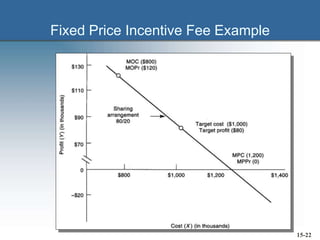
Elements of a Simplified Incentive Contract
• Target cost
» Cost outcome both buyer and supplier feel is
the most likely outcome
• Target profit
» Amount considered fair and reasonable
• Allocating costs above or below target
» Recognizes the target most likely will not be
met
» A sharing arrangement is agreed upon that
reflects the sharing of the cost responsibility
15-21
Fixed Price Incentive Fee Example
15-22
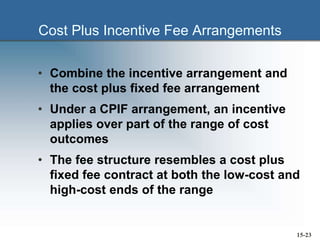
Cost Plus Incentive Fee Arrangements
• Combine the incentive arrangement and
the cost plus fixed fee arrangement
• Under a CPIF arrangement, an incentive
applies over part of the range of cost
outcomes
• The fee structure resembles a cost plus
fixed fee contract at both the low-cost and
high-cost ends of the range
15-23
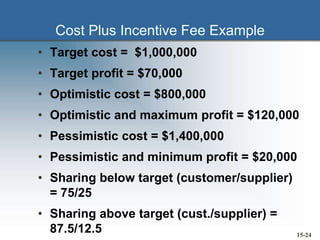
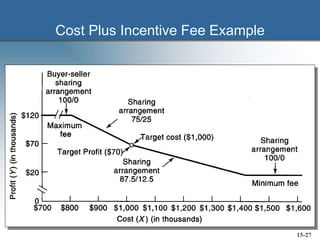
Cost Plus Incentive Fee Example
• Target cost = $1,000,000
• Target profit = $70,000
• Optimistic cost = $800,000
• Optimistic and maximum profit = $120,000
• Pessimistic cost = $1,400,000
• Pessimistic and minimum profit = $20,000
• Sharing below target (customer/supplier)
= 75/25
• Sharing above target (cust./supplier) =
87.5/12.5 15-24
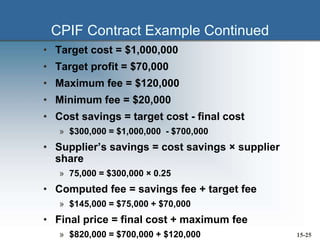
CPIF Contract Example Continued
• Target cost = $1,000,000
• Target profit = $70,000
• Maximum fee = $120,000
• Minimum fee = $20,000
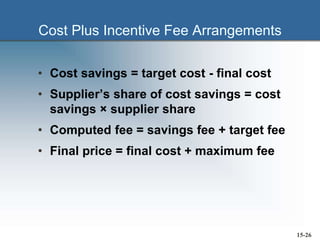
• Cost savings = target cost - final cost
» $300,000 = $1,000,000 - $700,000
• Supplier’s savings = cost savings × supplier
share
» 75,000 = $300,000 × 0.25
• Computed fee = savings fee + target fee
» $145,000 = $75,000 + $70,000
• Final price = final cost + maximum fee
» $820,000 = $700,000 + $120,000 15-25
Cost Plus Incentive Fee Arrangements
• Cost savings = target cost - final cost
• Supplier’s share of cost savings = cost
savings × supplier share
• Computed fee = savings fee + target fee
• Final price = final cost + maximum fee
15-26
Cost Plus Incentive Fee Example
15-27
Cost-type Arrangements
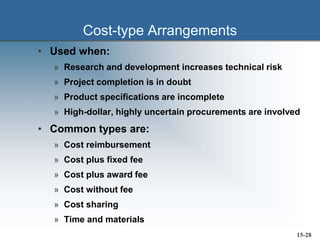
• Used when:
» Research and development increases technical risk
» Project completion is in doubt
» Product specifications are incomplete
» High-dollar, highly uncertain procurements are involved
• Common types are:
» Cost reimbursement
» Cost plus fixed fee
» Cost plus award fee
» Cost without fee
» Cost sharing
» Time and materials
15-28
Cost Plus Fixed Fee Arrangements (CPFF)
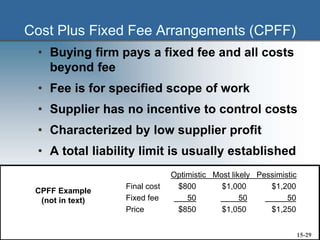
• Buying firm pays a fixed fee and all costs
beyond fee
• Fee is for specified scope of work
• Supplier has no incentive to control costs
• Characterized by low supplier profit
• A total liability limit is usually established
Optimistic Most likely Pessimistic
Final cost $800 $1,000 $1,200
Fixed fee 50 50 50
Price $850 $1,050 $1,250
CPFF Example
(not in text)
15-29
Cost Plus Award Fee (CPAF)
• The award fee is a pool of money
established by the buyer to reward the
supplier in meeting the buyer’s stated
needs
• Receipt of the fee is based on the buying
firm’s subjective evaluation
• CPAF works as a flexible tool
15-30
Cost Without Fee
• Used primarily by nonprofit institutions
• Used for research work without the
objective of making a profit
• Institutions recover all overhead costs
• In recent years, high-technology firms
have increased their use of this contract
type
15-31
Cost Sharing
• In some situations, a firm doing research
under a cost type of contract stands to
benefit if the product developed can be
used in its own product line
• Under such circumstances, the buyer and
the seller agree on what they consider to
be a fair basis to share the costs (most
often it is 50-50)
• The electronics industry has found this
type of contract especially useful
15-32
Considerations When Selecting Contract Types
• Unstable labor conditions
• Unstable market conditions
• Improvement in production is required
• Complexity of product or service
• Product or service requires development
• Design is not completed or may change
• Learning must take place
• Short time to prepare for a bid or negotiation
• Short delivery period
» Which may require additional resources to meet
deadlines
15-33
Concluding Remarks
• Sound application of the compensation
methods presented will significantly
reduce expenditures when cost risk is
present
• Compensation agreements must result in
a reasonable allocation of the cost risk
• Agreements should also provide adequate
motivation to the supplier to assure
effective performance
15-34

Chapter 15 Methods of Compensation

  • 1.
  • 2.
    Key Concepts • Introductionto compensation agreements • Contract cost risk appraisal » Technical risk » Contract schedule risk • General types of contract compensation agreements » Fixed price contracts » Incentive contracts » Cost-type contracts 15-2
  • 3.
    Key Concepts • Specifictypes of compensation agreements » Fixed price compensation arrangements: – Firm fixed price contracts – Fixed price with economic adjustment contracts – Fixed price redetermination contracts » Incentive arrangements – Fixed price incentive – Cost plus incentive fee arrangements » Cost-type arrangements: – Cost reimbursement – Cost sharing – Time and materials – Cost plus fixed fee arrangements – Cost plus award fee arrangements – Cost without fee • Considerations when selecting contract types 15-3
  • 4.
    Introduction to CompensationAgreements • The compensation arrangement determines: » Degree and timing of the cost responsibility assumed by the supplier » Amount of profit or fee available to the supplier » Motivational implications of the fee portion of the compensation arrangements 15-4
  • 5.
    Example 1: LowLevel of Uncertainty Potential Outcomes Seller’s Cost Seller’s Price Seller’s Profit Low $950,000 $1,100,000 $150,000 Most Likely 1,000,000 1,100,000 100,000 High 1,050,000 1,100,000 50,000 Firm Fixed Price Contract 15-5
  • 6.
    Example 2: HighLevel of Uncertainty Potential Outcomes Seller’s Cost Seller’s Price Seller’s Profit Low $500,000 $1,100,000 $600,000 Most Likely 1,000,000 1,100,000 100,000 High 1,500,000 1,100,000 (-400,000) Same FFP Contract as 19-1 15-6
  • 7.
    Example 2: Continued •Most sellers are unwilling to large risks » The supplier will not want to offer the contract at $1,100,000 due to this additional uncertainty • In this case, the seller studies the distribution of likely cost outcomes and concludes that, 9 times out of 10, the actual cost will be $1,400,000 or less • Based on the risk aversion, the seller may demand a firm fixed price of $1,540,000 » $1,400,000 plus $140,000 (10 percent profit on this cost) » The supplier will not lose money on the contract 15-7
  • 8.
    Example 2: Continued Potential OutcomesSeller’s Cost Seller’s Price Seller’s Profit Low $500,000 $1,540,000 $1,040,000 Most Likely 1,000,000 1,540,000 540,000 90% Level 1,400,000 1,540,000 140,000 High 1,500,000 1,540,000 40,000 Firm Fixed Price Contract 15-8
  • 9.
    Example 2: Continued Potential OutcomesSeller’s Cost Seller’s Price Seller’s Profit Low $500,000 $550,000 $50,000 Most Likely 1,000,000 1,050,000 50,000 90% Level 1,400,000 1,450,000 50,000 High 1,500,000 1,550,000 50,000 Cost Plus $50,000 Fixed Fee 15-9
  • 10.
    Example 2: Continued Potential OutcomesSeller’s Cost Seller’s Price Seller’s Profit Low $500,000 $550,000 $50,000 Most Likely 1,000,000 1,100,000 100,000 90% Level 1,400,000 1,540,000 140,000 High 1,500,000 1,650,000 150,000 Cost Plus Fixed 10% Fee 15-10
  • 11.
    Contract Cost RiskAppraisal • Technical Risk » Risk associated with the nature of the item » Technical risk appraisal: – Type and complexity of the item or service – Stability of design specifications or statement of work – Availability of historical pricing data – Prior production experience • Contract Schedule Risk » Anticipate material and labor cost increases – Forward pricing is common » Anticipate possible schedule slippages 15-11
  • 12.
    General Types ofContract Compensation Arrangements • Fixed Price Contracts • Incentive Contracts • Cost-Type Contracts Buyer Risk Supplier Risk Low High High Low Fixed Price Contracts Cost Type Contracts Incentive Contracts 15-12
  • 13.
    Firm Fixed PriceContracts • A firm fixed price (FFP) contract is an agreement to pay a specified price when the items (services) specified by the contract have been delivered (completed) and accepted • Common types: » Firm fixed price » Fixed price with economic price adjustment » Fixed price redetermination 15-13
  • 14.
    When to UseFFP • Specifications are well defined • Cost risk is low • Schedule risk is low • Technical risk is low • Competition has established pricing 15-14
  • 15.
    Firm Fixed PriceContract Example Figure 19-3 15-15
  • 16.
    Reasons Why FirmFixed Price Contracts Do Not Always Remained Fixed • A supplier losing money may request relief if: » Customer contributed to the loss » Customer badly needs the items – Assumes other suppliers are not available » Supplier has unique facilities and time is short » Customers representatives do not employ sound supply management practices 15-16
  • 17.
    Fixed Price andEconomic Price Adjustment Contracts (FPEPA) • (FPEPA) contracts are used to recognize economic contingencies, such as unstable labor or market conditions • FPEPA is an FFP contract that includes economic price adjustment clauses » Escalator clauses are for price increases » De-escalator clauses are for price decreases 15-17
  • 18.
    Rules for SelectingIndexes for Price Adjustment Clauses • Select from the appropriate Bureau of Labor Statistics category • Avoid broad indexes; use the lowest-level classification • Develop a weighted index for materials in a product • Select labor rate indexes by type and location • Define energy indexes by fuel type and location • Analyze the past history of each index versus actual price change of the item being indexed 15-18
  • 19.
    Fixed Price RedeterminationContracts (FPR) • A FFP is set for an initial contract period • A redetermination (upward or downward) occurs at a stated time during the contract • FPR prospective » Occurs at a stated time during the contract » Used where a fair and reasonable price can be developed for initial periods but not subsequent periods • FPR retroactive » Occurs at the end of the contract » Used when uncertainty exists as in the prospective, but the amount of the contract is small and/or the performance period is short 15-19
  • 20.
    Incentive Arrangements • Usedto motivate the supplier to: » Control costs » Encourage good supplier performance • Contract price will usually be higher • Ceiling price is usually fixed during negotiations • Cost responsibility is shared • Two primary types: » Fixed price incentive » Cost plus incentive fee 15-20
  • 21.
    Elements of aSimplified Incentive Contract • Target cost » Cost outcome both buyer and supplier feel is the most likely outcome • Target profit » Amount considered fair and reasonable • Allocating costs above or below target » Recognizes the target most likely will not be met » A sharing arrangement is agreed upon that reflects the sharing of the cost responsibility 15-21
  • 22.
    Fixed Price IncentiveFee Example 15-22
  • 23.
    Cost Plus IncentiveFee Arrangements • Combine the incentive arrangement and the cost plus fixed fee arrangement • Under a CPIF arrangement, an incentive applies over part of the range of cost outcomes • The fee structure resembles a cost plus fixed fee contract at both the low-cost and high-cost ends of the range 15-23
  • 24.
    Cost Plus IncentiveFee Example • Target cost = $1,000,000 • Target profit = $70,000 • Optimistic cost = $800,000 • Optimistic and maximum profit = $120,000 • Pessimistic cost = $1,400,000 • Pessimistic and minimum profit = $20,000 • Sharing below target (customer/supplier) = 75/25 • Sharing above target (cust./supplier) = 87.5/12.5 15-24
  • 25.
    CPIF Contract ExampleContinued • Target cost = $1,000,000 • Target profit = $70,000 • Maximum fee = $120,000 • Minimum fee = $20,000 • Cost savings = target cost - final cost » $300,000 = $1,000,000 - $700,000 • Supplier’s savings = cost savings × supplier share » 75,000 = $300,000 × 0.25 • Computed fee = savings fee + target fee » $145,000 = $75,000 + $70,000 • Final price = final cost + maximum fee » $820,000 = $700,000 + $120,000 15-25
  • 26.
    Cost Plus IncentiveFee Arrangements • Cost savings = target cost - final cost • Supplier’s share of cost savings = cost savings × supplier share • Computed fee = savings fee + target fee • Final price = final cost + maximum fee 15-26
  • 27.
    Cost Plus IncentiveFee Example 15-27
  • 28.
    Cost-type Arrangements • Usedwhen: » Research and development increases technical risk » Project completion is in doubt » Product specifications are incomplete » High-dollar, highly uncertain procurements are involved • Common types are: » Cost reimbursement » Cost plus fixed fee » Cost plus award fee » Cost without fee » Cost sharing » Time and materials 15-28
  • 29.
    Cost Plus FixedFee Arrangements (CPFF) • Buying firm pays a fixed fee and all costs beyond fee • Fee is for specified scope of work • Supplier has no incentive to control costs • Characterized by low supplier profit • A total liability limit is usually established Optimistic Most likely Pessimistic Final cost $800 $1,000 $1,200 Fixed fee 50 50 50 Price $850 $1,050 $1,250 CPFF Example (not in text) 15-29
  • 30.
    Cost Plus AwardFee (CPAF) • The award fee is a pool of money established by the buyer to reward the supplier in meeting the buyer’s stated needs • Receipt of the fee is based on the buying firm’s subjective evaluation • CPAF works as a flexible tool 15-30
  • 31.
    Cost Without Fee •Used primarily by nonprofit institutions • Used for research work without the objective of making a profit • Institutions recover all overhead costs • In recent years, high-technology firms have increased their use of this contract type 15-31
  • 32.
    Cost Sharing • Insome situations, a firm doing research under a cost type of contract stands to benefit if the product developed can be used in its own product line • Under such circumstances, the buyer and the seller agree on what they consider to be a fair basis to share the costs (most often it is 50-50) • The electronics industry has found this type of contract especially useful 15-32
  • 33.
    Considerations When SelectingContract Types • Unstable labor conditions • Unstable market conditions • Improvement in production is required • Complexity of product or service • Product or service requires development • Design is not completed or may change • Learning must take place • Short time to prepare for a bid or negotiation • Short delivery period » Which may require additional resources to meet deadlines 15-33
  • 34.
    Concluding Remarks • Soundapplication of the compensation methods presented will significantly reduce expenditures when cost risk is present • Compensation agreements must result in a reasonable allocation of the cost risk • Agreements should also provide adequate motivation to the supplier to assure effective performance 15-34