Contract Types
Introduction
• Although there are many contract types available to projects, most private companies and most
Government agencies typically elect to use only one contract type: the firm-fixed-price (FFP)
contract.
• The reason for this apparent disparity is the feeling of security that comes to management with
the use of FFP contacts, because;
1. you know exactly what you want to buy,
2. you can describe it in precise detail, and
3. you are not apt to later change your requirements.
• However, if you are uncertain about the requirements for a given procurement, and or, you need
flexibility due to project uncertainty, the FFP contract can be overly restrictive.
• The choice of contract type is a critical issue for both the buyer and seller. It is something which
should build on the consideration of many factors, more important issues to consider would
include the;
1. life cycle of the project,
2. the known risks facing the project,
3. Technology challenges, and of course,
4. the ability of the project to describe what it wants to buy, without later changing these requirements
Major Types
• The full spectrum of contract types runs from fixed-price, to cost
reimbursable, with an intermediate hybrid contract type called the
time and materials contracts.
• Each contract type has its advantages and its disadvantages.
• Also, in many cases the project may elect to use multiple contract
forms in a single relationship.
Fixed price contract
• Fixed-price contracts are agreements between a buyer and a seller
where the seller agrees to provide goods or services at a
predetermined price. In these contracts, the price is fixed regardless
of the actual costs incurred by the seller during the project. Fixed-
price contracts are commonly used in various industries, including
construction, consulting, software development, and manufacturing.
• There are several types of fixed-price contracts, including:
1. Firm Fixed-Price (FFP):
• In this type of contract, the price is set and remains fixed
throughout the duration of the contract, regardless of
any changes in the cost of labor, materials, or other
expenses. The seller bears the risk of cost overruns.
• A Firm Fixed-Price (FFP) contract is a type of
procurement contract where the buyer agrees to pay a
predetermined, fixed price to the seller for the goods or
services provided, regardless of the actual costs incurred
by the seller. In an FFP contract, the seller bears the risk
of any cost overruns or unforeseen expenses that may
arise during the performance of the contract.
• Key features of a Firm Fixed-Price contract include:
• Fixed Price: The contract specifies a set price for the
goods or services to be delivered. This price is agreed
upon by both parties before the start of the contract and
remains unchanged, regardless of any fluctuations in
costs or market conditions.
• Scope of Work: The contract clearly defines the scope of
work, outlining the specific deliverables, requirements,
and timelines agreed upon by both parties.
• Risk Allocation: The seller assumes the risk of cost
overruns, delays, or other performance issues. Once the
contract is signed, the seller is obligated to deliver the
goods or services at the agreed-upon price, regardless of
any unforeseen circumstances that may arise.
• Incentives for Efficiency: Since the seller bears the risk
of cost overruns, there is an inherent incentive for the
seller to complete the project efficiently and within
budget.
• Change Management: Any changes to the scope of work
or specifications outlined in the contract may require a
formal change order, with adjustments made to the
contract price and schedule as necessary.
Firm Fixed-Price contracts are commonly used in situations
where the scope of work is well-defined, and there is little
uncertainty regarding the costs and requirements of the
project. They provide both the buyer and seller with a
clear understanding of their respective obligations and
responsibilities, helping to minimize disputes and
uncertainties during contract performance.
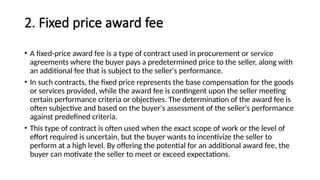
2. Fixed price award fee
• A fixed-price award fee is a type of contract used in procurement or service
agreements where the buyer pays a predetermined price to the seller, along with
an additional fee that is subject to the seller's performance.
• In such contracts, the fixed price represents the base compensation for the goods
or services provided, while the award fee is contingent upon the seller meeting
certain performance criteria or objectives. The determination of the award fee is
often subjective and based on the buyer's assessment of the seller's performance
against predefined criteria.
• This type of contract is often used when the exact scope of work or the level of
effort required is uncertain, but the buyer wants to incentivize the seller to
perform at a high level. By offering the potential for an additional award fee, the
buyer can motivate the seller to meet or exceed expectations.
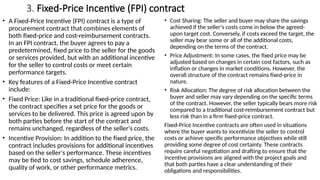
3. Fixed-Price Incentive (FPI) contract
• A Fixed-Price Incentive (FPI) contract is a type of
procurement contract that combines elements of
both fixed-price and cost-reimbursement contracts.
In an FPI contract, the buyer agrees to pay a
predetermined, fixed price to the seller for the goods
or services provided, but with an additional incentive
for the seller to control costs or meet certain
performance targets.
• Key features of a Fixed-Price Incentive contract
include:
• Fixed Price: Like in a traditional fixed-price contract,
the contract specifies a set price for the goods or
services to be delivered. This price is agreed upon by
both parties before the start of the contract and
remains unchanged, regardless of the seller's costs.
• Incentive Provision: In addition to the fixed price, the
contract includes provisions for additional incentives
based on the seller's performance. These incentives
may be tied to cost savings, schedule adherence,
quality of work, or other performance metrics.
• Cost Sharing: The seller and buyer may share the savings
achieved if the seller's costs come in below the agreed-
upon target cost. Conversely, if costs exceed the target, the
seller may bear some or all of the additional costs,
depending on the terms of the contract.
• Price Adjustment: In some cases, the fixed price may be
adjusted based on changes in certain cost factors, such as
inflation or changes in market conditions. However, the
overall structure of the contract remains fixed-price in
nature.
• Risk Allocation: The degree of risk allocation between the
buyer and seller may vary depending on the specific terms
of the contract. However, the seller typically bears more risk
compared to a traditional cost-reimbursement contract but
less risk than in a firm fixed-price contract.
Fixed-Price Incentive contracts are often used in situations
where the buyer wants to incentivize the seller to control
costs or achieve specific performance objectives while still
providing some degree of cost certainty. These contracts
require careful negotiation and drafting to ensure that the
incentive provisions are aligned with the project goals and
that both parties have a clear understanding of their
obligations and responsibilities.
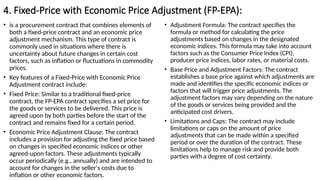
4. Fixed-Price with Economic Price Adjustment (FP-EPA):
• is a procurement contract that combines elements of
both a fixed-price contract and an economic price
adjustment mechanism. This type of contract is
commonly used in situations where there is
uncertainty about future changes in certain cost
factors, such as inflation or fluctuations in commodity
prices.
• Key features of a Fixed-Price with Economic Price
Adjustment contract include:
• Fixed Price: Similar to a traditional fixed-price
contract, the FP-EPA contract specifies a set price for
the goods or services to be delivered. This price is
agreed upon by both parties before the start of the
contract and remains fixed for a certain period.
• Economic Price Adjustment Clause: The contract
includes a provision for adjusting the fixed price based
on changes in specified economic indices or other
agreed-upon factors. These adjustments typically
occur periodically (e.g., annually) and are intended to
account for changes in the seller's costs due to
inflation or other economic factors.
• Adjustment Formula: The contract specifies the
formula or method for calculating the price
adjustments based on changes in the designated
economic indices. This formula may take into account
factors such as the Consumer Price Index (CPI),
producer price indices, labor rates, or material costs.
• Base Price and Adjustment Factors: The contract
establishes a base price against which adjustments are
made and identifies the specific economic indices or
factors that will trigger price adjustments. The
adjustment factors may vary depending on the nature
of the goods or services being provided and the
anticipated cost drivers.
• Limitations and Caps: The contract may include
limitations or caps on the amount of price
adjustments that can be made within a specified
period or over the duration of the contract. These
limitations help to manage risk and provide both
parties with a degree of cost certainty.
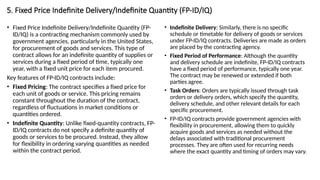
5. Fixed Price Indefinite Delivery/Indefinite Quantity (FP-ID/IQ)
• Fixed Price Indefinite Delivery/Indefinite Quantity (FP-
ID/IQ) is a contracting mechanism commonly used by
government agencies, particularly in the United States,
for procurement of goods and services. This type of
contract allows for an indefinite quantity of supplies or
services during a fixed period of time, typically one
year, with a fixed unit price for each item procured.
Key features of FP-ID/IQ contracts include:
• Fixed Pricing: The contract specifies a fixed price for
each unit of goods or service. This pricing remains
constant throughout the duration of the contract,
regardless of fluctuations in market conditions or
quantities ordered.
• Indefinite Quantity: Unlike fixed-quantity contracts, FP-
ID/IQ contracts do not specify a definite quantity of
goods or services to be procured. Instead, they allow
for flexibility in ordering varying quantities as needed
within the contract period.
• Indefinite Delivery: Similarly, there is no specific
schedule or timetable for delivery of goods or services
under FP-ID/IQ contracts. Deliveries are made as orders
are placed by the contracting agency.
• Fixed Period of Performance: Although the quantity
and delivery schedule are indefinite, FP-ID/IQ contracts
have a fixed period of performance, typically one year.
The contract may be renewed or extended if both
parties agree.
• Task Orders: Orders are typically issued through task
orders or delivery orders, which specify the quantity,
delivery schedule, and other relevant details for each
specific procurement.
• FP-ID/IQ contracts provide government agencies with
flexibility in procurement, allowing them to quickly
acquire goods and services as needed without the
delays associated with traditional procurement
processes. They are often used for recurring needs
where the exact quantity and timing of orders may vary.
Cost-Reimbursement Contracts
• Cost-reimbursement contracts are agreements between a buyer and a
seller where the seller is reimbursed for all allowable costs incurred
during the performance of the contract. Unlike fixed-price contracts
where the price is predetermined, cost-reimbursement contracts
involve payment of actual costs incurred by the seller, along with
additional compensation, such as profit or fee. These contracts are
often used when the scope of work is uncertain or highly complex,
making it difficult to determine a fixed price upfront.
• There are several types of cost-reimbursement contracts:
1. Cost Plus Fixed Fee (CPFF):
• Cost Plus Fixed Fee (CPFF) is a type of contract used in
procurement, particularly in government contracting and
sometimes in private sector contracts as well. In a CPFF
contract, the contractor is reimbursed for all allowable
costs incurred during the performance of the contract. In
addition to the reimbursement of costs, the contractor
receives a fixed fee, which is predetermined and
negotiated as part of the contract.
• Key features of CPFF contracts include:
• Reimbursement of Costs: The contractor is reimbursed
for all allowable costs incurred during the performance of
the contract. Allowable costs are typically defined in the
contract and must be reasonable, allocable, and
allowable under the applicable regulations and
guidelines.
• Fixed Fee: In addition to the reimbursement of costs, the
contractor receives a fixed fee, which is predetermined
and negotiated as part of the contract. This fixed fee
provides the contractor with a profit margin and is
intended to cover overhead, general and administrative
expenses, and profit.
• Cost Sharing: While the contractor is reimbursed for all
allowable costs, there may be provisions in the contract for cost-
sharing, where the contractor is responsible for covering a
portion of the costs. This encourages the contractor to manage
costs effectively and efficiently.
• Risk Allocation: CPFF contracts allocate certain risks between
the contractor and the contracting agency. Since the contractor
is reimbursed for all allowable costs, the contracting agency
bears the risk of cost overruns. However, the fixed fee provides
the contractor with some level of protection against fluctuations
in costs.
• Performance Incentives: CPFF contracts may include
performance incentives to encourage the contractor to meet or
exceed performance targets, such as cost, schedule, or quality
requirements. These incentives can take various forms, such as
bonuses for early completion or penalties for late delivery.
CPFF contracts are often used for projects where the scope,
schedule, or requirements are uncertain, making it difficult to
establish a fixed price at the outset. They provide flexibility for
both the contractor and the contracting agency, but also require
careful monitoring and oversight to ensure that costs are
reasonable and that the contractor is fulfilling its obligations under
the contract.
2. Cost Plus Incentive Fee (CPIF)
In this contract type, the buyer agrees to reimburse
the seller for all allowable costs incurred in
performing the contract work. Additionally, the seller
receives a predetermined fee, which is structured to
provide an incentive for the seller to meet or exceed
certain performance targets.
The fee structure in a CPIF contract typically includes a
target cost, a ceiling cost, and a fee. Here's a
breakdown of these components:
• Target Cost: This is the estimated total cost of
performing the work. It serves as a baseline for cost
control and performance evaluation. The seller's
reimbursement is based on actual costs incurred,
but it cannot exceed the target cost.
• Ceiling Cost: This is the maximum allowable cost
that the buyer will reimburse. If the actual costs
exceed the ceiling cost, the seller is responsible for
covering the overruns. The ceiling cost provides a
cap on the buyer's financial liability.
• Fee: The fee is the incentive portion of the contract. It is
a predetermined amount that the seller will receive in
addition to reimbursement for costs. The fee is typically
structured such that the seller receives additional
compensation if certain performance targets are met or
exceeded. Conversely, if the actual costs exceed the
target cost, the fee may be reduced or eliminated.
The incentive structure of a CPIF contract encourages the
seller to control costs and deliver the project efficiently. If
the seller completes the work under budget or ahead of
schedule, they stand to earn a higher fee, thus providing
motivation for cost savings and performance
improvement. However, if the seller fails to meet the
performance targets or exceeds the ceiling cost, it may
result in reduced or no additional fee.
CPIF contracts are commonly used in situations where the
scope of work is uncertain or where the buyer wants to
incentivize the seller to achieve specific performance goals
while maintaining cost control. They provide a balance of
risk and reward for both parties involved in the contract.
3. Cost Plus Award Fee (CPAF)
• It is another type of contract used in procurement and
project management. Similar to the Cost Plus Incentive Fee
(CPIF) contract, it involves the reimbursement of allowable
costs incurred by the seller, along with an additional fee.
However, in a CPAF contract, the fee is not predetermined
but is instead determined at the discretion of the buyer
based on the seller's performance.
• Here's how a CPAF contract typically works:
• Allowable Costs: The buyer agrees to reimburse the seller
for all allowable costs incurred in performing the contract
work. These costs may include labor, materials, overhead,
and other expenses directly related to the project.
• Award Fee Pool: Instead of a predetermined fee, the buyer
establishes an award fee pool. This pool of funds is set
aside to provide additional compensation to the seller
based on their performance.
• Performance Evaluation: Throughout the duration of the
contract, the buyer evaluates the seller's performance
against predetermined criteria or performance metrics.
These criteria may include factors such as quality,
timeliness, innovation, and cooperation.
• Award Fee Determination: At specified intervals, typically at the end
of performance periods (e.g., months or quarters), the buyer
assesses the seller's performance and determines the award fee to
be paid. The determination of the award fee is based on the buyer's
subjective evaluation of the seller's performance against the
established criteria.
• Award Fee Payment: Based on the evaluation, the buyer may award
a portion of the award fee pool to the seller. The amount awarded is
intended to incentivize exceptional performance and encourage the
seller to exceed the minimum requirements of the contract.
• Feedback and Improvement: The award fee process provides
feedback to the seller, highlighting areas of strength and areas
needing improvement. This feedback loop can help foster
continuous improvement and collaboration between the buyer and
the seller.
CPAF contracts are often used when the buyer seeks to incentivize
superior performance or when the project involves significant
complexity or innovation. By tying a portion of the seller's
compensation to their performance, CPAF contracts aim to promote
accountability, excellence, and alignment of interests between the
parties involved. However, the subjective nature of award fee
determinations can sometimes lead to disagreements or disputes
between the buyer and the seller. Therefore, it's essential for both
parties to have a clear understanding of the evaluation criteria and
expectations outlined in the contract.
4. Cost Sharing Contracts
• Cost sharing contracts, also known as cost-sharing agreements
or cost-sharing contracts, are agreements between two or
more parties in which they agree to share the costs associated
with a particular project, program, or initiative. These
contracts are common in various sectors, including research
and development, government funding, joint ventures, and
public-private partnerships. Here are some key characteristics
and examples of cost sharing contracts:
• Purpose: Cost sharing contracts are typically established to
distribute the financial burden of a project or program among
multiple stakeholders. By sharing costs, parties can leverage
their resources more effectively and achieve common
objectives.
• Types of Contributions:
• Financial Contributions: Parties may contribute funds or
monetary resources to cover a portion of the project costs.
These contributions can come in the form of cash, grants,
loans, or other financial instruments.
• In-Kind Contributions: Parties may also provide non-monetary
resources, such as equipment, facilities, personnel, expertise,
or services, to support the project. These contributions are
valued based on their fair market value and are considered as
part of the overall cost sharing arrangement.
• Parties Involved: Cost sharing contracts typically
involve multiple parties, including government
agencies, private companies, non-profit
organizations, research institutions, universities,
and other entities with a vested interest in the
project's outcomes.
• Legal Framework: Cost sharing contracts are
legally binding agreements that outline the terms
and conditions of the cost-sharing arrangement.
These agreements specify each party's
obligations, contributions, responsibilities, rights,
and any conditions or requirements associated
with the project.
• Overall, cost sharing contracts play a crucial role in
facilitating collaboration, resource allocation, and
risk management among multiple parties involved
in complex projects or programs. They help
distribute costs equitably and encourage
stakeholders to work together towards common
goals.
General examples of Cost Sharing Contracts
• Research Grants: In academia and scientific research, funding agencies often require
cost sharing from the recipient institutions as a condition of the grant award.
Universities and research institutions may contribute a portion of the project costs
through cash or in-kind contributions to support the research efforts.
• Public-Private Partnerships (PPPs): In infrastructure development projects,
governments may enter into cost sharing contracts with private companies to fund
and build public infrastructure such as roads, bridges, airports, and utilities. Both
parties share the costs and risks associated with the project, with the aim of delivering
public services efficiently.
• Joint Ventures: Companies may form joint ventures to collaborate on projects or
initiatives that require shared resources and expertise. Cost sharing contracts among
joint venture partners outline the financial and operational arrangements for the joint
venture activities.
5. Cost Plus a Percentage of Costs Fee (CPPCF)
• Cost Plus a Percentage of Costs Fee (CPPCF) is a type of
contract arrangement commonly used in procurement
and project management. In a CPPCF contract, the
buyer agrees to reimburse the seller for all allowable
costs incurred in performing the contract work, and
the seller receives an additional fee based on a
predetermined percentage of the total allowable costs.
• Here's a breakdown of how a CPPCF contract typically
operates:
• Allowable Costs: The buyer agrees to reimburse the
seller for all allowable costs incurred in the execution
of the contract. Allowable costs may include labor,
materials, equipment, overhead, and other direct
expenses directly related to the project.
• Percentage Fee: In addition to reimbursing allowable
costs, the buyer agrees to pay the seller an additional
fee based on a predetermined percentage of the total
allowable costs. This percentage fee is agreed upon
during contract negotiation and is typically expressed
as a fixed percentage of the total costs.
• Calculation of Fee: The fee payable to the seller is calculated by
multiplying the total allowable costs by the predetermined
percentage fee. For example, if the total allowable costs for the
project amount to $100,000 and the agreed-upon percentage fee
is 10%, the fee payable to the seller would be $10,000 (10% of
$100,000).
• Reimbursement and Payment: Throughout the duration of the
project, the seller submits invoices or requests for reimbursement
to the buyer for the allowable costs incurred. Upon verification of
the costs, the buyer reimburses the seller for these costs and pays
the additional fee based on the predetermined percentage.
• Transparency and Oversight: To ensure transparency and
accountability, CPPCF contracts often include provisions for
auditing and oversight. Both parties may have the right to audit
the financial records and documentation related to the project to
verify the accuracy of the costs incurred and the calculation of the
fee.
• CPPCF contracts provide the seller with a degree of certainty
regarding their compensation, as the fee is directly tied to the
costs incurred. However, they also present some risks for the
buyer, as the fee increases proportionally with the costs,
potentially incentivizing the seller to inflate costs. Therefore, it's
essential for both parties to negotiate the percentage fee carefully
and to establish mechanisms for cost control and oversight to
mitigate potential risks.
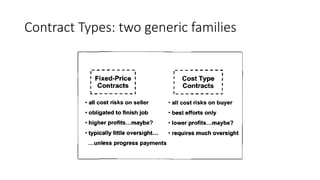
Contract Types: two generic families
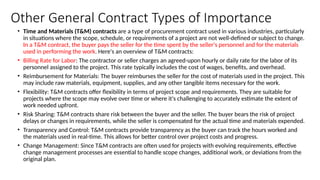
Other General Contract Types of Importance
• Time and Materials (T&M) contracts are a type of procurement contract used in various industries, particularly
in situations where the scope, schedule, or requirements of a project are not well-defined or subject to change.
In a T&M contract, the buyer pays the seller for the time spent by the seller's personnel and for the materials
used in performing the work. Here's an overview of T&M contracts:
• Billing Rate for Labor: The contractor or seller charges an agreed-upon hourly or daily rate for the labor of its
personnel assigned to the project. This rate typically includes the cost of wages, benefits, and overhead.
• Reimbursement for Materials: The buyer reimburses the seller for the cost of materials used in the project. This
may include raw materials, equipment, supplies, and any other tangible items necessary for the work.
• Flexibility: T&M contracts offer flexibility in terms of project scope and requirements. They are suitable for
projects where the scope may evolve over time or where it's challenging to accurately estimate the extent of
work needed upfront.
• Risk Sharing: T&M contracts share risk between the buyer and the seller. The buyer bears the risk of project
delays or changes in requirements, while the seller is compensated for the actual time and materials expended.
• Transparency and Control: T&M contracts provide transparency as the buyer can track the hours worked and
the materials used in real-time. This allows for better control over project costs and progress.
• Change Management: Since T&M contracts are often used for projects with evolving requirements, effective
change management processes are essential to handle scope changes, additional work, or deviations from the
original plan.
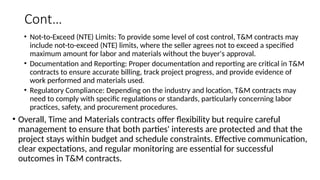
Cont…
• Not-to-Exceed (NTE) Limits: To provide some level of cost control, T&M contracts may
include not-to-exceed (NTE) limits, where the seller agrees not to exceed a specified
maximum amount for labor and materials without the buyer's approval.
• Documentation and Reporting: Proper documentation and reporting are critical in T&M
contracts to ensure accurate billing, track project progress, and provide evidence of
work performed and materials used.
• Regulatory Compliance: Depending on the industry and location, T&M contracts may
need to comply with specific regulations or standards, particularly concerning labor
practices, safety, and procurement procedures.
• Overall, Time and Materials contracts offer flexibility but require careful
management to ensure that both parties' interests are protected and that the
project stays within budget and schedule constraints. Effective communication,
clear expectations, and regular monitoring are essential for successful
outcomes in T&M contracts.
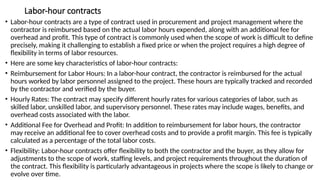
Labor-hour contracts
• Labor-hour contracts are a type of contract used in procurement and project management where the
contractor is reimbursed based on the actual labor hours expended, along with an additional fee for
overhead and profit. This type of contract is commonly used when the scope of work is difficult to define
precisely, making it challenging to establish a fixed price or when the project requires a high degree of
flexibility in terms of labor resources.
• Here are some key characteristics of labor-hour contracts:
• Reimbursement for Labor Hours: In a labor-hour contract, the contractor is reimbursed for the actual
hours worked by labor personnel assigned to the project. These hours are typically tracked and recorded
by the contractor and verified by the buyer.
• Hourly Rates: The contract may specify different hourly rates for various categories of labor, such as
skilled labor, unskilled labor, and supervisory personnel. These rates may include wages, benefits, and
overhead costs associated with the labor.
• Additional Fee for Overhead and Profit: In addition to reimbursement for labor hours, the contractor
may receive an additional fee to cover overhead costs and to provide a profit margin. This fee is typically
calculated as a percentage of the total labor costs.
• Flexibility: Labor-hour contracts offer flexibility to both the contractor and the buyer, as they allow for
adjustments to the scope of work, staffing levels, and project requirements throughout the duration of
the contract. This flexibility is particularly advantageous in projects where the scope is likely to change or
evolve over time.
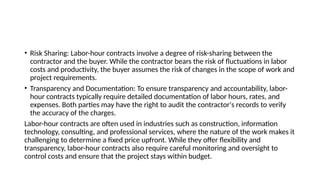
• Risk Sharing: Labor-hour contracts involve a degree of risk-sharing between the
contractor and the buyer. While the contractor bears the risk of fluctuations in labor
costs and productivity, the buyer assumes the risk of changes in the scope of work and
project requirements.
• Transparency and Documentation: To ensure transparency and accountability, labor-
hour contracts typically require detailed documentation of labor hours, rates, and
expenses. Both parties may have the right to audit the contractor's records to verify
the accuracy of the charges.
Labor-hour contracts are often used in industries such as construction, information
technology, consulting, and professional services, where the nature of the work makes it
challenging to determine a fixed price upfront. While they offer flexibility and
transparency, labor-hour contracts also require careful monitoring and oversight to
control costs and ensure that the project stays within budget.
Letter Contracts:
• A letter contract, also known as a letter of intent or a preliminary agreement, is a type of contract used in
procurement and business transactions. It serves as a temporary arrangement between two parties to
authorize the commencement of work or the provision of goods or services before a formal contract is
finalized. Letter contracts are commonly used in situations where it is necessary to expedite the start of
work or to provide interim authorization while negotiating the terms of a formal contract.
• Here are some key characteristics of letter contracts:
• Interim Authorization: A letter contract provides interim authorization for the contractor to begin work or
provide goods or services before a formal contract is executed. It allows the parties to initiate the project
or transaction promptly, without waiting for the completion of the entire contracting process.
• Temporary Nature: Letter contracts are temporary agreements that are intended to be replaced by a
formal contract once the terms and conditions have been fully negotiated and agreed upon by both
parties. They typically have a limited duration and are subject to specific terms and conditions outlined in
the letter.
• Basic Terms: While letter contracts are less formal than traditional contracts, they typically include
essential terms and conditions such as the scope of work, pricing, delivery schedule, and any other key
terms necessary to initiate the project or transaction.
• Negotiation of Formal Contract: After the letter contract is issued and work begins, the parties continue
to negotiate the terms of the formal contract. Once the negotiations are complete, the parties execute
the formal contract, which supersedes the letter contract.
• Risks and Limitations: Letter contracts carry certain risks and limitations for both
parties. Since the terms and conditions are not fully defined at the outset, there is a
risk of misunderstandings or disputes arising during the course of the work.
Additionally, letter contracts may limit the contractor's ability to recover costs or claim
compensation if the formal contract negotiations are unsuccessful.
• Regulatory Compliance: In government contracting, letter contracts are subject to
specific regulations and guidelines, including those outlined in the Federal Acquisition
Regulation (FAR) in the United States. These regulations govern the use of letter
contracts and specify the circumstances under which they may be used.
• Overall, letter contracts provide a flexible and expedited way to initiate work or
transactions while formal contract negotiations are ongoing. However, they require
careful management and oversight to ensure that the terms and conditions are fully
defined and agreed upon before the work progresses too far.
Basic Ordering Agreements (BOAs)
• Basic Ordering Agreements (BOAs) are widely used in government contracting, particularly in the United
States, as well as in some commercial sectors. BOAs are pre-established agreements between a buyer
(typically a government agency or a large organization) and a seller (usually a supplier or contractor).
These agreements outline the terms and conditions under which future orders for goods or services will
be issued.
• Here are the key features and characteristics of Basic Ordering Agreements:
• Framework Agreement: A BOA serves as a framework or umbrella agreement between the buyer and the
seller. It establishes the terms and conditions that will govern future transactions between the parties.
• Flexible Ordering Process: Instead of negotiating individual contracts for each order, the buyer can issue
purchase orders or task orders against the BOA as needed. This streamlines the procurement process and
reduces administrative burden for both parties.
• Scope of Work: The BOA defines the scope of work, including the types of goods or services to be
provided, pricing, delivery terms, performance standards, and any other relevant terms and conditions.
• Duration: BOAs typically have a fixed duration, often spanning multiple years. During this period, the buyer
can issue orders against the BOA as needed, up to the maximum value specified in the agreement.
• Price and Payment Terms: BOAs may include pricing mechanisms, such as fixed prices, ceiling prices, or
discounts, for the goods or services covered by the agreement. Payment terms, invoicing procedures, and
other financial arrangements are also specified in the BOA.
• Competition Requirements: BOAs may or may not require competitive procedures for individual orders,
depending on the regulations and policies governing the procurement process. In some cases, multiple
suppliers may compete for orders issued against the BOA, while in others, the BOA may be awarded on a
sole-source basis.
• Terms and Conditions: BOAs include terms and conditions that govern the relationship between the buyer
and the seller. These may cover various aspects such as warranties, intellectual property rights, dispute
resolution mechanisms, and termination provisions.
• Regulatory Compliance: BOAs in government contracting are subject to specific regulations and guidelines,
such as those outlined in the Federal Acquisition Regulation (FAR) in the United States. These regulations
govern the use of BOAs and prescribe requirements for their establishment, administration, and use.
• Overall, Basic Ordering Agreements provide a flexible and efficient mechanism for government agencies and
large organizations to procure goods and services from pre-approved suppliers. They help streamline the
procurement process, promote competition, and facilitate long-term business relationships between buyers
and sellers.
Contract types and explanation of differences

Contract types and explanation of differences

  • 1.
  • 2.
    Introduction • Although thereare many contract types available to projects, most private companies and most Government agencies typically elect to use only one contract type: the firm-fixed-price (FFP) contract. • The reason for this apparent disparity is the feeling of security that comes to management with the use of FFP contacts, because; 1. you know exactly what you want to buy, 2. you can describe it in precise detail, and 3. you are not apt to later change your requirements. • However, if you are uncertain about the requirements for a given procurement, and or, you need flexibility due to project uncertainty, the FFP contract can be overly restrictive. • The choice of contract type is a critical issue for both the buyer and seller. It is something which should build on the consideration of many factors, more important issues to consider would include the; 1. life cycle of the project, 2. the known risks facing the project, 3. Technology challenges, and of course, 4. the ability of the project to describe what it wants to buy, without later changing these requirements
  • 3.
    Major Types • Thefull spectrum of contract types runs from fixed-price, to cost reimbursable, with an intermediate hybrid contract type called the time and materials contracts. • Each contract type has its advantages and its disadvantages. • Also, in many cases the project may elect to use multiple contract forms in a single relationship.
  • 4.
    Fixed price contract •Fixed-price contracts are agreements between a buyer and a seller where the seller agrees to provide goods or services at a predetermined price. In these contracts, the price is fixed regardless of the actual costs incurred by the seller during the project. Fixed- price contracts are commonly used in various industries, including construction, consulting, software development, and manufacturing. • There are several types of fixed-price contracts, including:
  • 5.
    1. Firm Fixed-Price(FFP): • In this type of contract, the price is set and remains fixed throughout the duration of the contract, regardless of any changes in the cost of labor, materials, or other expenses. The seller bears the risk of cost overruns. • A Firm Fixed-Price (FFP) contract is a type of procurement contract where the buyer agrees to pay a predetermined, fixed price to the seller for the goods or services provided, regardless of the actual costs incurred by the seller. In an FFP contract, the seller bears the risk of any cost overruns or unforeseen expenses that may arise during the performance of the contract. • Key features of a Firm Fixed-Price contract include: • Fixed Price: The contract specifies a set price for the goods or services to be delivered. This price is agreed upon by both parties before the start of the contract and remains unchanged, regardless of any fluctuations in costs or market conditions. • Scope of Work: The contract clearly defines the scope of work, outlining the specific deliverables, requirements, and timelines agreed upon by both parties. • Risk Allocation: The seller assumes the risk of cost overruns, delays, or other performance issues. Once the contract is signed, the seller is obligated to deliver the goods or services at the agreed-upon price, regardless of any unforeseen circumstances that may arise. • Incentives for Efficiency: Since the seller bears the risk of cost overruns, there is an inherent incentive for the seller to complete the project efficiently and within budget. • Change Management: Any changes to the scope of work or specifications outlined in the contract may require a formal change order, with adjustments made to the contract price and schedule as necessary. Firm Fixed-Price contracts are commonly used in situations where the scope of work is well-defined, and there is little uncertainty regarding the costs and requirements of the project. They provide both the buyer and seller with a clear understanding of their respective obligations and responsibilities, helping to minimize disputes and uncertainties during contract performance.
  • 6.
    2. Fixed priceaward fee • A fixed-price award fee is a type of contract used in procurement or service agreements where the buyer pays a predetermined price to the seller, along with an additional fee that is subject to the seller's performance. • In such contracts, the fixed price represents the base compensation for the goods or services provided, while the award fee is contingent upon the seller meeting certain performance criteria or objectives. The determination of the award fee is often subjective and based on the buyer's assessment of the seller's performance against predefined criteria. • This type of contract is often used when the exact scope of work or the level of effort required is uncertain, but the buyer wants to incentivize the seller to perform at a high level. By offering the potential for an additional award fee, the buyer can motivate the seller to meet or exceed expectations.
  • 7.
    3. Fixed-Price Incentive(FPI) contract • A Fixed-Price Incentive (FPI) contract is a type of procurement contract that combines elements of both fixed-price and cost-reimbursement contracts. In an FPI contract, the buyer agrees to pay a predetermined, fixed price to the seller for the goods or services provided, but with an additional incentive for the seller to control costs or meet certain performance targets. • Key features of a Fixed-Price Incentive contract include: • Fixed Price: Like in a traditional fixed-price contract, the contract specifies a set price for the goods or services to be delivered. This price is agreed upon by both parties before the start of the contract and remains unchanged, regardless of the seller's costs. • Incentive Provision: In addition to the fixed price, the contract includes provisions for additional incentives based on the seller's performance. These incentives may be tied to cost savings, schedule adherence, quality of work, or other performance metrics. • Cost Sharing: The seller and buyer may share the savings achieved if the seller's costs come in below the agreed- upon target cost. Conversely, if costs exceed the target, the seller may bear some or all of the additional costs, depending on the terms of the contract. • Price Adjustment: In some cases, the fixed price may be adjusted based on changes in certain cost factors, such as inflation or changes in market conditions. However, the overall structure of the contract remains fixed-price in nature. • Risk Allocation: The degree of risk allocation between the buyer and seller may vary depending on the specific terms of the contract. However, the seller typically bears more risk compared to a traditional cost-reimbursement contract but less risk than in a firm fixed-price contract. Fixed-Price Incentive contracts are often used in situations where the buyer wants to incentivize the seller to control costs or achieve specific performance objectives while still providing some degree of cost certainty. These contracts require careful negotiation and drafting to ensure that the incentive provisions are aligned with the project goals and that both parties have a clear understanding of their obligations and responsibilities.
  • 8.
    4. Fixed-Price withEconomic Price Adjustment (FP-EPA): • is a procurement contract that combines elements of both a fixed-price contract and an economic price adjustment mechanism. This type of contract is commonly used in situations where there is uncertainty about future changes in certain cost factors, such as inflation or fluctuations in commodity prices. • Key features of a Fixed-Price with Economic Price Adjustment contract include: • Fixed Price: Similar to a traditional fixed-price contract, the FP-EPA contract specifies a set price for the goods or services to be delivered. This price is agreed upon by both parties before the start of the contract and remains fixed for a certain period. • Economic Price Adjustment Clause: The contract includes a provision for adjusting the fixed price based on changes in specified economic indices or other agreed-upon factors. These adjustments typically occur periodically (e.g., annually) and are intended to account for changes in the seller's costs due to inflation or other economic factors. • Adjustment Formula: The contract specifies the formula or method for calculating the price adjustments based on changes in the designated economic indices. This formula may take into account factors such as the Consumer Price Index (CPI), producer price indices, labor rates, or material costs. • Base Price and Adjustment Factors: The contract establishes a base price against which adjustments are made and identifies the specific economic indices or factors that will trigger price adjustments. The adjustment factors may vary depending on the nature of the goods or services being provided and the anticipated cost drivers. • Limitations and Caps: The contract may include limitations or caps on the amount of price adjustments that can be made within a specified period or over the duration of the contract. These limitations help to manage risk and provide both parties with a degree of cost certainty.
  • 9.
    5. Fixed PriceIndefinite Delivery/Indefinite Quantity (FP-ID/IQ) • Fixed Price Indefinite Delivery/Indefinite Quantity (FP- ID/IQ) is a contracting mechanism commonly used by government agencies, particularly in the United States, for procurement of goods and services. This type of contract allows for an indefinite quantity of supplies or services during a fixed period of time, typically one year, with a fixed unit price for each item procured. Key features of FP-ID/IQ contracts include: • Fixed Pricing: The contract specifies a fixed price for each unit of goods or service. This pricing remains constant throughout the duration of the contract, regardless of fluctuations in market conditions or quantities ordered. • Indefinite Quantity: Unlike fixed-quantity contracts, FP- ID/IQ contracts do not specify a definite quantity of goods or services to be procured. Instead, they allow for flexibility in ordering varying quantities as needed within the contract period. • Indefinite Delivery: Similarly, there is no specific schedule or timetable for delivery of goods or services under FP-ID/IQ contracts. Deliveries are made as orders are placed by the contracting agency. • Fixed Period of Performance: Although the quantity and delivery schedule are indefinite, FP-ID/IQ contracts have a fixed period of performance, typically one year. The contract may be renewed or extended if both parties agree. • Task Orders: Orders are typically issued through task orders or delivery orders, which specify the quantity, delivery schedule, and other relevant details for each specific procurement. • FP-ID/IQ contracts provide government agencies with flexibility in procurement, allowing them to quickly acquire goods and services as needed without the delays associated with traditional procurement processes. They are often used for recurring needs where the exact quantity and timing of orders may vary.
  • 10.
    Cost-Reimbursement Contracts • Cost-reimbursementcontracts are agreements between a buyer and a seller where the seller is reimbursed for all allowable costs incurred during the performance of the contract. Unlike fixed-price contracts where the price is predetermined, cost-reimbursement contracts involve payment of actual costs incurred by the seller, along with additional compensation, such as profit or fee. These contracts are often used when the scope of work is uncertain or highly complex, making it difficult to determine a fixed price upfront. • There are several types of cost-reimbursement contracts:
  • 11.
    1. Cost PlusFixed Fee (CPFF): • Cost Plus Fixed Fee (CPFF) is a type of contract used in procurement, particularly in government contracting and sometimes in private sector contracts as well. In a CPFF contract, the contractor is reimbursed for all allowable costs incurred during the performance of the contract. In addition to the reimbursement of costs, the contractor receives a fixed fee, which is predetermined and negotiated as part of the contract. • Key features of CPFF contracts include: • Reimbursement of Costs: The contractor is reimbursed for all allowable costs incurred during the performance of the contract. Allowable costs are typically defined in the contract and must be reasonable, allocable, and allowable under the applicable regulations and guidelines. • Fixed Fee: In addition to the reimbursement of costs, the contractor receives a fixed fee, which is predetermined and negotiated as part of the contract. This fixed fee provides the contractor with a profit margin and is intended to cover overhead, general and administrative expenses, and profit. • Cost Sharing: While the contractor is reimbursed for all allowable costs, there may be provisions in the contract for cost- sharing, where the contractor is responsible for covering a portion of the costs. This encourages the contractor to manage costs effectively and efficiently. • Risk Allocation: CPFF contracts allocate certain risks between the contractor and the contracting agency. Since the contractor is reimbursed for all allowable costs, the contracting agency bears the risk of cost overruns. However, the fixed fee provides the contractor with some level of protection against fluctuations in costs. • Performance Incentives: CPFF contracts may include performance incentives to encourage the contractor to meet or exceed performance targets, such as cost, schedule, or quality requirements. These incentives can take various forms, such as bonuses for early completion or penalties for late delivery. CPFF contracts are often used for projects where the scope, schedule, or requirements are uncertain, making it difficult to establish a fixed price at the outset. They provide flexibility for both the contractor and the contracting agency, but also require careful monitoring and oversight to ensure that costs are reasonable and that the contractor is fulfilling its obligations under the contract.
  • 12.
    2. Cost PlusIncentive Fee (CPIF) In this contract type, the buyer agrees to reimburse the seller for all allowable costs incurred in performing the contract work. Additionally, the seller receives a predetermined fee, which is structured to provide an incentive for the seller to meet or exceed certain performance targets. The fee structure in a CPIF contract typically includes a target cost, a ceiling cost, and a fee. Here's a breakdown of these components: • Target Cost: This is the estimated total cost of performing the work. It serves as a baseline for cost control and performance evaluation. The seller's reimbursement is based on actual costs incurred, but it cannot exceed the target cost. • Ceiling Cost: This is the maximum allowable cost that the buyer will reimburse. If the actual costs exceed the ceiling cost, the seller is responsible for covering the overruns. The ceiling cost provides a cap on the buyer's financial liability. • Fee: The fee is the incentive portion of the contract. It is a predetermined amount that the seller will receive in addition to reimbursement for costs. The fee is typically structured such that the seller receives additional compensation if certain performance targets are met or exceeded. Conversely, if the actual costs exceed the target cost, the fee may be reduced or eliminated. The incentive structure of a CPIF contract encourages the seller to control costs and deliver the project efficiently. If the seller completes the work under budget or ahead of schedule, they stand to earn a higher fee, thus providing motivation for cost savings and performance improvement. However, if the seller fails to meet the performance targets or exceeds the ceiling cost, it may result in reduced or no additional fee. CPIF contracts are commonly used in situations where the scope of work is uncertain or where the buyer wants to incentivize the seller to achieve specific performance goals while maintaining cost control. They provide a balance of risk and reward for both parties involved in the contract.
  • 13.
    3. Cost PlusAward Fee (CPAF) • It is another type of contract used in procurement and project management. Similar to the Cost Plus Incentive Fee (CPIF) contract, it involves the reimbursement of allowable costs incurred by the seller, along with an additional fee. However, in a CPAF contract, the fee is not predetermined but is instead determined at the discretion of the buyer based on the seller's performance. • Here's how a CPAF contract typically works: • Allowable Costs: The buyer agrees to reimburse the seller for all allowable costs incurred in performing the contract work. These costs may include labor, materials, overhead, and other expenses directly related to the project. • Award Fee Pool: Instead of a predetermined fee, the buyer establishes an award fee pool. This pool of funds is set aside to provide additional compensation to the seller based on their performance. • Performance Evaluation: Throughout the duration of the contract, the buyer evaluates the seller's performance against predetermined criteria or performance metrics. These criteria may include factors such as quality, timeliness, innovation, and cooperation. • Award Fee Determination: At specified intervals, typically at the end of performance periods (e.g., months or quarters), the buyer assesses the seller's performance and determines the award fee to be paid. The determination of the award fee is based on the buyer's subjective evaluation of the seller's performance against the established criteria. • Award Fee Payment: Based on the evaluation, the buyer may award a portion of the award fee pool to the seller. The amount awarded is intended to incentivize exceptional performance and encourage the seller to exceed the minimum requirements of the contract. • Feedback and Improvement: The award fee process provides feedback to the seller, highlighting areas of strength and areas needing improvement. This feedback loop can help foster continuous improvement and collaboration between the buyer and the seller. CPAF contracts are often used when the buyer seeks to incentivize superior performance or when the project involves significant complexity or innovation. By tying a portion of the seller's compensation to their performance, CPAF contracts aim to promote accountability, excellence, and alignment of interests between the parties involved. However, the subjective nature of award fee determinations can sometimes lead to disagreements or disputes between the buyer and the seller. Therefore, it's essential for both parties to have a clear understanding of the evaluation criteria and expectations outlined in the contract.
  • 14.
    4. Cost SharingContracts • Cost sharing contracts, also known as cost-sharing agreements or cost-sharing contracts, are agreements between two or more parties in which they agree to share the costs associated with a particular project, program, or initiative. These contracts are common in various sectors, including research and development, government funding, joint ventures, and public-private partnerships. Here are some key characteristics and examples of cost sharing contracts: • Purpose: Cost sharing contracts are typically established to distribute the financial burden of a project or program among multiple stakeholders. By sharing costs, parties can leverage their resources more effectively and achieve common objectives. • Types of Contributions: • Financial Contributions: Parties may contribute funds or monetary resources to cover a portion of the project costs. These contributions can come in the form of cash, grants, loans, or other financial instruments. • In-Kind Contributions: Parties may also provide non-monetary resources, such as equipment, facilities, personnel, expertise, or services, to support the project. These contributions are valued based on their fair market value and are considered as part of the overall cost sharing arrangement. • Parties Involved: Cost sharing contracts typically involve multiple parties, including government agencies, private companies, non-profit organizations, research institutions, universities, and other entities with a vested interest in the project's outcomes. • Legal Framework: Cost sharing contracts are legally binding agreements that outline the terms and conditions of the cost-sharing arrangement. These agreements specify each party's obligations, contributions, responsibilities, rights, and any conditions or requirements associated with the project. • Overall, cost sharing contracts play a crucial role in facilitating collaboration, resource allocation, and risk management among multiple parties involved in complex projects or programs. They help distribute costs equitably and encourage stakeholders to work together towards common goals.
  • 15.
    General examples ofCost Sharing Contracts • Research Grants: In academia and scientific research, funding agencies often require cost sharing from the recipient institutions as a condition of the grant award. Universities and research institutions may contribute a portion of the project costs through cash or in-kind contributions to support the research efforts. • Public-Private Partnerships (PPPs): In infrastructure development projects, governments may enter into cost sharing contracts with private companies to fund and build public infrastructure such as roads, bridges, airports, and utilities. Both parties share the costs and risks associated with the project, with the aim of delivering public services efficiently. • Joint Ventures: Companies may form joint ventures to collaborate on projects or initiatives that require shared resources and expertise. Cost sharing contracts among joint venture partners outline the financial and operational arrangements for the joint venture activities.
  • 16.
    5. Cost Plusa Percentage of Costs Fee (CPPCF) • Cost Plus a Percentage of Costs Fee (CPPCF) is a type of contract arrangement commonly used in procurement and project management. In a CPPCF contract, the buyer agrees to reimburse the seller for all allowable costs incurred in performing the contract work, and the seller receives an additional fee based on a predetermined percentage of the total allowable costs. • Here's a breakdown of how a CPPCF contract typically operates: • Allowable Costs: The buyer agrees to reimburse the seller for all allowable costs incurred in the execution of the contract. Allowable costs may include labor, materials, equipment, overhead, and other direct expenses directly related to the project. • Percentage Fee: In addition to reimbursing allowable costs, the buyer agrees to pay the seller an additional fee based on a predetermined percentage of the total allowable costs. This percentage fee is agreed upon during contract negotiation and is typically expressed as a fixed percentage of the total costs. • Calculation of Fee: The fee payable to the seller is calculated by multiplying the total allowable costs by the predetermined percentage fee. For example, if the total allowable costs for the project amount to $100,000 and the agreed-upon percentage fee is 10%, the fee payable to the seller would be $10,000 (10% of $100,000). • Reimbursement and Payment: Throughout the duration of the project, the seller submits invoices or requests for reimbursement to the buyer for the allowable costs incurred. Upon verification of the costs, the buyer reimburses the seller for these costs and pays the additional fee based on the predetermined percentage. • Transparency and Oversight: To ensure transparency and accountability, CPPCF contracts often include provisions for auditing and oversight. Both parties may have the right to audit the financial records and documentation related to the project to verify the accuracy of the costs incurred and the calculation of the fee. • CPPCF contracts provide the seller with a degree of certainty regarding their compensation, as the fee is directly tied to the costs incurred. However, they also present some risks for the buyer, as the fee increases proportionally with the costs, potentially incentivizing the seller to inflate costs. Therefore, it's essential for both parties to negotiate the percentage fee carefully and to establish mechanisms for cost control and oversight to mitigate potential risks.
  • 17.
    Contract Types: twogeneric families
  • 18.
    Other General ContractTypes of Importance • Time and Materials (T&M) contracts are a type of procurement contract used in various industries, particularly in situations where the scope, schedule, or requirements of a project are not well-defined or subject to change. In a T&M contract, the buyer pays the seller for the time spent by the seller's personnel and for the materials used in performing the work. Here's an overview of T&M contracts: • Billing Rate for Labor: The contractor or seller charges an agreed-upon hourly or daily rate for the labor of its personnel assigned to the project. This rate typically includes the cost of wages, benefits, and overhead. • Reimbursement for Materials: The buyer reimburses the seller for the cost of materials used in the project. This may include raw materials, equipment, supplies, and any other tangible items necessary for the work. • Flexibility: T&M contracts offer flexibility in terms of project scope and requirements. They are suitable for projects where the scope may evolve over time or where it's challenging to accurately estimate the extent of work needed upfront. • Risk Sharing: T&M contracts share risk between the buyer and the seller. The buyer bears the risk of project delays or changes in requirements, while the seller is compensated for the actual time and materials expended. • Transparency and Control: T&M contracts provide transparency as the buyer can track the hours worked and the materials used in real-time. This allows for better control over project costs and progress. • Change Management: Since T&M contracts are often used for projects with evolving requirements, effective change management processes are essential to handle scope changes, additional work, or deviations from the original plan.
  • 19.
    Cont… • Not-to-Exceed (NTE)Limits: To provide some level of cost control, T&M contracts may include not-to-exceed (NTE) limits, where the seller agrees not to exceed a specified maximum amount for labor and materials without the buyer's approval. • Documentation and Reporting: Proper documentation and reporting are critical in T&M contracts to ensure accurate billing, track project progress, and provide evidence of work performed and materials used. • Regulatory Compliance: Depending on the industry and location, T&M contracts may need to comply with specific regulations or standards, particularly concerning labor practices, safety, and procurement procedures. • Overall, Time and Materials contracts offer flexibility but require careful management to ensure that both parties' interests are protected and that the project stays within budget and schedule constraints. Effective communication, clear expectations, and regular monitoring are essential for successful outcomes in T&M contracts.
  • 20.
    Labor-hour contracts • Labor-hourcontracts are a type of contract used in procurement and project management where the contractor is reimbursed based on the actual labor hours expended, along with an additional fee for overhead and profit. This type of contract is commonly used when the scope of work is difficult to define precisely, making it challenging to establish a fixed price or when the project requires a high degree of flexibility in terms of labor resources. • Here are some key characteristics of labor-hour contracts: • Reimbursement for Labor Hours: In a labor-hour contract, the contractor is reimbursed for the actual hours worked by labor personnel assigned to the project. These hours are typically tracked and recorded by the contractor and verified by the buyer. • Hourly Rates: The contract may specify different hourly rates for various categories of labor, such as skilled labor, unskilled labor, and supervisory personnel. These rates may include wages, benefits, and overhead costs associated with the labor. • Additional Fee for Overhead and Profit: In addition to reimbursement for labor hours, the contractor may receive an additional fee to cover overhead costs and to provide a profit margin. This fee is typically calculated as a percentage of the total labor costs. • Flexibility: Labor-hour contracts offer flexibility to both the contractor and the buyer, as they allow for adjustments to the scope of work, staffing levels, and project requirements throughout the duration of the contract. This flexibility is particularly advantageous in projects where the scope is likely to change or evolve over time.
  • 21.
    • Risk Sharing:Labor-hour contracts involve a degree of risk-sharing between the contractor and the buyer. While the contractor bears the risk of fluctuations in labor costs and productivity, the buyer assumes the risk of changes in the scope of work and project requirements. • Transparency and Documentation: To ensure transparency and accountability, labor- hour contracts typically require detailed documentation of labor hours, rates, and expenses. Both parties may have the right to audit the contractor's records to verify the accuracy of the charges. Labor-hour contracts are often used in industries such as construction, information technology, consulting, and professional services, where the nature of the work makes it challenging to determine a fixed price upfront. While they offer flexibility and transparency, labor-hour contracts also require careful monitoring and oversight to control costs and ensure that the project stays within budget.
  • 22.
    Letter Contracts: • Aletter contract, also known as a letter of intent or a preliminary agreement, is a type of contract used in procurement and business transactions. It serves as a temporary arrangement between two parties to authorize the commencement of work or the provision of goods or services before a formal contract is finalized. Letter contracts are commonly used in situations where it is necessary to expedite the start of work or to provide interim authorization while negotiating the terms of a formal contract. • Here are some key characteristics of letter contracts: • Interim Authorization: A letter contract provides interim authorization for the contractor to begin work or provide goods or services before a formal contract is executed. It allows the parties to initiate the project or transaction promptly, without waiting for the completion of the entire contracting process. • Temporary Nature: Letter contracts are temporary agreements that are intended to be replaced by a formal contract once the terms and conditions have been fully negotiated and agreed upon by both parties. They typically have a limited duration and are subject to specific terms and conditions outlined in the letter. • Basic Terms: While letter contracts are less formal than traditional contracts, they typically include essential terms and conditions such as the scope of work, pricing, delivery schedule, and any other key terms necessary to initiate the project or transaction. • Negotiation of Formal Contract: After the letter contract is issued and work begins, the parties continue to negotiate the terms of the formal contract. Once the negotiations are complete, the parties execute the formal contract, which supersedes the letter contract.
  • 23.
    • Risks andLimitations: Letter contracts carry certain risks and limitations for both parties. Since the terms and conditions are not fully defined at the outset, there is a risk of misunderstandings or disputes arising during the course of the work. Additionally, letter contracts may limit the contractor's ability to recover costs or claim compensation if the formal contract negotiations are unsuccessful. • Regulatory Compliance: In government contracting, letter contracts are subject to specific regulations and guidelines, including those outlined in the Federal Acquisition Regulation (FAR) in the United States. These regulations govern the use of letter contracts and specify the circumstances under which they may be used. • Overall, letter contracts provide a flexible and expedited way to initiate work or transactions while formal contract negotiations are ongoing. However, they require careful management and oversight to ensure that the terms and conditions are fully defined and agreed upon before the work progresses too far.
  • 24.
    Basic Ordering Agreements(BOAs) • Basic Ordering Agreements (BOAs) are widely used in government contracting, particularly in the United States, as well as in some commercial sectors. BOAs are pre-established agreements between a buyer (typically a government agency or a large organization) and a seller (usually a supplier or contractor). These agreements outline the terms and conditions under which future orders for goods or services will be issued. • Here are the key features and characteristics of Basic Ordering Agreements: • Framework Agreement: A BOA serves as a framework or umbrella agreement between the buyer and the seller. It establishes the terms and conditions that will govern future transactions between the parties. • Flexible Ordering Process: Instead of negotiating individual contracts for each order, the buyer can issue purchase orders or task orders against the BOA as needed. This streamlines the procurement process and reduces administrative burden for both parties. • Scope of Work: The BOA defines the scope of work, including the types of goods or services to be provided, pricing, delivery terms, performance standards, and any other relevant terms and conditions. • Duration: BOAs typically have a fixed duration, often spanning multiple years. During this period, the buyer can issue orders against the BOA as needed, up to the maximum value specified in the agreement. • Price and Payment Terms: BOAs may include pricing mechanisms, such as fixed prices, ceiling prices, or discounts, for the goods or services covered by the agreement. Payment terms, invoicing procedures, and other financial arrangements are also specified in the BOA.
  • 25.
    • Competition Requirements:BOAs may or may not require competitive procedures for individual orders, depending on the regulations and policies governing the procurement process. In some cases, multiple suppliers may compete for orders issued against the BOA, while in others, the BOA may be awarded on a sole-source basis. • Terms and Conditions: BOAs include terms and conditions that govern the relationship between the buyer and the seller. These may cover various aspects such as warranties, intellectual property rights, dispute resolution mechanisms, and termination provisions. • Regulatory Compliance: BOAs in government contracting are subject to specific regulations and guidelines, such as those outlined in the Federal Acquisition Regulation (FAR) in the United States. These regulations govern the use of BOAs and prescribe requirements for their establishment, administration, and use. • Overall, Basic Ordering Agreements provide a flexible and efficient mechanism for government agencies and large organizations to procure goods and services from pre-approved suppliers. They help streamline the procurement process, promote competition, and facilitate long-term business relationships between buyers and sellers.