Some Comma Rules
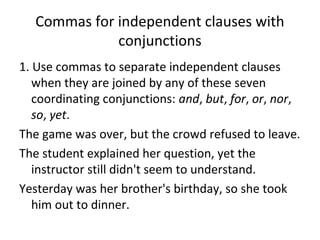
Commas for independent clauses with
conjunctions
1. Use commas to separate independent clauses
when they are joined by any of these seven
coordinating conjunctions: and, but, for, or, nor,
so, yet.
The game was over, but the crowd refused to leave.
The student explained her question, yet the
instructor still didn't seem to understand.
Yesterday was her brother's birthday, so she took
him out to dinner.
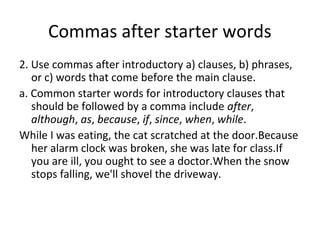
Commas after starter words
2. Use commas after introductory a) clauses, b) phrases,
or c) words that come before the main clause.
a. Common starter words for introductory clauses that
should be followed by a comma include after,
although, as, because, if, since, when, while.
While I was eating, the cat scratched at the door.Because
her alarm clock was broken, she was late for class.If
you are ill, you ought to see a doctor.When the snow
stops falling, we'll shovel the driveway.
No comma after main clause +
subordinate clause
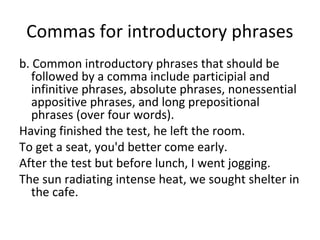
Commas for introductory phrases
b. Common introductory phrases that should be
followed by a comma include participial and
infinitive phrases, absolute phrases, nonessential
appositive phrases, and long prepositional
phrases (over four words).
Having finished the test, he left the room.
To get a seat, you'd better come early.
After the test but before lunch, I went jogging.
The sun radiating intense heat, we sought shelter in
the cafe.
Commas for Introductory Words
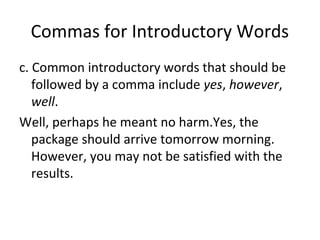
c. Common introductory words that should be
followed by a comma include yes, however,
well.
Well, perhaps he meant no harm.Yes, the
package should arrive tomorrow morning.
However, you may not be satisfied with the
results.
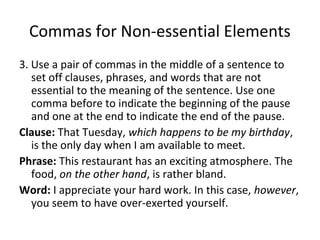
Commas for Non-essential Elements
3. Use a pair of commas in the middle of a sentence to
set off clauses, phrases, and words that are not
essential to the meaning of the sentence. Use one
comma before to indicate the beginning of the pause
and one at the end to indicate the end of the pause.
Clause: That Tuesday, which happens to be my birthday,
is the only day when I am available to meet.
Phrase: This restaurant has an exciting atmosphere. The
food, on the other hand, is rather bland.
Word: I appreciate your hard work. In this case, however,
you seem to have over-exerted yourself.
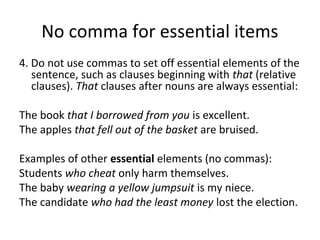
No comma for essential items
4. Do not use commas to set off essential elements of the
sentence, such as clauses beginning with that (relative
clauses). That clauses after nouns are always essential:
The book that I borrowed from you is excellent.
The apples that fell out of the basket are bruised.
Examples of other essential elements (no commas):
Students who cheat only harm themselves.
The baby wearing a yellow jumpsuit is my niece.
The candidate who had the least money lost the election.
No comma after that clauses
expressing mental action
That clauses following a verb expressing mental
action are always essential.
She believes that she will be able to earn an A.
He is dreaming that he can fly.
I contend that it was wrong to mislead her.
They wished that warm weather would finally
arrive.
No comma after that clauses
expressing mental action
That clauses following a verb expressing mental
action are always essential.
She believes that she will be able to earn an A.
He is dreaming that he can fly.
I contend that it was wrong to mislead her.
They wished that warm weather would finally
arrive.

Comma rules

  • 1.
  • 2.
    Commas for independentclauses with conjunctions 1. Use commas to separate independent clauses when they are joined by any of these seven coordinating conjunctions: and, but, for, or, nor, so, yet. The game was over, but the crowd refused to leave. The student explained her question, yet the instructor still didn't seem to understand. Yesterday was her brother's birthday, so she took him out to dinner.
  • 3.
    Commas after starterwords 2. Use commas after introductory a) clauses, b) phrases, or c) words that come before the main clause. a. Common starter words for introductory clauses that should be followed by a comma include after, although, as, because, if, since, when, while. While I was eating, the cat scratched at the door.Because her alarm clock was broken, she was late for class.If you are ill, you ought to see a doctor.When the snow stops falling, we'll shovel the driveway.
  • 4.
    No comma aftermain clause + subordinate clause
  • 5.
    Commas for introductoryphrases b. Common introductory phrases that should be followed by a comma include participial and infinitive phrases, absolute phrases, nonessential appositive phrases, and long prepositional phrases (over four words). Having finished the test, he left the room. To get a seat, you'd better come early. After the test but before lunch, I went jogging. The sun radiating intense heat, we sought shelter in the cafe.
  • 6.
    Commas for IntroductoryWords c. Common introductory words that should be followed by a comma include yes, however, well. Well, perhaps he meant no harm.Yes, the package should arrive tomorrow morning. However, you may not be satisfied with the results.
  • 7.
    Commas for Non-essentialElements 3. Use a pair of commas in the middle of a sentence to set off clauses, phrases, and words that are not essential to the meaning of the sentence. Use one comma before to indicate the beginning of the pause and one at the end to indicate the end of the pause. Clause: That Tuesday, which happens to be my birthday, is the only day when I am available to meet. Phrase: This restaurant has an exciting atmosphere. The food, on the other hand, is rather bland. Word: I appreciate your hard work. In this case, however, you seem to have over-exerted yourself.
  • 8.
    No comma foressential items 4. Do not use commas to set off essential elements of the sentence, such as clauses beginning with that (relative clauses). That clauses after nouns are always essential: The book that I borrowed from you is excellent. The apples that fell out of the basket are bruised. Examples of other essential elements (no commas): Students who cheat only harm themselves. The baby wearing a yellow jumpsuit is my niece. The candidate who had the least money lost the election.
  • 9.
    No comma afterthat clauses expressing mental action That clauses following a verb expressing mental action are always essential. She believes that she will be able to earn an A. He is dreaming that he can fly. I contend that it was wrong to mislead her. They wished that warm weather would finally arrive.
  • 10.
    No comma afterthat clauses expressing mental action That clauses following a verb expressing mental action are always essential. She believes that she will be able to earn an A. He is dreaming that he can fly. I contend that it was wrong to mislead her. They wished that warm weather would finally arrive.