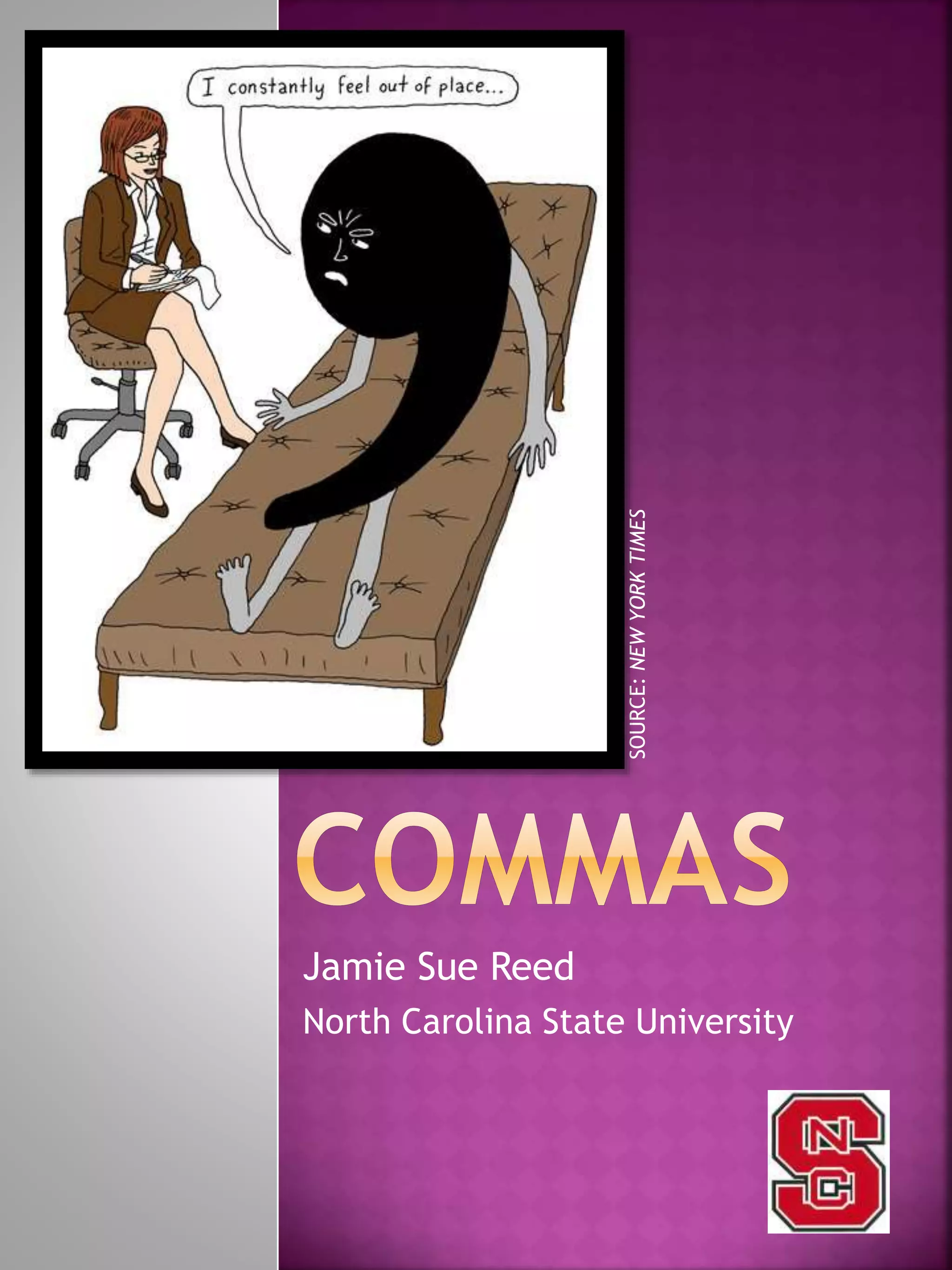
SOURCE: NEW YORK TIMES 
Jamie Sue Reed 
North Carolina State University
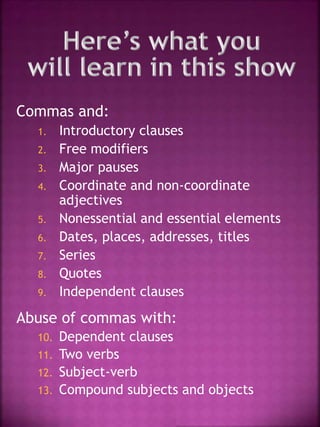
Commas and: 
1. Introductory clauses 
2. Free modifiers 
3. Major pauses 
4. Coordinate and non-coordinate 
adjectives 
5. Nonessential and essential elements 
6. Dates, places, addresses, titles 
7. Series 
8. Quotes 
9. Independent clauses 
Abuse of commas with: 
10. Dependent clauses 
11. Two verbs 
12. Subject-verb 
13. Compound subjects and objects
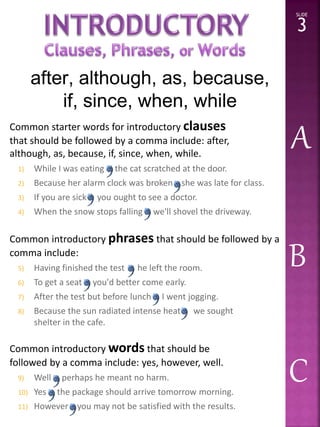
Common starter words for introductory clauses 
that should be followed by a comma include: after, 
although, as, because, if, since, when, while. 
1) While I was eating the cat scratched at the door. 
2) Because her alarm clock was broken she was late for class. 
3) If you are sick you ought to see a doctor. 
4) When the snow stops falling we'll shovel the driveway. 
Common introductory phrases that should be followed by a 
comma include: 
5) Having finished the test he left the room. 
6) To get a seat you'd better come early. 
7) After the test but before lunch I went jogging. 
8) Because the sun radiated intense heat we sought 
shelter in the cafe. 
Common introductorywords that should be 
followed by a comma include: yes, however, well. 
9) Well perhaps he meant no harm. 
10) Yes the package should arrive tomorrow morning. 
11) However you may not be satisfied with the results. 
3 
A 
B 
C 
after, although, as, because, 
if, since, when, while 
SLIDE 
3
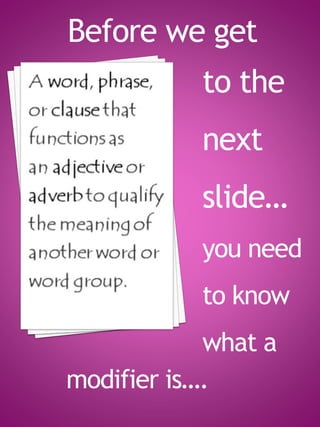
Before we get 
to the 
next 
slide… 
you need 
to know 
what a 
modifier is….
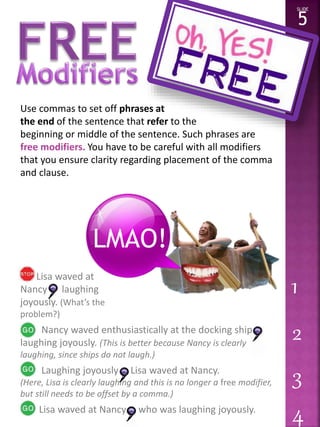
Use commas to set off phrases at 
the end of the sentence that refer to the 
beginning or middle of the sentence. Such phrases are 
free modifiers. You have to be careful with all modifiers 
that you ensure clarity regarding placement of the comma 
and clause. 
Lisa waved at 
Nancy laughing 
joyously. (What’s the 
problem?) 
Nancy waved enthusiastically at the docking ship 
laughing joyously. (This is better because Nancy is clearly 
laughing, since ships do not laugh.) 
Laughing joyously Lisa waved at Nancy. 
(Here, Lisa is clearly laughing and this is no longer a free modifier, 
but still needs to be offset by a comma.) 
Lisa waved at Nancy who was laughing joyously. 
SLIDE 
5 
LMAO! 
1 
2 
3 
4
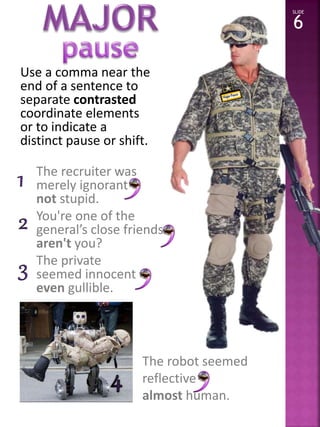
Use a comma near the 
end of a sentence to 
separate contrasted 
coordinate elements 
or to indicate a 
distinct pause or shift. 
The recruiter was 
merely ignorant 
not stupid. 
You're one of the 
general’s close friends 
aren't you? 
The private 
seemed innocent 
even gullible. 
SLIDE 
6 
The robot seemed 
reflective 
almost human.
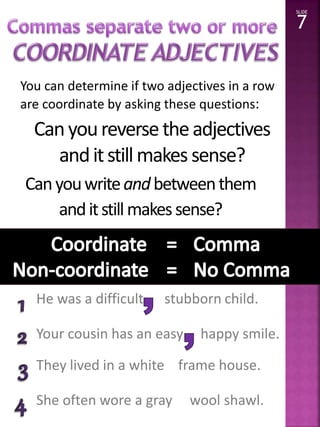
You can determine if two adjectives in a row 
are coordinate by asking these questions: 
He was a difficult stubborn child. 
Your cousin has an easy happy smile. 
They lived in a white frame house. 
She often wore a gray wool shawl. 
SLIDE 
7 
Can you reverse the adjectives 
and it still makes sense? 
Can you write and between them 
and it still makes sense? 
Yes!
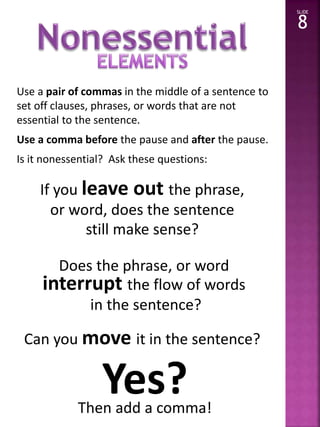
Use a pair of commas in the middle of a sentence to 
set off clauses, phrases, or words that are not 
essential to the sentence. 
Use a comma before the pause and after the pause. 
Is it nonessential? Ask these questions: 
SLIDE 
8 
If you leave out the phrase, 
or word, does the sentence 
still make sense? 
Does the phrase, or word 
interrupt the flow of words 
in the sentence? 
Can you move it in the sentence? 
Yes? 
Then add a comma!
SLIDE 
9 
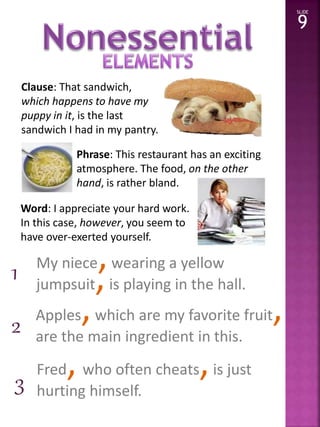
Clause: That sandwich, 
which happens to have my 
puppy in it, is the last 
sandwich I had in my pantry. 
Phrase: This restaurant has an exciting 
atmosphere. The food, on the other 
hand, is rather bland. 
Word: I appreciate your hard work. 
In this case, however, you seem to 
have over-exerted yourself. 
1 
2 
My niece, wearing a yellow 
jumpsuit, is playing in the hall. 
Apples, which are my favorite fruit, 
are the main ingredient in this. 
3 Fred, who often cheats, is just 
hurting himself.
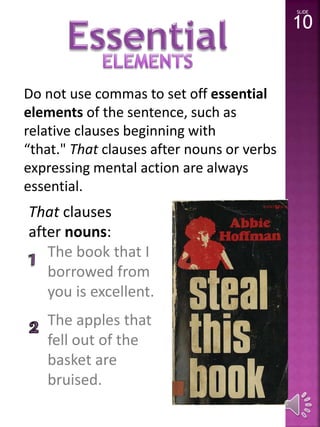
Do not use commas to set off essential 
elements of the sentence, such as 
relative clauses beginning with 
“that." That clauses after nouns or verbs 
expressing mental action are always 
essential. 
That clauses 
after nouns: 
The book that I 
borrowed from 
you is excellent. 
The apples that 
fell out of the 
basket are 
bruised. 
SLIDE 
10
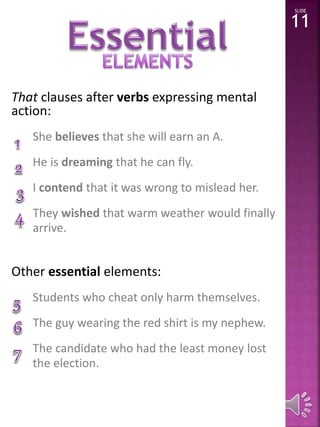
That clauses after verbs expressing mental 
action: 
She believes that she will earn an A. 
He is dreaming that he can fly. 
I contend that it was wrong to mislead her. 
They wished that warm weather would finally 
arrive. 
Other essential elements: 
Students who cheat only harm themselves. 
The guy wearing the red shirt is my nephew. 
The candidate who had the least money lost 
the election. 
SLIDE 
11
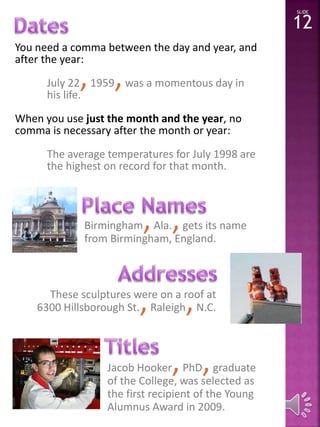
You need a comma between the day and year, and 
after the year: 
July 22,1959,was a momentous day in 
his life. 
When you use just the month and the year, no 
comma is necessary after the month or year: 
The average temperatures for July 1998 are 
the highest on record for that month. 
Birmingham, Ala., gets its name 
from Birmingham, England. 
SLIDE 
12 
These sculptures St.,were Raleigh,on a roof at 
6300 Hillsborough N.C. 
Jacob Hooker,PhD,graduate 
of the College, was selected as 
the first recipient of the Young 
Alumnus Award in 2009.
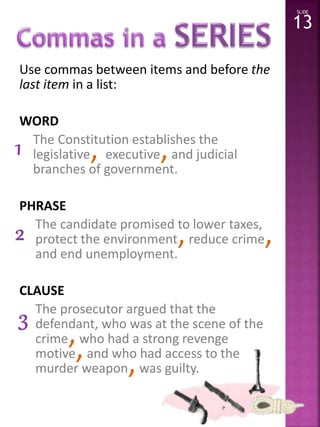
Use commas between items and before the 
last item in a list: 
WORD 
The Constitution establishes the 
legislative, executive, and judicial 
branches of government. 
PHRASE 
The candidate promised to lower taxes, 
protect the environment, reduce crime, 
and end unemployment. 
CLAUSE 
The prosecutor argued that the 
defendant, who was at the scene of the 
crime, who had a strong revenge 
motive, and who had access to the 
murder weapon, was guilty. 
SLIDE 
13
“ ” 
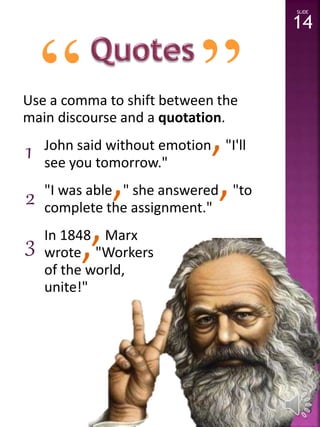
Use a comma to shift between the 
main discourse and a quotation. 
John said without emotion,"I'll 
see you tomorrow." 
"I was able," she answered,"to 
complete the assignment." 
In 1848,Marx 
wrote,"Workers 
of the world, 
unite!" 
SLIDE 
14 
1 
2 
3
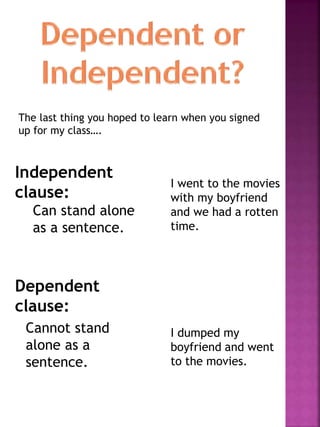
The last thing you hoped to learn when you signed 
up for my class…. 
Independent 
clause: 
Dependent 
clause: 
Cannot stand 
alone as a 
sentence. 
I went to the movies 
with my boyfriend 
and we had a rotten 
time. 
I dumped my 
boyfriend and went 
to the movies. 
Can stand alone 
as a sentence.
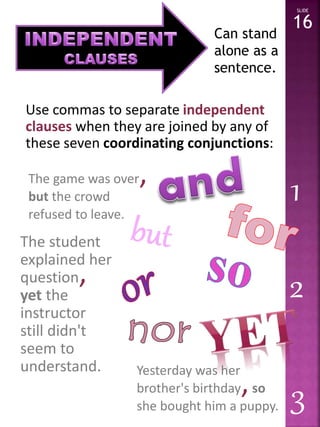
Use commas to separate independent 
clauses when they are joined by any of 
these seven coordinating conjunctions: 
SLIDE 
16 
The game was over, 
but the crowd 
refused to leave. 
The student 
explained her 
question, 
yet the 
instructor 
still didn't 
seem to 
understand. Yesterday was her 
brother's birthday, so 
she bought him a puppy. 
1 
2 
3 
Can stand 
alone as a 
sentence.
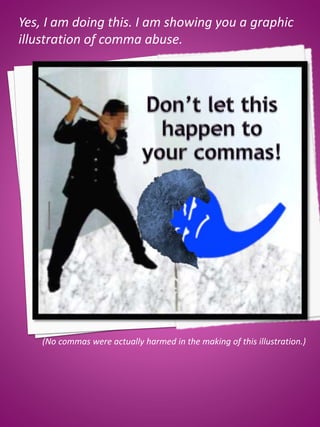
Yes, I am doing this. I am showing you a graphic 
illustration of comma abuse. 
(No commas were actually harmed in the making of this illustration.)
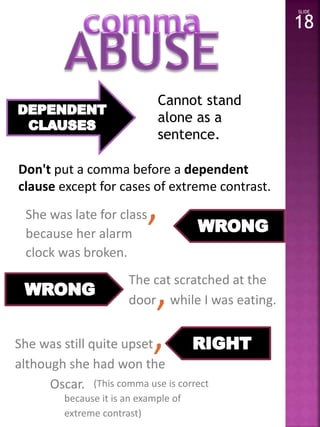
Cannot stand 
alone as a 
sentence. 
Don't put a comma before a dependent 
clause except for cases of extreme contrast. 
She was late for class, 
because her alarm 
clock was broken. 
The cat scratched at the 
door,while I was eating. 
She was still quite upset, 
although she had won the 
Oscar. 
SLIDE 
18 
(This comma use is correct 
because it is an example of 
extreme contrast)
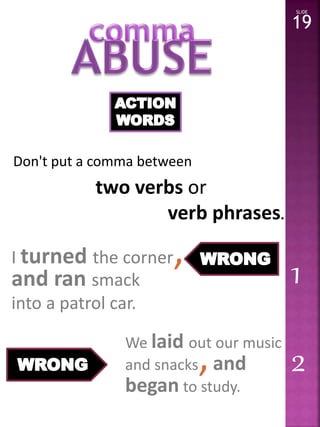
Don't put a comma between 
two verbs or 
verb phrases. 
SLIDE 
19 
We laid out our music 
and snacks, and 
began to study. 
2 
I turned the corner, 
and ran smack 
into a patrol car. 
1
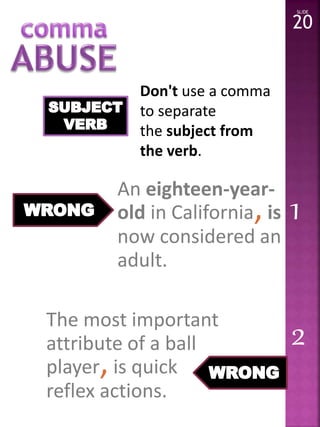
Don't use a comma 
to separate 
the subject from 
the verb. 
SLIDE 
20 
An eighteen-year-old 
in California, is 
now considered an 
adult. 
The most important 
attribute of a ball 
player, is quick 
reflex actions. 
1 
2
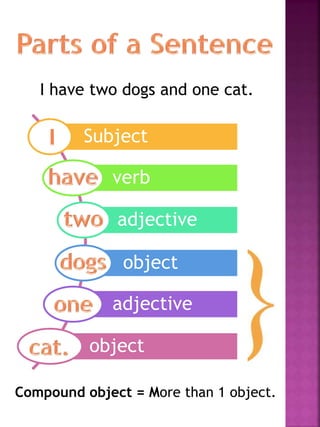
I have two dogs and one cat. 
Subject 
verb 
adjective 
object 
adjective 
object 
Compound object = More than 1 object.
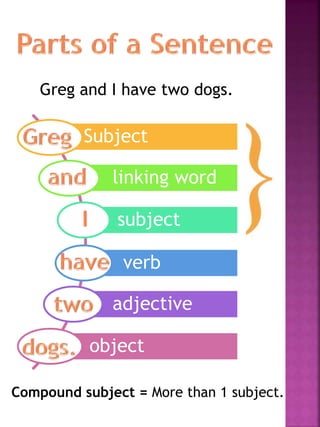
Greg and I have two dogs. 
Subject 
linking word 
subject 
verb 
adjective 
object 
Compound subject = More than 1 subject.
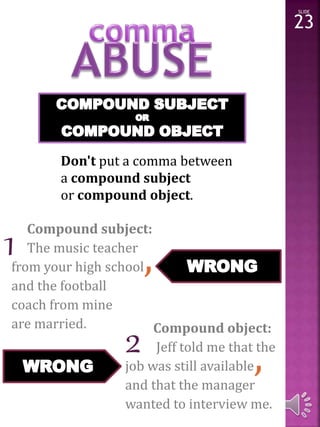
Don't put a comma between 
a compound subject 
or compound object. 
Compound subject: 
The music teacher 
from your high school, 
and the football 
coach from mine 
are married. Compound object: 
job was still available, 
and that the manager 
wanted to interview me. 
Jeff told me that the 
SLIDE 
23 
1 
2
2 
3 
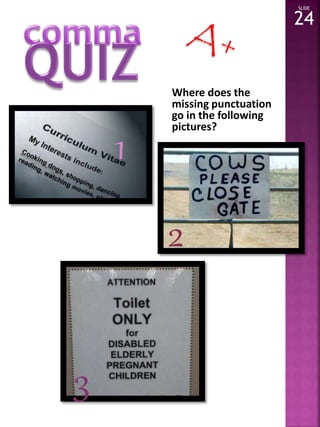
Where does the 
missing punctuation 
go in the following 
pictures? 
SLIDE 
24 
1
“Why I Won’t Hire 
People Who Use 
Poor Grammar” 
KYLE WIENS 
Harvard Business Review
Grammar signifies more 
than just a person’s ability 
to remember high school 
English. I’ve found that 
people who make fewer 
mistakes on a grammar 
test also make fewer 
mistakes when they are 
doing something 
completely unrelated to 
writing — like stocking 
shelves or labeling parts.
In the same vein, 
programmers who pay 
attention to how they 
construct written language 
also tend to pay a lot more 
attention to how they 
code…. 
And just like good writing 
and good grammar, when 
it comes to programming, 
the devil is in the details. 
In fact, when it comes to 
my whole business, 
details are everything.
I hire people who care 
about those details. 
Applicants who don’t 
think writing is 
important are likely to 
think lots of other 
(important) things also 
aren’t important.
That’s why people who 
walk in the door 
looking for a job are 
given a grammar test. 
Grammar is my litmus 
test. All applicants say 
they’re detail-oriented; 
I just make my 
employees prove it.
And I guarantee that 
even if other companies 
aren’t issuing grammar 
tests, they pay attention 
to sloppy mistakes on 
résumés. After all… 
sloppy is 
as sloppy does.
31

Commas Demystified

  • 1.
    SOURCE: NEW YORKTIMES Jamie Sue Reed North Carolina State University
  • 2.
    Commas and: 1.Introductory clauses 2. Free modifiers 3. Major pauses 4. Coordinate and non-coordinate adjectives 5. Nonessential and essential elements 6. Dates, places, addresses, titles 7. Series 8. Quotes 9. Independent clauses Abuse of commas with: 10. Dependent clauses 11. Two verbs 12. Subject-verb 13. Compound subjects and objects
  • 3.
    Common starter wordsfor introductory clauses that should be followed by a comma include: after, although, as, because, if, since, when, while. 1) While I was eating the cat scratched at the door. 2) Because her alarm clock was broken she was late for class. 3) If you are sick you ought to see a doctor. 4) When the snow stops falling we'll shovel the driveway. Common introductory phrases that should be followed by a comma include: 5) Having finished the test he left the room. 6) To get a seat you'd better come early. 7) After the test but before lunch I went jogging. 8) Because the sun radiated intense heat we sought shelter in the cafe. Common introductorywords that should be followed by a comma include: yes, however, well. 9) Well perhaps he meant no harm. 10) Yes the package should arrive tomorrow morning. 11) However you may not be satisfied with the results. 3 A B C after, although, as, because, if, since, when, while SLIDE 3
  • 4.
    Before we get to the next slide… you need to know what a modifier is….
  • 5.
    Use commas toset off phrases at the end of the sentence that refer to the beginning or middle of the sentence. Such phrases are free modifiers. You have to be careful with all modifiers that you ensure clarity regarding placement of the comma and clause. Lisa waved at Nancy laughing joyously. (What’s the problem?) Nancy waved enthusiastically at the docking ship laughing joyously. (This is better because Nancy is clearly laughing, since ships do not laugh.) Laughing joyously Lisa waved at Nancy. (Here, Lisa is clearly laughing and this is no longer a free modifier, but still needs to be offset by a comma.) Lisa waved at Nancy who was laughing joyously. SLIDE 5 LMAO! 1 2 3 4
  • 6.
    Use a commanear the end of a sentence to separate contrasted coordinate elements or to indicate a distinct pause or shift. The recruiter was merely ignorant not stupid. You're one of the general’s close friends aren't you? The private seemed innocent even gullible. SLIDE 6 The robot seemed reflective almost human.
  • 7.
    You can determineif two adjectives in a row are coordinate by asking these questions: He was a difficult stubborn child. Your cousin has an easy happy smile. They lived in a white frame house. She often wore a gray wool shawl. SLIDE 7 Can you reverse the adjectives and it still makes sense? Can you write and between them and it still makes sense? Yes!
  • 8.
    Use a pairof commas in the middle of a sentence to set off clauses, phrases, or words that are not essential to the sentence. Use a comma before the pause and after the pause. Is it nonessential? Ask these questions: SLIDE 8 If you leave out the phrase, or word, does the sentence still make sense? Does the phrase, or word interrupt the flow of words in the sentence? Can you move it in the sentence? Yes? Then add a comma!
  • 9.
    SLIDE 9 Clause:That sandwich, which happens to have my puppy in it, is the last sandwich I had in my pantry. Phrase: This restaurant has an exciting atmosphere. The food, on the other hand, is rather bland. Word: I appreciate your hard work. In this case, however, you seem to have over-exerted yourself. 1 2 My niece, wearing a yellow jumpsuit, is playing in the hall. Apples, which are my favorite fruit, are the main ingredient in this. 3 Fred, who often cheats, is just hurting himself.
  • 10.
    Do not usecommas to set off essential elements of the sentence, such as relative clauses beginning with “that." That clauses after nouns or verbs expressing mental action are always essential. That clauses after nouns: The book that I borrowed from you is excellent. The apples that fell out of the basket are bruised. SLIDE 10
  • 11.
    That clauses afterverbs expressing mental action: She believes that she will earn an A. He is dreaming that he can fly. I contend that it was wrong to mislead her. They wished that warm weather would finally arrive. Other essential elements: Students who cheat only harm themselves. The guy wearing the red shirt is my nephew. The candidate who had the least money lost the election. SLIDE 11
  • 12.
    You need acomma between the day and year, and after the year: July 22,1959,was a momentous day in his life. When you use just the month and the year, no comma is necessary after the month or year: The average temperatures for July 1998 are the highest on record for that month. Birmingham, Ala., gets its name from Birmingham, England. SLIDE 12 These sculptures St.,were Raleigh,on a roof at 6300 Hillsborough N.C. Jacob Hooker,PhD,graduate of the College, was selected as the first recipient of the Young Alumnus Award in 2009.
  • 13.
    Use commas betweenitems and before the last item in a list: WORD The Constitution establishes the legislative, executive, and judicial branches of government. PHRASE The candidate promised to lower taxes, protect the environment, reduce crime, and end unemployment. CLAUSE The prosecutor argued that the defendant, who was at the scene of the crime, who had a strong revenge motive, and who had access to the murder weapon, was guilty. SLIDE 13
  • 14.
    “ ” Usea comma to shift between the main discourse and a quotation. John said without emotion,"I'll see you tomorrow." "I was able," she answered,"to complete the assignment." In 1848,Marx wrote,"Workers of the world, unite!" SLIDE 14 1 2 3
  • 15.
    The last thingyou hoped to learn when you signed up for my class…. Independent clause: Dependent clause: Cannot stand alone as a sentence. I went to the movies with my boyfriend and we had a rotten time. I dumped my boyfriend and went to the movies. Can stand alone as a sentence.
  • 16.
    Use commas toseparate independent clauses when they are joined by any of these seven coordinating conjunctions: SLIDE 16 The game was over, but the crowd refused to leave. The student explained her question, yet the instructor still didn't seem to understand. Yesterday was her brother's birthday, so she bought him a puppy. 1 2 3 Can stand alone as a sentence.
  • 17.
    Yes, I amdoing this. I am showing you a graphic illustration of comma abuse. (No commas were actually harmed in the making of this illustration.)
  • 18.
    Cannot stand aloneas a sentence. Don't put a comma before a dependent clause except for cases of extreme contrast. She was late for class, because her alarm clock was broken. The cat scratched at the door,while I was eating. She was still quite upset, although she had won the Oscar. SLIDE 18 (This comma use is correct because it is an example of extreme contrast)
  • 19.
    Don't put acomma between two verbs or verb phrases. SLIDE 19 We laid out our music and snacks, and began to study. 2 I turned the corner, and ran smack into a patrol car. 1
  • 20.
    Don't use acomma to separate the subject from the verb. SLIDE 20 An eighteen-year-old in California, is now considered an adult. The most important attribute of a ball player, is quick reflex actions. 1 2
  • 21.
    I have twodogs and one cat. Subject verb adjective object adjective object Compound object = More than 1 object.
  • 22.
    Greg and Ihave two dogs. Subject linking word subject verb adjective object Compound subject = More than 1 subject.
  • 23.
    Don't put acomma between a compound subject or compound object. Compound subject: The music teacher from your high school, and the football coach from mine are married. Compound object: job was still available, and that the manager wanted to interview me. Jeff told me that the SLIDE 23 1 2
  • 24.
    2 3 Wheredoes the missing punctuation go in the following pictures? SLIDE 24 1
  • 25.
    “Why I Won’tHire People Who Use Poor Grammar” KYLE WIENS Harvard Business Review
  • 26.
    Grammar signifies more than just a person’s ability to remember high school English. I’ve found that people who make fewer mistakes on a grammar test also make fewer mistakes when they are doing something completely unrelated to writing — like stocking shelves or labeling parts.
  • 27.
    In the samevein, programmers who pay attention to how they construct written language also tend to pay a lot more attention to how they code…. And just like good writing and good grammar, when it comes to programming, the devil is in the details. In fact, when it comes to my whole business, details are everything.
  • 28.
    I hire peoplewho care about those details. Applicants who don’t think writing is important are likely to think lots of other (important) things also aren’t important.
  • 29.
    That’s why peoplewho walk in the door looking for a job are given a grammar test. Grammar is my litmus test. All applicants say they’re detail-oriented; I just make my employees prove it.
  • 30.
    And I guaranteethat even if other companies aren’t issuing grammar tests, they pay attention to sloppy mistakes on résumés. After all… sloppy is as sloppy does.
  • 31.