OBJECTIVES
After going throughthis module, you are expected
to:
1. Compare and contrast comets, meteors, and
asteroids (MELC Week S8ES-IIg-22)
3.
COMETS, METEORS, ANDASTEROIDS
Have you already watched a movie showing rocks
from outer space crashing violently on Earth? Do
you know that there are many rocks in outer
space? Those are what we call comets and
asteroids. Are you aware that “falling stars” are not
stars but meteors?
4.
CHARACTERISTICS OF COMETS,METEORS, AND
ASTEROIDS
Did you know that recent discoveries like the Comet ‘Neowise’
that dazzled on Hungary’s sky on July 23, 2020 have made the
experts know more about the Near-Earth Objects (NEO) like
comets, asteroids, and meteors? With the advent of telescopes
and space probes, these instruments provided more knowledge
on the origin and nature of the universe. Recently, astronomers
have discovered asteroid 2012 DA14 that came close to Earth.
It made a very close approach to the Earth as it orbited the Sun
on February 16, 2012. It exploded over the Lake Cherbakul in
Russia causing damages to properties and according to the
press release of National Aeronautics and Space Administration
(NASA), the material exploded are composed of different
objects.
6.
Comets, meteors, andasteroids come in different
sizes and compositions. A relatively higher amount
of silicate content caused these celestial bodies to
reflect light. Silicates are types of metal that
contain silicon, oxygen, and at least one metal. If
an asteroid has fewer silicate content, then it
would be hard to see it even with the aid of a
telescope because only a small part of the asteroid
can reflect light and it might seem smaller than its
actual size.
8.
Both the cometand asteroid orbit the Earth and
move relatively slow when viewed from the Earth.
This means that you can view a comet for up to a
year in the night sky. The main difference between
the comet and asteroid is the origin. Comets
typically come from the Oort Cloud which is
beyond the solar system and some from the
Kuiper Belt which is beyond the Neptune’s orbit.
Long-period comets originate from the Oort Cloud
while a short-period comes from the Kuiper Belt.
10.
Comet Halley isthe most well-known short-period
comet of the 20th century since it takes 75 to 76
years for this comet to orbit the Sun. We can view
it in the sky every time it comes closer to the Sun.
All other comets have been identified as long-
period comets since it takes 200 to several
thousand years to complete their orbit around the
Sun. On the other hand, asteroids originate from
the Asteroid Belt. These are found between Mars
and Jupiter.
11.
The recent theorystates that the Asteroid Belt
was heavily populated with asteroids, but the
gravitational pull of Jupiter has made these
asteroids thrown. It was also theorized that
Jupiter’s gravitational pull prevented these
asteroids from forming into a new planet.
Another group of astronomical researchers
theorized that the Asteroid Belt was an empty
space and the debris of other planets have filled
this area with the objects which are then called
asteroids.
12.
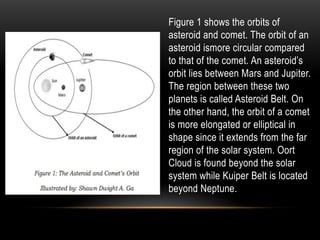
The orbit ofan asteroid is more rounded and less
elliptical than the orbit of a comet. On February
2013, Asteroid 2012 DA14 made a closer
approach to Earth as it orbited around the Sun.
Distance in space was measured by lightyears and
this asteroid was just 0.4 l i g h ty ea r s a w a y f r
o m t h e E a r th , th e c l o s e s t t h a t an
asteroid has ever been on Earth. On December
2012, during the issue of the doomsday
prophecies, Asteroid Toutatis has made a near
approach to Earth but not as close as Asteroid
2012 DA14.
13.
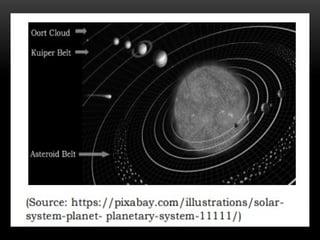
Figure 1 showsthe orbits of
asteroid and comet. The orbit of an
asteroid ismore circular compared
to that of the comet. An asteroid’s
orbit lies between Mars and Jupiter.
The region between these two
planets is called Asteroid Belt. On
the other hand, the orbit of a comet
is more elongated or elliptical in
shape since it extends from the far
region of the solar system. Oort
Cloud is found beyond the solar
system while Kuiper Belt is located
beyond Neptune.
14.
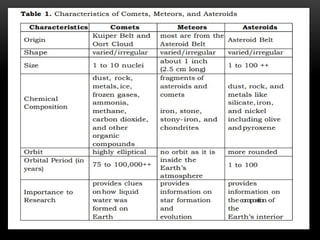
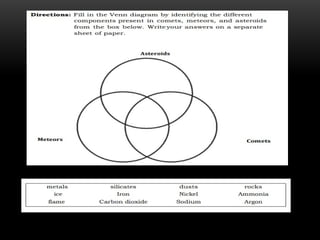
Another difference betweenasteroids and comets
is their chemical compositions. Asteroids contain
rocks and metals while comets contain ice or icy
objects including dusts, metals, and elements like
Sodium and Argon. Unlike a comet, an asteroid is
composed of rocky metals that are mostly Iron and
Nickel. Scientists discovered that Comet-Hale
Bopp contains Argon which made the comet
appear brightly.
15.
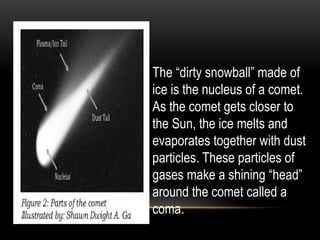
The “dirty snowball”made of
ice is the nucleus of a comet.
As the comet gets closer to
the Sun, the ice melts and
evaporates together with dust
particles. These particles of
gases make a shining “head”
around the comet called a
coma.
16.
Scientists theorized thatEarth has been too hot to have
water on the surface. A closer study reveals that the
collected samples of ice from drilling down the Earth’s
crust and marine layers have brought water to the planet.
The comet’s composition provides clues for them to
understand how Earth obtained liquid water which makes
it habitable.
17.
The composition ofan asteroid provides information to the
chemical compositions of planets in the solar system. Iron and
Nickel are the asteroid's components which are the same
metals that make up the Earth’s core. An element called
Iridium was discovered on oceanic sedimentary layers of
Denmark, Italy, and New Zealand, by Alvarez Brothers namely
Luis and Walter Alvarez. They have discovered the rocks that
contains higher level of Iridium compared to the Earth’s crust
which is with the same level of Iridium of the asteroid.
Because of this, they have presumed that asteroids landed on
Earth that caused the death of the dinosaurs. They came up
to their hypothesis which was later called as Alvarez
Hypothesis.
18.
Based on Alvarezhypothesis, an asteroid with about
ten kilometers in diameter made an impact on Earth.
This phenomenon caused the blocking of sunlight in
the air, bringing a period of long winter that caused
the mass extinction of plants and animals including
the dinosaurs.
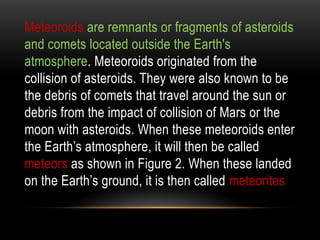
Meteoroids are remnantsor fragments of asteroids
and comets located outside the Earth's
atmosphere. Meteoroids originated from the
collision of asteroids. They were also known to be
the debris of comets that travel around the sun or
debris from the impact of collision of Mars or the
moon with asteroids. When these meteoroids enter
the Earth’s atmosphere, it will then be called
meteors as shown in Figure 2. When these landed
on the Earth’s ground, it is then called meteorites
21.
A little bodybegins as a meteoroid skimming
through space between the planets until it enters
the Earth's atmosphere creating a streak of light
as a meteor or commonly known as “shooting
star”. Afterwards, if it was not vaporized completely
by frictional heat and landed on the Earth’s
ground, it is called meteorite. There are times in
the year where we observe meteor showers
occurring when the Earth passes through debris
left by comets or asteroids.
22.
The orbit ofan asteroid is more rounded and less
elliptical than the orbit of a comet. On February
2013, Asteroid 2012 DA14 made a closer
approach to Earth as it orbited around the Sun.
Distance in space was measured by light years
and this asteroid was just 0.4 light years away
from the Earth , the closest that an asteroid has
ever been on Earth. On December 2012, during
the issue of the doomsday prophecies, Asteroid
Toutatis has made a near approach to Earth but
not as close as Asteroid 2012 DA14.
23.
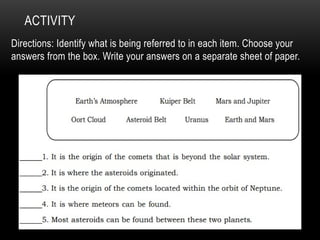
ACTIVITY
Directions: Identify whatis being referred to in each item. Choose your
answers from the box. Write your answers on a separate sheet of paper.