11/04/16
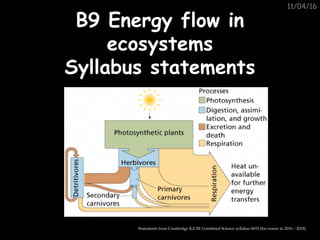
B9 Energy flow inB9 Energy flow in
ecosystemsecosystems
Syllabus statementsSyllabus statements
Statements from Cambridge IGCSE Combined Science syllabus 0653 (for exams in 2016 – 2018)
B10 Energy flow in ecosystemsB10 Energy flow in ecosystems
1. State that the Sun is the principal source of
energy input to biological systems.
2. Define the terms:
•food chain as a chart showing the flow of energy
(food) from one organism to the next beginning
with a producer (e.g. mahogany tree caterpillar→
song bird hawk);→ →
B10 Energy flow in ecosystemsB10 Energy flow in ecosystems
• food web as a network of interconnected food
chains showing the energy flow through part of
an ecosystem;
• producer as an organism that makes its own
organic nutrients, usually using energy from
sunlight, through photosynthesis;
• consumer as an organism that gets its energy
by feeding on other organisms;
B10 Energy flow in ecosystemsB10 Energy flow in ecosystems
• herbivore as an animal that gets its energy by
eating plants;
• carnivore as an animal that gets its energy by
eating other animals.
B10 Energy flow in ecosystemsB10 Energy flow in ecosystems
4. Define the terms:
•decomposer as an organism that gets its energy
from dead or waste organic matter;
•ecosystem as a unit containing all of the
organisms and their environment, interacting
together, in a given area e.g. decomposing log or a
lake;
•trophic level as the position of an organism in a
food chain or food web.
B10 Energy flow in ecosystemsB10 Energy flow in ecosystems
3. Describe energy losses between trophic levels.
5. Explain why food chains usually have fewer
than five trophic levels.
B10 Energy flow in ecosystemsB10 Energy flow in ecosystems
6. Describe the carbon cycle.
7. Discuss the effects of the combustion of fossil
fuels and the cutting down of forests on the
oxygen and carbon dioxide concentrations in the
atmosphere.

Combined sci b9 syllabus

  • 1.
    11/04/16 B9 Energy flowinB9 Energy flow in ecosystemsecosystems Syllabus statementsSyllabus statements Statements from Cambridge IGCSE Combined Science syllabus 0653 (for exams in 2016 – 2018)
  • 2.
    B10 Energy flowin ecosystemsB10 Energy flow in ecosystems 1. State that the Sun is the principal source of energy input to biological systems. 2. Define the terms: •food chain as a chart showing the flow of energy (food) from one organism to the next beginning with a producer (e.g. mahogany tree caterpillar→ song bird hawk);→ →
  • 3.
    B10 Energy flowin ecosystemsB10 Energy flow in ecosystems • food web as a network of interconnected food chains showing the energy flow through part of an ecosystem; • producer as an organism that makes its own organic nutrients, usually using energy from sunlight, through photosynthesis; • consumer as an organism that gets its energy by feeding on other organisms;
  • 4.
    B10 Energy flowin ecosystemsB10 Energy flow in ecosystems • herbivore as an animal that gets its energy by eating plants; • carnivore as an animal that gets its energy by eating other animals.
  • 5.
    B10 Energy flowin ecosystemsB10 Energy flow in ecosystems 4. Define the terms: •decomposer as an organism that gets its energy from dead or waste organic matter; •ecosystem as a unit containing all of the organisms and their environment, interacting together, in a given area e.g. decomposing log or a lake; •trophic level as the position of an organism in a food chain or food web.
  • 6.
    B10 Energy flowin ecosystemsB10 Energy flow in ecosystems 3. Describe energy losses between trophic levels. 5. Explain why food chains usually have fewer than five trophic levels.
  • 7.
    B10 Energy flowin ecosystemsB10 Energy flow in ecosystems 6. Describe the carbon cycle. 7. Discuss the effects of the combustion of fossil fuels and the cutting down of forests on the oxygen and carbon dioxide concentrations in the atmosphere.