Chapter 5, section 1Energy Flow in Ecosystems
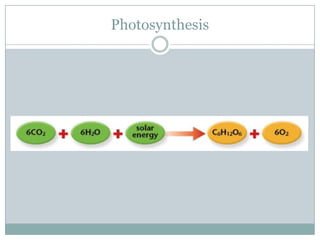
Life Depends on the SunEnergy from the sun enters an ecosystem when a plant uses sunlight to make sugar molecules.PhotosynthesisPlants, algae, some bacteria capture solar energy.Solar energy powers a series of reactions that require carbon dioxide and water.Sugar molecules (carbohydrates) are produced.Carbohydrates provide the energy that organisms need to carry out daily activities.As organisms consume food and use energy, the energy travels from one organism to another.
Photosynthesis
Life Depends on the SunProducers (Autotrophs) – Organisms that make their own food.Plants, algae, some bacteriaConsumers (Heterotrophs) – Organisms that get energy by eating other organisms.Humans, coyotes, cats, cows,
Deep-Ocean EcosystemsTotal darknessBacteria use Hydrogen Sulfide (H2S) to make their own food.H2S comes from the hot water that escapes the cracks in the ocean floor.The bacteria are then eaten by consumers.
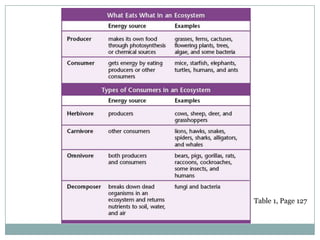
What Eats WhatOrganisms can be classified by what they eat.Types of Consumers:HerbivoresCarnivoresOmnivoresDecomposers
Table 1, Page 127
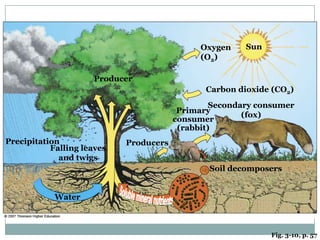
SunOxygen (O2)ProducerCarbon dioxide (CO2)Secondary consumer(fox)Primaryconsumer(rabbit)PrecipitationProducersFalling leaves and twigsSoil decomposersSoluble mineral nutrientsWaterFig. 3-10, p. 57
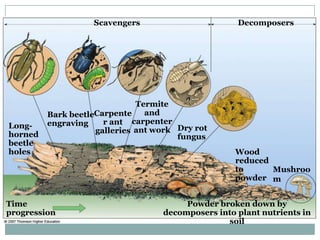
ScavengersDecomposersTermite and carpenter ant workCarpenter ant galleriesBark beetle engravingLong-horned beetle holesDry rot fungusWood reduced to powderMushroomPowder broken down by decomposers into plant nutrients in soilTime progression
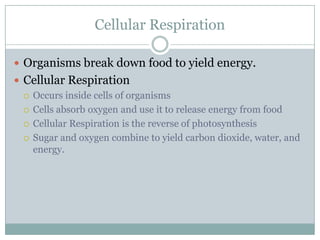
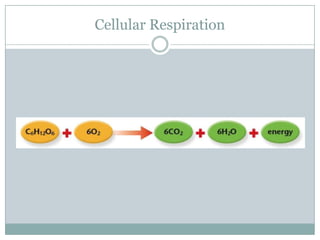
Cellular RespirationOrganisms break down food to yield energy.Cellular RespirationOccurs inside cells of organismsCells absorb oxygen and use it to release energy from foodCellular Respiration is the reverse of photosynthesisSugar and oxygen combine to yield carbon dioxide, water, and energy.
Cellular Respiration
Energy TransferEach time one organism eats another organism, a transfer of energy occurs. Food chains, food webs, and trophic levels tell us how energy is transferred and how much energy is transferred.Studying the paths of energy between organisms can tell us which organisms in an ecosystem depend on other organisms to survive.
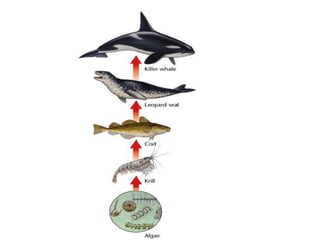
Food Chains, Food Webs, Trophic LevelsFood Chain – A sequence in which energy is transferred from one organism to the next as each organism eats another organism.Food Web – Includes many organisms and multiple food chains linked together.Trophic Levels – Each step through which energy is transferred in a food chain or web.
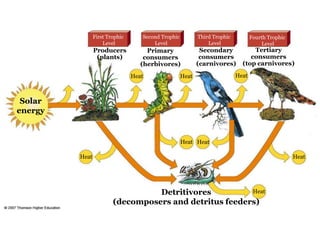
First Trophic LevelSecond TrophicLevelThird Trophic LevelFourth Trophic LevelTertiary consumers(top carnivores)Secondary consumers(carnivores)Producers(plants)Primary consumers(herbivores)HeatHeatHeatSolar energyHeatHeatHeatHeatDetritivores (decomposers and detritus feeders)Heat
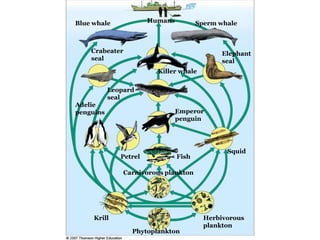
HumansBlue whaleSperm whaleCrabeater sealElephant seal Killer whaleLeopard sealAdelie penguinsEmperor penguinSquidPetrelFishCarnivorous planktonKrillHerbivorous planktonPhytoplankton
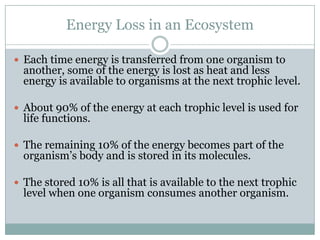
Energy Loss in an EcosystemEach time energy is transferred from one organism to another, some of the energy is lost as heat and less energy is available to organisms at the next trophic level.About 90% of the energy at each trophic level is used for life functions.The remaining 10% of the energy becomes part of the organism’s body and is stored in its molecules.The stored 10% is all that is available to the next trophic level when one organism consumes another organism.
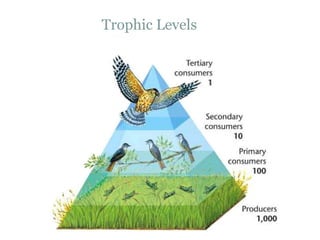
Trophic Levels
Energy Loss in an EcosystemThe Loss of Energy…Means there are fewer organisms at each level.Limits the number of trophic levels in an ecosystem
Summary QuestionsDescribe how energy is transferred from one organism to another.  Give examples.Describe the role that producers play in an ecosystem.  What would happen if the producers became extinct?Define and give examples of herbivore, carnivore, and omnivore.Compare energy transfer in a food chain to energy transfer in a food web.Could more people be supported by 20 acres of land if they only ate plants instead of both plants and animals.  Explain your answer.

Ecology - Chapter 5 Section 1

  • 1.
    Chapter 5, section1Energy Flow in Ecosystems
  • 2.
    Life Depends onthe SunEnergy from the sun enters an ecosystem when a plant uses sunlight to make sugar molecules.PhotosynthesisPlants, algae, some bacteria capture solar energy.Solar energy powers a series of reactions that require carbon dioxide and water.Sugar molecules (carbohydrates) are produced.Carbohydrates provide the energy that organisms need to carry out daily activities.As organisms consume food and use energy, the energy travels from one organism to another.
  • 3.
  • 4.
    Life Depends onthe SunProducers (Autotrophs) – Organisms that make their own food.Plants, algae, some bacteriaConsumers (Heterotrophs) – Organisms that get energy by eating other organisms.Humans, coyotes, cats, cows,
  • 5.
    Deep-Ocean EcosystemsTotal darknessBacteriause Hydrogen Sulfide (H2S) to make their own food.H2S comes from the hot water that escapes the cracks in the ocean floor.The bacteria are then eaten by consumers.
  • 6.
    What Eats WhatOrganismscan be classified by what they eat.Types of Consumers:HerbivoresCarnivoresOmnivoresDecomposers
  • 7.
  • 8.
    SunOxygen (O2)ProducerCarbon dioxide(CO2)Secondary consumer(fox)Primaryconsumer(rabbit)PrecipitationProducersFalling leaves and twigsSoil decomposersSoluble mineral nutrientsWaterFig. 3-10, p. 57
  • 9.
    ScavengersDecomposersTermite and carpenterant workCarpenter ant galleriesBark beetle engravingLong-horned beetle holesDry rot fungusWood reduced to powderMushroomPowder broken down by decomposers into plant nutrients in soilTime progression
  • 10.
    Cellular RespirationOrganisms breakdown food to yield energy.Cellular RespirationOccurs inside cells of organismsCells absorb oxygen and use it to release energy from foodCellular Respiration is the reverse of photosynthesisSugar and oxygen combine to yield carbon dioxide, water, and energy.
  • 11.
  • 12.
    Energy TransferEach timeone organism eats another organism, a transfer of energy occurs. Food chains, food webs, and trophic levels tell us how energy is transferred and how much energy is transferred.Studying the paths of energy between organisms can tell us which organisms in an ecosystem depend on other organisms to survive.
  • 13.
    Food Chains, FoodWebs, Trophic LevelsFood Chain – A sequence in which energy is transferred from one organism to the next as each organism eats another organism.Food Web – Includes many organisms and multiple food chains linked together.Trophic Levels – Each step through which energy is transferred in a food chain or web.
  • 15.
    First Trophic LevelSecondTrophicLevelThird Trophic LevelFourth Trophic LevelTertiary consumers(top carnivores)Secondary consumers(carnivores)Producers(plants)Primary consumers(herbivores)HeatHeatHeatSolar energyHeatHeatHeatHeatDetritivores (decomposers and detritus feeders)Heat
  • 16.
    HumansBlue whaleSperm whaleCrabeatersealElephant seal Killer whaleLeopard sealAdelie penguinsEmperor penguinSquidPetrelFishCarnivorous planktonKrillHerbivorous planktonPhytoplankton
  • 17.
    Energy Loss inan EcosystemEach time energy is transferred from one organism to another, some of the energy is lost as heat and less energy is available to organisms at the next trophic level.About 90% of the energy at each trophic level is used for life functions.The remaining 10% of the energy becomes part of the organism’s body and is stored in its molecules.The stored 10% is all that is available to the next trophic level when one organism consumes another organism.
  • 18.
  • 19.
    Energy Loss inan EcosystemThe Loss of Energy…Means there are fewer organisms at each level.Limits the number of trophic levels in an ecosystem
  • 20.
    Summary QuestionsDescribe howenergy is transferred from one organism to another. Give examples.Describe the role that producers play in an ecosystem. What would happen if the producers became extinct?Define and give examples of herbivore, carnivore, and omnivore.Compare energy transfer in a food chain to energy transfer in a food web.Could more people be supported by 20 acres of land if they only ate plants instead of both plants and animals. Explain your answer.