FEEDING RELATIONSHIPSFEEDING RELATIONSHIPS
FOODCHAINS, FOODWEBFOODCHAINS, FOODWEB
HEADINGS
VOCABULARYVOCABULARY
IMPORTANT INFO
KOMPETENSI INTI
 KI1 dan KI2: Menghargai dan menghayati ajaran agama
yang dianutnya serta Menghargai dan menghayati perilaku
jujur, disiplin, santun, percaya diri, peduli, dan bertanggung
jawab dalam berinteraksi secara efektif sesuai dengan
perkembangan anak di lingkungan, keluarga, sekolah,
masyarakat dan lingkungan alam sekitar, bangsa, negara, dan
kawasan regional.
 KI3: Memahami dan menerapkan pengetahuan faktual,
konseptual, prosedural, dan metakognitif pada tingkat teknis dan
spesifik sederhana berdasarkan rasa ingin tahunya tentang ilmu
pengetahuan, teknologi, seni, budaya dengan wawasan
kemanusiaan, kebangsaan, dan kenegaraan terkait fenomena dan
kejadian tampak mata.
 KI4: Menunjukkan keterampilan menalar, mengolah, dan
menyaji secara kreatif, produktif, kritis, mandiri, kolaboratif, dan
komunikatif, dalam ranah konkret dan ranah abstrak sesuai
dengan yang dipelajari di sekolah dan sumber lain yang sama
dalam sudut pandang teori.
KOMPETENSI DASAR
 3.7 Menganalisis interaksi antara makhluk
hidup dan lingkungannya serta dinamika
populasi akibat interaksi tersebut
 4.7 Menyajikan hasil pengamatan terhadap
interaksi makhluk hidup dengan lingkungan
sekitarnya.
INDIKATOR KKM: 70
3.7.3 Menjelaskan pengertian interaksi.
3.7.4 Menjabarkan pola-pola interaksi.
3.7.5 Menjelaskan konsep bentuk saling ketergantungan
makhluk hidup.
3.7.6 Menyebutkan perbedaan antara rantai makanan
dengan jaring-jaring makanan, rantai makanan de
tritus dengan rantai makanan perumput.
3.7.7 Memiliki keterampilan berbicara di depan kelas
melalui kegiatan presentasi hasil eksplorasi.
4.7.1 Peserta didik dapat melakukan pengamatan
lingkungan dan mengidentifikasi komponen biotik
dan abiotik.
4.7.2 Peserta didik mampu mempresentasikan hail
pengamatan mengenai konsep saling
kebergantungan antar makhluk hidup.
FEEDING TYPES
1.1. AutotrophsAutotrophs:
a. Self feeders, produce
their own food through
photosynthesisphotosynthesis
 Transformation of light
energy to chemical
energy to make food in
the form of glucose
a. Examples: plants, algae
2.2. HeterotrophsHeterotrophs:
a. Depend on other organisms for their food
1.1. HerbivoreHerbivore: Eats only plants
2.2. CarnivoreCarnivore: Eats only meat
3.3. OmnivoreOmnivore: Eats both plants and
meat
4.4. DetrivoreDetrivore: Eats dead organisms
3.3. DecomposersDecomposers:
a. Break down and absorb nutrients from
dead, decaying organisms
b. Examples: mushrooms and bacteria
SymbiosisSymbiosis
a. close, permanent relationship
between organisms
b. Three major types:
1. CommensalismCommensalism  
2. MutualismMutualism  
3. ParasitismParasitism  
1) Mr. Fungus is ready to greet our friend the alga
2) Friend alga cell is prepared to
greet Mr. Fungus
3) The Lichen is created between the fungus and the alga
FEEDING
RELATIONSHIPS
CommensalismCommensalism::  
a. A feeding relationship in which one organism
benefits and the other is not affected.
b. Example: Remoras that live on or around a shark’s
mouth.
*Remora benefits
from the scraps
of food that fall
from the shark’s
mouth and the
shark is not
affected.
MutualismMutualism::  
a. Both organisms benefit from the
relationship
b. “you scratch my back and I
scratch yours”
c. Example: tickbirds eat parasites
off of the back of zebras. The
tickbirds get fed and the zebra
gets cleaned.
ParasitismParasitism::  
a. One organism benefits and
the other is harmed
b. Example: tapeworm living
inside an organism’s
intestine (may cause death)
c. Example: flea living on a
dog
WEBS
1.1. Food Chain:Food Chain:
a. model showing the movement of energy through the
ecosystem
b. Consists of Producers, Consumers, and DecomposersProducers, Consumers, and Decomposers
 ProducerProducer:: living organisms that take non-living matter (like
minerals and gases) from the environment and use them to
support life (Example: plants). These are the first
organisms in the food chain.
 ConsumerConsumer:: living things
that need producers to
be their food.
 EX: (Herbivores,
carnivores, and omnivores)
 Decomposer:Decomposer: living things
which feed off of dead
plants and animals to reduce
their remains to minerals and
gases again
http://magma.nationalgeographic.com/ngexplorer/0309/quickflicks/index.html
FOOD CHAINS AND FOOD
WEBS
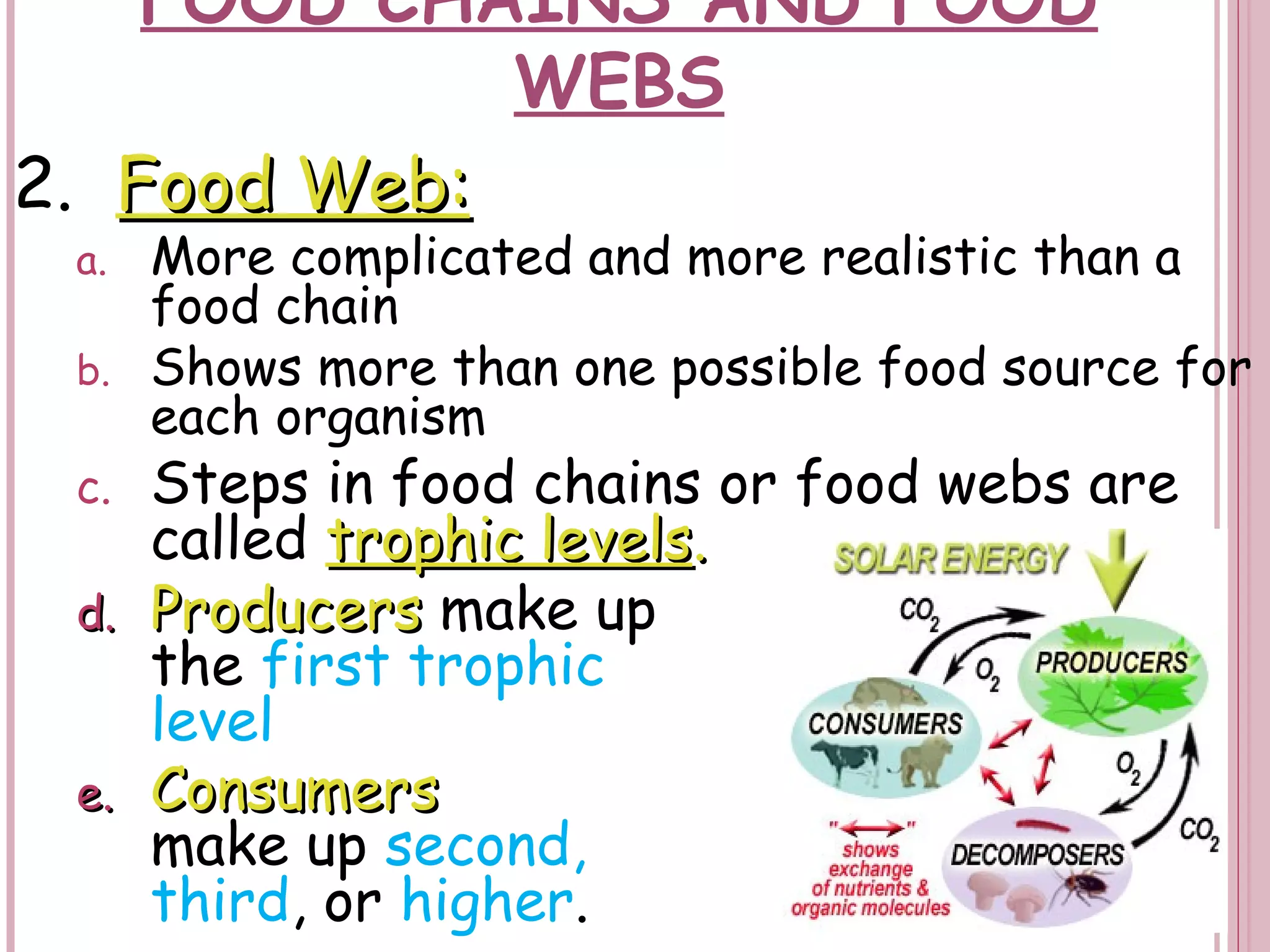
2. Food Web:Food Web:
a. More complicated and more realistic than a
food chain
b. Shows more than one possible food source for
each organism
c. Steps in food chains or food webs are
called trophic levelstrophic levels..
d.d. ProducersProducers make up
the first trophic
level
e.e. ConsumersConsumers
make up second,
third, or higher.
• When you read a food chain or food web, the
arrows point from what is being eaten to
what it is eaten by (where the energy goes).
Ex.: mouse  snake;
the mouse is
EATEN BY
the snake
KEY CONCEPT
Pyramids model the distribution of energy and matter
in an ecosystem.
energy transferred
energy
lost
AN ENERGY PYRAMID SHOWS THE
DISTRIBUTION OF ENERGY AMONG TROPHIC
LEVELS.
 Energy pyramids compare energy used by producers
and other organisms on trophic levels.
• Between each tier of an energy
pyramid, up to 90 percent of the
energy is lost into the
atmosphere as heat.
• Only 10 percent of the energy at
each tier is transferred from one
trophic level to the next.
1,000 kcal
#1-WITH YOUR GROUP WORK TO ANSWER THE
FOLLOWING QUESTION:
 If each level in a food
chain typically loses 90%
of the energy it takes in
and the producer level
uses 1000kcal of energy,
how much of that energy
is left after the third
trophic level?
3rd
level
2nd
level
How much
remains for
this level?
#2- WITH YOUR GROUP WORK TO ANSWER THE
FOLLOWING QUESTION:
 Why is an herbivorous diet more energy efficient than
a carnivorous diet? Explain your answer.
OTHER PYRAMID MODELS ILLUSTRATE AN
ECOSYSTEM’S BIOMASS AND DISTRIBUTION OF
ORGANISMS.
 Biomass is a measure of the total dry mass of organisms
in a given area.
tertiary
consumers
secondary
consumers
primary
consumers
producers
75 g/m2
150g/m2
675g/m2
2000g/m2producers 2000g/m2
 A pyramid of numbers shows the numbers of individual
organisms at each trophic level in an ecosystem.
tertiary
consumers
secondary
consumers
primary
consumers
producers
5
5000
500,000
5,000,0005,000,000producers
• A vast number of producers are required to support even a
few top level consumers.
#3- WITH YOUR GROUP WORK TO ANSWER THE
FOLLOWING QUESTION:
 What is the difference between a biomass pyramid and
a pyramid of numbers?
 What is a similarity of all 3 types of pyramids?

food and web chain

  • 3.
    FEEDING RELATIONSHIPSFEEDING RELATIONSHIPS FOODCHAINS,FOODWEBFOODCHAINS, FOODWEB HEADINGS VOCABULARYVOCABULARY IMPORTANT INFO
  • 4.
    KOMPETENSI INTI  KI1dan KI2: Menghargai dan menghayati ajaran agama yang dianutnya serta Menghargai dan menghayati perilaku jujur, disiplin, santun, percaya diri, peduli, dan bertanggung jawab dalam berinteraksi secara efektif sesuai dengan perkembangan anak di lingkungan, keluarga, sekolah, masyarakat dan lingkungan alam sekitar, bangsa, negara, dan kawasan regional.  KI3: Memahami dan menerapkan pengetahuan faktual, konseptual, prosedural, dan metakognitif pada tingkat teknis dan spesifik sederhana berdasarkan rasa ingin tahunya tentang ilmu pengetahuan, teknologi, seni, budaya dengan wawasan kemanusiaan, kebangsaan, dan kenegaraan terkait fenomena dan kejadian tampak mata.  KI4: Menunjukkan keterampilan menalar, mengolah, dan menyaji secara kreatif, produktif, kritis, mandiri, kolaboratif, dan komunikatif, dalam ranah konkret dan ranah abstrak sesuai dengan yang dipelajari di sekolah dan sumber lain yang sama dalam sudut pandang teori.
  • 5.
    KOMPETENSI DASAR  3.7Menganalisis interaksi antara makhluk hidup dan lingkungannya serta dinamika populasi akibat interaksi tersebut  4.7 Menyajikan hasil pengamatan terhadap interaksi makhluk hidup dengan lingkungan sekitarnya.
  • 6.
    INDIKATOR KKM: 70 3.7.3Menjelaskan pengertian interaksi. 3.7.4 Menjabarkan pola-pola interaksi. 3.7.5 Menjelaskan konsep bentuk saling ketergantungan makhluk hidup. 3.7.6 Menyebutkan perbedaan antara rantai makanan dengan jaring-jaring makanan, rantai makanan de tritus dengan rantai makanan perumput. 3.7.7 Memiliki keterampilan berbicara di depan kelas melalui kegiatan presentasi hasil eksplorasi. 4.7.1 Peserta didik dapat melakukan pengamatan lingkungan dan mengidentifikasi komponen biotik dan abiotik. 4.7.2 Peserta didik mampu mempresentasikan hail pengamatan mengenai konsep saling kebergantungan antar makhluk hidup.
  • 7.
    FEEDING TYPES 1.1. AutotrophsAutotrophs: a.Self feeders, produce their own food through photosynthesisphotosynthesis  Transformation of light energy to chemical energy to make food in the form of glucose a. Examples: plants, algae
  • 8.
    2.2. HeterotrophsHeterotrophs: a. Dependon other organisms for their food 1.1. HerbivoreHerbivore: Eats only plants 2.2. CarnivoreCarnivore: Eats only meat 3.3. OmnivoreOmnivore: Eats both plants and meat 4.4. DetrivoreDetrivore: Eats dead organisms
  • 9.
    3.3. DecomposersDecomposers: a. Breakdown and absorb nutrients from dead, decaying organisms b. Examples: mushrooms and bacteria
  • 10.
    SymbiosisSymbiosis a. close, permanentrelationship between organisms b. Three major types: 1. CommensalismCommensalism   2. MutualismMutualism   3. ParasitismParasitism   1) Mr. Fungus is ready to greet our friend the alga 2) Friend alga cell is prepared to greet Mr. Fungus 3) The Lichen is created between the fungus and the alga
  • 11.
    FEEDING RELATIONSHIPS CommensalismCommensalism::   a.A feeding relationship in which one organism benefits and the other is not affected. b. Example: Remoras that live on or around a shark’s mouth. *Remora benefits from the scraps of food that fall from the shark’s mouth and the shark is not affected.
  • 12.
    MutualismMutualism::   a.Both organisms benefit from the relationship b. “you scratch my back and I scratch yours” c. Example: tickbirds eat parasites off of the back of zebras. The tickbirds get fed and the zebra gets cleaned. ParasitismParasitism::   a. One organism benefits and the other is harmed b. Example: tapeworm living inside an organism’s intestine (may cause death) c. Example: flea living on a dog
  • 13.
    WEBS 1.1. Food Chain:FoodChain: a. model showing the movement of energy through the ecosystem b. Consists of Producers, Consumers, and DecomposersProducers, Consumers, and Decomposers  ProducerProducer:: living organisms that take non-living matter (like minerals and gases) from the environment and use them to support life (Example: plants). These are the first organisms in the food chain.  ConsumerConsumer:: living things that need producers to be their food.  EX: (Herbivores, carnivores, and omnivores)  Decomposer:Decomposer: living things which feed off of dead plants and animals to reduce their remains to minerals and gases again http://magma.nationalgeographic.com/ngexplorer/0309/quickflicks/index.html
  • 15.
    FOOD CHAINS ANDFOOD WEBS 2. Food Web:Food Web: a. More complicated and more realistic than a food chain b. Shows more than one possible food source for each organism c. Steps in food chains or food webs are called trophic levelstrophic levels.. d.d. ProducersProducers make up the first trophic level e.e. ConsumersConsumers make up second, third, or higher.
  • 16.
    • When youread a food chain or food web, the arrows point from what is being eaten to what it is eaten by (where the energy goes). Ex.: mouse  snake; the mouse is EATEN BY the snake
  • 17.
    KEY CONCEPT Pyramids modelthe distribution of energy and matter in an ecosystem.
  • 18.
    energy transferred energy lost AN ENERGYPYRAMID SHOWS THE DISTRIBUTION OF ENERGY AMONG TROPHIC LEVELS.  Energy pyramids compare energy used by producers and other organisms on trophic levels. • Between each tier of an energy pyramid, up to 90 percent of the energy is lost into the atmosphere as heat. • Only 10 percent of the energy at each tier is transferred from one trophic level to the next.
  • 20.
    1,000 kcal #1-WITH YOURGROUP WORK TO ANSWER THE FOLLOWING QUESTION:  If each level in a food chain typically loses 90% of the energy it takes in and the producer level uses 1000kcal of energy, how much of that energy is left after the third trophic level? 3rd level 2nd level How much remains for this level?
  • 21.
    #2- WITH YOURGROUP WORK TO ANSWER THE FOLLOWING QUESTION:  Why is an herbivorous diet more energy efficient than a carnivorous diet? Explain your answer.
  • 22.
    OTHER PYRAMID MODELSILLUSTRATE AN ECOSYSTEM’S BIOMASS AND DISTRIBUTION OF ORGANISMS.  Biomass is a measure of the total dry mass of organisms in a given area. tertiary consumers secondary consumers primary consumers producers 75 g/m2 150g/m2 675g/m2 2000g/m2producers 2000g/m2
  • 23.
     A pyramidof numbers shows the numbers of individual organisms at each trophic level in an ecosystem. tertiary consumers secondary consumers primary consumers producers 5 5000 500,000 5,000,0005,000,000producers • A vast number of producers are required to support even a few top level consumers.
  • 24.
    #3- WITH YOURGROUP WORK TO ANSWER THE FOLLOWING QUESTION:  What is the difference between a biomass pyramid and a pyramid of numbers?  What is a similarity of all 3 types of pyramids?