• Food Web
• Food Chain (Grazing and Detritus food chain)
• Energy flow/transfer
– Photosynthesis
– why is photosynthesis so important to life
• Lindeman’s 10% law of energy flow – tropic level
• Energy flow model
– Single channel energy flow model.
– Y - shaped or 2 – channel energy flow model.
Food Chain and Food Web
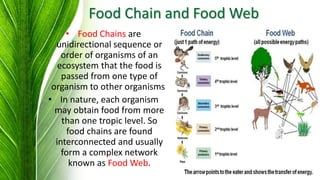
• Food Chains are
unidirectional sequence or
order of organisms of an
ecosystem that the food is
passed from one type of
organism to other organisms.
• In nature, each organism
may obtain food from more
than one tropic level. So
food chains are found
interconnected and usually
form a complex network
known as Food Web.
Grazing and Detritus food chain
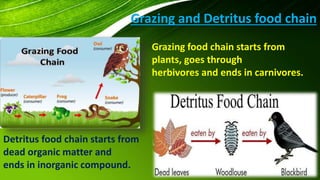
Grazing food chain starts from
plants, goes through
herbivores and ends in carnivores.
Detritus food chain starts from
dead organic matter and
ends in inorganic compound.
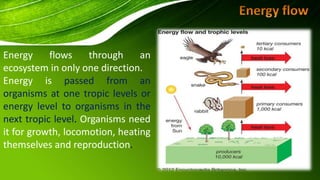
Energy flows through an
ecosystem in only one direction.
Energy is passed from an
organisms at one tropic levels or
energy level to organisms in the
next tropic level. Organisms need
it for growth, locomotion, heating
themselves and reproduction.
Photosynthesis and its important in life
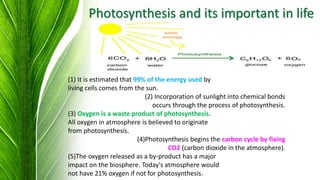
(1) It is estimated that 99% of the energy used by
living cells comes from the sun.
(2) Incorporation of sunlight into chemical bonds
occurs through the process of photosynthesis.
(3) Oxygen is a waste product of photosynthesis.
All oxygen in atmosphere is believed to originate
from photosynthesis.
(4)Photosynthesis begins the carbon cycle by fixing
CO2 (carbon dioxide in the atmosphere).
(5)The oxygen released as a by-product has a major
impact on the biosphere. Today's atmosphere would
not have 21% oxygen if not for photosynthesis.
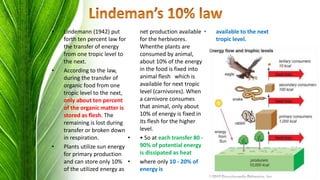
• Lindemann (1942) put
forth ten percent law for
the transfer of energy
from one tropic level to
the next.
• According to the law,
during the transfer of
organic food from one
tropic level to the next,
only about ten percent
of the organic matter is
stored as flesh. The
remaining is lost during
transfer or broken down
in respiration.
• Plants utilize sun energy
for primary production
and can store only 10%
of the utilized energy as
net production available
for the herbivores.
Whenthe plants are
consumed by animal,
about 10% of the energy
in the food is fixed into
animal flesh which is
available for next tropic
level (carnivores). When
a carnivore consumes
that animal, only about
10% of energy is fixed in
its flesh for the higher
level.
• • So at each transfer 80 -
90% of potential energy
is dissipated as heat
• where only 10 - 20% of
energy is
• available to the next
tropic level.
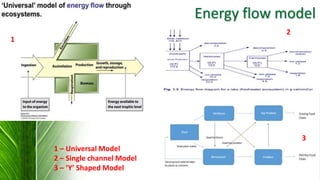
Energy flow model
1
2
3
1 – Universal Model
2 – Single channel Model
3 – ā€˜Y’ Shaped Model
• Solar energy moves through
communities in ecosystems in a
continuous one-way flow;
nutrients, obtained from the
environment, constantly cycle and
recycle within and among
ecosystems.
• Producers (photosynthesizers)
form the first tropic level; they use
solar energy and nutrients to
produce food.
• Consumers (organisms that
cannot photosynthesize) must
acquire energy, and many of their
nutrients are prepackaged in the
molecules of other organisms.
• Primary consumers (herbivores,
which feed on photosynthesizers)
form the second tropic level.
• Secondary consumers
(carnivores, predators that feed
primarily on primary consumers)
form the third tropic level.
• Tertiary consumers (carnivores
that eat other carnivores) form the
fourth tropic level.
• Detritus feeders (animals and
protists that consume dead organic
matter, extract some of its stored
energy, and excrete it in a further
decomposed state) and
decomposers (fungi and bacteria
that secrete digestive enzymes into
the environment) liberate
nutrients for reuse.
• At each tropic level, some energy
is lost to the environment as heat.
• A food chain is a linear feeding
relationship; an organism at one
tropic level eats an organism at the
level below it.
• A food web, a more natural
representation than a food chain,
shows interconnecting food chains
and describes feeding relationships
within a community.
Food web structure and energy flow

Food web structure and energy flow

  • 2.
    • Food Web •Food Chain (Grazing and Detritus food chain) • Energy flow/transfer – Photosynthesis – why is photosynthesis so important to life • Lindeman’s 10% law of energy flow – tropic level • Energy flow model – Single channel energy flow model. – Y - shaped or 2 – channel energy flow model.
  • 3.
    Food Chain andFood Web • Food Chains are unidirectional sequence or order of organisms of an ecosystem that the food is passed from one type of organism to other organisms. • In nature, each organism may obtain food from more than one tropic level. So food chains are found interconnected and usually form a complex network known as Food Web.
  • 4.
    Grazing and Detritusfood chain Grazing food chain starts from plants, goes through herbivores and ends in carnivores. Detritus food chain starts from dead organic matter and ends in inorganic compound.
  • 5.
    Energy flows throughan ecosystem in only one direction. Energy is passed from an organisms at one tropic levels or energy level to organisms in the next tropic level. Organisms need it for growth, locomotion, heating themselves and reproduction.
  • 6.
    Photosynthesis and itsimportant in life (1) It is estimated that 99% of the energy used by living cells comes from the sun. (2) Incorporation of sunlight into chemical bonds occurs through the process of photosynthesis. (3) Oxygen is a waste product of photosynthesis. All oxygen in atmosphere is believed to originate from photosynthesis. (4)Photosynthesis begins the carbon cycle by fixing CO2 (carbon dioxide in the atmosphere). (5)The oxygen released as a by-product has a major impact on the biosphere. Today's atmosphere would not have 21% oxygen if not for photosynthesis.
  • 7.
    • Lindemann (1942)put forth ten percent law for the transfer of energy from one tropic level to the next. • According to the law, during the transfer of organic food from one tropic level to the next, only about ten percent of the organic matter is stored as flesh. The remaining is lost during transfer or broken down in respiration. • Plants utilize sun energy for primary production and can store only 10% of the utilized energy as net production available for the herbivores. Whenthe plants are consumed by animal, about 10% of the energy in the food is fixed into animal flesh which is available for next tropic level (carnivores). When a carnivore consumes that animal, only about 10% of energy is fixed in its flesh for the higher level. • • So at each transfer 80 - 90% of potential energy is dissipated as heat • where only 10 - 20% of energy is • available to the next tropic level.
  • 8.
    Energy flow model 1 2 3 1– Universal Model 2 – Single channel Model 3 – ā€˜Y’ Shaped Model
  • 9.
    • Solar energymoves through communities in ecosystems in a continuous one-way flow; nutrients, obtained from the environment, constantly cycle and recycle within and among ecosystems. • Producers (photosynthesizers) form the first tropic level; they use solar energy and nutrients to produce food. • Consumers (organisms that cannot photosynthesize) must acquire energy, and many of their nutrients are prepackaged in the molecules of other organisms. • Primary consumers (herbivores, which feed on photosynthesizers) form the second tropic level. • Secondary consumers (carnivores, predators that feed primarily on primary consumers) form the third tropic level. • Tertiary consumers (carnivores that eat other carnivores) form the fourth tropic level. • Detritus feeders (animals and protists that consume dead organic matter, extract some of its stored energy, and excrete it in a further decomposed state) and decomposers (fungi and bacteria that secrete digestive enzymes into the environment) liberate nutrients for reuse. • At each tropic level, some energy is lost to the environment as heat. • A food chain is a linear feeding relationship; an organism at one tropic level eats an organism at the level below it. • A food web, a more natural representation than a food chain, shows interconnecting food chains and describes feeding relationships within a community.