

Column Stride Fields aka. DocValues
Simon Willnauer @ Lucene Revolution 2011

PMC Member & Core Comitter Apache Lucene
simonw@apache.org / simonw@jteam.nl
2
Column Stride Fields aka. DocValues

Agenda
‣ What is this all about? aka. The Problem!

‣ The more native solution

‣ DocValues - current state and future

‣ Questions?


                                              3
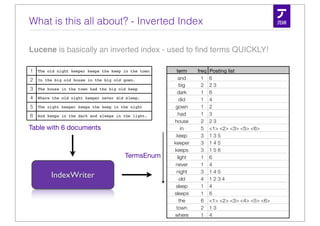
What is this all about? - Inverted Index

Lucene is basically an inverted index - used to find terms QUICKLY!

1   The old night keeper keeps the keep in the town    term     freq   Posting list
2   In the big old house in the big old gown.           and       1    6
                                                         big      2    23
3   The house in the town had the big old keep
                                                       dark       1    6
4   Where the old night keeper never did sleep.
                                                         did      1    4
5   The night keeper keeps the keep in the night       gown       1    2
6   And keeps in the dark and sleeps in the light.      had       1    3
                                                      house       2    23
Table with 6 documents                                    in      5    <1> <2> <3> <5> <6>
                                                       keep       3    135
                                                      keeper      3    145
                                                      keeps       3    156
                                        TermsEnum       light     1    6
                                                       never      1    4
                                                       night      3    145
         IndexWriter                                     old      4    1234
                                                       sleep      1    4
                                                      sleeps      1    6
                                                         the      6    <1> <2> <3> <4> <5> <6>
                                                       town       2    13
                                                      where       1    4
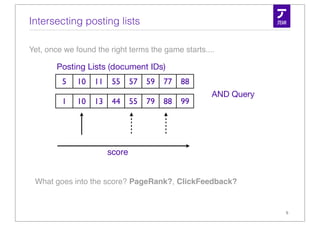
Intersecting posting lists

Yet, once we found the right terms the game starts....

        Posting Lists (document IDs)
         5    10   11    55     57   59   77   88
                                                     AND Query
         1    10   13    44     55   79   88   99


                        score


 What goes into the score? PageRank?, ClickFeedback?


                                                                 5
How to store scoring factors?

Lucene provides 2 ways of storing data

  • Stored Fields (document to String or Binary mapping)
  • Inverted Index (term to document mapping)

What if we need here is one or more values per document!

  • document to value mapping
Why not use Stored Fields?


                                                           6
Using Stored Fields


• Stored Fields serve a different purpose
   • loading body or title fields for result rendering / highlighting
   • very suited for loading multiple values
• With Stored Fields you have one indirection per document resulting in
 going to disk twice for each document

  • on-disk random access is too slow
  • remember Lucene could score millions of documents even if you just
    render the top 10 or 20!


                                                                          7
Stored Fields under the hood

                             Document
                                                     title:        title:
                                   id: 108232
                                                  Deutschland    Germany


                                                absolute file pointers
                       [...][...][93438][...]

  Field Index (.fdx)


                         [...][id:108232title:Deutschlandtitle:Germany][...]

  Field Data (.fdt)
                        numFields(vint) [ fieldid(vint) length(vint) payload ]


                                                                                8
Stored Fields - accessing a field


                            1       Lookup filepointer in .fdx


                       [...][...][93438][...]

  Field Index (.fdx)

                        2         Scan on .fdt until you find the field by ID


                         [...][id:108232title:Deutschlandtitle:Germany][...]

  Field Data (.fdt)
                        numFields(vint) [ fieldid(vint) length(vint) payload ]


                                                                                9
Alternatives?

Lucene can un-invert a field into FieldCache


                               un-invert
 weight                                         term     freq    Posting list
  5.8
                                                 1.0         1   16
  1.0
                                                 2.7         1   23
  2.7
                     parse
  2.7                                            3.2         1   7
  4.3         convert to datatype                4.3         1   4
  7.9
                                                 4.7         1   8
  1.0

  3.2                                            5.8         1   0

  4.7
                                                 7.9         1   59
  7.9
          array per field /                       9.0         1   10
  9.0        segment


float 32                                    string / byte[]                      10
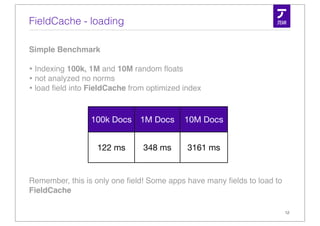
FieldCache - is fast once loaded, once!

• Constant time lookup DocID to value
• Efficient representation
   • primitive array
   • low GC overhead
• loading can be slow (realtime can be a problem)
• must parse values
• builds unnecessary term dictionary
• always memory resident


                                                    11
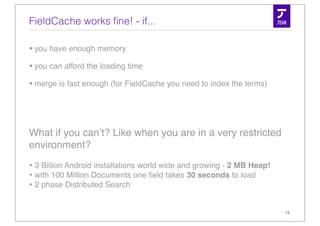
FieldCache - loading

Simple Benchmark

• Indexing 100k, 1M and 10M random floats
• not analyzed no norms
• load field into FieldCache from optimized index


                 100k Docs     1M Docs     10M Docs


                   122 ms      348 ms       3161 ms


Remember, this is only one field! Some apps have many fields to load to
FieldCache

                                                                        12
FieldCache works fine! - if...

• you have enough memory
• you can afford the loading time
• merge is fast enough (for FieldCache you need to index the terms)


What if you canʼt? Like when you are in a very restricted
environment?

• 3 Billion Android installations world wide and growing - 2 MB Heap!
• with 100 Million Documents one field takes 30 seconds to load
• 2 phase Distributed Search

                                                                        13
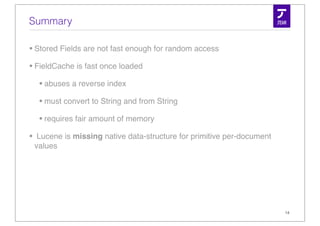
Summary

• Stored Fields are not fast enough for random access
• FieldCache is fast once loaded
   • abuses a reverse index
   • must convert to String and from String
   • requires fair amount of memory
• Lucene is missing native data-structure for primitive per-document
 values


                                                                       14
Column Stride Fields aka. DocValues

Agenda
‣ What is this all about? aka. The Problem!

‣ The more native solution

‣ DocValues - current state and future

‣ Questions?


                                              15
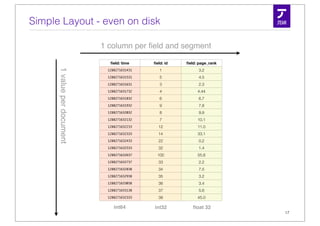
The more native solution - Column Stride Fields

• A dense column based storage
• 1 value per document
• accepts primitives - no conversion from / to String
   • int & long
   • float & double
   • byte[ ]
• each field has a DocValues Type but can still be indexed or stored
• Entirely optional


                                                                      16
Simple Layout - even on disk

                             1 column per field and segment

                               field: time     field: id   field: page_rank
      1 value per document
                              1288271631431      1             3.2
                              1288271631531      5             4.5
                              1288271631631      3             2.3
                              1288271631732      4            4.44
                              1288271631832      6             6.7
                              1288271631932      9             7.8
                              1288271632032      8             9.9
                              1288271632132      7            10.1
                              1288271632233     12            11.0
                              1288271632333     14            33.1
                              1288271632433     22             0.2
                              1288271632533     32             1.4
                              1288271632637     100           55.6
                              1288271632737     33             2.2
                              1288271632838     34             7.5
                              1288271632938     35             3.2
                              1288271633038     36             3.4
                              1288271633138     37             5.6
                              1288271632333     38            45.0

                                 int64        int32         float 32
                                                                           17
Numeric Types - Int

                    Number of bit depend on the numeric
                    range in the field:                                                                        field: id
                                                                            7 - bit per doc                      1
                                                                                                                 5
                                                                                                                 3
                                     Math.max(1, (int) Math.ceil(
                                               Math.log(1+maxValue)/Math.log(2.0))                               4
                                               );
                                                                                                                 6
                                                                                                                 9


                                                                                              Random Access
                                                                                                                 8
                                                                                                                 7
                                                                                                                12
                                                                                                                14
• Integer are stored dense based on PackedInts                                                                  22
                                                                                                                32
• Space depends on the value-range per segment                                                                  100
                                                                                                                33
  Example: [1, 100] maps to [0, 99] requires 7 bit per doc                                                      34
                                                                                                                35
                                                                                                                36

• Floats are stored without compression                                                                         37
                                                                                                                38

   • either 32 or 64 bit per value
                                                                                                                         18
Arbitrary Values - The byte[] variants

• Length Variants:
   • Fixed / Variable
• Store Variants:
   • Straight or Referenced
                                        fixed / straight                   fixed / deref
                                              data                        offsets          data

                                            10/01/2011                      0            10/01/2011

                                            12/01/2011                      10           12/01/2011


                                                          Random Access
                        Random Access


                                            10/04/2011                      20           10/04/2011
                                            10/06/2011                      30
                                                                                         10/06/2011
                                            10/05/2011                      40
                                                                                         10/05/2011
                                            10/01/2011                      50
                                                                                         10/01/2011
                                            10/07/2011                      60
                                                                                         10/07/2011
                                            10/04/2011                      20

                                            10/04/2011                      20

                                            10/04/2011                      20                        19
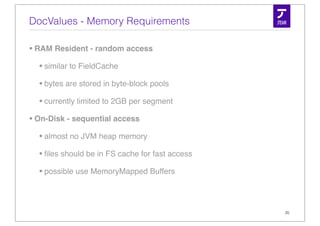
DocValues - Memory Requirements

• RAM Resident - random access
   • similar to FieldCache
   • bytes are stored in byte-block pools
   • currently limited to 2GB per segment
• On-Disk - sequential access
   • almost no JVM heap memory
   • files should be in FS cache for fast access
   • possible use MemoryMapped Buffers


                                                  20
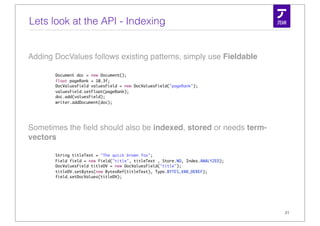
Lets look at the API - Indexing


Adding DocValues follows existing patterns, simply use Fieldable

       Document doc = new Document();
       float pageRank = 10.3f;
       DocValuesField valuesField = new DocValuesField("pageRank");
       valuesField.setFloat(pageRank);
       doc.add(valuesField);
       writer.addDocument(doc);


Sometimes the field should also be indexed, stored or needs term-
vectors

       String titleText = "The quick brown fox";
       Field field = new Field("title", titleText , Store.NO, Index.ANALYZED);
       DocValuesField titleDV = new DocValuesField("title");
       titleDV.setBytes(new BytesRef(titleText), Type.BYTES_VAR_DEREF);
       field.setDocValues(titleDV);


                                                                                 21
Looking at the API - Search / Retrieve


On disk sequential access is exposed through DocValuesEnum

 IndexReader reader = ...;
 DocValues values = reader.docValues("pageRank");
 DocValuesEnum floatEnum = values.getEnum();
 int doc = 0;
 FloatsRef ref = floatEnum.getFloat(); // values are filled when iterating

 while((doc = floatEnum.nextDoc()) != DocValuesEnum.NO_MORE_DOCS) {
   double value = ref.floats[0];
 }

 // equivalent to ...

 int doc = 0;
 while((doc = floatEnum.advance(doc+1)) != DocValuesEnum.NO_MORE_DOCS) {
   double value = ref.floats[0];
 }


DocValuesEnum is based on DocIdSetIterator just like Scorer or
DocsEnum

                                                                             22
Looking at the API - Search / Retrieve


RAM Resident API is very similar to FieldCache


IndexReader reader = ...;
DocValues values = reader.docValues("pageRank");
Source source = values.getSource();
double value = source.getFloat(x);

// still allows iterating over the RAM resident values

DocValuesEnum floatEnum = source.getEnum();
int doc;
FloatsRef ref = floatEnum.getFloat();
while((doc = floatEnum.nextDoc()) != DocValuesEnum.NO_MORE_DOCS) {
  value = ref.floats[0];
}


DocValuesEnum still available on RAM Resident API


                                                                     23
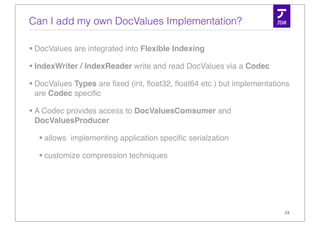
Can I add my own DocValues Implementation?

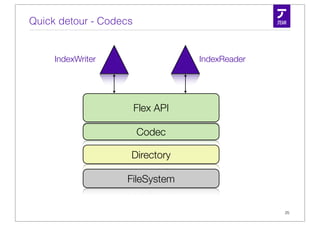
• DocValues are integrated into Flexible Indexing
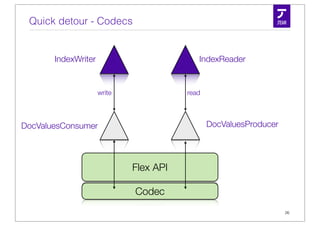
• IndexWriter / IndexReader write and read DocValues via a Codec
• DocValues Types are fixed (int, float32, float64 etc.) but implementations
 are Codec specific

• A Codec provides access to DocValuesComsumer and
 DocValuesProducer

  • allows implementing application specific serialzation
  • customize compression techniques


                                                                       24
Quick detour - Codecs


     IndexWriter                   IndexReader


                        Flex API

                        Codec

                    Directory

                   FileSystem


                                                 25
Quick detour - Codecs


       IndexWriter                         IndexReader


                     write              read


DocValuesConsumer                              DocValuesProducer


                             Flex API

                             Codec
                                                                   26
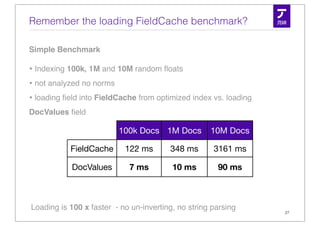
Remember the loading FieldCache benchmark?

Simple Benchmark

• Indexing 100k, 1M and 10M random floats
• not analyzed no norms
• loading field into FieldCache from optimized index vs. loading
DocValues field

                         100k Docs 1M Docs          10M Docs

           FieldCache      122 ms       348 ms       3161 ms

            DocValues       7 ms         10 ms        90 ms


Loading is 100 x faster - no un-inverting, no string parsing
                                                                  27
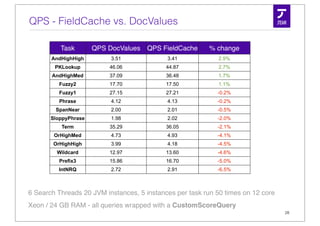
QPS - FieldCache vs. DocValues

          Task        QPS DocValues   QPS FieldCache     % change
       AndHighHigh         3.51             3.41            2.9%
        PKLookup          46.06             44.87           2.7%
       AndHighMed         37.09             36.48           1.7%
          Fuzzy2          17.70             17.50           1.1%
          Fuzzy1          27.15             27.21           -0.2%
          Phrase           4.12             4.13            -0.2%
        SpanNear           2.00             2.01            -0.5%
       SloppyPhrase        1.98             2.02            -2.0%
           Term           35.29             36.05           -2.1%
        OrHighMed          4.73             4.93            -4.1%
        OrHighHigh         3.99             4.18            -4.5%
         Wildcard         12.97             13.60           -4.6%
          Prefix3         15.86             16.70           -5.0%
         IntNRQ            2.72             2.91            -6.5%


6 Search Threads 20 JVM instances, 5 instances per task run 50 times on 12 core
Xeon / 24 GB RAM - all queries wrapped with a CustomScoreQuery
                                                                                  28
Column Stride Fields aka. DocValues

Agenda
‣ What is this all about? aka. The Problem!

‣ The more native solution

‣ DocValues - current state and future

‣ Questions?


                                              29
DocValues - current state

• Currently still in a branch
   • Some minor JavaDoc issues
   • needs some cleanups

• Landing on trunk very soon
   • issue is already opened and active


                                          30
DocValues - current features

• Fully customizable via Codecs
• User can control memory usage per field
• Suitable for environments where memory is tight
• Compact and native representation on disk and in RAM
• Fast Loading times
• Comparable to FieldCache (small overhead)
• Direct value access even when on disk (single seek)


                                                         31
DocValues - what is next?

• the ultimate goal for DocValues is to be update-able
   • changing a per-document values without reindexing
   • users can replace existing values directly for each document
   • each field by itself will be update-able
• Will be available in Lucene 4.0 once released ;)


                                                                    32
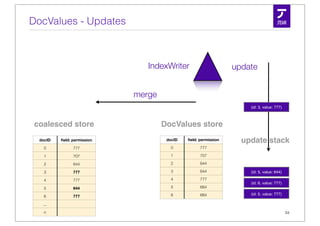
DocValues - Updates

• Lucene has write-once policy for files
   • Changing in place is not a good idea - Consistency / Corruption!
• Problem is comparable to norms or deleted docs
   • updating norms requires re-writing the entire norms array (1 byte per
    Document with in memory copy-on-write)

  • same is true for deleted docs while cost is low (1 bit per document)
• DocValues will use a stacked-approach instead


                                                                           33
DocValues - Updates


                                IndexWriter                      update


                             merge
                                                                     (id: 3, value: 777)


coalesced store                      DocValues store
  docID   field: permission            docID   field: permission     update stack
    0           777                     0           777

    1           707                     1           707

    2           644                     2           644

    3           777                     3           644              (id: 5, value: 644)

    4           777                     4           777
                                                                     (id: 6, value: 777)
    5           644                     5           664
                                        6           664              (id: 5, value: 777)
    6           777

   ...

    n                                                                                      34
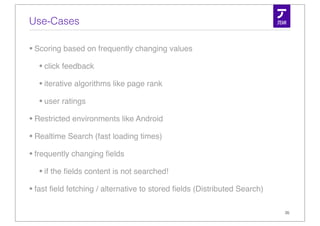
Use-Cases

• Scoring based on frequently changing values
    • click feedback
    • iterative algorithms like page rank
    • user ratings
• Restricted environments like Android
• Realtime Search (fast loading times)
• frequently changing fields
    • if the fields content is not searched!
• fast field fetching / alternative to stored fields (Distributed Search)
                                                                          35
Questions?


Thank you for your attention!


                                36

Column Stride Fields aka. DocValues

  • 1.
    Column Stride Fieldsaka. DocValues Simon Willnauer @ Lucene Revolution 2011 PMC Member & Core Comitter Apache Lucene simonw@apache.org / simonw@jteam.nl
  • 2.
  • 3.
    Column Stride Fieldsaka. DocValues Agenda ‣ What is this all about? aka. The Problem! ‣ The more native solution ‣ DocValues - current state and future ‣ Questions? 3
  • 4.
    What is thisall about? - Inverted Index Lucene is basically an inverted index - used to find terms QUICKLY! 1 The old night keeper keeps the keep in the town term freq Posting list 2 In the big old house in the big old gown. and 1 6 big 2 23 3 The house in the town had the big old keep dark 1 6 4 Where the old night keeper never did sleep. did 1 4 5 The night keeper keeps the keep in the night gown 1 2 6 And keeps in the dark and sleeps in the light. had 1 3 house 2 23 Table with 6 documents in 5 <1> <2> <3> <5> <6> keep 3 135 keeper 3 145 keeps 3 156 TermsEnum light 1 6 never 1 4 night 3 145 IndexWriter old 4 1234 sleep 1 4 sleeps 1 6 the 6 <1> <2> <3> <4> <5> <6> town 2 13 where 1 4
  • 5.
    Intersecting posting lists Yet,once we found the right terms the game starts.... Posting Lists (document IDs) 5 10 11 55 57 59 77 88 AND Query 1 10 13 44 55 79 88 99 score What goes into the score? PageRank?, ClickFeedback? 5
  • 6.
    How to storescoring factors? Lucene provides 2 ways of storing data • Stored Fields (document to String or Binary mapping) • Inverted Index (term to document mapping) What if we need here is one or more values per document! • document to value mapping Why not use Stored Fields? 6
  • 7.
    Using Stored Fields •Stored Fields serve a different purpose • loading body or title fields for result rendering / highlighting • very suited for loading multiple values • With Stored Fields you have one indirection per document resulting in going to disk twice for each document • on-disk random access is too slow • remember Lucene could score millions of documents even if you just render the top 10 or 20! 7
  • 8.
    Stored Fields underthe hood Document title: title: id: 108232 Deutschland Germany absolute file pointers [...][...][93438][...] Field Index (.fdx) [...][id:108232title:Deutschlandtitle:Germany][...] Field Data (.fdt) numFields(vint) [ fieldid(vint) length(vint) payload ] 8
  • 9.
    Stored Fields -accessing a field 1 Lookup filepointer in .fdx [...][...][93438][...] Field Index (.fdx) 2 Scan on .fdt until you find the field by ID [...][id:108232title:Deutschlandtitle:Germany][...] Field Data (.fdt) numFields(vint) [ fieldid(vint) length(vint) payload ] 9
  • 10.
    Alternatives? Lucene can un-inverta field into FieldCache un-invert weight term freq Posting list 5.8 1.0 1 16 1.0 2.7 1 23 2.7 parse 2.7 3.2 1 7 4.3 convert to datatype 4.3 1 4 7.9 4.7 1 8 1.0 3.2 5.8 1 0 4.7 7.9 1 59 7.9 array per field / 9.0 1 10 9.0 segment float 32 string / byte[] 10
  • 11.
    FieldCache - isfast once loaded, once! • Constant time lookup DocID to value • Efficient representation • primitive array • low GC overhead • loading can be slow (realtime can be a problem) • must parse values • builds unnecessary term dictionary • always memory resident 11
  • 12.
    FieldCache - loading SimpleBenchmark • Indexing 100k, 1M and 10M random floats • not analyzed no norms • load field into FieldCache from optimized index 100k Docs 1M Docs 10M Docs 122 ms 348 ms 3161 ms Remember, this is only one field! Some apps have many fields to load to FieldCache 12
  • 13.
    FieldCache works fine!- if... • you have enough memory • you can afford the loading time • merge is fast enough (for FieldCache you need to index the terms) What if you canʼt? Like when you are in a very restricted environment? • 3 Billion Android installations world wide and growing - 2 MB Heap! • with 100 Million Documents one field takes 30 seconds to load • 2 phase Distributed Search 13
  • 14.
    Summary • Stored Fieldsare not fast enough for random access • FieldCache is fast once loaded • abuses a reverse index • must convert to String and from String • requires fair amount of memory • Lucene is missing native data-structure for primitive per-document values 14
  • 15.
    Column Stride Fieldsaka. DocValues Agenda ‣ What is this all about? aka. The Problem! ‣ The more native solution ‣ DocValues - current state and future ‣ Questions? 15
  • 16.
    The more nativesolution - Column Stride Fields • A dense column based storage • 1 value per document • accepts primitives - no conversion from / to String • int & long • float & double • byte[ ] • each field has a DocValues Type but can still be indexed or stored • Entirely optional 16
  • 17.
    Simple Layout -even on disk 1 column per field and segment field: time field: id field: page_rank 1 value per document 1288271631431 1 3.2 1288271631531 5 4.5 1288271631631 3 2.3 1288271631732 4 4.44 1288271631832 6 6.7 1288271631932 9 7.8 1288271632032 8 9.9 1288271632132 7 10.1 1288271632233 12 11.0 1288271632333 14 33.1 1288271632433 22 0.2 1288271632533 32 1.4 1288271632637 100 55.6 1288271632737 33 2.2 1288271632838 34 7.5 1288271632938 35 3.2 1288271633038 36 3.4 1288271633138 37 5.6 1288271632333 38 45.0 int64 int32 float 32 17
  • 18.
    Numeric Types -Int Number of bit depend on the numeric range in the field: field: id 7 - bit per doc 1 5 3 Math.max(1, (int) Math.ceil( Math.log(1+maxValue)/Math.log(2.0)) 4 ); 6 9 Random Access 8 7 12 14 • Integer are stored dense based on PackedInts 22 32 • Space depends on the value-range per segment 100 33 Example: [1, 100] maps to [0, 99] requires 7 bit per doc 34 35 36 • Floats are stored without compression 37 38 • either 32 or 64 bit per value 18
  • 19.
    Arbitrary Values -The byte[] variants • Length Variants: • Fixed / Variable • Store Variants: • Straight or Referenced fixed / straight fixed / deref data offsets data 10/01/2011 0 10/01/2011 12/01/2011 10 12/01/2011 Random Access Random Access 10/04/2011 20 10/04/2011 10/06/2011 30 10/06/2011 10/05/2011 40 10/05/2011 10/01/2011 50 10/01/2011 10/07/2011 60 10/07/2011 10/04/2011 20 10/04/2011 20 10/04/2011 20 19
  • 20.
    DocValues - MemoryRequirements • RAM Resident - random access • similar to FieldCache • bytes are stored in byte-block pools • currently limited to 2GB per segment • On-Disk - sequential access • almost no JVM heap memory • files should be in FS cache for fast access • possible use MemoryMapped Buffers 20
  • 21.
    Lets look atthe API - Indexing Adding DocValues follows existing patterns, simply use Fieldable Document doc = new Document(); float pageRank = 10.3f; DocValuesField valuesField = new DocValuesField("pageRank"); valuesField.setFloat(pageRank); doc.add(valuesField); writer.addDocument(doc); Sometimes the field should also be indexed, stored or needs term- vectors String titleText = "The quick brown fox"; Field field = new Field("title", titleText , Store.NO, Index.ANALYZED); DocValuesField titleDV = new DocValuesField("title"); titleDV.setBytes(new BytesRef(titleText), Type.BYTES_VAR_DEREF); field.setDocValues(titleDV); 21
  • 22.
    Looking at theAPI - Search / Retrieve On disk sequential access is exposed through DocValuesEnum IndexReader reader = ...; DocValues values = reader.docValues("pageRank"); DocValuesEnum floatEnum = values.getEnum(); int doc = 0; FloatsRef ref = floatEnum.getFloat(); // values are filled when iterating while((doc = floatEnum.nextDoc()) != DocValuesEnum.NO_MORE_DOCS) { double value = ref.floats[0]; } // equivalent to ... int doc = 0; while((doc = floatEnum.advance(doc+1)) != DocValuesEnum.NO_MORE_DOCS) { double value = ref.floats[0]; } DocValuesEnum is based on DocIdSetIterator just like Scorer or DocsEnum 22
  • 23.
    Looking at theAPI - Search / Retrieve RAM Resident API is very similar to FieldCache IndexReader reader = ...; DocValues values = reader.docValues("pageRank"); Source source = values.getSource(); double value = source.getFloat(x); // still allows iterating over the RAM resident values DocValuesEnum floatEnum = source.getEnum(); int doc; FloatsRef ref = floatEnum.getFloat(); while((doc = floatEnum.nextDoc()) != DocValuesEnum.NO_MORE_DOCS) { value = ref.floats[0]; } DocValuesEnum still available on RAM Resident API 23
  • 24.
    Can I addmy own DocValues Implementation? • DocValues are integrated into Flexible Indexing • IndexWriter / IndexReader write and read DocValues via a Codec • DocValues Types are fixed (int, float32, float64 etc.) but implementations are Codec specific • A Codec provides access to DocValuesComsumer and DocValuesProducer • allows implementing application specific serialzation • customize compression techniques 24
  • 25.
    Quick detour -Codecs IndexWriter IndexReader Flex API Codec Directory FileSystem 25
  • 26.
    Quick detour -Codecs IndexWriter IndexReader write read DocValuesConsumer DocValuesProducer Flex API Codec 26
  • 27.
    Remember the loadingFieldCache benchmark? Simple Benchmark • Indexing 100k, 1M and 10M random floats • not analyzed no norms • loading field into FieldCache from optimized index vs. loading DocValues field 100k Docs 1M Docs 10M Docs FieldCache 122 ms 348 ms 3161 ms DocValues 7 ms 10 ms 90 ms Loading is 100 x faster - no un-inverting, no string parsing 27
  • 28.
    QPS - FieldCachevs. DocValues Task QPS DocValues QPS FieldCache % change AndHighHigh 3.51 3.41 2.9% PKLookup 46.06 44.87 2.7% AndHighMed 37.09 36.48 1.7% Fuzzy2 17.70 17.50 1.1% Fuzzy1 27.15 27.21 -0.2% Phrase 4.12 4.13 -0.2% SpanNear 2.00 2.01 -0.5% SloppyPhrase 1.98 2.02 -2.0% Term 35.29 36.05 -2.1% OrHighMed 4.73 4.93 -4.1% OrHighHigh 3.99 4.18 -4.5% Wildcard 12.97 13.60 -4.6% Prefix3 15.86 16.70 -5.0% IntNRQ 2.72 2.91 -6.5% 6 Search Threads 20 JVM instances, 5 instances per task run 50 times on 12 core Xeon / 24 GB RAM - all queries wrapped with a CustomScoreQuery 28
  • 29.
    Column Stride Fieldsaka. DocValues Agenda ‣ What is this all about? aka. The Problem! ‣ The more native solution ‣ DocValues - current state and future ‣ Questions? 29
  • 30.
    DocValues - currentstate • Currently still in a branch • Some minor JavaDoc issues • needs some cleanups • Landing on trunk very soon • issue is already opened and active 30
  • 31.
    DocValues - currentfeatures • Fully customizable via Codecs • User can control memory usage per field • Suitable for environments where memory is tight • Compact and native representation on disk and in RAM • Fast Loading times • Comparable to FieldCache (small overhead) • Direct value access even when on disk (single seek) 31
  • 32.
    DocValues - whatis next? • the ultimate goal for DocValues is to be update-able • changing a per-document values without reindexing • users can replace existing values directly for each document • each field by itself will be update-able • Will be available in Lucene 4.0 once released ;) 32
  • 33.
    DocValues - Updates •Lucene has write-once policy for files • Changing in place is not a good idea - Consistency / Corruption! • Problem is comparable to norms or deleted docs • updating norms requires re-writing the entire norms array (1 byte per Document with in memory copy-on-write) • same is true for deleted docs while cost is low (1 bit per document) • DocValues will use a stacked-approach instead 33
  • 34.
    DocValues - Updates IndexWriter update merge (id: 3, value: 777) coalesced store DocValues store docID field: permission docID field: permission update stack 0 777 0 777 1 707 1 707 2 644 2 644 3 777 3 644 (id: 5, value: 644) 4 777 4 777 (id: 6, value: 777) 5 644 5 664 6 664 (id: 5, value: 777) 6 777 ... n 34
  • 35.
    Use-Cases • Scoring basedon frequently changing values • click feedback • iterative algorithms like page rank • user ratings • Restricted environments like Android • Realtime Search (fast loading times) • frequently changing fields • if the fields content is not searched! • fast field fetching / alternative to stored fields (Distributed Search) 35
  • 36.
    Questions? Thank you foryour attention! 36