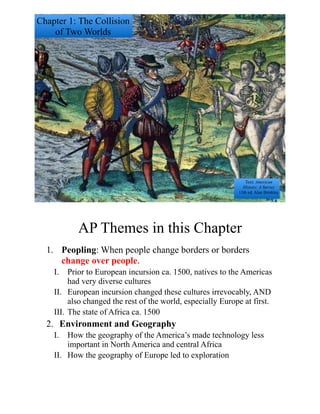
Chapter 1: The Collision
of Two Worlds
Text: American
History: A Survey
13th ed. Alan Brinkley
AP Themes in this Chapter
1. Peopling: When people change borders or borders
change over people.
I. Prior to European incursion ca. 1500, natives to the Americas
had very diverse cultures
II. European incursion changed these cultures irrevocably, AND
also changed the rest of the world, especially Europe at first.
III. The state of Africa ca. 1500
2. Environment and Geography
I. How the geography of the America’s made technology less
important in North America and central Africa
II. How the geography of Europe led to exploration
AP Skills in Chapter 1
1. Comparison and Contextualization
I. Comparing various American cultures
II. Comparing European cultures (ex: Protestant vs.
Catholic)
III. Comparing African cultures
IV. Comparing American, African and European cultures
V. Contextualization. How was early colonization of
the Americas a part of larger regional, national, and
global processes?
AP Skills in Chapter 1
1. Continuity and Change over Time
I. What changed, what stayed the same for European
settlers in the New world. Did they retain their
old ways????
II. What changed, what stayed the same for natives
after first contact????
III. What changed, what stayed the same for African
cultures due to European expanstion of trade,
especially the slave trade????
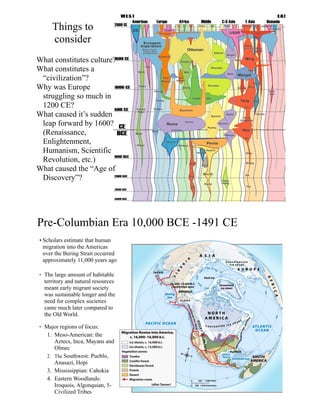
Things to
consider
What constitutes culture?
What constitutes a
“civilization”?
Why was Europe
struggling so much in
1200 CE?
What caused it’s sudden
leap forward by 1600?
(Renaissance,
Enlightenment,
Humanism, Scientific
Revolution, etc.)
What caused the “Age of
Discovery”?
Pre-Columbian Era 10,000 BCE -1491 CE
• Scholars estimate that human
migration into the Americas
over the Bering Strait occurred
approximately 11,000 years ago
• The large amount of habitable
territory and natural resources
meant early migrant society
was sustainable longer and the
need for complex societies
came much later compared to
the Old World.
• Major regions of focus:
1. Meso-American: the
Aztecs, Inca, Mayans and
Olmec
2. The Southwest: Pueblo,
Anasazi, Hopi
3. Mississippian: Cahokia
4. Eastern Woodlands:
Iroquois, Algonquian, 5-
Civilized Tribes
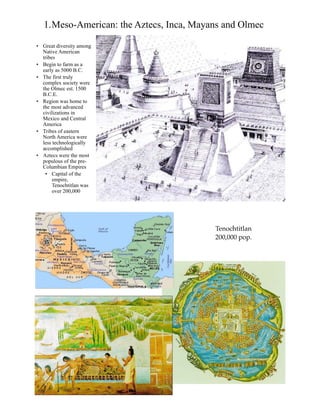
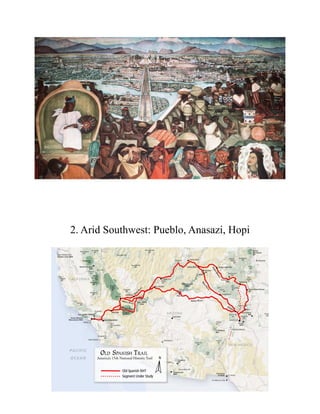
1.Meso-American: the Aztecs, Inca, Mayans and Olmec
• Great diversity among
Native American
tribes
• Begin to farm as a
early as 5000 B.C.
• The first truly
complex society were
the Olmec est. 1500
B.C.E.
• Region was home to
the most advanced
civilizations in
Mexico and Central
America
• Tribes of eastern
North America were
less technologically
accomplished
• Aztecs were the most
populous of the pre-
Columbian Empires
• Capital of the
empire,
Tenochtitlan was
over 200,000
Tenochtitlan
200,000 pop.
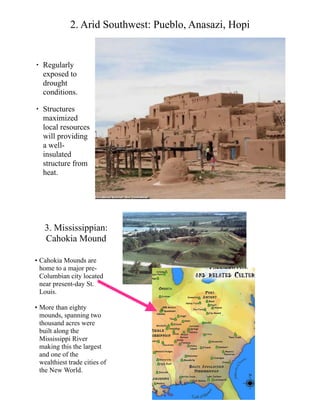
2. Arid Southwest: Pueblo, Anasazi, Hopi
• Regularly
exposed to
drought
conditions.
• Structures
maximized
local resources
will providing
a well-
insulated
structure from
heat.
3. Mississippian:
Cahokia Mound
• Cahokia Mounds are
home to a major pre-
Columbian city located
near present-day St.
Louis.
• More than eighty
mounds, spanning two
thousand acres were
built along the
Mississippi River
making this the largest
and one of the
wealthiest trade cities of
the New World.
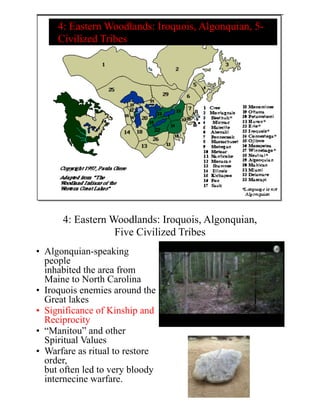
4: Eastern Woodlands: Iroquois, Algonquian, 5-
Civilized Tribes
4: Eastern Woodlands: Iroquois, Algonquian,
Five Civilized Tribes
• Algonquian-speaking
people 

inhabited the area from 

Maine to North Carolina
• Iroquois enemies around the 

Great lakes
• Significance of Kinship and
Reciprocity
• “Manitou” and other
Spiritual Values
• Warfare as ritual to restore
order, 

but often led to very bloody
internecine warfare.
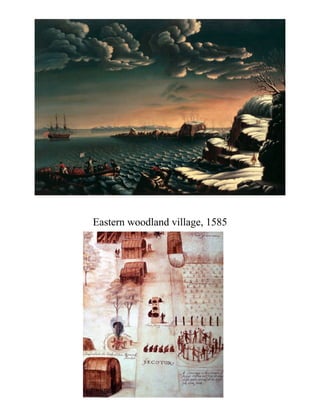
Eastern woodland village, 1585
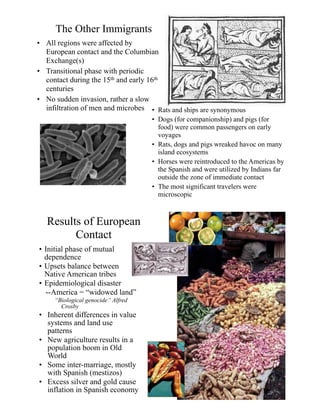
The Other Immigrants
• All regions were affected by
European contact and the Columbian
Exchange(s)
• Transitional phase with periodic
contact during the 15th and early 16th
centuries
• No sudden invasion, rather a slow
infiltration of men and microbes • Rats and ships are synonymous
• Dogs (for companionship) and pigs (for
food) were common passengers on early
voyages
• Rats, dogs and pigs wreaked havoc on many
island ecosystems
• Horses were reintroduced to the Americas by
the Spanish and were utilized by Indians far
outside the zone of immediate contact
• The most significant travelers were
microscopic
Results of European
Contact
• Initial phase of mutual
dependence
• Upsets balance between
Native American tribes
• Epidemiological disaster
--America = “widowed land”
“Biological genocide” Alfred
Crosby
• Inherent differences in value
systems and land use
patterns
• New agriculture results in a
population boom in Old
World
• Some inter-marriage, mostly
with Spanish (mestizos)
• Excess silver and gold cause
inflation in Spanish economy
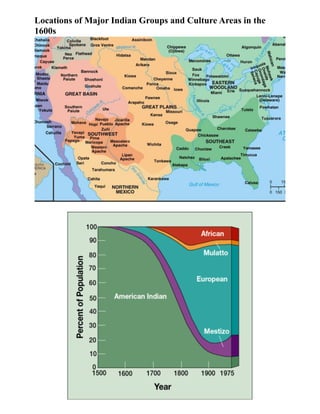
Locations of Major Indian Groups and Culture Areas in the
1600s
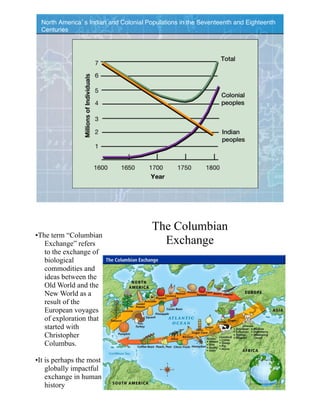
North America s Indian and Colonial Populations in the Seventeenth and Eighteenth
Centuries
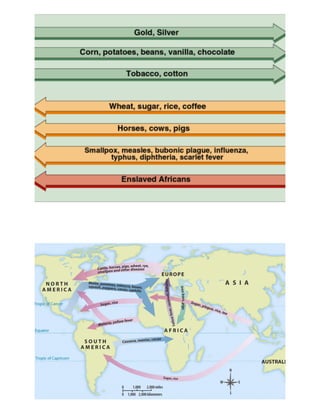
The Columbian
Exchange
•The term “Columbian
Exchange” refers
to the exchange of
biological
commodities and
ideas between the
Old World and the
New World as a
result of the
European voyages
of exploration that
started with
Christopher
Columbus.
•It is perhaps the most
globally impactful
exchange in human
history
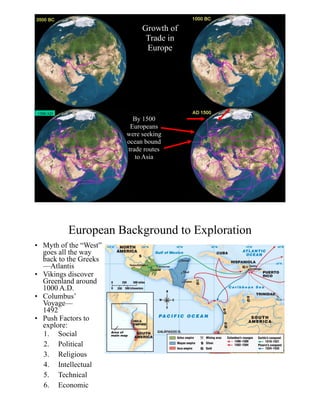
Growth of
Trade in
Europe
1300 AD
By 1500
Europeans
were seeking
ocean bound
trade routes
to Asia
European Background to Exploration
• Myth of the “West”
goes all the way
back to the Greeks
—Atlantis
• Vikings discover
Greenland around
1000 A.D.
• Columbus’ 

Voyage—

1492
• Push Factors to
explore:
1. Social
2. Political
3. Religious
4. Intellectual
5. Technical
6. Economic
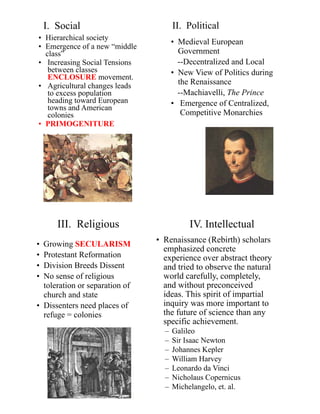
I. Social
• Hierarchical society
• Emergence of a new “middle
class”
• Increasing Social Tensions
between classes
ENCLOSURE movement.
• Agricultural changes leads
to excess population
heading toward European
towns and American
colonies
• PRIMOGENITURE
II. Political
• Medieval European
Government
--Decentralized and Local
• New View of Politics during
the Renaissance
--Machiavelli, The Prince
• Emergence of Centralized,
Competitive Monarchies
III. Religious
• Growing SECULARISM
• Protestant Reformation
• Division Breeds Dissent
• No sense of religious
toleration or separation of
church and state
• Dissenters need places of
refuge = colonies
• Renaissance (Rebirth) scholars
emphasized concrete
experience over abstract theory
and tried to observe the natural
world carefully, completely,
and without preconceived
ideas. This spirit of impartial
inquiry was more important to
the future of science than any
specific achievement.
– Galileo
– Sir Isaac Newton
– Johannes Kepler
– William Harvey
– Leonardo da Vinci
– Nicholaus Copernicus
– Michelangelo, et. al.
IV. Intellectual
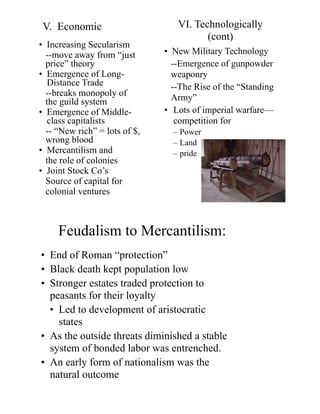
V. Economic
• Increasing Secularism
--move away from “just
price” theory
• Emergence of Long-
Distance Trade
--breaks monopoly of
the guild system
• Emergence of Middle-
class capitalists
-- “New rich” = lots of $,
wrong blood
• Mercantilism and
the role of colonies
• Joint Stock Co’s
Source of capital for
colonial ventures
• New Military Technology
--Emergence of gunpowder
weaponry
--The Rise of the “Standing
Army”
• Lots of imperial warfare—
competition for
– Power
– Land
– pride
VI. Technologically
(cont)
Feudalism to Mercantilism:
• End of Roman “protection”
• Black death kept population low
• Stronger estates traded protection to
peasants for their loyalty
• Led to development of aristocratic
states
• As the outside threats diminished a stable
system of bonded labor was entrenched.
• An early form of nationalism was the
natural outcome
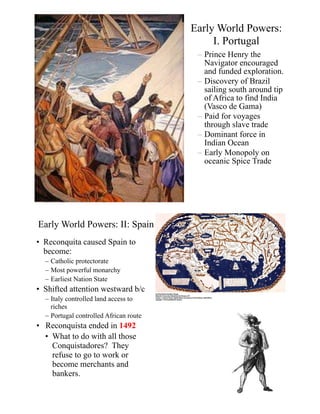
Early World Powers: 

I. Portugal
– Prince Henry the
Navigator encouraged
and funded exploration.
– Discovery of Brazil
sailing south around tip
of Africa to find India
(Vasco de Gama)
– Paid for voyages
through slave trade
– Dominant force in
Indian Ocean
– Early Monopoly on
oceanic Spice Trade
Early World Powers: II: Spain
• Reconquita caused Spain to
become:
– Catholic protectorate
– Most powerful monarchy
– Earliest Nation State
• Shifted attention westward b/c
– Italy controlled land access to
riches
– Portugal controlled African route
• Reconquista ended in 1492
• What to do with all those
Conquistadores? They
refuse to go to work or
become merchants and
bankers.
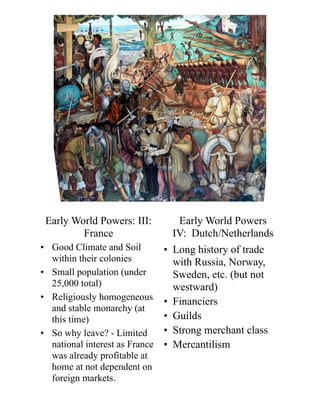
Early World Powers
IV: Dutch/Netherlands
• Long history of trade
with Russia, Norway,
Sweden, etc. (but not
westward)
• Financiers
• Guilds
• Strong merchant class
• Mercantilism
• Good Climate and Soil
within their colonies
• Small population (under
25,000 total)
• Religiously homogeneous
and stable monarchy (at
this time)
• So why leave? - Limited
national interest as France
was already profitable at
home at not dependent on
foreign markets.
Early World Powers: III:
France
Early World Powers

V: Italy
• Not a country/nation state,
but dozens of principalities
and kingdoms that
constantly squabbled for
dominance of:
• Early wealth due to position
b/w Arab world (supply) and
Europe (growing demand)
• Controls the Vatican and
therefore the Pope
• Will be the financier of Joint
Stock companies, and
voyages of exploration.
Factors in Exploration
• Accidental discovery.
• Desire to bypass Moslem world’s
monopoly on trade (luxury?)
goods.
• Disruptions of overland routes
• Intra-European rivalry.
• Curiosity.
• Rebirth of science and medicine
due to contact with Muslim
world (their Golden Age) led to
vastly increased life span and
population growth.
• End of Black Death 1350 (further
Population Pressure—what do
people do during GOOD times?)
• End of Reconquista
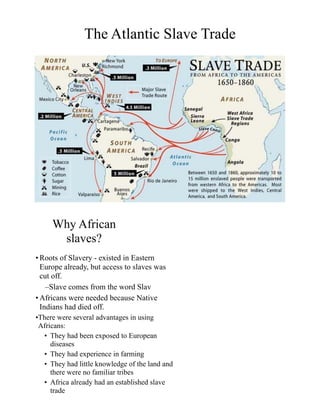
The Atlantic Slave Trade
Why African
slaves?
• Roots of Slavery - existed in Eastern
Europe already, but access to slaves was
cut off.
–Slave comes from the word Slav
• Africans were needed because Native
Indians had died off.
•There were several advantages in using
Africans:
• They had been exposed to European
diseases
• They had experience in farming
• They had little knowledge of the land and
there were no familiar tribes
• Africa already had an established slave
trade
The Triangular Trade
• England dominated the slave trade
from the 1690 until 1807.
• By 1830, there were nearly 2 million
African slaves in North America.
• African merchants, with the help of
local rulers, captured fellow Africans
to be enslaved.
• They delivered them to the Europeans
in exchange for gold, guns and other
goods.
• The trade routes formed a Triangle,
becoming known as the triangular
trade.
•Manufactured goods from
Europe to Africa
•Slaves from Africa to the
Americas
•Rum and raw materials from
the Americas to Europe
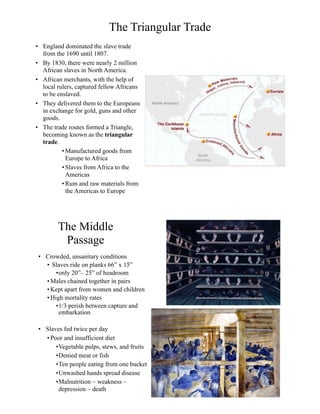
The Middle
Passage
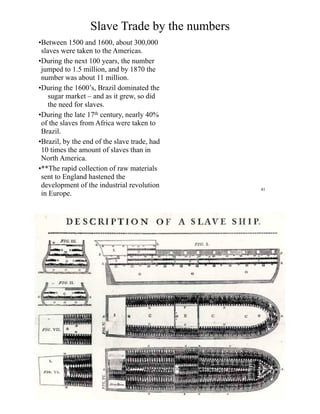
• Crowded, unsanitary conditions
• Slaves ride on planks 66” x 15”
•only 20”– 25” of headroom
• Males chained together in pairs
• Kept apart from women and children
• High mortality rates
•1/3 perish between capture and
embarkation
• Slaves fed twice per day
• Poor and insufficient diet
•Vegetable pulps, stews, and fruits
•Denied meat or fish
•Ten people eating from one bucket
•Unwashed hands spread disease
•Malnutrition ~ weakness ~
depression ~ death
Slave Trade by the numbers
•Between 1500 and 1600, about 300,000
slaves were taken to the Americas.
•During the next 100 years, the number
jumped to 1.5 million, and by 1870 the
number was about 11 million.
•During the 1600’s, Brazil dominated the
sugar market – and as it grew, so did
the need for slaves.
•During the late 17th century, nearly 40%
of the slaves from Africa were taken to
Brazil.
•Brazil, by the end of the slave trade, had
10 times the amount of slaves than in
North America.
•**The rapid collection of raw materials
sent to England hastened the
development of the industrial revolution
in Europe.
41
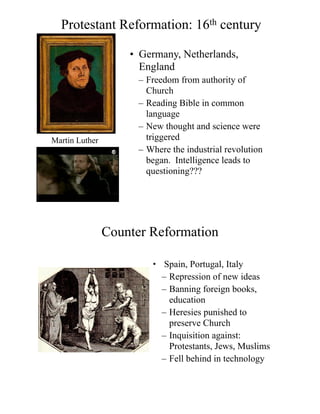
Protestant Reformation: 16th century
• Germany, Netherlands,
England
– Freedom from authority of
Church
– Reading Bible in common
language
– New thought and science were
triggered
– Where the industrial revolution
began. Intelligence leads to
questioning???
Martin Luther
Counter Reformation
• Spain, Portugal, Italy
– Repression of new ideas
– Banning foreign books,
education
– Heresies punished to
preserve Church
– Inquisition against:
Protestants, Jews, Muslims
– Fell behind in technology
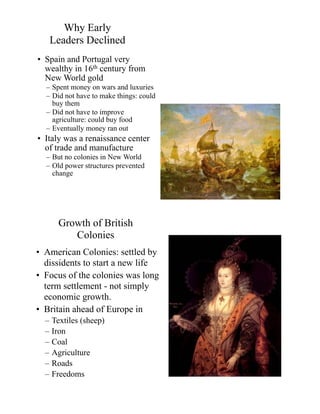
Why Early
Leaders Declined
• Spain and Portugal very
wealthy in 16th century from
New World gold
– Spent money on wars and luxuries
– Did not have to make things: could
buy them
– Did not have to improve
agriculture: could buy food
– Eventually money ran out
• Italy was a renaissance center
of trade and manufacture
– But no colonies in New World
– Old power structures prevented
change
Growth of British
Colonies
• American Colonies: settled by
dissidents to start a new life
• Focus of the colonies was long
term settlement - not simply
economic growth.
• Britain ahead of Europe in
– Textiles (sheep)
– Iron
– Coal
– Agriculture
– Roads
– Freedoms

AP US History Chapter 1

  • 1.
    Chapter 1: TheCollision of Two Worlds Text: American History: A Survey 13th ed. Alan Brinkley AP Themes in this Chapter 1. Peopling: When people change borders or borders change over people. I. Prior to European incursion ca. 1500, natives to the Americas had very diverse cultures II. European incursion changed these cultures irrevocably, AND also changed the rest of the world, especially Europe at first. III. The state of Africa ca. 1500 2. Environment and Geography I. How the geography of the America’s made technology less important in North America and central Africa II. How the geography of Europe led to exploration
  • 2.
    AP Skills inChapter 1 1. Comparison and Contextualization I. Comparing various American cultures II. Comparing European cultures (ex: Protestant vs. Catholic) III. Comparing African cultures IV. Comparing American, African and European cultures V. Contextualization. How was early colonization of the Americas a part of larger regional, national, and global processes? AP Skills in Chapter 1 1. Continuity and Change over Time I. What changed, what stayed the same for European settlers in the New world. Did they retain their old ways???? II. What changed, what stayed the same for natives after first contact???? III. What changed, what stayed the same for African cultures due to European expanstion of trade, especially the slave trade????
  • 3.
    Things to consider What constitutesculture? What constitutes a “civilization”? Why was Europe struggling so much in 1200 CE? What caused it’s sudden leap forward by 1600? (Renaissance, Enlightenment, Humanism, Scientific Revolution, etc.) What caused the “Age of Discovery”? Pre-Columbian Era 10,000 BCE -1491 CE • Scholars estimate that human migration into the Americas over the Bering Strait occurred approximately 11,000 years ago • The large amount of habitable territory and natural resources meant early migrant society was sustainable longer and the need for complex societies came much later compared to the Old World. • Major regions of focus: 1. Meso-American: the Aztecs, Inca, Mayans and Olmec 2. The Southwest: Pueblo, Anasazi, Hopi 3. Mississippian: Cahokia 4. Eastern Woodlands: Iroquois, Algonquian, 5- Civilized Tribes
  • 4.
    1.Meso-American: the Aztecs,Inca, Mayans and Olmec • Great diversity among Native American tribes • Begin to farm as a early as 5000 B.C. • The first truly complex society were the Olmec est. 1500 B.C.E. • Region was home to the most advanced civilizations in Mexico and Central America • Tribes of eastern North America were less technologically accomplished • Aztecs were the most populous of the pre- Columbian Empires • Capital of the empire, Tenochtitlan was over 200,000 Tenochtitlan 200,000 pop.
  • 5.
    2. Arid Southwest:Pueblo, Anasazi, Hopi
  • 6.
    2. Arid Southwest:Pueblo, Anasazi, Hopi • Regularly exposed to drought conditions. • Structures maximized local resources will providing a well- insulated structure from heat. 3. Mississippian: Cahokia Mound • Cahokia Mounds are home to a major pre- Columbian city located near present-day St. Louis. • More than eighty mounds, spanning two thousand acres were built along the Mississippi River making this the largest and one of the wealthiest trade cities of the New World.
  • 7.
    4: Eastern Woodlands:Iroquois, Algonquian, 5- Civilized Tribes 4: Eastern Woodlands: Iroquois, Algonquian, Five Civilized Tribes • Algonquian-speaking people 
 inhabited the area from 
 Maine to North Carolina • Iroquois enemies around the 
 Great lakes • Significance of Kinship and Reciprocity • “Manitou” and other Spiritual Values • Warfare as ritual to restore order, 
 but often led to very bloody internecine warfare.
  • 8.
  • 9.
    The Other Immigrants •All regions were affected by European contact and the Columbian Exchange(s) • Transitional phase with periodic contact during the 15th and early 16th centuries • No sudden invasion, rather a slow infiltration of men and microbes • Rats and ships are synonymous • Dogs (for companionship) and pigs (for food) were common passengers on early voyages • Rats, dogs and pigs wreaked havoc on many island ecosystems • Horses were reintroduced to the Americas by the Spanish and were utilized by Indians far outside the zone of immediate contact • The most significant travelers were microscopic Results of European Contact • Initial phase of mutual dependence • Upsets balance between Native American tribes • Epidemiological disaster --America = “widowed land” “Biological genocide” Alfred Crosby • Inherent differences in value systems and land use patterns • New agriculture results in a population boom in Old World • Some inter-marriage, mostly with Spanish (mestizos) • Excess silver and gold cause inflation in Spanish economy
  • 10.
    Locations of MajorIndian Groups and Culture Areas in the 1600s
  • 11.
    North America sIndian and Colonial Populations in the Seventeenth and Eighteenth Centuries The Columbian Exchange •The term “Columbian Exchange” refers to the exchange of biological commodities and ideas between the Old World and the New World as a result of the European voyages of exploration that started with Christopher Columbus. •It is perhaps the most globally impactful exchange in human history
  • 13.
    Growth of Trade in Europe 1300AD By 1500 Europeans were seeking ocean bound trade routes to Asia European Background to Exploration • Myth of the “West” goes all the way back to the Greeks —Atlantis • Vikings discover Greenland around 1000 A.D. • Columbus’ 
 Voyage—
 1492 • Push Factors to explore: 1. Social 2. Political 3. Religious 4. Intellectual 5. Technical 6. Economic
  • 14.
    I. Social • Hierarchicalsociety • Emergence of a new “middle class” • Increasing Social Tensions between classes ENCLOSURE movement. • Agricultural changes leads to excess population heading toward European towns and American colonies • PRIMOGENITURE II. Political • Medieval European Government --Decentralized and Local • New View of Politics during the Renaissance --Machiavelli, The Prince • Emergence of Centralized, Competitive Monarchies III. Religious • Growing SECULARISM • Protestant Reformation • Division Breeds Dissent • No sense of religious toleration or separation of church and state • Dissenters need places of refuge = colonies • Renaissance (Rebirth) scholars emphasized concrete experience over abstract theory and tried to observe the natural world carefully, completely, and without preconceived ideas. This spirit of impartial inquiry was more important to the future of science than any specific achievement. – Galileo – Sir Isaac Newton – Johannes Kepler – William Harvey – Leonardo da Vinci – Nicholaus Copernicus – Michelangelo, et. al. IV. Intellectual
  • 15.
    V. Economic • IncreasingSecularism --move away from “just price” theory • Emergence of Long- Distance Trade --breaks monopoly of the guild system • Emergence of Middle- class capitalists -- “New rich” = lots of $, wrong blood • Mercantilism and the role of colonies • Joint Stock Co’s Source of capital for colonial ventures • New Military Technology --Emergence of gunpowder weaponry --The Rise of the “Standing Army” • Lots of imperial warfare— competition for – Power – Land – pride VI. Technologically (cont) Feudalism to Mercantilism: • End of Roman “protection” • Black death kept population low • Stronger estates traded protection to peasants for their loyalty • Led to development of aristocratic states • As the outside threats diminished a stable system of bonded labor was entrenched. • An early form of nationalism was the natural outcome
  • 16.
    Early World Powers:
 I. Portugal – Prince Henry the Navigator encouraged and funded exploration. – Discovery of Brazil sailing south around tip of Africa to find India (Vasco de Gama) – Paid for voyages through slave trade – Dominant force in Indian Ocean – Early Monopoly on oceanic Spice Trade Early World Powers: II: Spain • Reconquita caused Spain to become: – Catholic protectorate – Most powerful monarchy – Earliest Nation State • Shifted attention westward b/c – Italy controlled land access to riches – Portugal controlled African route • Reconquista ended in 1492 • What to do with all those Conquistadores? They refuse to go to work or become merchants and bankers.
  • 17.
    Early World Powers IV:Dutch/Netherlands • Long history of trade with Russia, Norway, Sweden, etc. (but not westward) • Financiers • Guilds • Strong merchant class • Mercantilism • Good Climate and Soil within their colonies • Small population (under 25,000 total) • Religiously homogeneous and stable monarchy (at this time) • So why leave? - Limited national interest as France was already profitable at home at not dependent on foreign markets. Early World Powers: III: France
  • 18.
    Early World Powers
 V:Italy • Not a country/nation state, but dozens of principalities and kingdoms that constantly squabbled for dominance of: • Early wealth due to position b/w Arab world (supply) and Europe (growing demand) • Controls the Vatican and therefore the Pope • Will be the financier of Joint Stock companies, and voyages of exploration. Factors in Exploration • Accidental discovery. • Desire to bypass Moslem world’s monopoly on trade (luxury?) goods. • Disruptions of overland routes • Intra-European rivalry. • Curiosity. • Rebirth of science and medicine due to contact with Muslim world (their Golden Age) led to vastly increased life span and population growth. • End of Black Death 1350 (further Population Pressure—what do people do during GOOD times?) • End of Reconquista
  • 19.
    The Atlantic SlaveTrade Why African slaves? • Roots of Slavery - existed in Eastern Europe already, but access to slaves was cut off. –Slave comes from the word Slav • Africans were needed because Native Indians had died off. •There were several advantages in using Africans: • They had been exposed to European diseases • They had experience in farming • They had little knowledge of the land and there were no familiar tribes • Africa already had an established slave trade
  • 20.
    The Triangular Trade •England dominated the slave trade from the 1690 until 1807. • By 1830, there were nearly 2 million African slaves in North America. • African merchants, with the help of local rulers, captured fellow Africans to be enslaved. • They delivered them to the Europeans in exchange for gold, guns and other goods. • The trade routes formed a Triangle, becoming known as the triangular trade. •Manufactured goods from Europe to Africa •Slaves from Africa to the Americas •Rum and raw materials from the Americas to Europe The Middle Passage • Crowded, unsanitary conditions • Slaves ride on planks 66” x 15” •only 20”– 25” of headroom • Males chained together in pairs • Kept apart from women and children • High mortality rates •1/3 perish between capture and embarkation • Slaves fed twice per day • Poor and insufficient diet •Vegetable pulps, stews, and fruits •Denied meat or fish •Ten people eating from one bucket •Unwashed hands spread disease •Malnutrition ~ weakness ~ depression ~ death
  • 21.
    Slave Trade bythe numbers •Between 1500 and 1600, about 300,000 slaves were taken to the Americas. •During the next 100 years, the number jumped to 1.5 million, and by 1870 the number was about 11 million. •During the 1600’s, Brazil dominated the sugar market – and as it grew, so did the need for slaves. •During the late 17th century, nearly 40% of the slaves from Africa were taken to Brazil. •Brazil, by the end of the slave trade, had 10 times the amount of slaves than in North America. •**The rapid collection of raw materials sent to England hastened the development of the industrial revolution in Europe. 41
  • 22.
    Protestant Reformation: 16thcentury • Germany, Netherlands, England – Freedom from authority of Church – Reading Bible in common language – New thought and science were triggered – Where the industrial revolution began. Intelligence leads to questioning??? Martin Luther Counter Reformation • Spain, Portugal, Italy – Repression of new ideas – Banning foreign books, education – Heresies punished to preserve Church – Inquisition against: Protestants, Jews, Muslims – Fell behind in technology
  • 23.
    Why Early Leaders Declined •Spain and Portugal very wealthy in 16th century from New World gold – Spent money on wars and luxuries – Did not have to make things: could buy them – Did not have to improve agriculture: could buy food – Eventually money ran out • Italy was a renaissance center of trade and manufacture – But no colonies in New World – Old power structures prevented change Growth of British Colonies • American Colonies: settled by dissidents to start a new life • Focus of the colonies was long term settlement - not simply economic growth. • Britain ahead of Europe in – Textiles (sheep) – Iron – Coal – Agriculture – Roads – Freedoms