Directions
 With your group, each person needs to
take out a clue and read it aloud.
 Pass the bag around so that everyone
reads a clue
 Continue until all the clues are gone.
 At the end, make a hypothesis what
the item is.
The Columbian Exchange
Unit 7 Notes
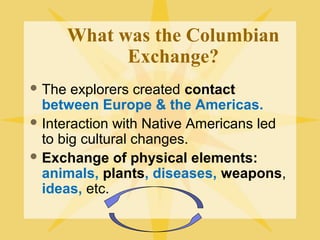
What was the Columbian
Exchange?
 The explorers created contact
between Europe & the Americas.
 Interaction with Native Americans led
to big cultural changes.
 Exchange of physical elements:
animals, plants, diseases, weapons,
ideas, etc.
Animals
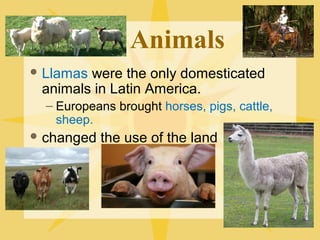
 Llamas were the only domesticated
animals in Latin America.
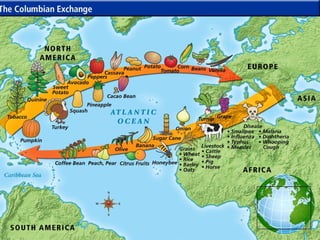
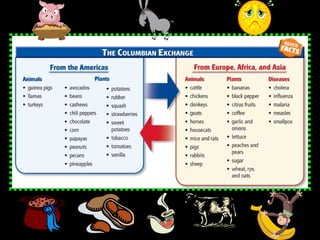
– Europeans brought horses, pigs, cattle,
sheep.
 changed the use of the land
Plants
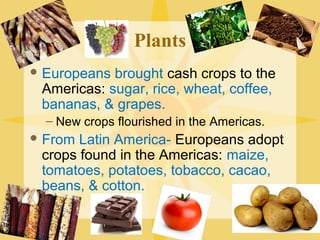
 Europeans brought cash crops to the
Americas: sugar, rice, wheat, coffee,
bananas, & grapes.
– New crops flourished in the Americas.
 From Latin America- Europeans adopt
crops found in the Americas: maize,
tomatoes, potatoes, tobacco, cacao,
beans, & cotton.
The Introduction of
New Diseases
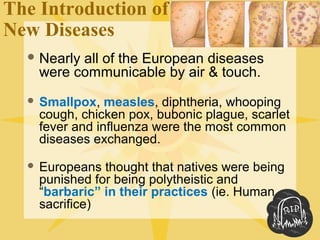
 Nearly all of the European diseases
were communicable by air & touch.
 Smallpox, measles, diphtheria, whooping
cough, chicken pox, bubonic plague, scarlet
fever and influenza were the most common
diseases exchanged.
 Europeans thought that natives were being
punished for being polytheistic and
“barbaric” in their practices (ie. Human
sacrifice)
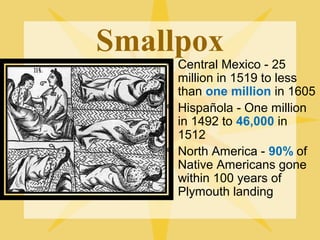
Smallpox Central Mexico - 25
million in 1519 to less
than one million in 1605
 Hispañola - One million
in 1492 to 46,000 in
1512
 North America - 90% of
Native Americans gone
within 100 years of
Plymouth landing
Effects of Diseases
 Native American population
dramatically decreases
because they had no immunity
to European diseases.
 Europeans need labor to
cultivate new crops in the
Americas, but there aren’t
many natives left.
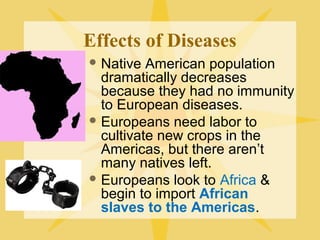
 Europeans look to Africa &
begin to import African
slaves to the Americas.
Impact of the Columbian
Exchange
 Different Foods
– Exchange of foods & animals had a dramatic impact on later
societies
– Over time, crops native to the Americas became staples in
the diets of Europeans
– Foods provided nutrition, helped people live longer
– Until contact with Americas, Europeans had never tried
tomatoes--by 1600s, tomatoes included in Italian cookbooks
 Economics
– Activities like cattle ranching and coffee growing not possible
without Columbian Exchange
– Traditional cuisines changed because of Columbian
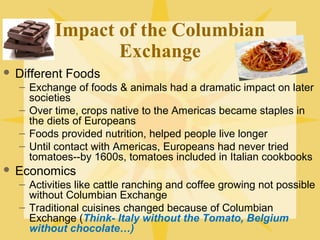
Exchange (Think- Italy without the Tomato, Belgium
without chocolate…)
Effects Around the Globe
 The Columbian Exchange not only impacted
Europe & the Americas, but also…
 China:
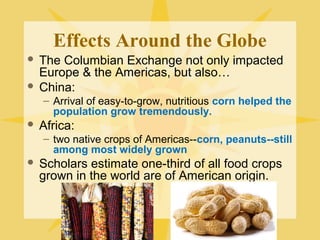
– Arrival of easy-to-grow, nutritious corn helped the
population grow tremendously.
 Africa:
– two native crops of Americas--corn, peanuts--still
among most widely grown
 Scholars estimate one-third of all food crops
grown in the world are of American origin.

Columbian exchange

  • 1.
    Directions  With yourgroup, each person needs to take out a clue and read it aloud.  Pass the bag around so that everyone reads a clue  Continue until all the clues are gone.  At the end, make a hypothesis what the item is.
  • 2.
  • 3.
    What was theColumbian Exchange?  The explorers created contact between Europe & the Americas.  Interaction with Native Americans led to big cultural changes.  Exchange of physical elements: animals, plants, diseases, weapons, ideas, etc.
  • 8.
    Animals  Llamas werethe only domesticated animals in Latin America. – Europeans brought horses, pigs, cattle, sheep.  changed the use of the land
  • 9.
    Plants  Europeans broughtcash crops to the Americas: sugar, rice, wheat, coffee, bananas, & grapes. – New crops flourished in the Americas.  From Latin America- Europeans adopt crops found in the Americas: maize, tomatoes, potatoes, tobacco, cacao, beans, & cotton.
  • 10.
    The Introduction of NewDiseases  Nearly all of the European diseases were communicable by air & touch.  Smallpox, measles, diphtheria, whooping cough, chicken pox, bubonic plague, scarlet fever and influenza were the most common diseases exchanged.  Europeans thought that natives were being punished for being polytheistic and “barbaric” in their practices (ie. Human sacrifice)
  • 11.
    Smallpox Central Mexico- 25 million in 1519 to less than one million in 1605  Hispañola - One million in 1492 to 46,000 in 1512  North America - 90% of Native Americans gone within 100 years of Plymouth landing
  • 12.
    Effects of Diseases Native American population dramatically decreases because they had no immunity to European diseases.  Europeans need labor to cultivate new crops in the Americas, but there aren’t many natives left.  Europeans look to Africa & begin to import African slaves to the Americas.
  • 13.
    Impact of theColumbian Exchange  Different Foods – Exchange of foods & animals had a dramatic impact on later societies – Over time, crops native to the Americas became staples in the diets of Europeans – Foods provided nutrition, helped people live longer – Until contact with Americas, Europeans had never tried tomatoes--by 1600s, tomatoes included in Italian cookbooks  Economics – Activities like cattle ranching and coffee growing not possible without Columbian Exchange – Traditional cuisines changed because of Columbian Exchange (Think- Italy without the Tomato, Belgium without chocolate…)
  • 14.
    Effects Around theGlobe  The Columbian Exchange not only impacted Europe & the Americas, but also…  China: – Arrival of easy-to-grow, nutritious corn helped the population grow tremendously.  Africa: – two native crops of Americas--corn, peanuts--still among most widely grown  Scholars estimate one-third of all food crops grown in the world are of American origin.