Ms. Margaux Gonzales
Lesson Plan 16
Hair Care—Haircoloring
  Basic Color Theory---Level 1


                                 Pages 756-782 & 784-786
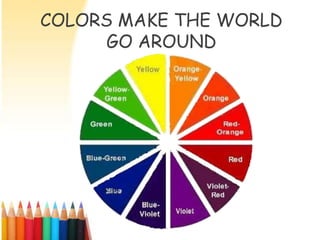
COLORS MAKE THE WORLD
     GO AROUND
Hair Coloring-                      Color Theory #1

                                C0LOR- #1
1.   The property of reflecting light of a particular visible wavelenght.
2.   Any coloring matter; dye; pigment.

                                 C0LOR- #2
1.   Color is a form of light energy.
2.   Color is described as a property of objects that depends on the light
     they reflect and is perceived.
3.   All the color we see are contained in the visible spectrum of light.

                                C0LOR- #3
1.   The visual perception of the reflection of light.
OBJECTIVES
At the conclusion of class, each student will be able to:
 Knowing how to practice safety & sanitation.
 Describe color theory.
 Defining various color terms.
 Identify primary, secondary & tertiary colors.
 Define & identify the levels system.
 Identify types of hair color.
 Understanding the color wheel.
 Perform color wheel placement.
Practice Safety & Sanitation
                HAIR COLORING SAFETY
a.   Always wash your hands before and after your color services.
b.   Administer a PATCH TEST ALWAYS.
c.   Do not apply if you see CADD’S.
d.   Do not brush hair prior to service.
e.   Follow ALL MANUFACTURER’S directions.
f.   Drape client property.
g.   Perform a STRAND TEST as needed.
h.   Do not mix color until ready to use.
i.   Always wear protective gloves.
j.   Do not let color get into the clients eyes.
COLOR THEORY
                                THE LAW OF COLOR
                   Is a system of understanding color relationships.

1.    When combining colors you will always get the same results when you mixed the
      same colors combinations.
2.    BASE COLOR– the predominant tone of the color.

                      THE C0LOR RULES- “sited from KJ's Upholstery”
•    Rule One: Family is Always Welcome. Most colors look great with shades from the
     same family as themselves—reds go with other reds, greens with greens.

•    Rule Two: Next Door Neighbors are Friends. You can also use colors from next
     door on the color wheel—in the case of red, that’s orange and violet.

•    Rule Three: Opposites Attract. Every color has a natural color on the opposite
     side of the color wheel— that’s why red and green look so good together.
COLORS TERMS
Colorist—Cosmetologist who           Predisposition (PD) Test— Skin
specializing in hair color design.   test that is give 24 hour before
                                     a color design services.
Desired Color—The field and          Process— Time it takes for the
shade of color agreed upon by        color to develop.
the client and Colorist prior to     Strand Test— Test that is
the color design service.            performed during the process of
                                     a color design service to monitor
Fields of Color—Categories of        processing time and assess any
color; light, medium and dark.       stress to the hair and scalp.
                                     Also help to determine if
Existing Color—The color(s) that     desired color is achieved.
are present in the hair prior to
the color design services.
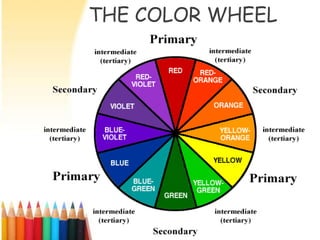
PRIMARY COLORS
          All colors are made up of 3 Primary Colors
1.   BLUE:
        Strongest Primary Color.
        Only COOL COLOR.
        Brings depths and darkness to any color.

2. Red:
        Medium Primary Color.
        Add BLUE –Base color will appear lighter.
        Add YELLOW–Base color will appear darker.

3. YELLOW:
        Weakest Primary Color.
        Add to other color will appear lighter and brighter.
SECONDARY COLORS
           Colors that are obtained by mixing
            equal parts of two primary colors

1. GREEN:
     Equal parts of BLUE and YELLOW.


2. ORANGE:
     Equal parts of RED and YELLOW.


3. VIOLET:
     Equal parts of BLUE and RED.
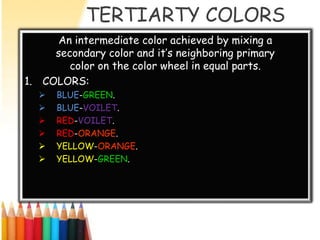
TERTIARTY COLORS
      An intermediate color achieved by mixing a
     secondary color and it’s neighboring primary
        color on the color wheel in equal parts.
1. COLORS:
     BLUE-GREEN.
     BLUE-VOILET.
     RED-VOILET.
     RED-ORANGE.
     YELLOW-ORANGE.
     YELLOW-GREEN.
THE COLOR WHEEL
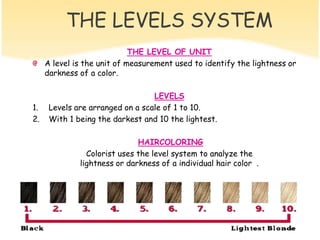
THE LEVELS SYSTEM
                             THE LEVEL OF UNIT
     A level is the unit of measurement used to identify the lightness or
     darkness of a color.

                                  LEVELS
1.    Levels are arranged on a scale of 1 to 10.
2.    With 1 being the darkest and 10 the lightest.

                              HAIRCOLORING
                Colorist uses the level system to analyze the
              lightness or darkness of a individual hair color .
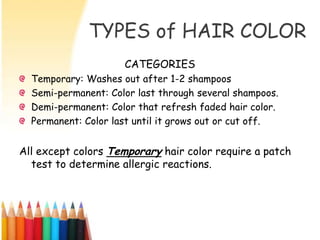
TYPES of HAIR COLOR
                     CATEGORIES
  Temporary: Washes out after 1-2 shampoos
  Semi-permanent: Color last through several shampoos.
  Demi-permanent: Color that refresh faded hair color.
  Permanent: Color last until it grows out or cut off.


All except colors Temporary hair color require a patch
  test to determine allergic reactions.
EVALUATION --- SUMMARY
  What are the 3 primary colors?
  Answer: Red, Blue, & Yellow
  What is the purpose of a Strand Test?

  Answer: Test that is performed during the process of a
  color design service to monitor processing time.

   What are the 3 ―THE COLOR RULES?
1. Answer: Rule One: Family is Always Welcome.
2. Answer: Rule Two: Next Door Neighbors are Friends.
3. Answer: Rule Three: Opposites Attract.
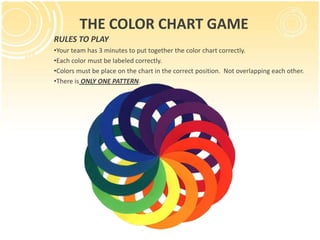
THE COLOR CHART GAME
RULES TO PLAY
•Your team has 3 minutes to put together the color chart correctly.
•Each color must be labeled correctly.
•Colors must be place on the chart in the correct position. Not overlapping each other.
•There is ONLY ONE PATTERN.

Color theroy level 1

  • 1.
    Ms. Margaux Gonzales LessonPlan 16 Hair Care—Haircoloring Basic Color Theory---Level 1 Pages 756-782 & 784-786
  • 2.
    COLORS MAKE THEWORLD GO AROUND
  • 3.
    Hair Coloring- Color Theory #1 C0LOR- #1 1. The property of reflecting light of a particular visible wavelenght. 2. Any coloring matter; dye; pigment. C0LOR- #2 1. Color is a form of light energy. 2. Color is described as a property of objects that depends on the light they reflect and is perceived. 3. All the color we see are contained in the visible spectrum of light. C0LOR- #3 1. The visual perception of the reflection of light.
  • 4.
    OBJECTIVES At the conclusionof class, each student will be able to: Knowing how to practice safety & sanitation. Describe color theory. Defining various color terms. Identify primary, secondary & tertiary colors. Define & identify the levels system. Identify types of hair color. Understanding the color wheel. Perform color wheel placement.
  • 5.
    Practice Safety &Sanitation HAIR COLORING SAFETY a. Always wash your hands before and after your color services. b. Administer a PATCH TEST ALWAYS. c. Do not apply if you see CADD’S. d. Do not brush hair prior to service. e. Follow ALL MANUFACTURER’S directions. f. Drape client property. g. Perform a STRAND TEST as needed. h. Do not mix color until ready to use. i. Always wear protective gloves. j. Do not let color get into the clients eyes.
  • 6.
    COLOR THEORY THE LAW OF COLOR Is a system of understanding color relationships. 1. When combining colors you will always get the same results when you mixed the same colors combinations. 2. BASE COLOR– the predominant tone of the color. THE C0LOR RULES- “sited from KJ's Upholstery” • Rule One: Family is Always Welcome. Most colors look great with shades from the same family as themselves—reds go with other reds, greens with greens. • Rule Two: Next Door Neighbors are Friends. You can also use colors from next door on the color wheel—in the case of red, that’s orange and violet. • Rule Three: Opposites Attract. Every color has a natural color on the opposite side of the color wheel— that’s why red and green look so good together.
  • 7.
    COLORS TERMS Colorist—Cosmetologist who Predisposition (PD) Test— Skin specializing in hair color design. test that is give 24 hour before a color design services. Desired Color—The field and Process— Time it takes for the shade of color agreed upon by color to develop. the client and Colorist prior to Strand Test— Test that is the color design service. performed during the process of a color design service to monitor Fields of Color—Categories of processing time and assess any color; light, medium and dark. stress to the hair and scalp. Also help to determine if Existing Color—The color(s) that desired color is achieved. are present in the hair prior to the color design services.
  • 8.
    PRIMARY COLORS All colors are made up of 3 Primary Colors 1. BLUE:  Strongest Primary Color.  Only COOL COLOR.  Brings depths and darkness to any color. 2. Red:  Medium Primary Color.  Add BLUE –Base color will appear lighter.  Add YELLOW–Base color will appear darker. 3. YELLOW:  Weakest Primary Color.  Add to other color will appear lighter and brighter.
  • 9.
    SECONDARY COLORS Colors that are obtained by mixing equal parts of two primary colors 1. GREEN:  Equal parts of BLUE and YELLOW. 2. ORANGE:  Equal parts of RED and YELLOW. 3. VIOLET:  Equal parts of BLUE and RED.
  • 10.
    TERTIARTY COLORS An intermediate color achieved by mixing a secondary color and it’s neighboring primary color on the color wheel in equal parts. 1. COLORS:  BLUE-GREEN.  BLUE-VOILET.  RED-VOILET.  RED-ORANGE.  YELLOW-ORANGE.  YELLOW-GREEN.
  • 11.
  • 12.
    THE LEVELS SYSTEM THE LEVEL OF UNIT A level is the unit of measurement used to identify the lightness or darkness of a color. LEVELS 1. Levels are arranged on a scale of 1 to 10. 2. With 1 being the darkest and 10 the lightest. HAIRCOLORING Colorist uses the level system to analyze the lightness or darkness of a individual hair color .
  • 13.
    TYPES of HAIRCOLOR CATEGORIES Temporary: Washes out after 1-2 shampoos Semi-permanent: Color last through several shampoos. Demi-permanent: Color that refresh faded hair color. Permanent: Color last until it grows out or cut off. All except colors Temporary hair color require a patch test to determine allergic reactions.
  • 14.
    EVALUATION --- SUMMARY What are the 3 primary colors? Answer: Red, Blue, & Yellow What is the purpose of a Strand Test? Answer: Test that is performed during the process of a color design service to monitor processing time. What are the 3 ―THE COLOR RULES? 1. Answer: Rule One: Family is Always Welcome. 2. Answer: Rule Two: Next Door Neighbors are Friends. 3. Answer: Rule Three: Opposites Attract.
  • 15.
    THE COLOR CHARTGAME RULES TO PLAY •Your team has 3 minutes to put together the color chart correctly. •Each color must be labeled correctly. •Colors must be place on the chart in the correct position. Not overlapping each other. •There is ONLY ONE PATTERN.