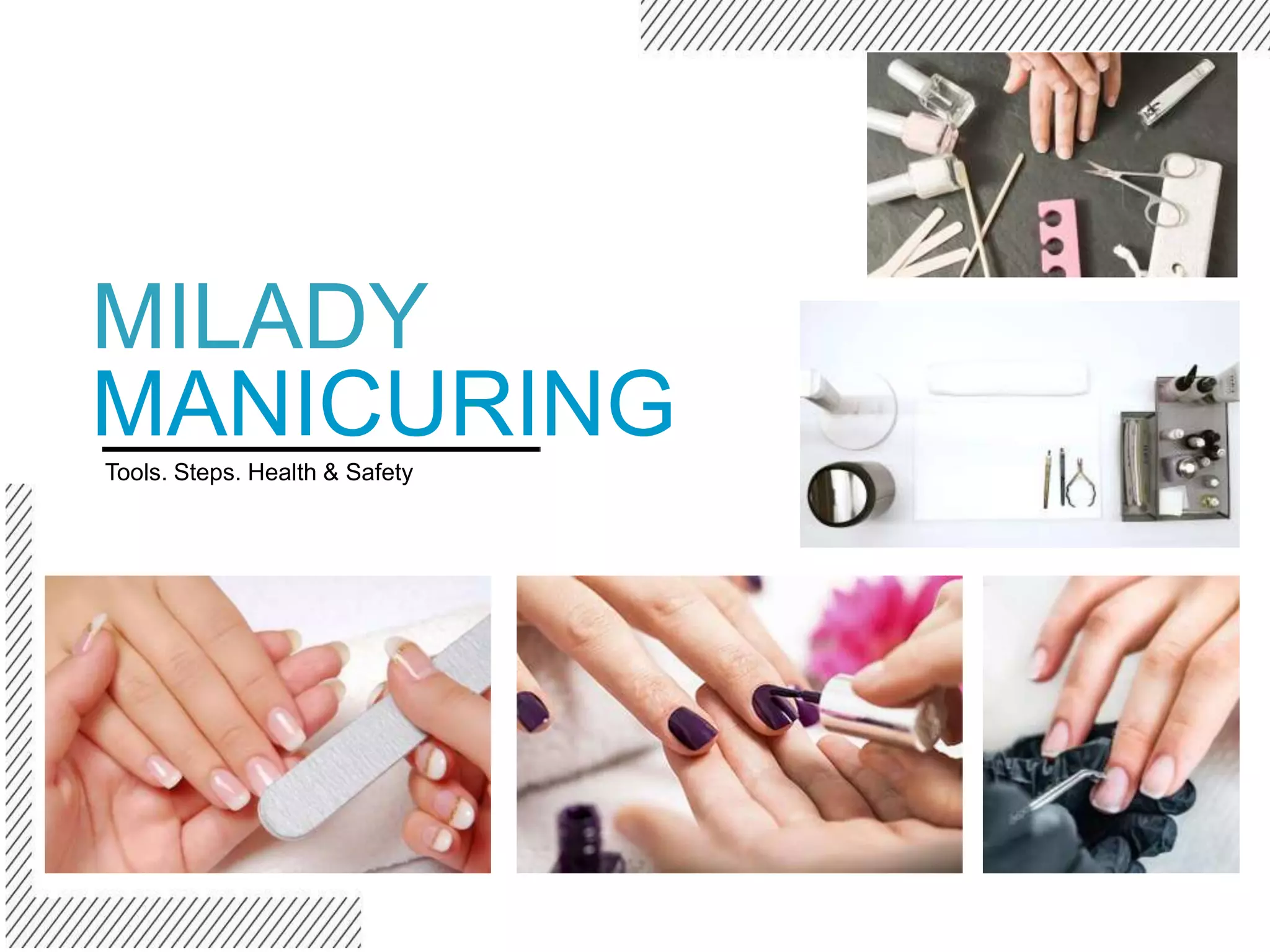
MILADY
MANICURINGTools. Steps. Health & Safety
THE WHY
(continues)
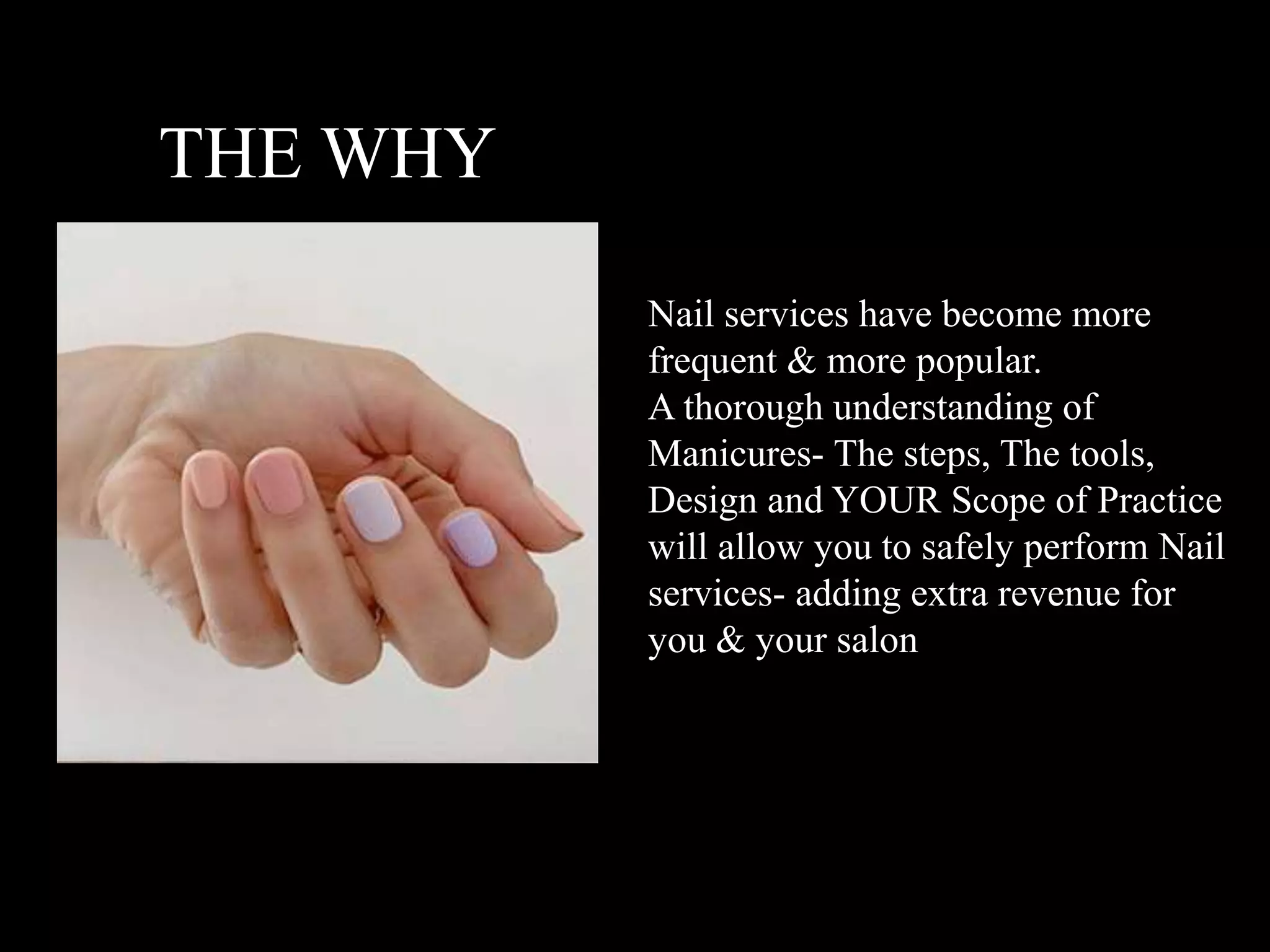
Nail services have become more
frequent & more popular.
A thorough understanding of
Manicures- The steps, The tools,
Design and YOUR Scope of Practice
will allow you to safely perform Nail
services- adding extra revenue for
you & your salon
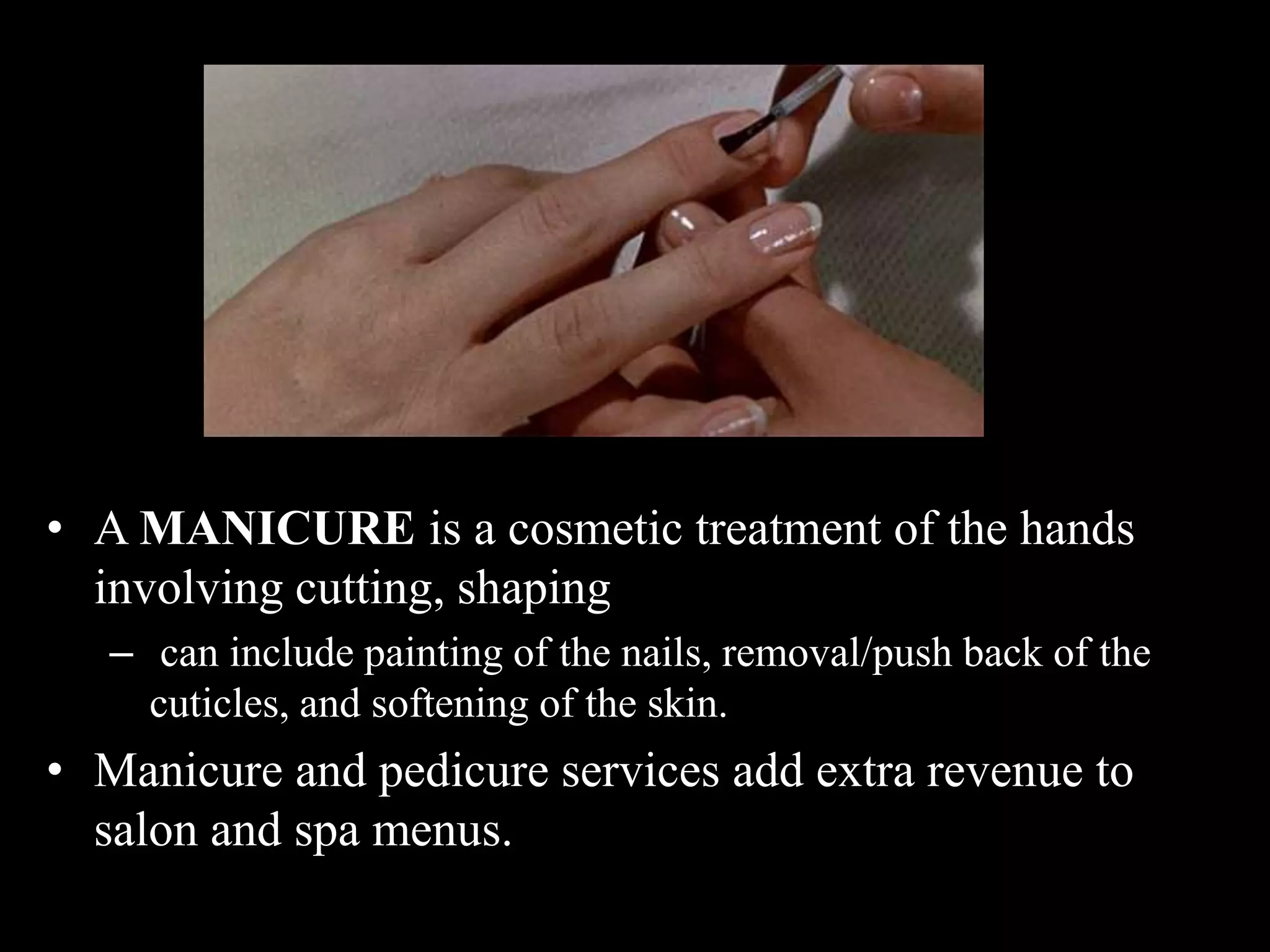
• A MANICURE is a cosmetic treatment of the hands
involving cutting, shaping
– can include painting of the nails, removal/push back of the
cuticles, and softening of the skin.
• Manicure and pedicure services add extra revenue to
salon and spa menus.
Adhere to State Government Regulations
• Scope of practice (SOP) – the list of services that
you are legally allowed to perform in your specialty
in your state.
• If you perform services outside these regulations-you
may lose your license.
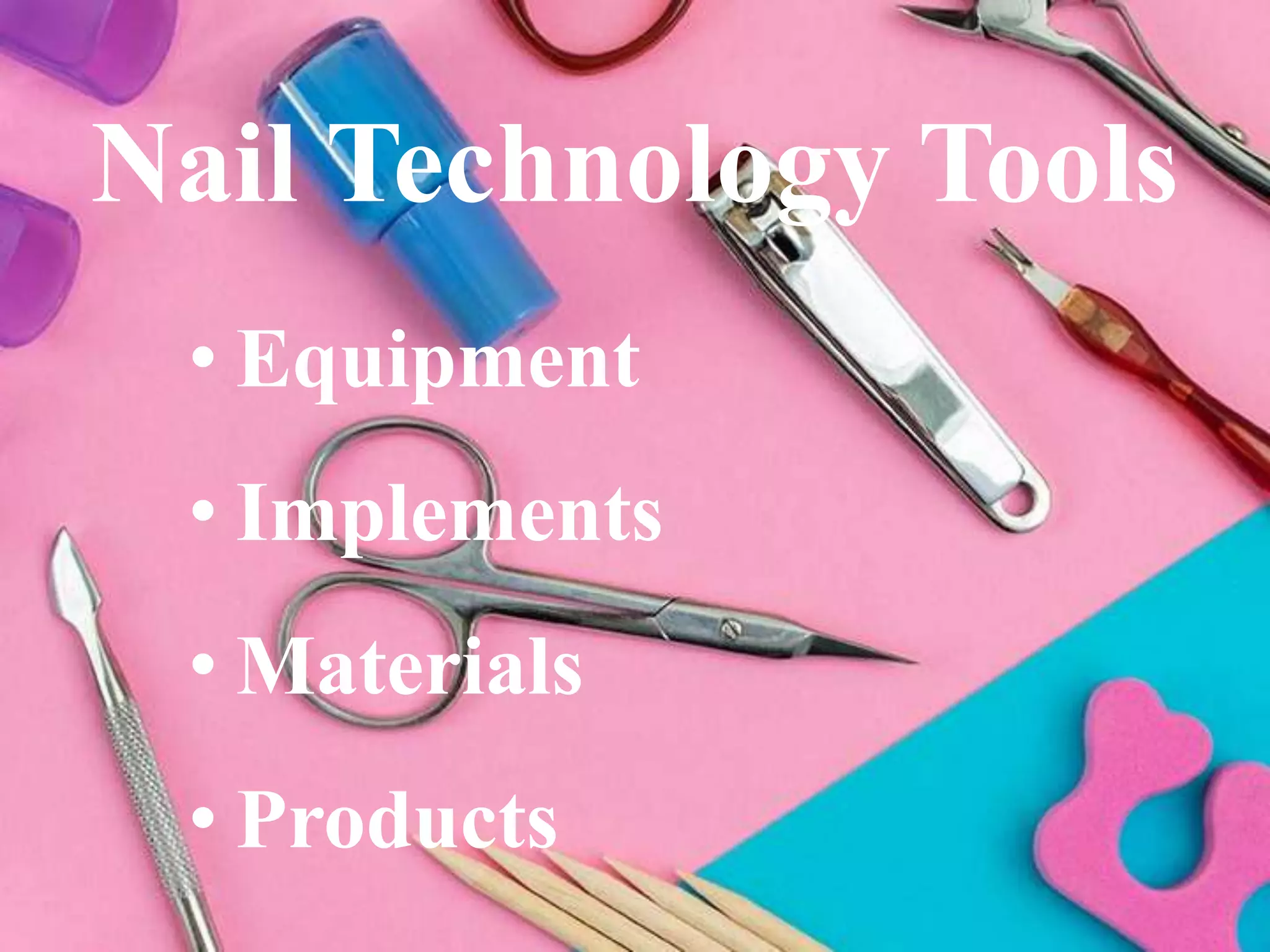
Nail Technology Tools
• Equipment
• Implements
• Materials
• Products
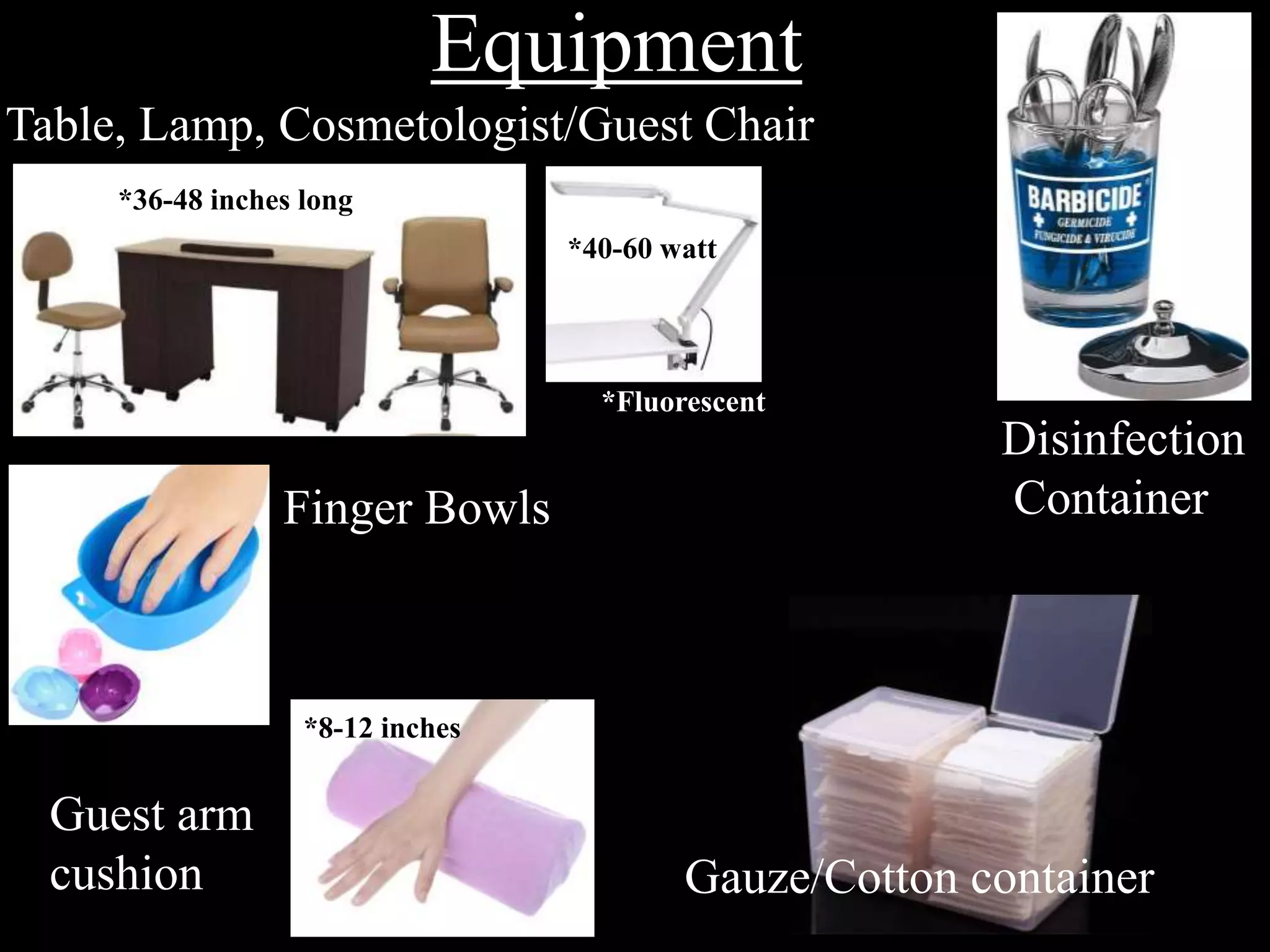
Equipment
(continues)
CourtesyofEuropeanTouch.
Table, Lamp, Cosmetologist/Guest Chair
Finger Bowls
Disinfection
Container
Guest arm
cushion Gauze/Cotton container
*36-48 inches long
*40-60 watt
*Fluorescent
*8-12 inches
CourtesyofEuropeanTouch.
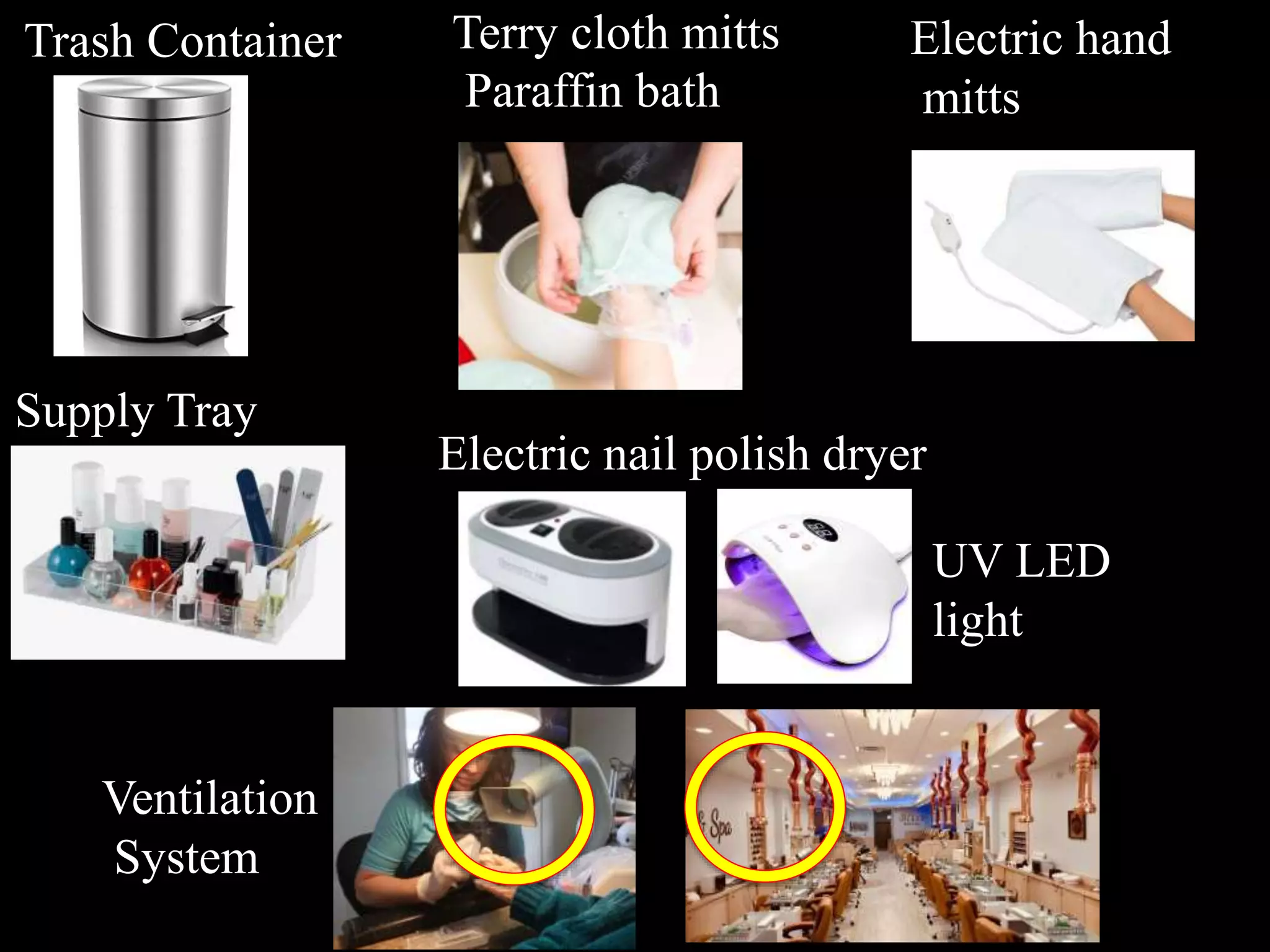
Trash Container
Supply Tray
Electric nail polish dryer
UV LED
light
Electric hand
mittsParaffin bath
Ventilation
System
Terry cloth mitts
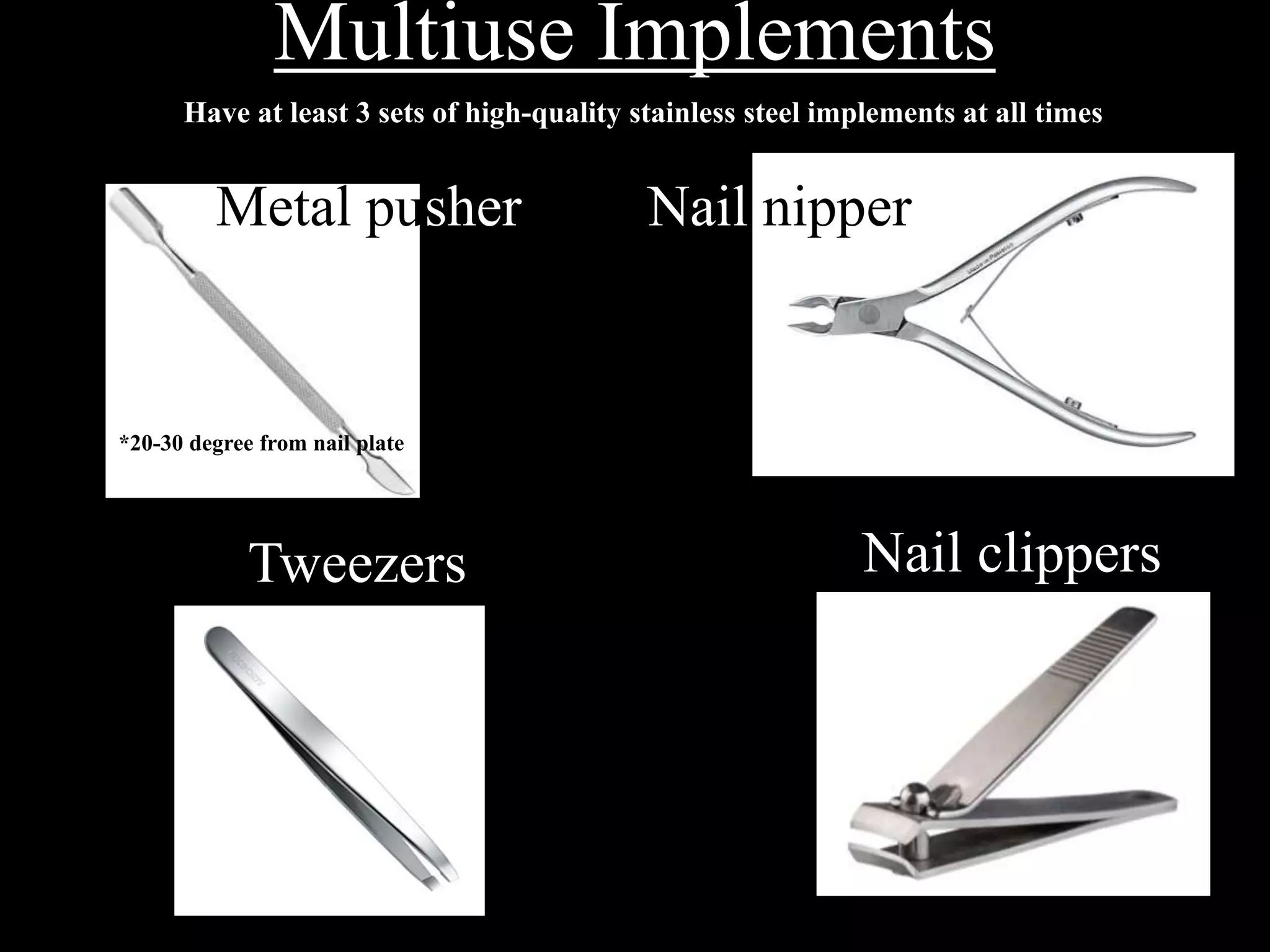
Multiuse Implements
Metal pusher Nail nipper
Tweezers Nail clippers
*20-30 degree from nail plate
Have at least 3 sets of high-quality stainless steel implements at all times
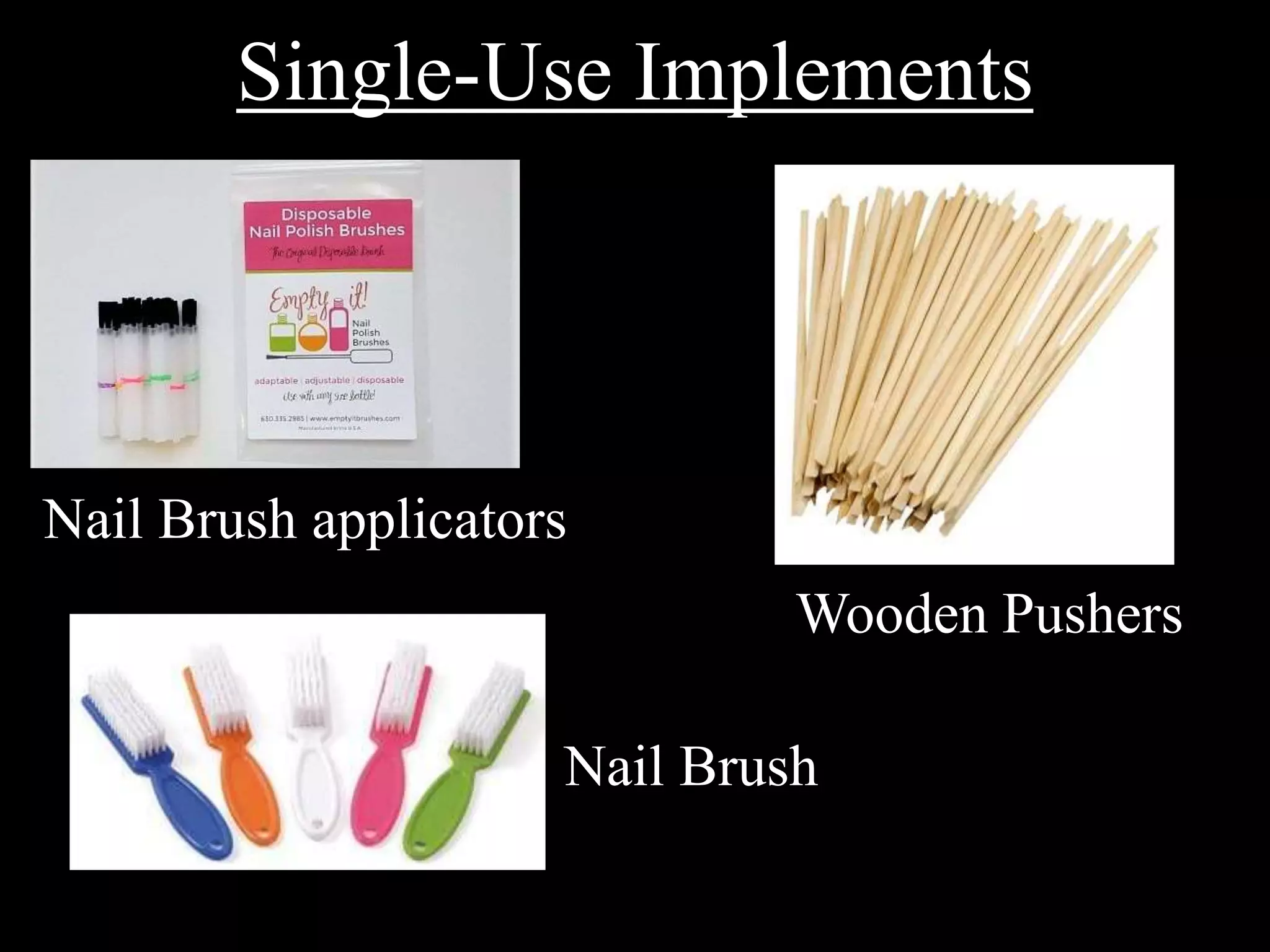
Single-Use Implements
Nail Brush applicators
Wooden Pushers
Nail Brush
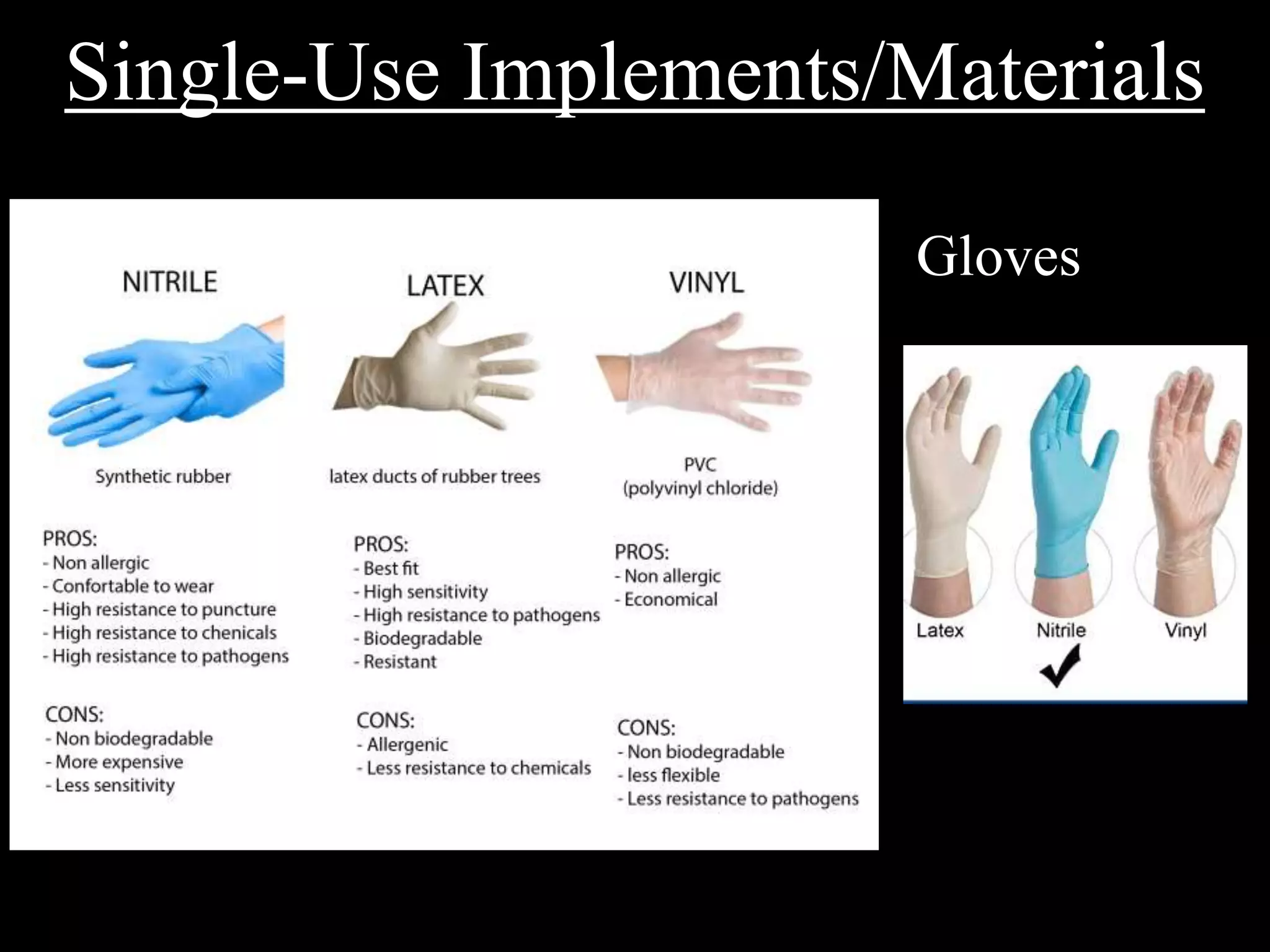
Single-Use Implements/Materials
Gloves
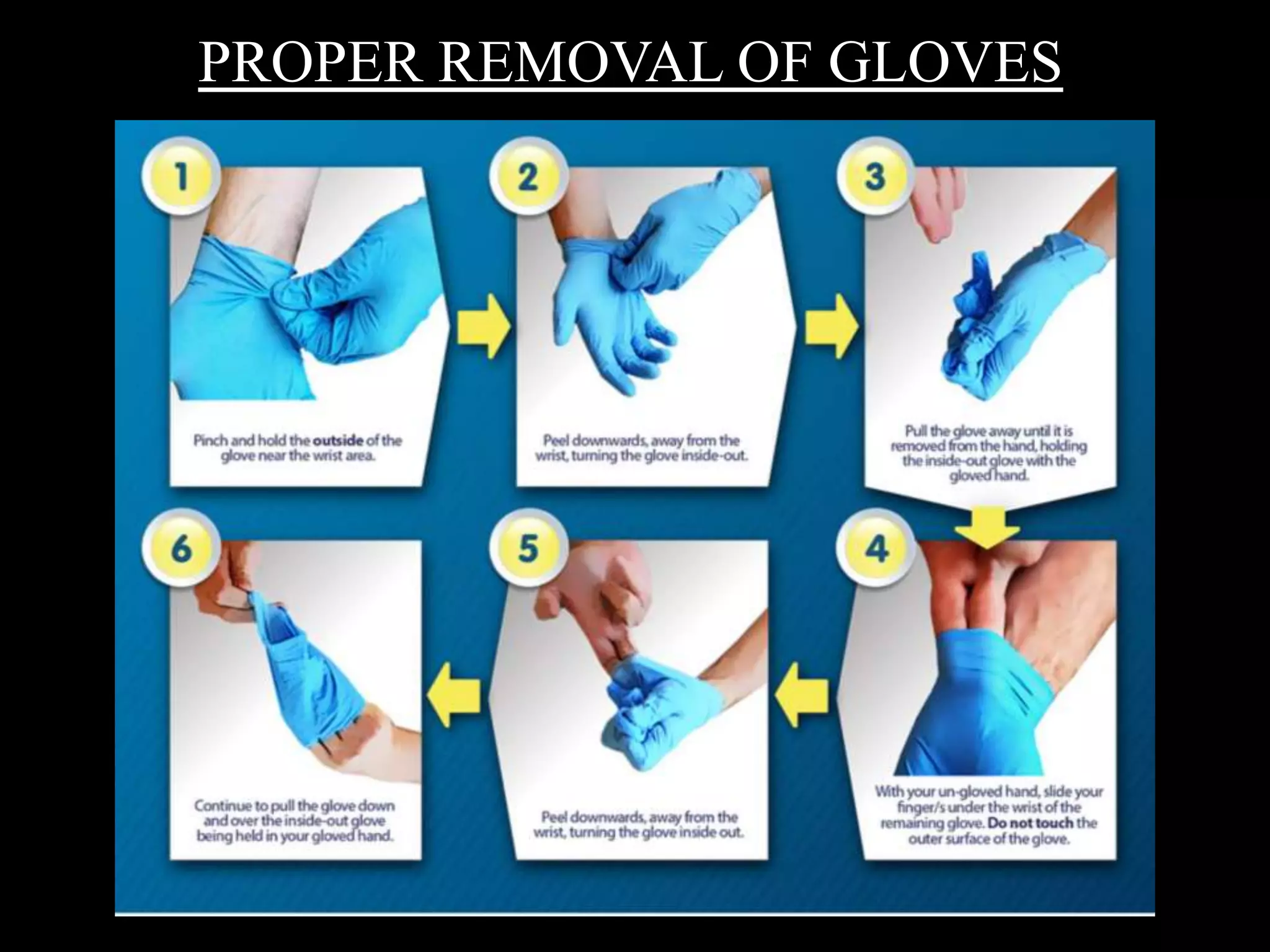
PROPER REMOVAL OF GLOVES
Materials
Courtesyofpurespadirect.com
Dust Masks
Abrasives/Buffers
Two/Three way Buffer
Single use towels
Gauze/cotton/pads
Plastic spatulas
*180-240
*Lint-free,
plastic-backed,
fiber or cotton
pads
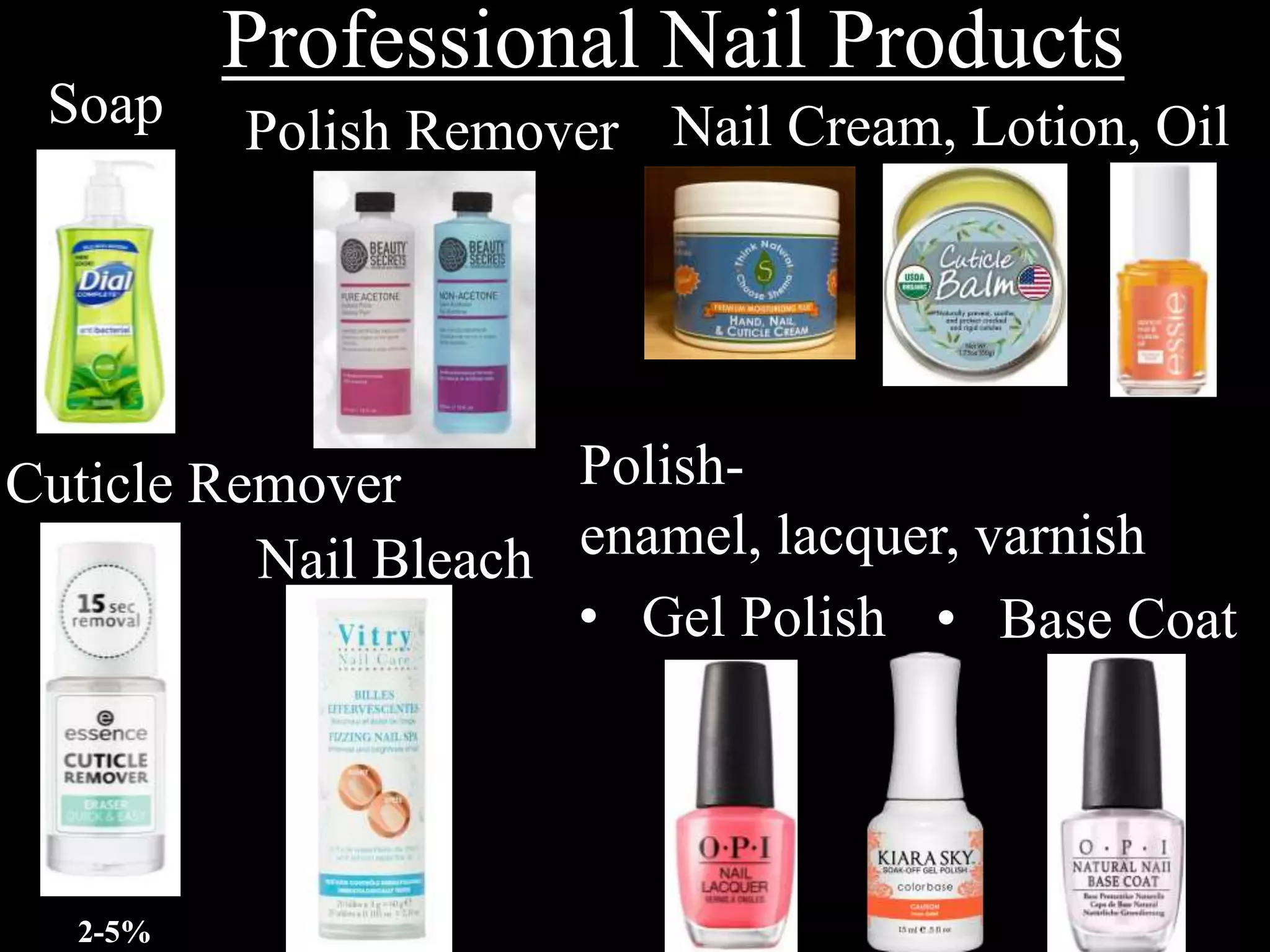
Professional Nail Products
(continues)
Soap Polish Remover Nail Cream, Lotion, Oil
Cuticle Remover
Nail Bleach
Polish-
enamel, lacquer, varnish
• Gel Polish • Base Coat
2-5%
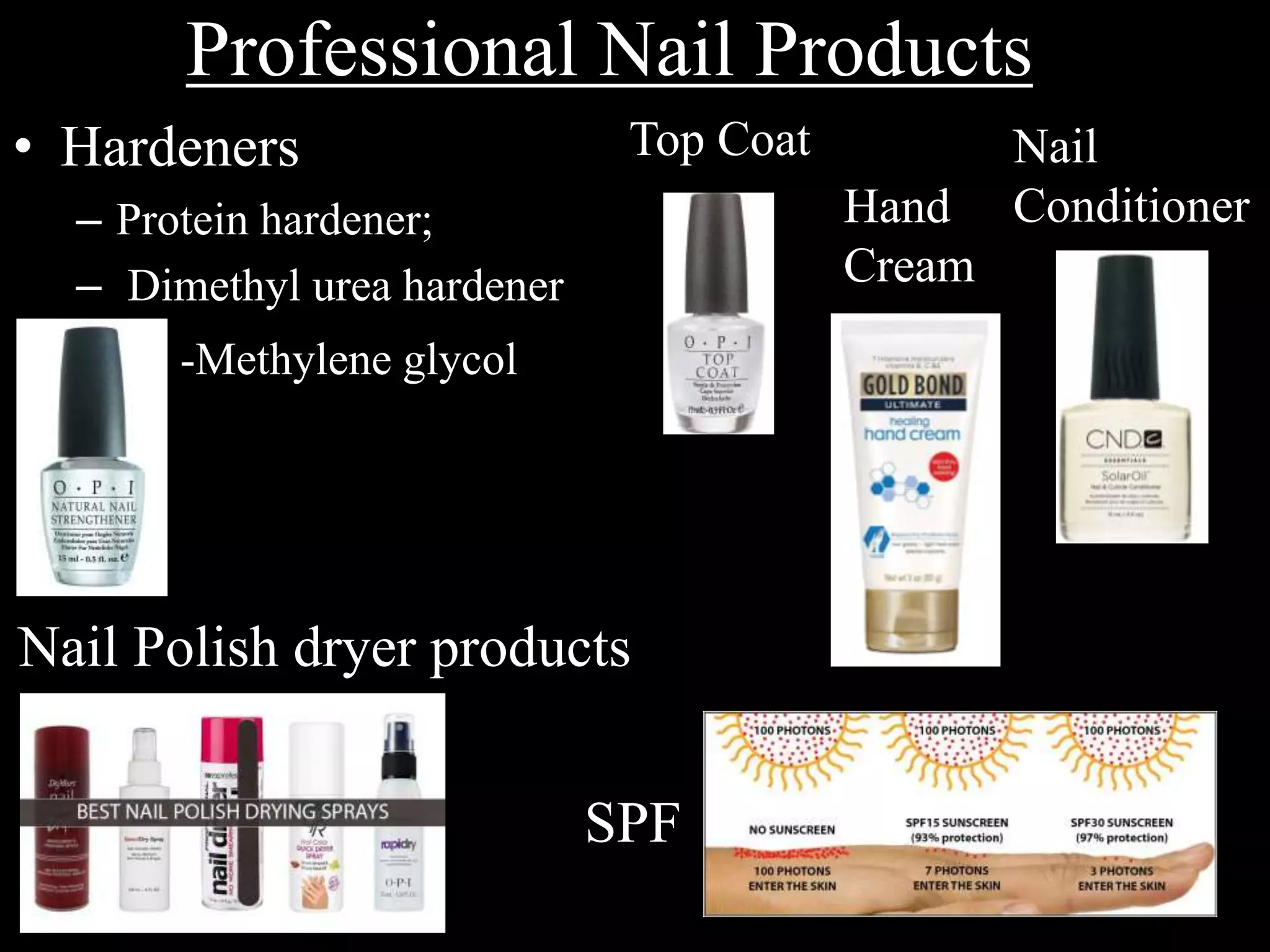
• Hardeners
– Protein hardener;
– Dimethyl urea hardener
Professional Nail Products
Top Coat
Nail Polish dryer products
Hand
Cream
Nail
Conditioner
SPF
-Methylene glycol
Necessary Components to Perform
the Basic Manicure
• The basic manicure is
the foundation of all
nail technology
services
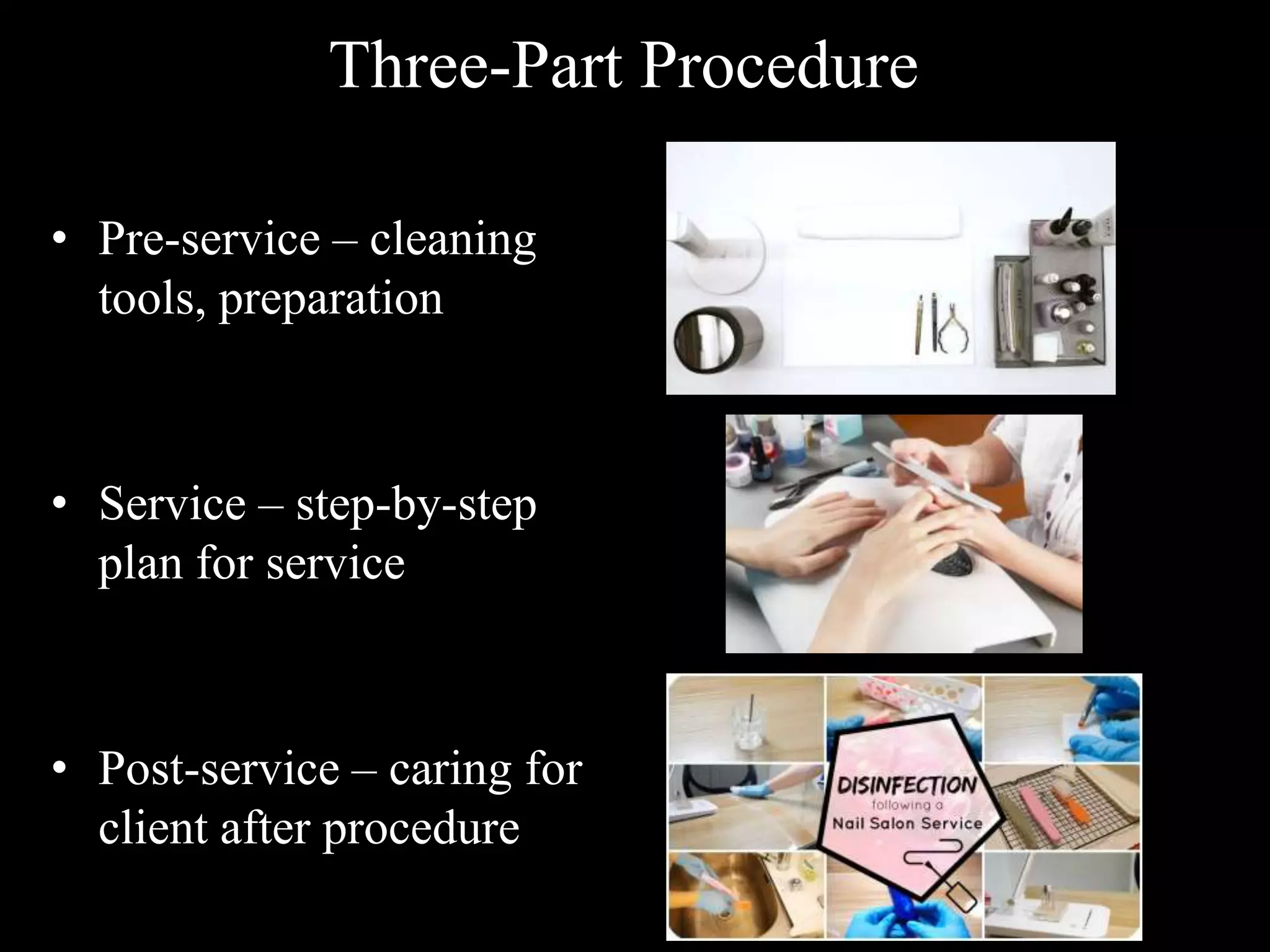
Three-Part Procedure
• Pre-service – cleaning
tools, preparation
• Service – step-by-step
plan for service
• Post-service – caring for
client after procedure
Hand Washing
• Hand washing prevents the
spread of communicable
diseases.
• Wash hands before and after
each client.
• Have clients wash hands
before service.
• Provide clean nail brushes.
• Hand sanitizers do not replace
hand washing.
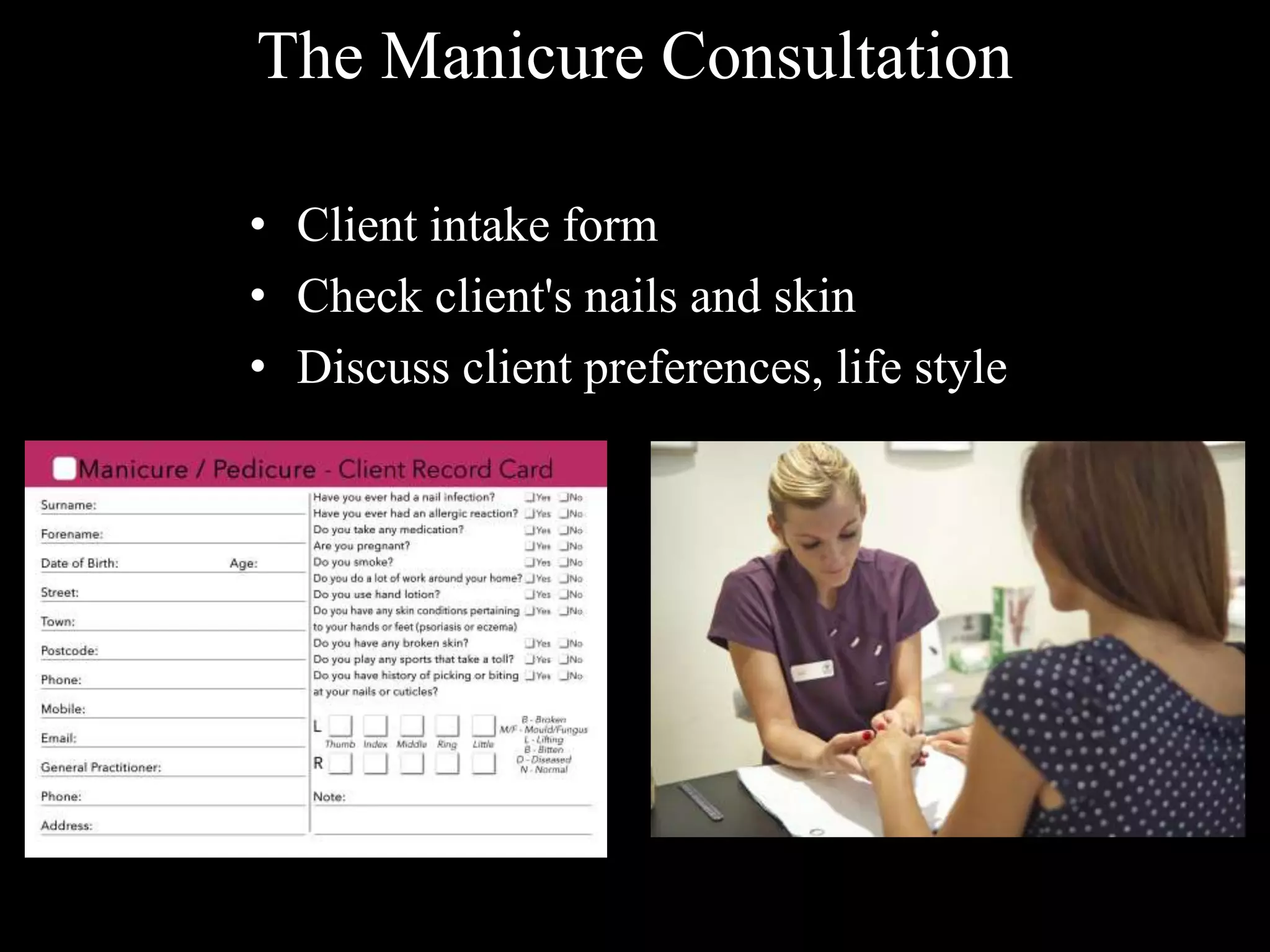
The Manicure Consultation
• Client intake form
• Check client's nails and skin
• Discuss client preferences, life style
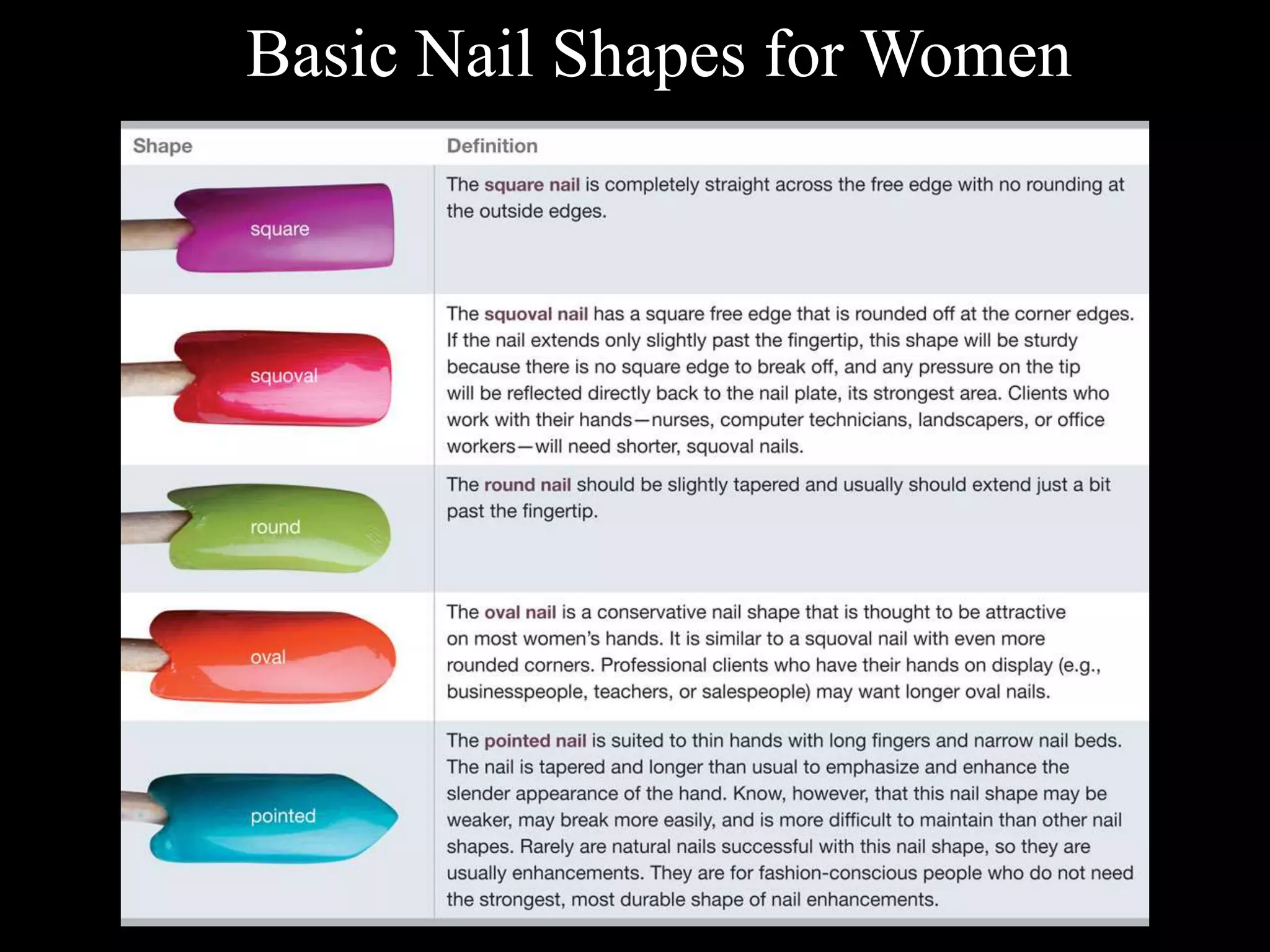
Basic Nail Shapes for Women
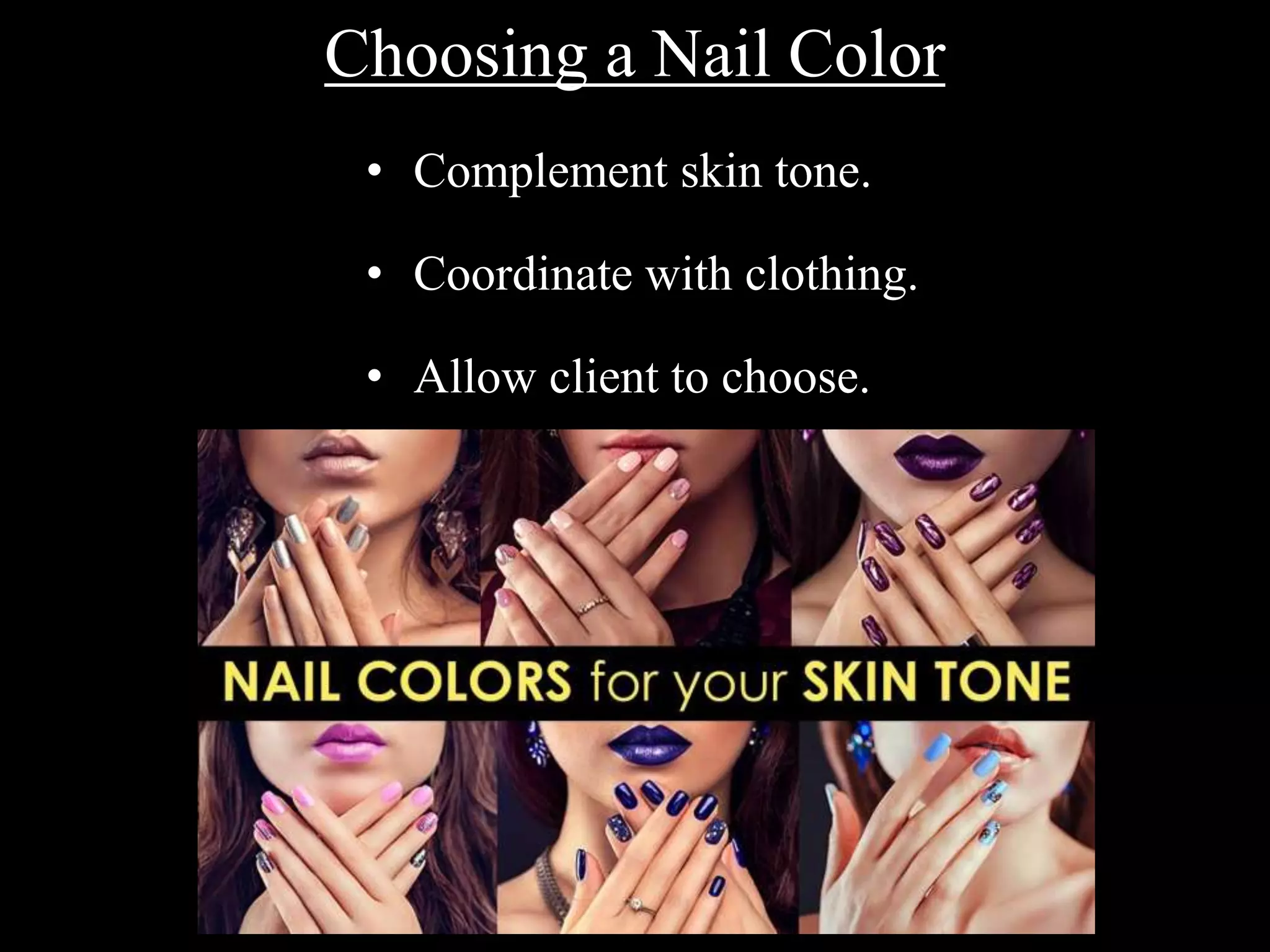
Choosing a Nail Color
• Complement skin tone.
• Coordinate with clothing.
• Allow client to choose.
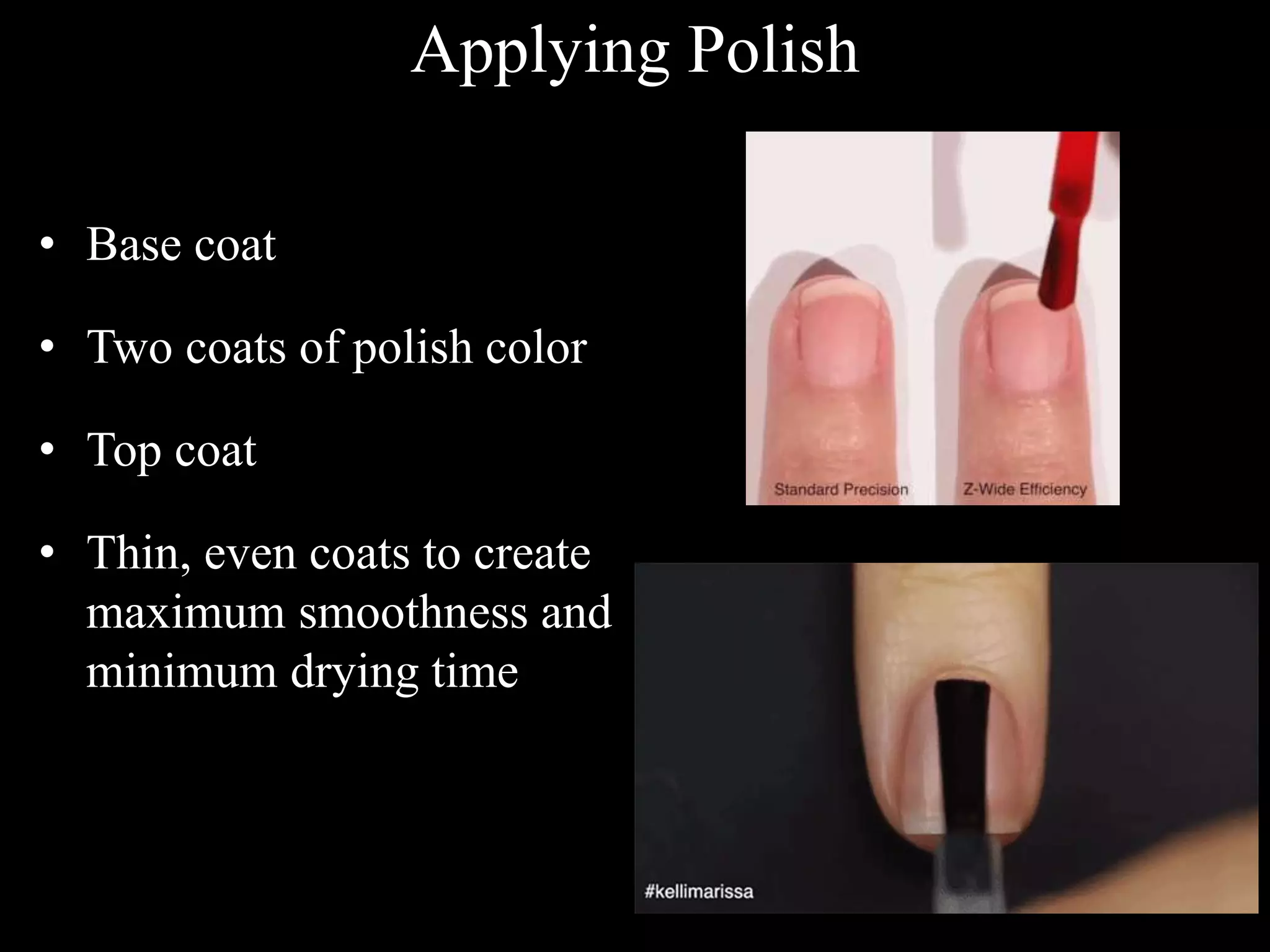
Applying Polish
• Base coat
• Two coats of polish color
• Top coat
• Thin, even coats to create
maximum smoothness and
minimum drying time
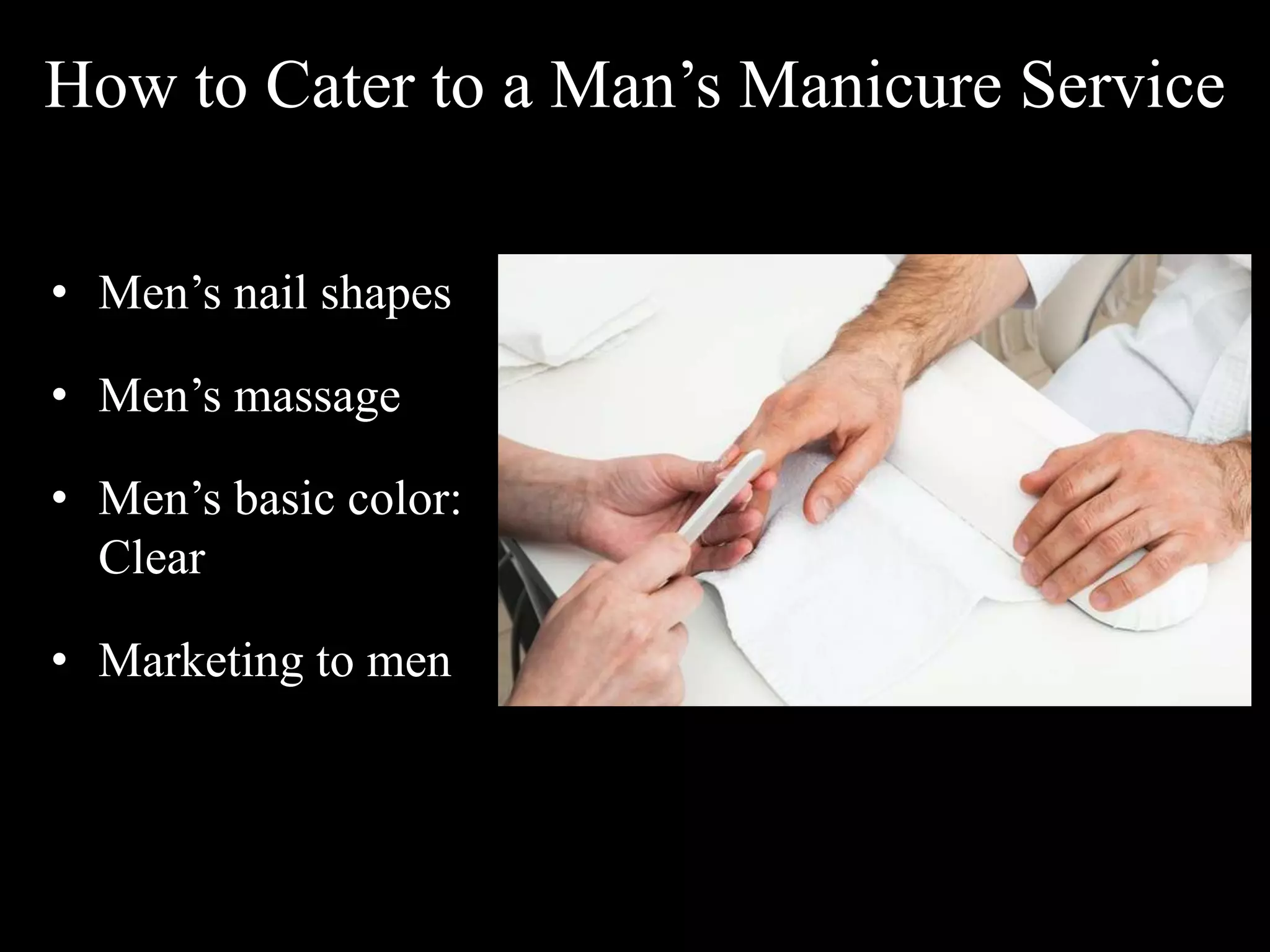
How to Cater to a Man’s Manicure Service
• Men’s nail shapes
• Men’s massage
• Men’s basic color:
Clear
• Marketing to men
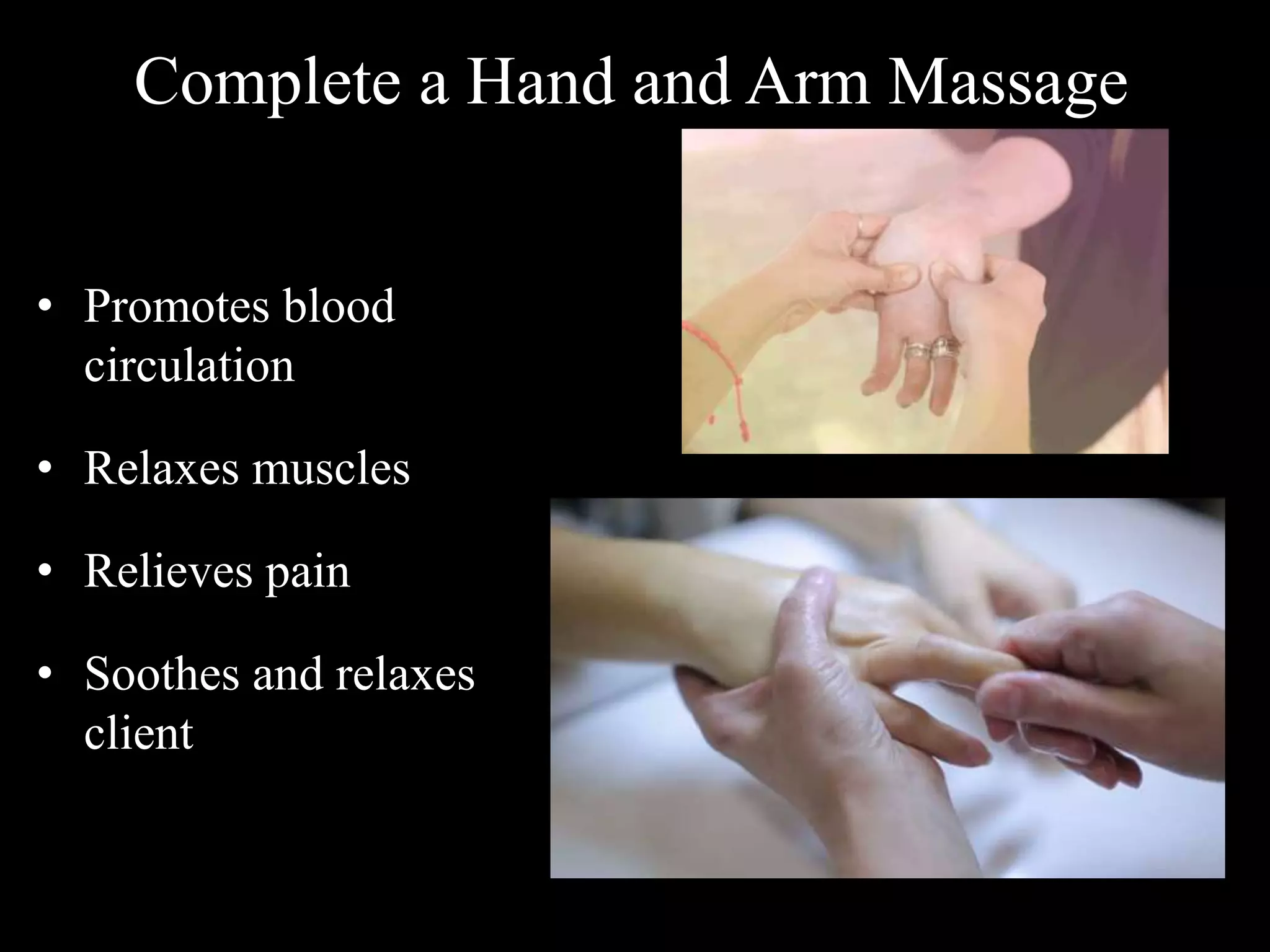
Complete a Hand and Arm Massage
• Promotes blood
circulation
• Relaxes muscles
• Relieves pain
• Soothes and relaxes
client
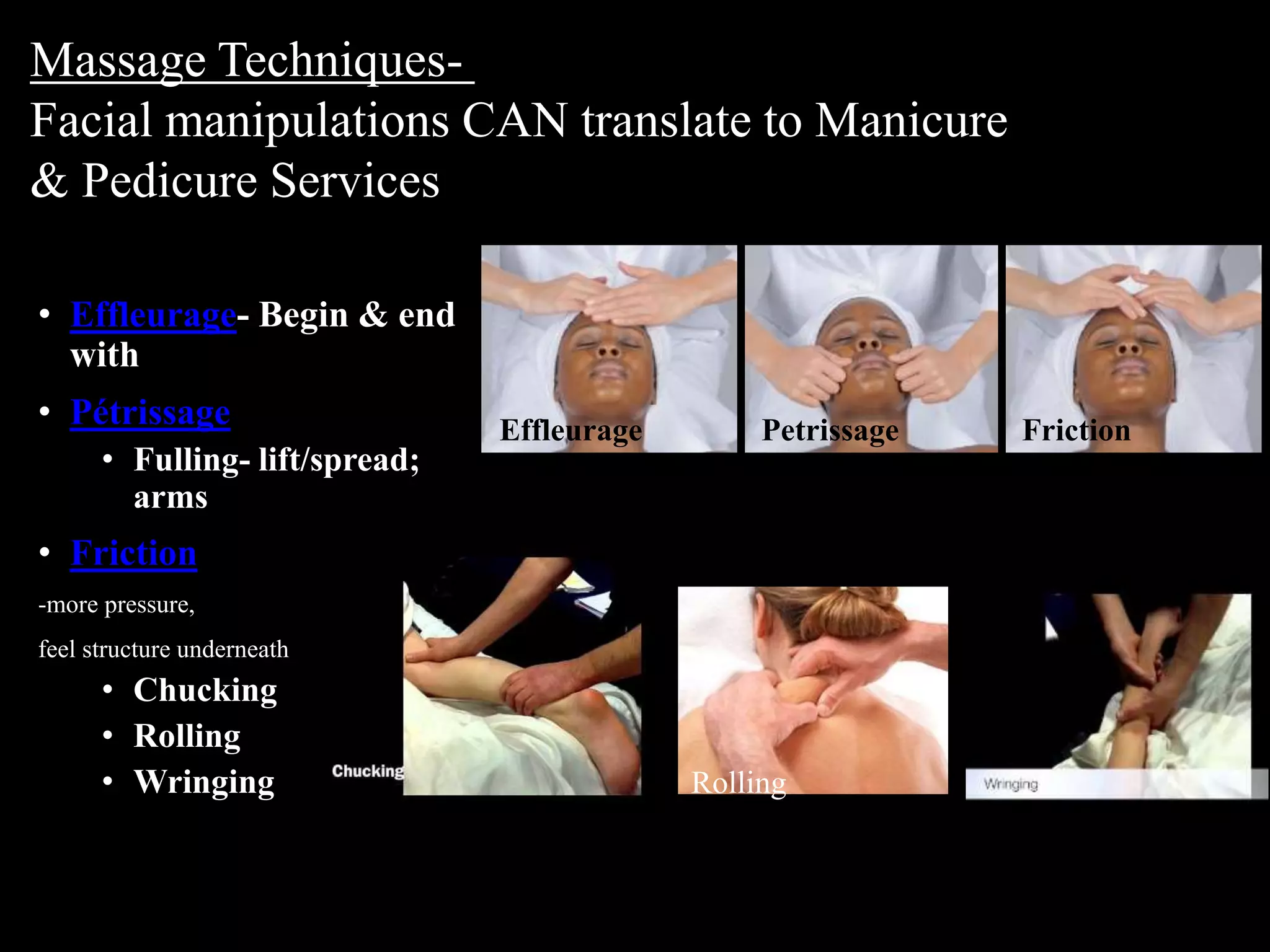
• Effleurage- Begin & end
with
• Pétrissage
• Fulling- lift/spread;
arms
• Friction
-more pressure,
feel structure underneath
• Chucking
• Rolling
• Wringing
Massage Techniques-
Facial manipulations CAN translate to Manicure
& Pedicure Services
Rolling
Effleurage Petrissage Friction
• Tapotement
• Slapping
• Hacking
• Vibration
Massage Techniques-
Facial manipulations CAN translate to Manicure
& Pedicure Services
State the Differences Between Spa
Manicures and Basic Manicures
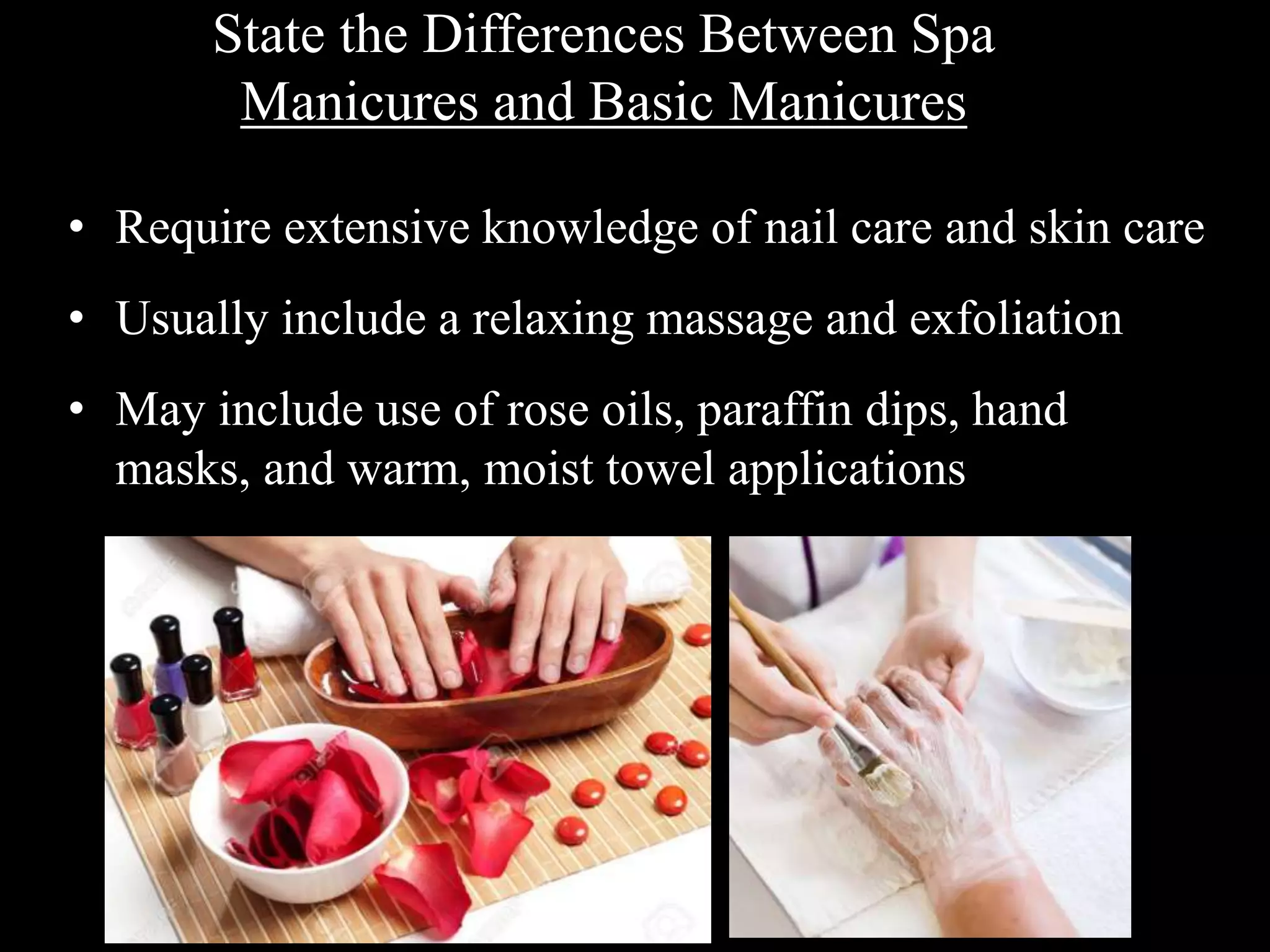
• Require extensive knowledge of nail care and skin care
• Usually include a relaxing massage and exfoliation
• May include use of rose oils, paraffin dips, hand
masks, and warm, moist towel applications
Theme Manicures
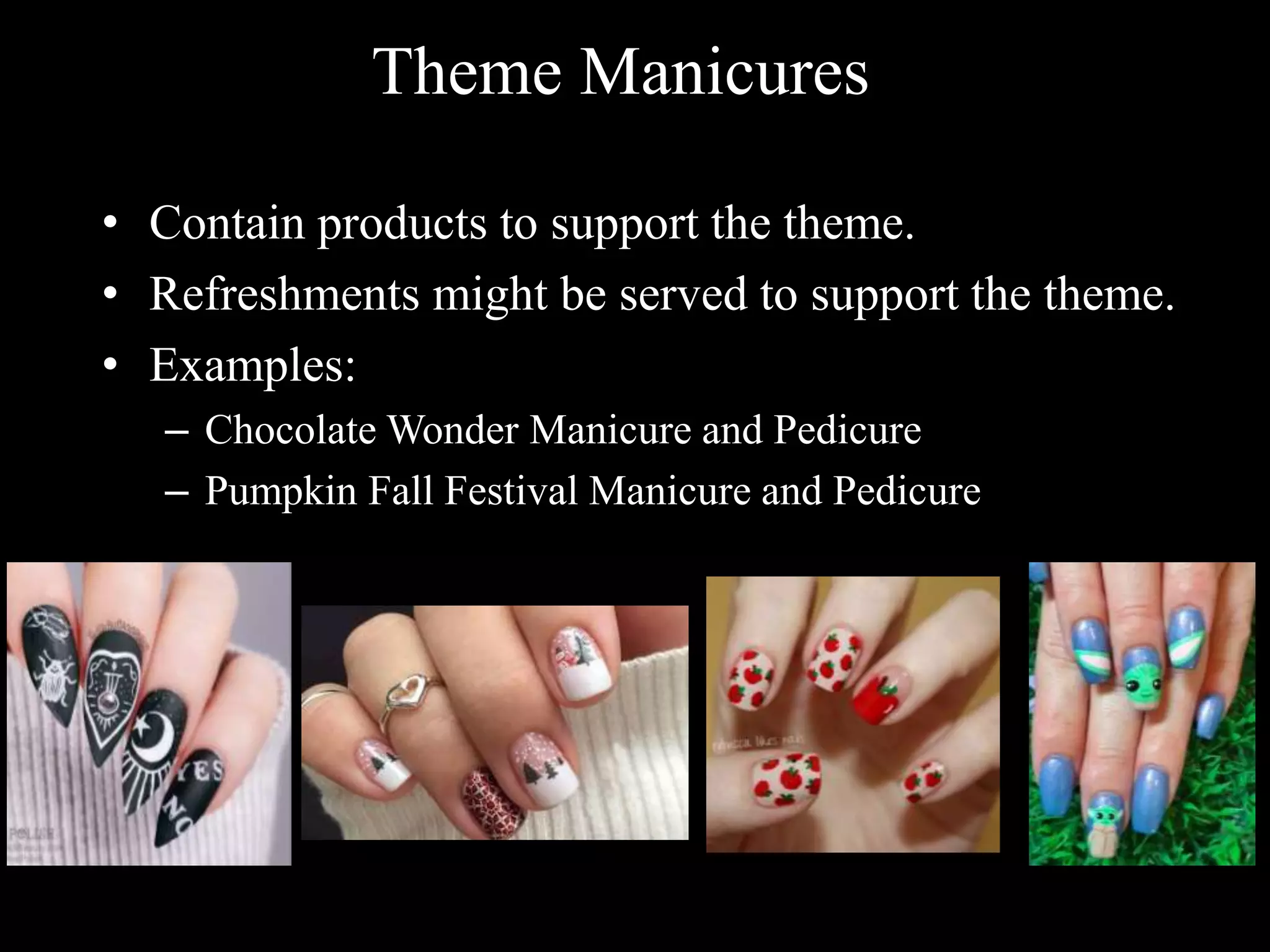
• Contain products to support the theme.
• Refreshments might be served to support the theme.
• Examples:
– Chocolate Wonder Manicure and Pedicure
– Pumpkin Fall Festival Manicure and Pedicure
Waterless
Manicures
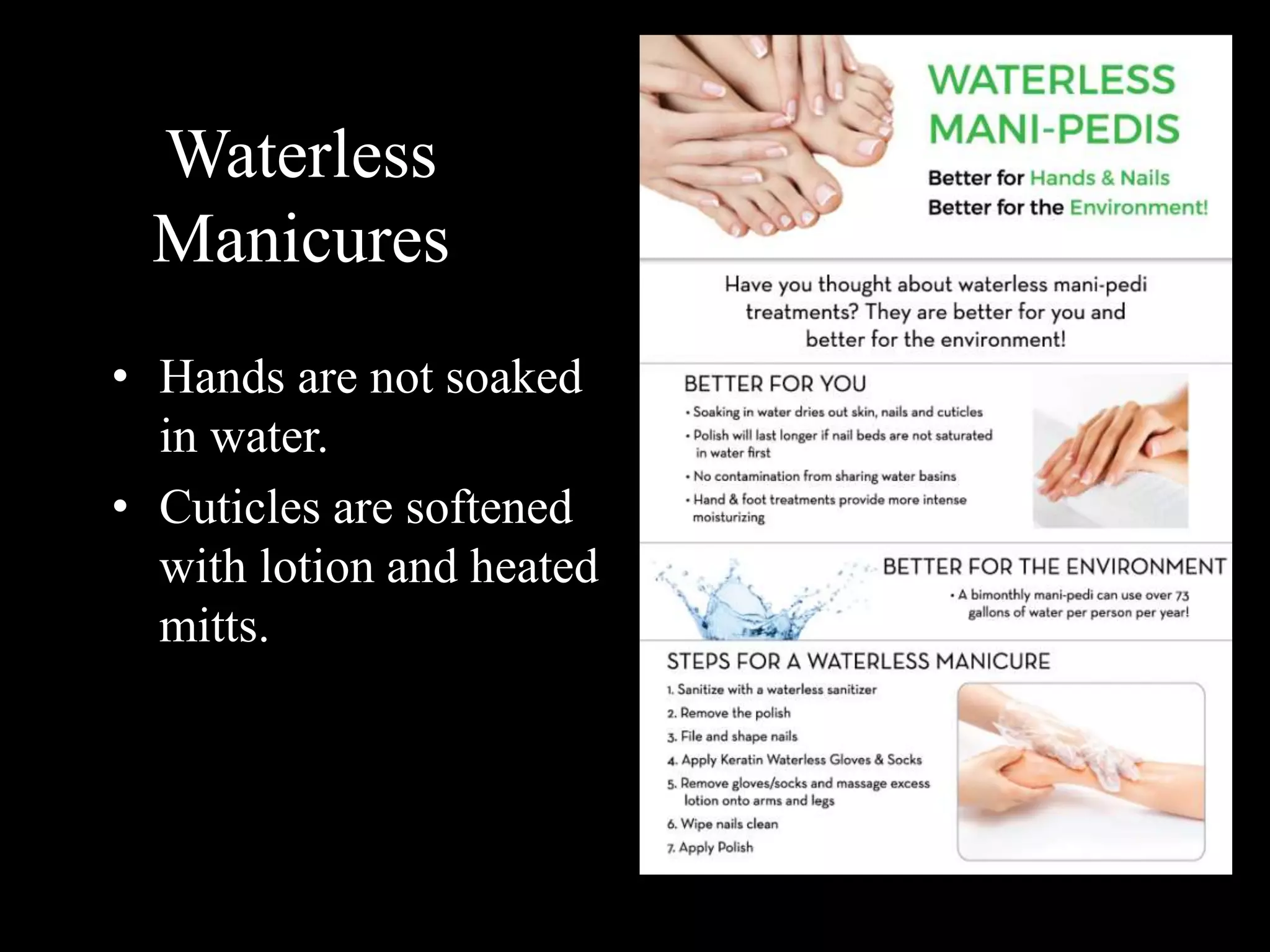
• Hands are not soaked
in water.
• Cuticles are softened
with lotion and heated
mitts.
Aromatherapy
During a Nail Service
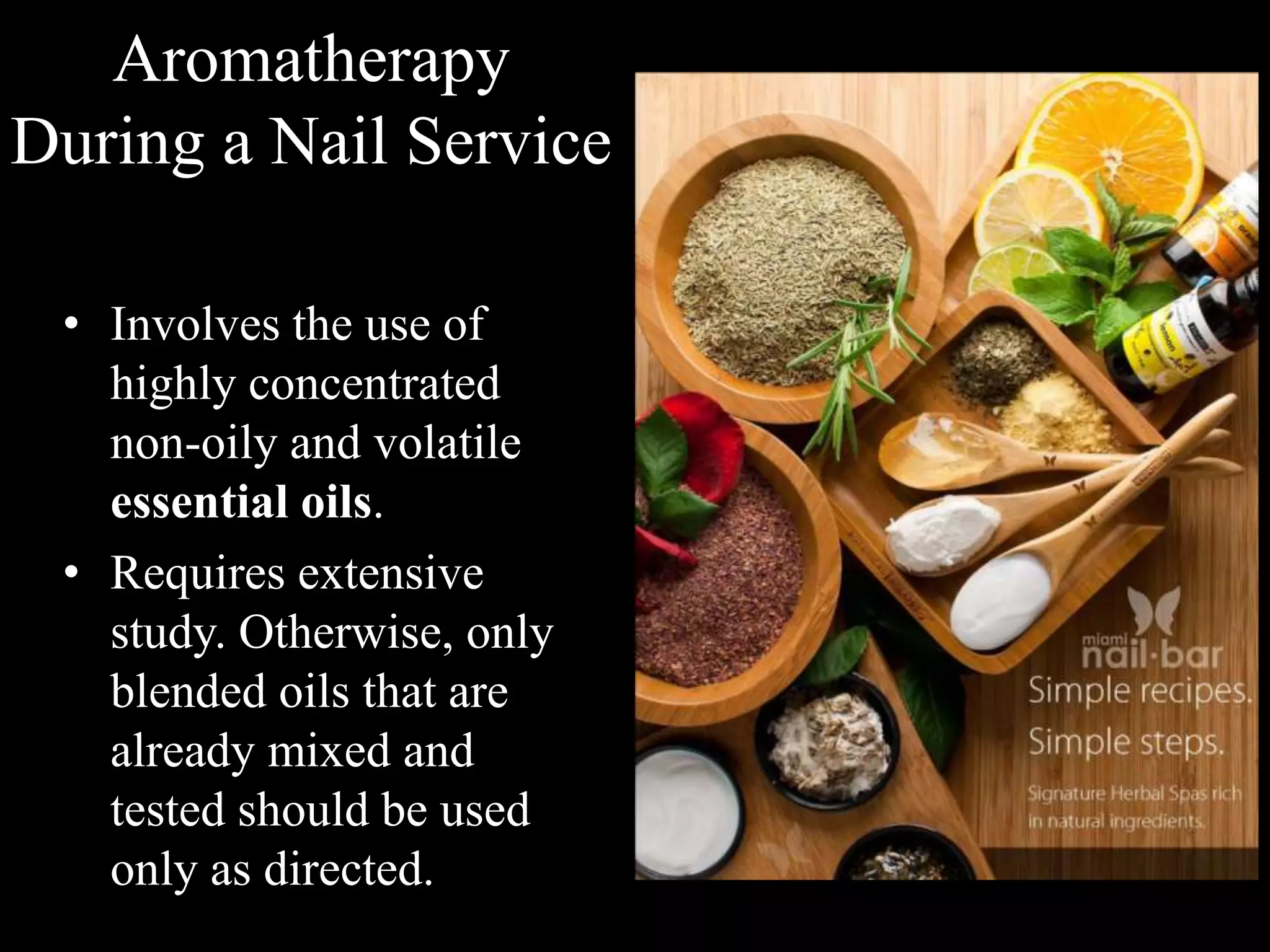
• Involves the use of
highly concentrated
non-oily and volatile
essential oils.
• Requires extensive
study. Otherwise, only
blended oils that are
already mixed and
tested should be used
only as directed.
Benefits of Paraffin
Wax Treatments
• Paraffin – petroleum-based product that has excellent
sealing properties to retain moisture in the skin
• Dip, Glove, Heated mitt ( one time use ), Cheese
Cloth, Spray
120-130 degrees
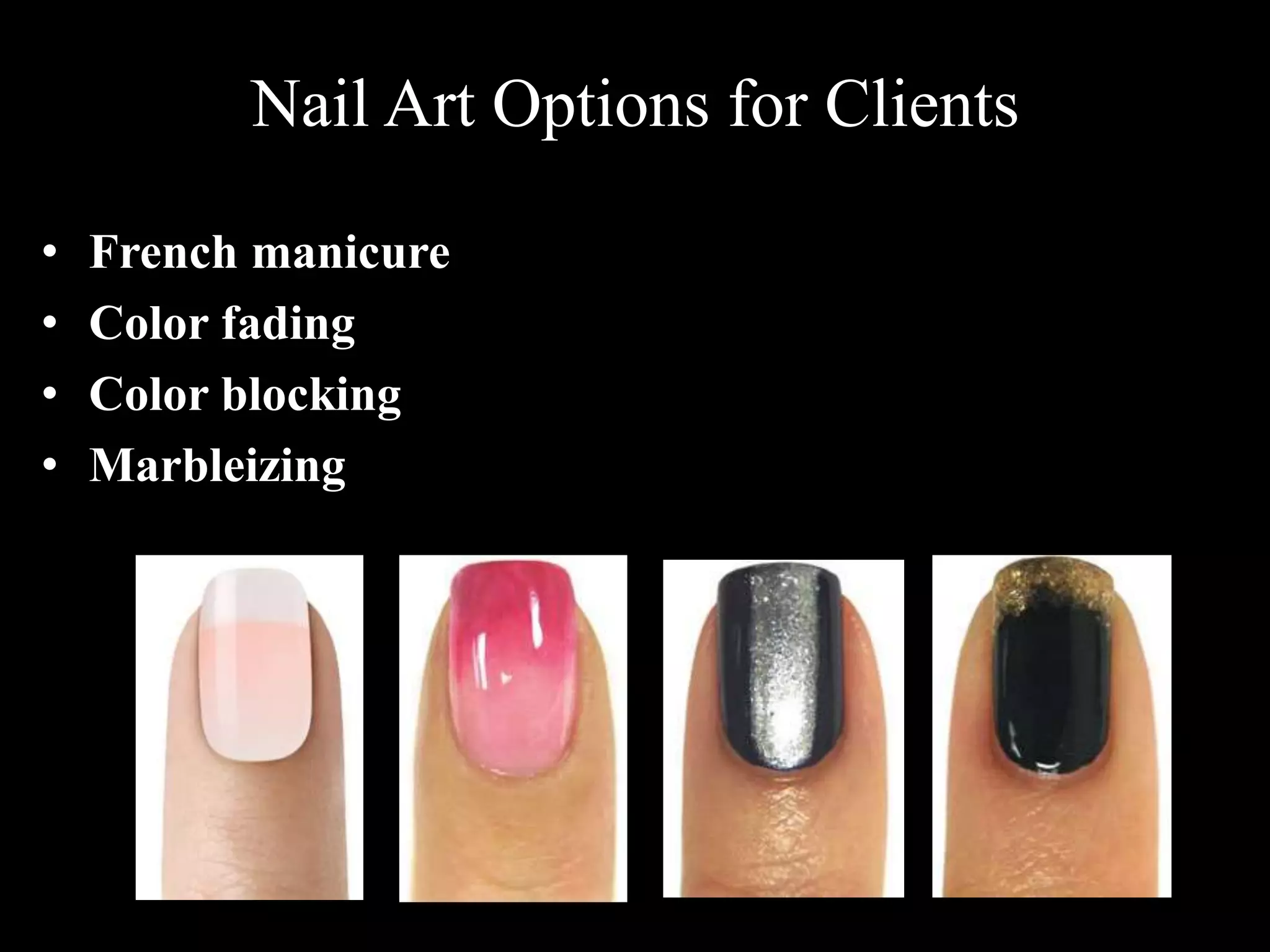
Nail Art Options for Clients
• French manicure
• Color fading
• Color blocking
• Marbleizing
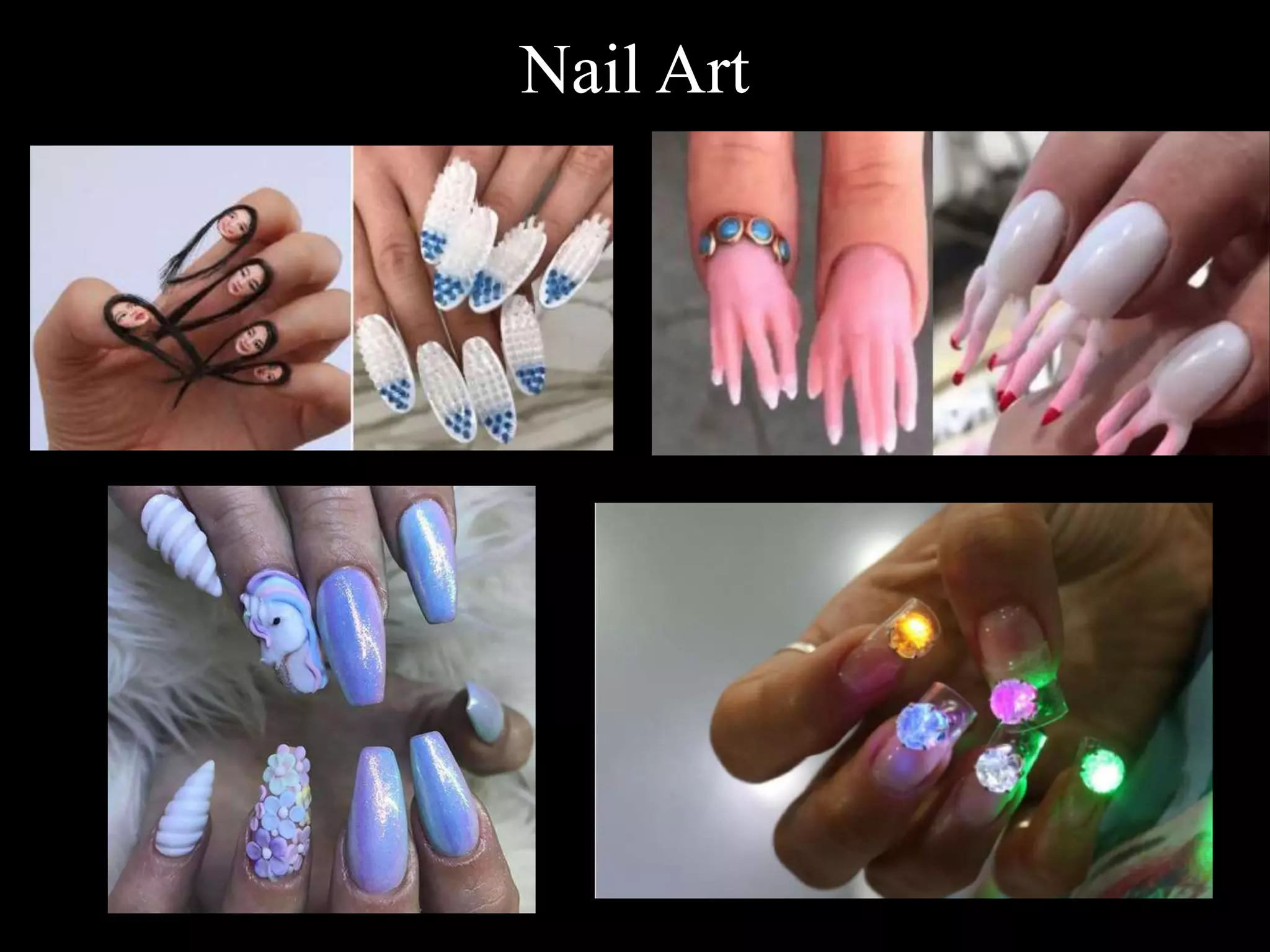
Nail Art
NailartbyAlishaRimando
Botero.
NailartbyAlishaRimando
Botero.
• Define scope of practice.
• Name the four types of professional nail tools required to
perform a manicure.
• What is the difference between multiuse and single-use
implements?
• What is the three-part procedure?
• Is a consultation necessary each time a client has a service in the
salon? Why? (continues)
REVIEW
• Name the basic nail shapes for women.
• What is the most popular nail shape for men?
• Which massage movement is most appropriate for a hand and
arm massage? Why?
• What is the difference between a basic manicure and a spa
manicure?
• How is aromatherapy used in manicuring services? (continues)
REVIEW
• Explain the use and benefits of paraffin wax in manicuring.
• What would be on the manicuring table if it were properly set
up?
• What are the steps in the post-service procedure?
(continues)
• What are the steps in a basic manicure procedure?
• How is nail polish applied properly?
REVIEW

Milady manicuring ch 25

  • 1.
  • 3.
    THE WHY (continues) Nail serviceshave become more frequent & more popular. A thorough understanding of Manicures- The steps, The tools, Design and YOUR Scope of Practice will allow you to safely perform Nail services- adding extra revenue for you & your salon
  • 4.
    • A MANICUREis a cosmetic treatment of the hands involving cutting, shaping – can include painting of the nails, removal/push back of the cuticles, and softening of the skin. • Manicure and pedicure services add extra revenue to salon and spa menus.
  • 5.
    Adhere to StateGovernment Regulations • Scope of practice (SOP) – the list of services that you are legally allowed to perform in your specialty in your state. • If you perform services outside these regulations-you may lose your license.
  • 6.
    Nail Technology Tools •Equipment • Implements • Materials • Products
  • 7.
    Equipment (continues) CourtesyofEuropeanTouch. Table, Lamp, Cosmetologist/GuestChair Finger Bowls Disinfection Container Guest arm cushion Gauze/Cotton container *36-48 inches long *40-60 watt *Fluorescent *8-12 inches
  • 8.
    CourtesyofEuropeanTouch. Trash Container Supply Tray Electricnail polish dryer UV LED light Electric hand mittsParaffin bath Ventilation System Terry cloth mitts
  • 9.
    Multiuse Implements Metal pusherNail nipper Tweezers Nail clippers *20-30 degree from nail plate Have at least 3 sets of high-quality stainless steel implements at all times
  • 10.
    Single-Use Implements Nail Brushapplicators Wooden Pushers Nail Brush
  • 11.
  • 12.
  • 13.
    Materials Courtesyofpurespadirect.com Dust Masks Abrasives/Buffers Two/Three wayBuffer Single use towels Gauze/cotton/pads Plastic spatulas *180-240 *Lint-free, plastic-backed, fiber or cotton pads
  • 14.
    Professional Nail Products (continues) SoapPolish Remover Nail Cream, Lotion, Oil Cuticle Remover Nail Bleach Polish- enamel, lacquer, varnish • Gel Polish • Base Coat 2-5%
  • 15.
    • Hardeners – Proteinhardener; – Dimethyl urea hardener Professional Nail Products Top Coat Nail Polish dryer products Hand Cream Nail Conditioner SPF -Methylene glycol
  • 16.
    Necessary Components toPerform the Basic Manicure • The basic manicure is the foundation of all nail technology services
  • 17.
    Three-Part Procedure • Pre-service– cleaning tools, preparation • Service – step-by-step plan for service • Post-service – caring for client after procedure
  • 18.
    Hand Washing • Handwashing prevents the spread of communicable diseases. • Wash hands before and after each client. • Have clients wash hands before service. • Provide clean nail brushes. • Hand sanitizers do not replace hand washing.
  • 19.
    The Manicure Consultation •Client intake form • Check client's nails and skin • Discuss client preferences, life style
  • 20.
  • 21.
    Choosing a NailColor • Complement skin tone. • Coordinate with clothing. • Allow client to choose.
  • 22.
    Applying Polish • Basecoat • Two coats of polish color • Top coat • Thin, even coats to create maximum smoothness and minimum drying time
  • 23.
    How to Caterto a Man’s Manicure Service • Men’s nail shapes • Men’s massage • Men’s basic color: Clear • Marketing to men
  • 24.
    Complete a Handand Arm Massage • Promotes blood circulation • Relaxes muscles • Relieves pain • Soothes and relaxes client
  • 25.
    • Effleurage- Begin& end with • Pétrissage • Fulling- lift/spread; arms • Friction -more pressure, feel structure underneath • Chucking • Rolling • Wringing Massage Techniques- Facial manipulations CAN translate to Manicure & Pedicure Services Rolling Effleurage Petrissage Friction
  • 26.
    • Tapotement • Slapping •Hacking • Vibration Massage Techniques- Facial manipulations CAN translate to Manicure & Pedicure Services
  • 27.
    State the DifferencesBetween Spa Manicures and Basic Manicures • Require extensive knowledge of nail care and skin care • Usually include a relaxing massage and exfoliation • May include use of rose oils, paraffin dips, hand masks, and warm, moist towel applications
  • 28.
    Theme Manicures • Containproducts to support the theme. • Refreshments might be served to support the theme. • Examples: – Chocolate Wonder Manicure and Pedicure – Pumpkin Fall Festival Manicure and Pedicure
  • 29.
    Waterless Manicures • Hands arenot soaked in water. • Cuticles are softened with lotion and heated mitts.
  • 30.
    Aromatherapy During a NailService • Involves the use of highly concentrated non-oily and volatile essential oils. • Requires extensive study. Otherwise, only blended oils that are already mixed and tested should be used only as directed.
  • 31.
    Benefits of Paraffin WaxTreatments • Paraffin – petroleum-based product that has excellent sealing properties to retain moisture in the skin • Dip, Glove, Heated mitt ( one time use ), Cheese Cloth, Spray 120-130 degrees
  • 32.
    Nail Art Optionsfor Clients • French manicure • Color fading • Color blocking • Marbleizing
  • 33.
  • 34.
    • Define scopeof practice. • Name the four types of professional nail tools required to perform a manicure. • What is the difference between multiuse and single-use implements? • What is the three-part procedure? • Is a consultation necessary each time a client has a service in the salon? Why? (continues) REVIEW
  • 35.
    • Name thebasic nail shapes for women. • What is the most popular nail shape for men? • Which massage movement is most appropriate for a hand and arm massage? Why? • What is the difference between a basic manicure and a spa manicure? • How is aromatherapy used in manicuring services? (continues) REVIEW
  • 36.
    • Explain theuse and benefits of paraffin wax in manicuring. • What would be on the manicuring table if it were properly set up? • What are the steps in the post-service procedure? (continues) • What are the steps in a basic manicure procedure? • How is nail polish applied properly? REVIEW

Editor's Notes

  • #5 INTRODUCTION Once you have learned the fundamental techniques in this chapter, you will be officially on your way to providing clients with a professional manicure. A manicure is a cosmetic treatment of the hands involving cutting, shaping, and often painting of the nails, removal of the cuticles, and softening of the skin. Manicure and pedicure services are currently the fastest-growing services on salon and spa menus.
  • #6 ADHERE TO STATE GOVERNMENT REGULATIONS Understand the regulations that are designated by your state. Know that if you perform services outside these regulations concerning allowable services, you may lose your license. Also, if damages to a client occur while performing an illegal service, you are fully liable, both professionally and personally. Occupational Safety and Health Administration (commonly referred to as OSHA) also provides guidelines for protecting cosmetologists from chemicals that can affect your health. The main health issue a cosmetologist is prone to is hypersensitivity reactions.
  • #7 WORK WITH NAIL TECHNOLOGY TOOLS There are four categories of nail technology tools.
  • #8 EQUIPMENT These are permanent items used in cosmetology; they don’t have to be replaced. Table: Usually includes one or more drawers and is 36 to 48 inches (90 to 120 cm) long and 16 to 21 inches (40 to 52 cm) wide. Adjustable lamp: The lamp should be adjustable and have a 40- to 60-watt bulb. Client/technician chair: The technician’s chair should be selected for ergonomics, comfort, durability, resistance to staining, and ease of cleaning. The client chair should be durable and comfortable. Finger bowls: A finger bowl is used for soaking the client’s fingers in warm water to soften the skin and cuticle. Disinfection container: It holds disinfection solution in order to immerse clean implements. Client’s arm cushion: A cushion for the client’s arm. Service cushion (optional): This should be placed between the client and technician for more comfort. Gauze and cotton wipe container: Holds clean, absorbent cotton lint-free wipes, or gauze squares for use during the services.
  • #9 EQUIPMENT (continued) Trash containers Supply tray (optional): Holds professional nail products. Electric nail polish dryer (optional): Shortens the time necessary for the client’s nail polish to dry. UV or LED light (optional): These lamps cure or harden products that contain photoinitiators which are designed to be sensitive to the UVA wavelengths the bulbs emit. Electric hand/foot mitts (optional): Warmth aids in the penetration of conditioning ingredients. Terry cloth mitts (optional): Used over paraffin to hold in heat. Paraffin bath (optional): Used for melting paraffin wax to moisturize the skin. Ventilation system (optional): Products used when performing nail services may contain chemicals that can affect a worker's health. Exposure to nail dust and chemical odors and vapors can affect one's breathing and respiratory health. Proper ventilation should be used in the salon to protect nail technicians from becoming overexposed to vapors and dust.
  • #10 MULTIUSE IMPLEMENTS Tools that can be cleaned or disposed of; reusable tools are generally stainless steel. Disposables are for single use only. Metal pusher: Used to push back excess cuticle. Hold it like a pencil. Improper use can cause microscopic trauma or injury to the tissues, called microtrauma, which is tiny openings in the skin that can allow microbes to enter the skin. Nail nipper: Used to trim away tags of dead skin. It is never used to trim away eponychium. Hold it in the palm with the blades facing the cuticle. Place the thumb on one handle and three fingers on the other with the index finger on the screw to the guide blade. Tweezers: Used to lift small bits of debris from the nail plate or remove implements from disinfectant solution. Nail clippers: Used to shorten nails to reduce filing time. They must be properly disinfected after each use.
  • #11 SINGLE-USE IMPLEMENTS Disposable implements that are used once on a client and then discarded. Brushes and applicators: If they cannot be properly cleaned and disinfected after each use, they must be disposed of unless self-disinfecting. Wooden pusher: For loosening the cuticle; hold it like a pencil. When applying cosmetics, wrap a small piece of cotton around the end. Nail brush: Used to clean and remove debris from nails and implements. Application brush: Used to apply nail oils, nail polish, or nail treatments to a client’s nails.
  • #14 MATERIALS Gloves: Personal protective equipment worn to protect the cosmetologist and the client. Dust mask: Should be a high quality, properly fitted dust mask when transferring chemicals from one container to another or when buffing a nail. Abrasive files and buffers: Used to shape the free edge of nails. The lower grit abrasives (less than 180 grit), are aggressive and will quickly reduce the thickness of any surface. Medium grit abrasive (150 to 180 grit) are used to smooth and refine surfaces, and the 180 grit is used to shorten and shape natural nails. Fine-grit abrasives are those with 240 or higher grit. Two-way or three-way buffer: Used to buff the nails to a beautiful shine. Single-use or terry cloth towels: Wash terry towels between clients. Dispose of paper towels. Gauze, cotton, and pads: Primarily used to remove nail polish. Plastic or metal spatulas: Used to remove products from containers.
  • #15 PROFESSIONAL NAIL PRODUCTS Soap: Soap and warm water are used to clean the technician’s and client’s hands. Liquid soaps are recommended. NOTE: Ask students why. (Because bar soaps harbor bacteria and can become a breeding place for pathogens.) Polish remover: Used to dissolve and remove nail polish; they contain solvents (acetone or ethyl acetate). Acetone is a colorless, inflammable liquid, miscible with water, alcohol, and ether, and has a sweetish odor or burning taste; it is used as a solvent. Nail creams, lotions, and oils: These are designed to soften dry skin around nail plate and increase the flexibility of natural nails. Nail creams are barrier products because they contain ingredients designed to seal the surface of the skin around the nail and hold in the subdermal moisture in the skin. Nail oils are designed to absorb into the nail plate to increase flexibility and into the surrounding skin to soften and moisturize. Typically, oils have a longer lasting effect than creams. Cuticle removers: These are designed to loosen and dissolve dead tissue from the nail plate for easy removal. Nail bleach: Used to remove yellow surface discoloration or stains such as tobacco stains; they contain H2O2 or some other keratin bleaching agent. Use as directed. Colored polish, enamel, lacquer, or varnish Gel polish: Form of nail color that lasts 10 to 21 days is a high-demand salon service that addresses the constant smudging clients experience after a manicure. Base coat: A colorless layer that improves the adhesion of polish; it also prevents staining of the natural nail plate.  
  • #16 PROFESSIONAL NAIL PRODUCTS (continued) Hardener: Used to improve surface hardness or durability of weak or thin nail plates. It helps prevent splitting or peeling of the nail plate. Protein hardener: Combination of clear polish and protein; it cannot absorb into the nail plate. Other types: They contain reinforcing fibers such as nylon. They cannot absorb into the nail plate. Dimethyl urea hardeners: These add cross-links to the natural nail plate. They do not cause adverse skin reactions. Top coat: Used over polish to prevent chipping and to add shine to the finished nail. The main ingredients are acrylic or cellulose-type film formers. Nail polish dryer products: Accelerates drying of nail polish. Hand cream or lotion: These add a finishing touch to the manicure. They soften and smooth the hands and help skin retain moisture. Nail conditioners: Used to reduce brittleness of the nail plate and moisturize the surrounding skin. Use as directed. Sunscreens: These protect skin from damage by UVA rays.
  • #18 THREE-PART PROCEDURE Pre-service procedure: This is an organized plan for preparing tools, setting up the table, and greeting the client. See Procedure 25-1, Pre-Service Procedure, found on page 880 of Milady Standard Cosmetology. Service: Step-by-step procedure for service. Post-service procedure: Organized plan for caring for the client after the service. See Procedure 25-2, Post-Service Procedure, found on page 884 of Milady Standard Cosmetology.
  • #19 HAND WASHING The technician washes hands before and after each client. The client must wash hands before the service.
  • #20 THE MANICURE CONSULTATION NOTE: Remind students that they can review the 9-Step Consultation Procedure in this chapter on page 868 in the Focus On box. Use the information on the client intake form to guide you during the client consultation. Client intake form: Keep the intake form close by throughout the procedure for reference. Look at the forms closely for important responses from the client, and then record your observations after the service on a service record card or in the salon software program at the end of the service. Check client’s nails and skin: Always check the client’s nails and skin to make sure that they are healthy and that the service you are providing is appropriate. Discuss client preferences, life style: Discuss the shape, color, and length of nails that your client prefers. Consider client’s lifestyle; such as hobbies, recreational activities, and type of work when determining the best nail shape and length.
  • #21 BASIC NAIL SHAPES FOR WOMEN Consider the shape of the hands, length of fingers, shape of the cuticle area, hobbies, recreational activities, and type of work the client does. Square: Straight across with no rounding at the edges; length depends on the client’s preference. Squoval: Has a square free end with corners rounded off; it extends slightly past fingertip. Round: Should be slightly tapered and extend just a bit past fingertip; this is most common for males. Oval: Conservative and attractive. Pointed: Suited to thin hands with narrow nail beds; they are tapered somewhat longer than usual to enhance the slender appearance of the hand; they are weak and break easily.
  • #22 CHOOSING A NAIL COLOR Suggest a shade that compliments skin tone or coordinate with clothing for a special event. Allow the client to make the final choice.
  • #23 APPLYING POLISH This is best achieved with four coats: base coat, two coats of polish color, and a top coat. Apply thin, even coats to create maximum smoothness and minimum drying time. See Procedure 25-5, Polishing the Nails, found on page 893 of Milady Standard Cosmetology.
  • #24 HOW TO CATER TO A MAN'S MANICURE SERVICE It is the same as a basic manicure except that colored polish is replaced with buffing the nails to a high shine. Also, use a citrus or spice scented hand cream versus a flowering scent. Men’s nail shapes: Short and rounded is most popular. Men’s massage: Use more firm finger movements on the palm and longer, firmer slides in effleurage movements. Men’s basic color: Clear; use a base coat and quick-drying top coat. Marketing to men: Describe the service and list the benefits. Distribute flyers at gyms and men’s stores. Sell gift certificates to female clients. Schedule a men’s night.
  • #25 COMPLETE A HAND AND ARM MASSAGE Massage is the manipulation of soft body tissues. Benefits: Promotes blood circulation Relaxes muscles Relieves pain Soothes and relaxes client
  • #28 STATE THE DIFFERENCES BETWEEN SPA MANICURES AND BASIC MANICURES Spa manicures require extensive knowledge of nail care and skin care. They usually include a relaxing massage and exfoliation. They may incorporate the use of rose oils. Additional techniques include paraffin dips, hand masks, and warm, moist towel applications.
  • #29 THEME MANICURES These contain products to support the theme, from lotions to oils to masks. Refreshments might even be served to support the theme. Examples include: “Chocolate Wonder Manicure and Pedicure” or “Pumpkin Fall Festival Manicure and Pedicure.”
  • #30 WATERLESS MANICURES Instead of soaking the hands in water, some nail technicians use lotion and heated mitts to soften the cuticles. See Procedure 25-3, Performing a Basic Manicure, found on page 886 of Milady Standard Cosmetology.
  • #31 INDICATE WHY AROMATHERAPY IS USED DURING A NAIL SERVICE Discovered by Professor Gattefosse, a French scientist, it involves the use of highly concentrated nonoily and volatile essential oils. The practice requires extensive study. Otherwise, only blended oils that are already mixed and tested should be used only as directed.
  • #32 SUMMARIZE THE BENEFITS OF PARAFFIN WAX TREATMENTS Paraffin wax treatments are designed to trap moisture in the skin while the heat causes skin pores to open and increases blood circulation. Various types of applications include applying to the hands directly, dip paraffin in cheesecloth or paper towel, spray paraffin, and Single-Use Commercial Gloves. Plastic bag paraffin application: This method would be pouring the paraffin in plastic bags and wrapping each bag around the client’s hands or feet. Cheesecloth or paper towel paraffin application: This is when cheesecloth or paper towel is dipped into paraffin and wrapped around the hands or feet. Spray paraffin: In this method, a special machine with replaceable paraffin cartridges is used and sprayed onto the client’s hands or feet. Single-use commercial gloves: These gloves come with paraffin lined inside the glove and are disposed of after use.
  • #33 OUTLINE NAIL ART OPTIONS FOR CLIENTS French manicure: This is where the nail bed is pink, peach, or beige and the tip is white or another color. Color fading: This is when one color fades into another. Color blocking: This is when a section of the nail is a different color. Marbleizing: This is a swirled affect created when combining two or more colors. Other nail art: You can use embellishments or 3-D applications to create a different type of art.
  • #35 CHAPTER REVIEW QUESTIONS 1. Define scope of practice. Answer: It is the list of services that you are legally allowed to perform in your specialty in your state.  2. Name the four types of professional nail tools required to perform a manicure. Answer: Metal pusher, nail nippers, tweezers, and nail clippers.  3. What is the difference between multiuse and single-use implements? Answer: Multiuse implements can be cleaned and disinfected; single-use implements are only used once and then discarded.  4. What is the three-part procedure, and how is it used in the performance of the basic manicure? Answer: The three-part procedure includes the pre-service, actual procedure, and the post-service.  5. Is a consultation necessary each time a client has a service in the salon? Why? Answer: Yes, because medical history or lifestyle could have changed which would reflect the varied use of the client’s hands and condition of nails.
  • #36 CHAPTER REVIEW QUESTIONS (continued) 6. Name the basic nail shapes for women. Answer: Nail shapes for women include square, squoval, round, oval, and pointed.  7. What is the most popular nail shape for men? Answer: Round nails seem to be the most popular shape for men.  8. Which massage movement is most appropriate for a hand and arm massage? Why? Answer: Effleurage is the most appropriate movement for a hand and arm massage because it is a succession of strokes that glide over the hand and arm that are very relaxing. 9. What is the difference between a basic manicure and a spa manicure? Answer: A spa manicure includes more pampering than a basic manicure adding a longer, relaxing massage and some form of exfoliation. 10. How is aromatherapy used in manicuring services? Answer: Essential oils are inhaled or applied to the skin and used to induce relaxation or invigoration.
  • #37 CHAPTER REVIEW QUESTIONS (continued) 11. Explain the use and benefits of paraffin wax in manicuring. Answer: Paraffin is applied to the skin to trap moisture in the skin while the heat causes skin pores to open to allow deeper penetration of lotions and oils used prior to application. 12. What would be on the manicuring table if it were properly set up? Answer: The items that would be on the manicuring table would include a clean cloth, abrasives, buffers, trash receptacle, finger bowl, and nail brush. 13. What are the steps in the post-service procedure? Answer: The steps during the post-service procedure include: discuss home care, have the client schedule his/her next appointment, collect payment, thank them for their business, and record their service information on the service record card and file it away. Afterward, you can prepare your table for your next client by removing everything off the table, and cleaning and disinfecting the implements and table.