©Clare Hargreaves-Norris
Skin Analysis
NVQ Level 2 Beauty
Therapy
©Clare Hargreaves-Norris
Skin Analysis
When carrying out a
skin analysis you should
consider the following
3 points:
 Look
 Touch
 Question
©Clare Hargreaves-Norris
Look
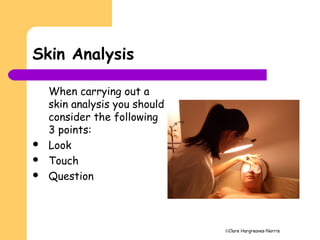
Use the magnifying light to look for
characteristics and conditions to guide you
in making a decision as to the client’s skin
type. You would also look for areas that are
showing signs of ageing.
©Clare Hargreaves-Norris
Touch
Using you fingers touch the client’s skin to
feel the texture of the skin, muscle tone,
elasticity, skin tone, amount of subcutaneous
tissue and sebaceous secretions.
©Clare Hargreaves-Norris
Questioning
Determine their skin care routine, the type of
products they are using and for what skin type and
finally if they have any problems with their skin. It
is important that you get the client’s point of view!
Questions to ask:
 Have you had a facial before?
 How long has it been since your last facial?
 How was your skin after your last facial?
 Have you noticed any problems with your skin?
 Have you noticed any areas of dryness/oiliness?
 What is the main reason for you having a facial today?
©Clare Hargreaves-Norris
Remember
It is vital that you assess the skin
correctly, otherwise incorrect products and
pressure could be applied resulting in an
ineffective treatment. It is also important
that you find out the clients requirements
from the treatment i.e. just because the
client has blackheads do not automatically
presume that they want them extracting.
©Clare Hargreaves-Norris
Note
The products/frequency that the client is using
them can affect the current skin condition. It is
important that you gain information on the client’s
skin care routine and the products used. Do not
presume that if the client is cleansing, toning and
moisturising that the skin care routine is perfect
as they may be using the wrong products or
applying them incorrectly.
©Clare Hargreaves-Norris
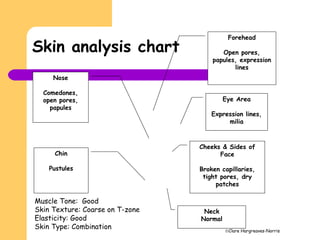
Skin analysis chart
Forehead
Open pores,
papules, expression
lines
Eye Area
Expression lines,
milia
Nose
Comedones,
open pores,
papules
Cheeks & Sides of
Face
Broken capillaries,
tight pores, dry
patches
Neck
Normal
Chin
Pustules
Muscle Tone: Good
Skin Texture: Coarse on T-zone
Elasticity: Good
Skin Type: Combination

Facial skin analysis

  • 1.
  • 2.
    ©Clare Hargreaves-Norris Skin Analysis Whencarrying out a skin analysis you should consider the following 3 points:  Look  Touch  Question
  • 3.
    ©Clare Hargreaves-Norris Look Use themagnifying light to look for characteristics and conditions to guide you in making a decision as to the client’s skin type. You would also look for areas that are showing signs of ageing.
  • 4.
    ©Clare Hargreaves-Norris Touch Using youfingers touch the client’s skin to feel the texture of the skin, muscle tone, elasticity, skin tone, amount of subcutaneous tissue and sebaceous secretions.
  • 5.
    ©Clare Hargreaves-Norris Questioning Determine theirskin care routine, the type of products they are using and for what skin type and finally if they have any problems with their skin. It is important that you get the client’s point of view! Questions to ask:  Have you had a facial before?  How long has it been since your last facial?  How was your skin after your last facial?  Have you noticed any problems with your skin?  Have you noticed any areas of dryness/oiliness?  What is the main reason for you having a facial today?
  • 6.
    ©Clare Hargreaves-Norris Remember It isvital that you assess the skin correctly, otherwise incorrect products and pressure could be applied resulting in an ineffective treatment. It is also important that you find out the clients requirements from the treatment i.e. just because the client has blackheads do not automatically presume that they want them extracting.
  • 7.
    ©Clare Hargreaves-Norris Note The products/frequencythat the client is using them can affect the current skin condition. It is important that you gain information on the client’s skin care routine and the products used. Do not presume that if the client is cleansing, toning and moisturising that the skin care routine is perfect as they may be using the wrong products or applying them incorrectly.
  • 8.
    ©Clare Hargreaves-Norris Skin analysischart Forehead Open pores, papules, expression lines Eye Area Expression lines, milia Nose Comedones, open pores, papules Cheeks & Sides of Face Broken capillaries, tight pores, dry patches Neck Normal Chin Pustules Muscle Tone: Good Skin Texture: Coarse on T-zone Elasticity: Good Skin Type: Combination