Collision Warning
and Avoidance
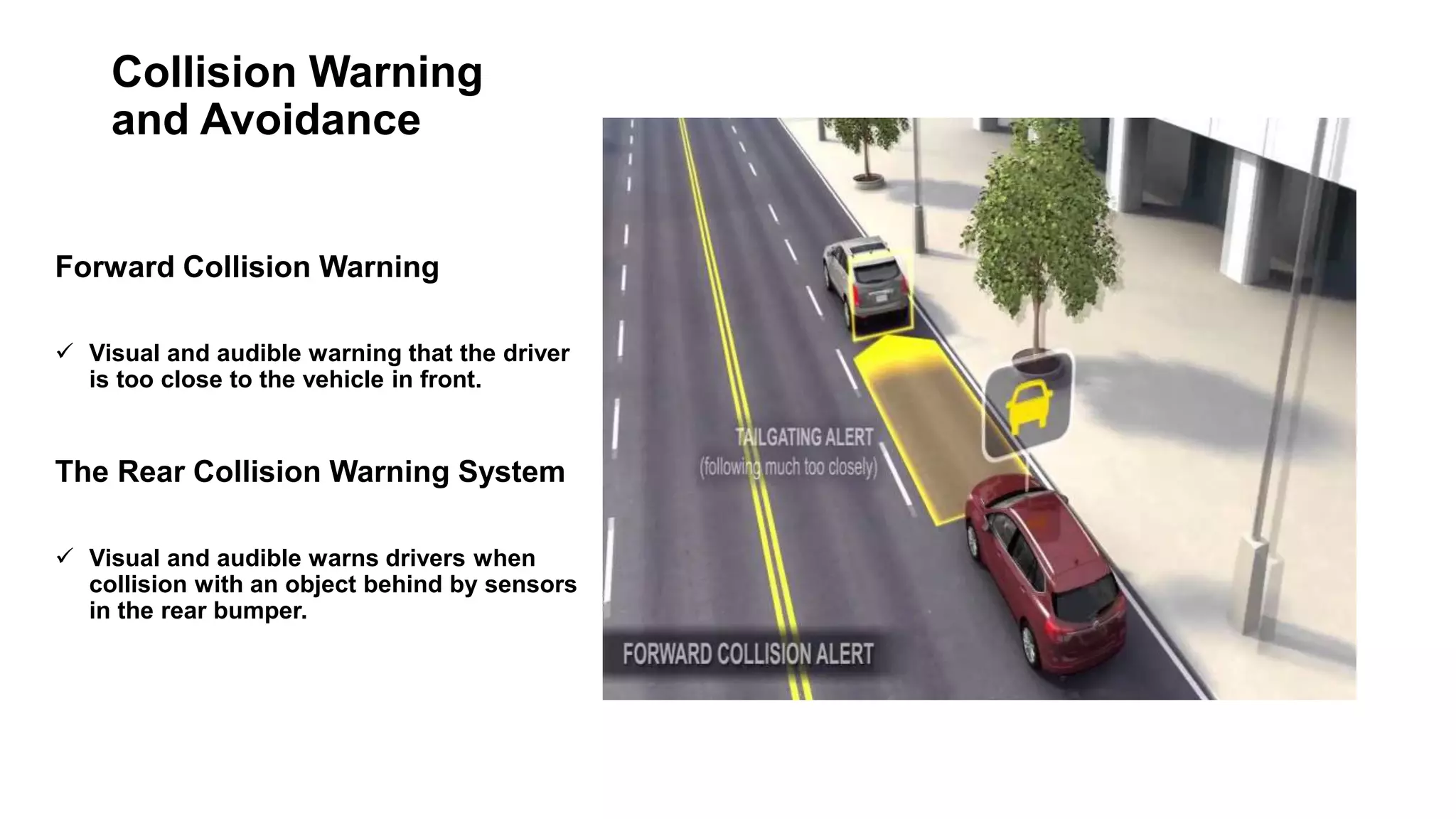
Forward Collision Warning
 Visual and audible warning that the driver
is too close to the vehicle in front.
The Rear Collision Warning System
 Visual and audible warns drivers when
collision with an object behind by sensors
in the rear bumper.
Collision Warning
and Avoidance
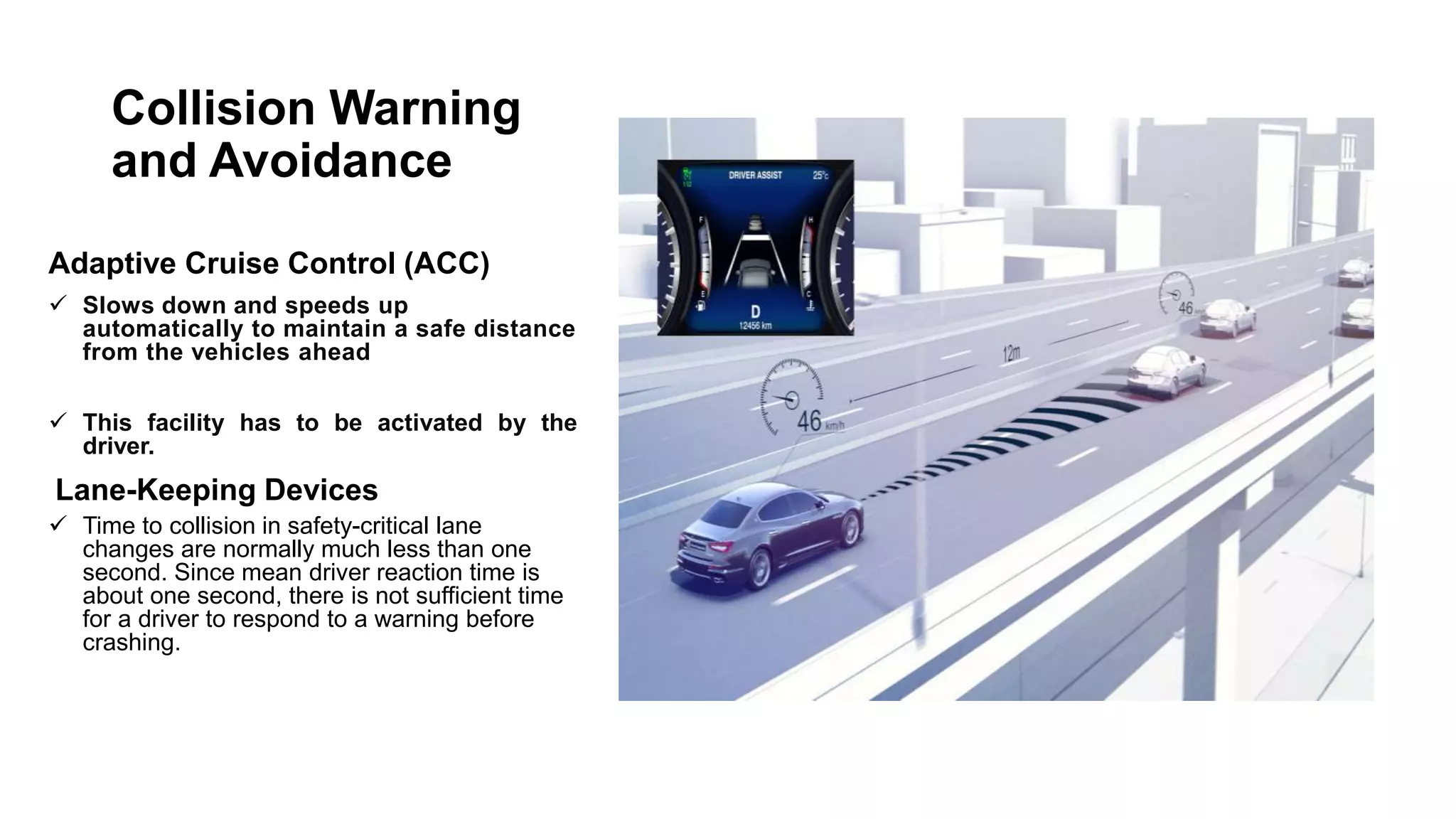
Adaptive Cruise Control (ACC)
 Slows down and speeds up
automatically to maintain a safe distance
from the vehicles ahead
 This facility has to be activated by the
driver.
Lane-Keeping Devices
 Time to collision in safety-critical lane
changes are normally much less than one
second. Since mean driver reaction time is
about one second, there is not sufficient time
for a driver to respond to a warning before
crashing.
Collision Warning
and Avoidance
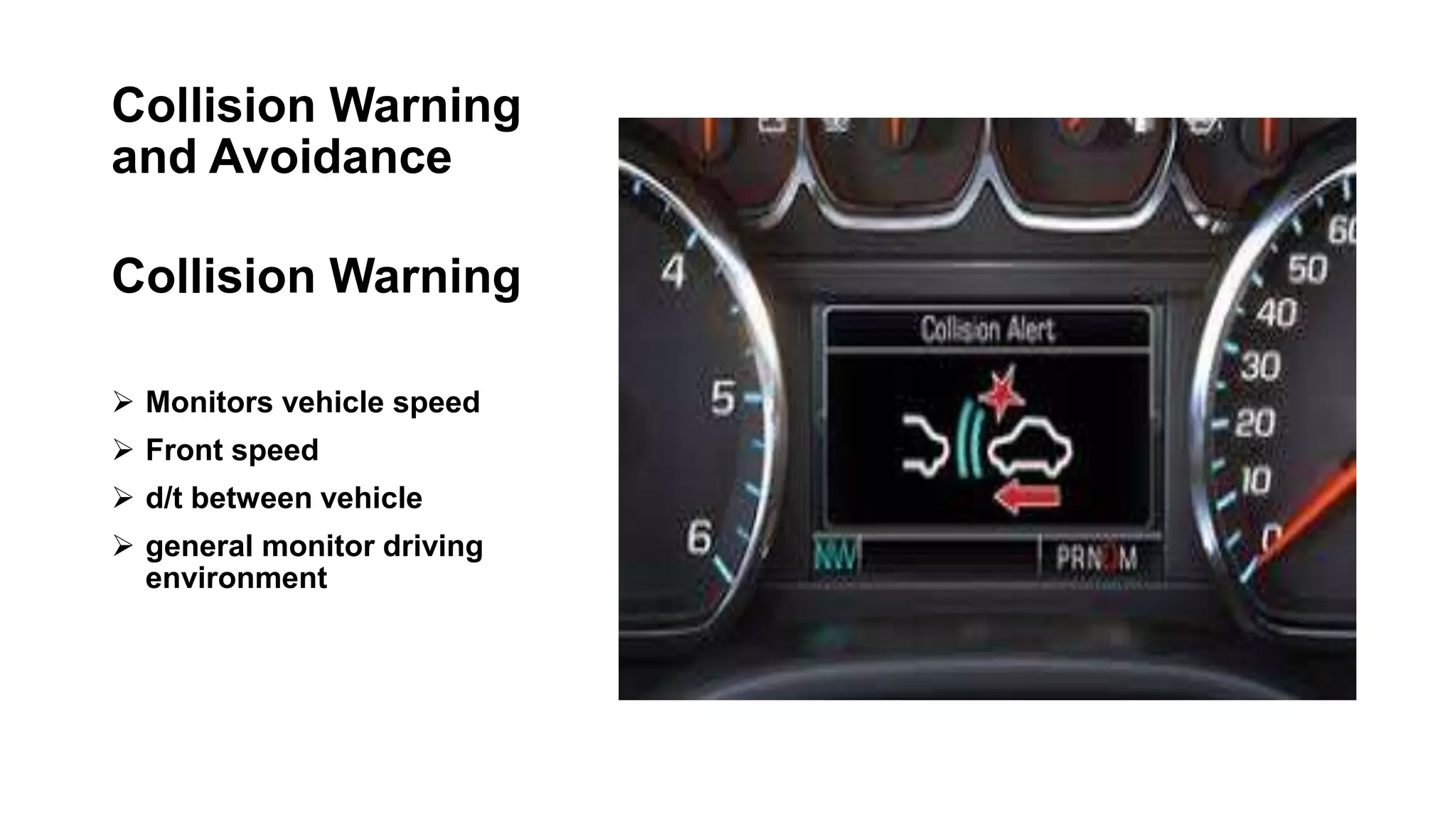
Collision Warning
 Monitors vehicle speed
 Front speed
 d/t between vehicle
 general monitor driving
environment
Collision Warning
and Avoidance
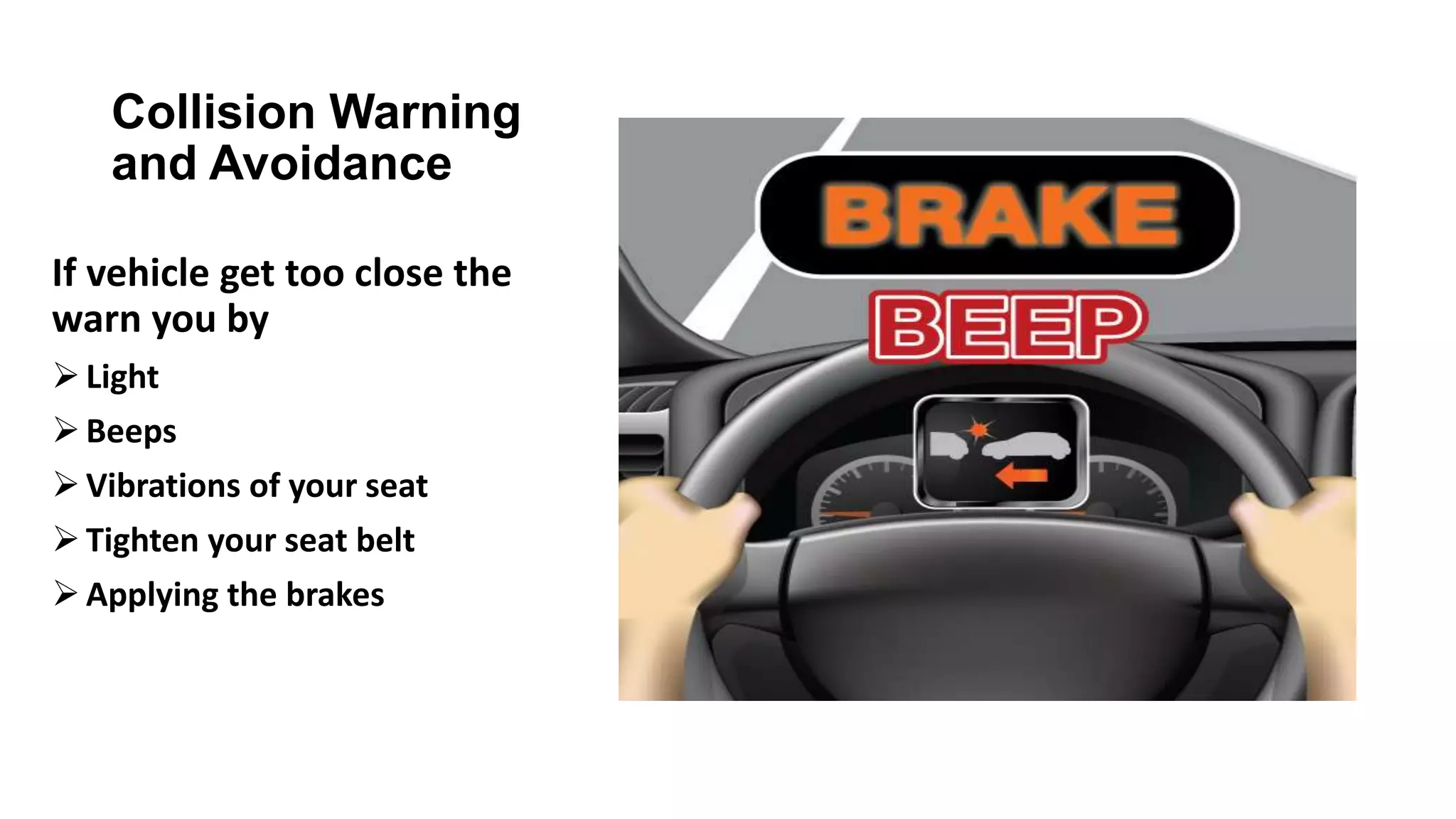
If vehicle get too close the
warn you by
Light
Beeps
Vibrations of your seat
Tighten your seat belt
Applying the brakes
Collision Warning
and Avoidance
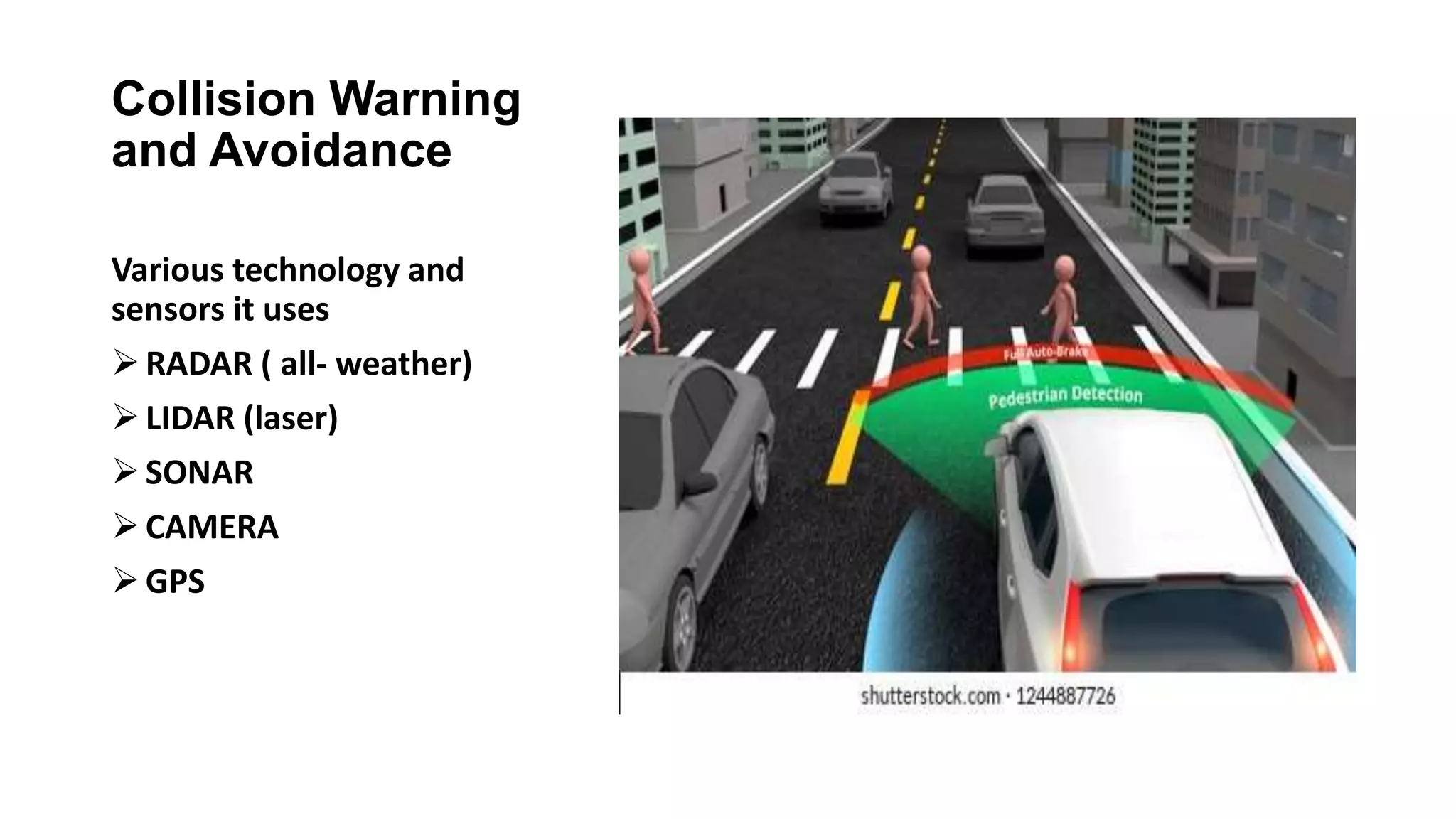
Various technology and
sensors it uses
RADAR ( all- weather)
LIDAR (laser)
SONAR
CAMERA
GPS
Collision Warning
and Avoidance
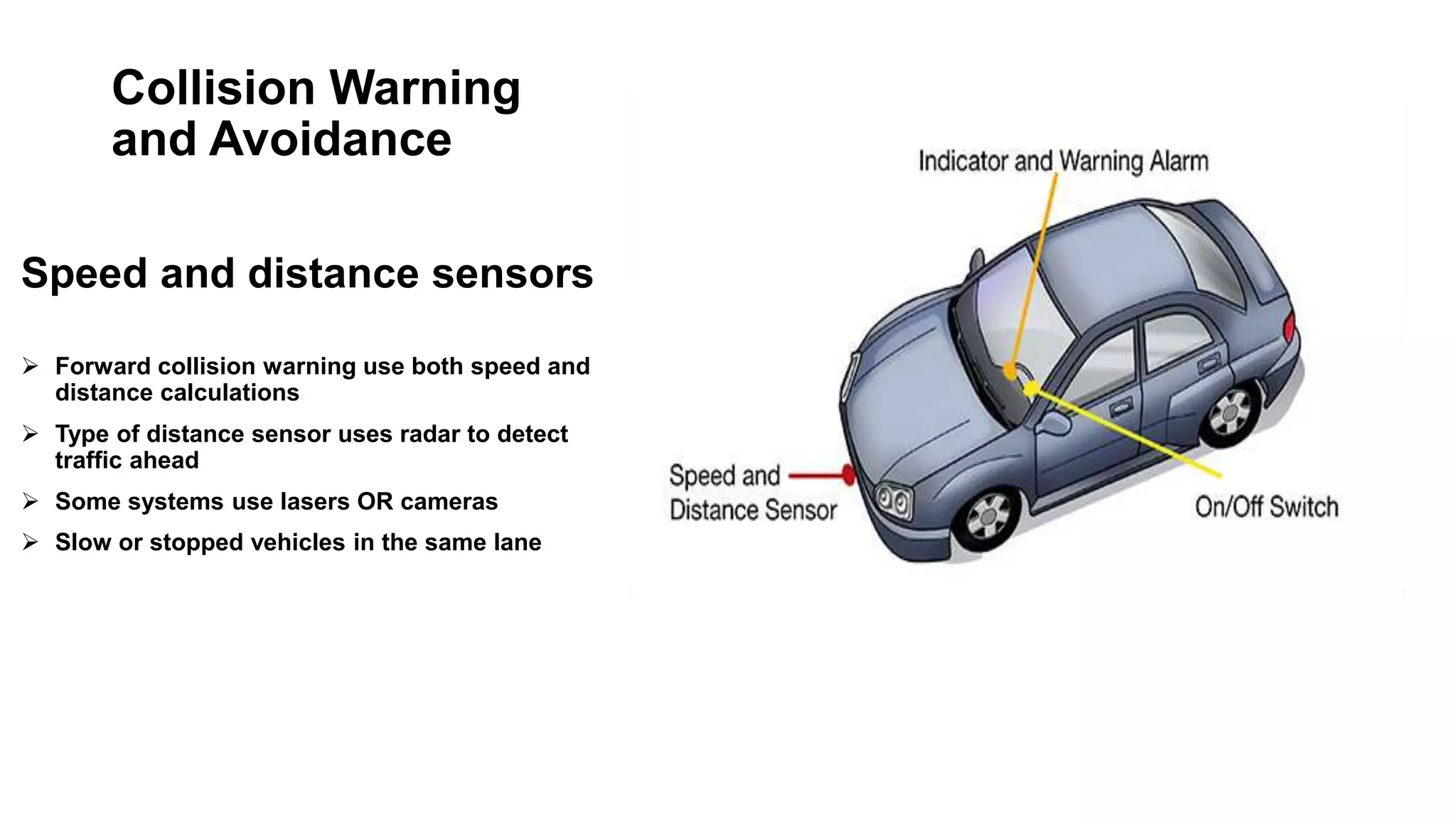
Speed and distance sensors
 Forward collision warning use both speed and
distance calculations
 Type of distance sensor uses radar to detect
traffic ahead
 Some systems use lasers OR cameras
 Slow or stopped vehicles in the same lane
Collision Warning
and Avoidance
Rear End Collision
 It is common vehicle accidents
There are many different ways
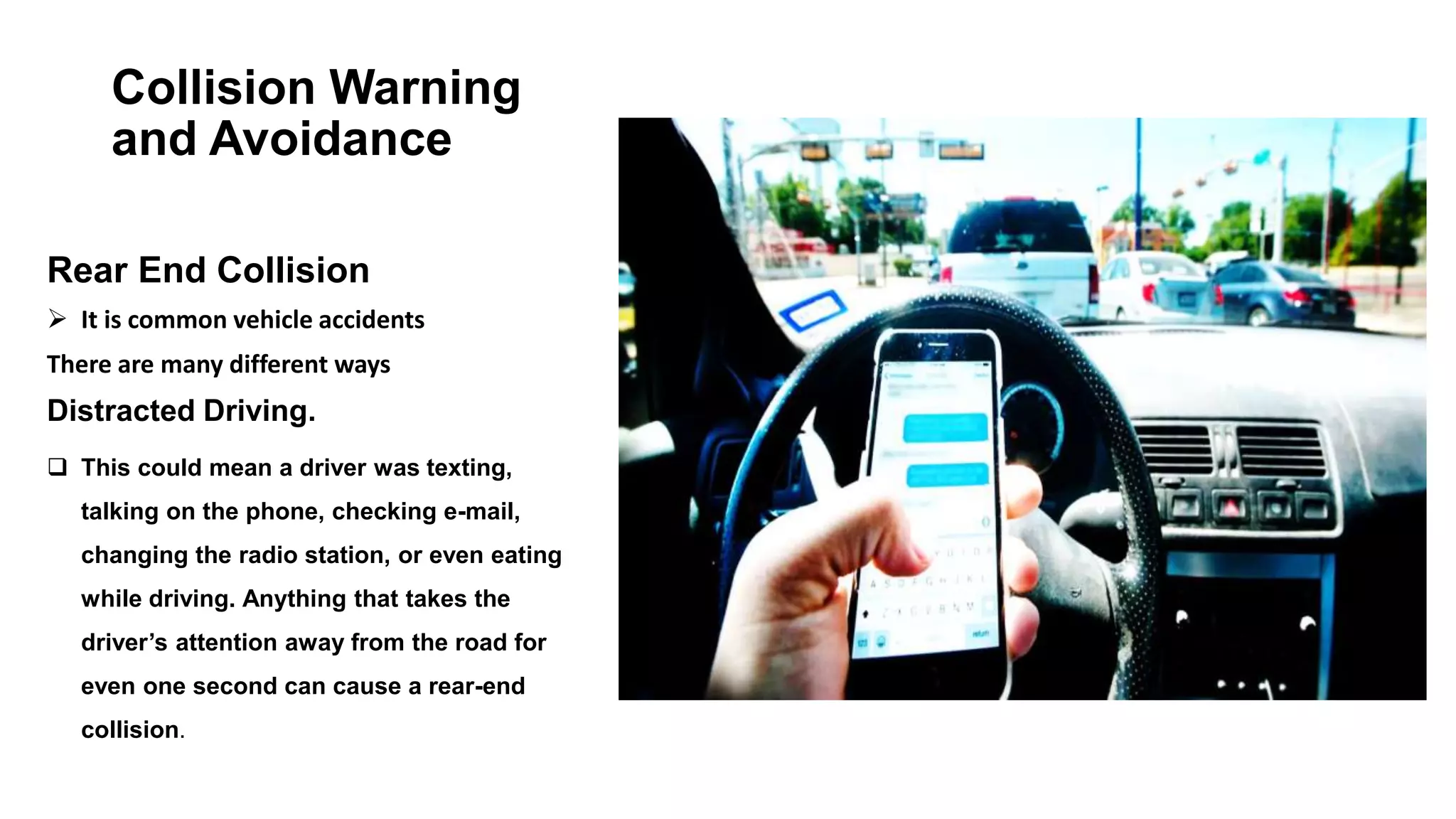
Distracted Driving.
 This could mean a driver was texting,
talking on the phone, checking e-mail,
changing the radio station, or even eating
while driving. Anything that takes the
driver’s attention away from the road for
even one second can cause a rear-end
collision.
Collision Warning
and Avoidance
Rear End Collision
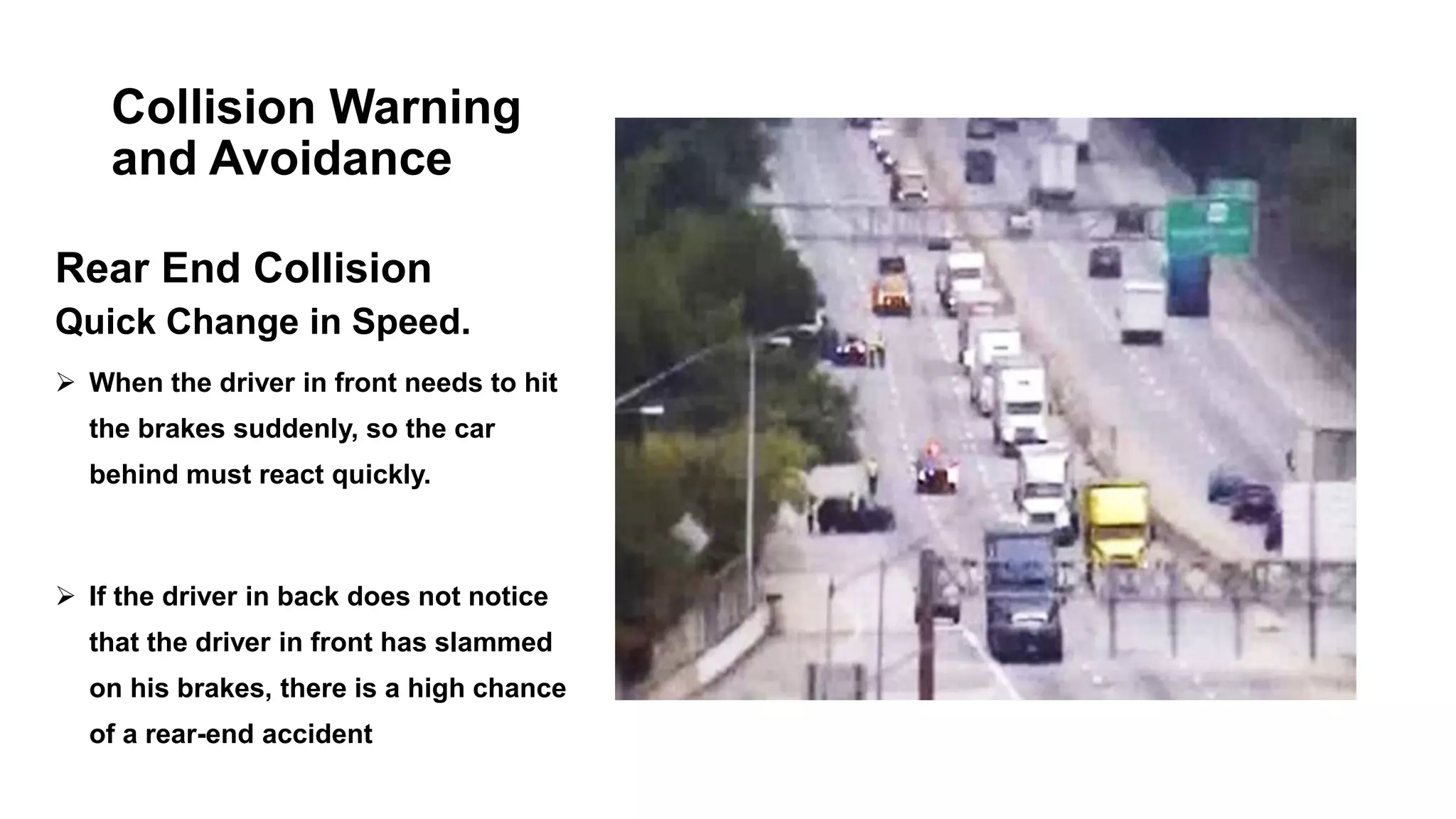
Quick Change in Speed.
 When the driver in front needs to hit
the brakes suddenly, so the car
behind must react quickly.
 If the driver in back does not notice
that the driver in front has slammed
on his brakes, there is a high chance
of a rear-end accident
Collision Warning
and Avoidance
Rear End Collision
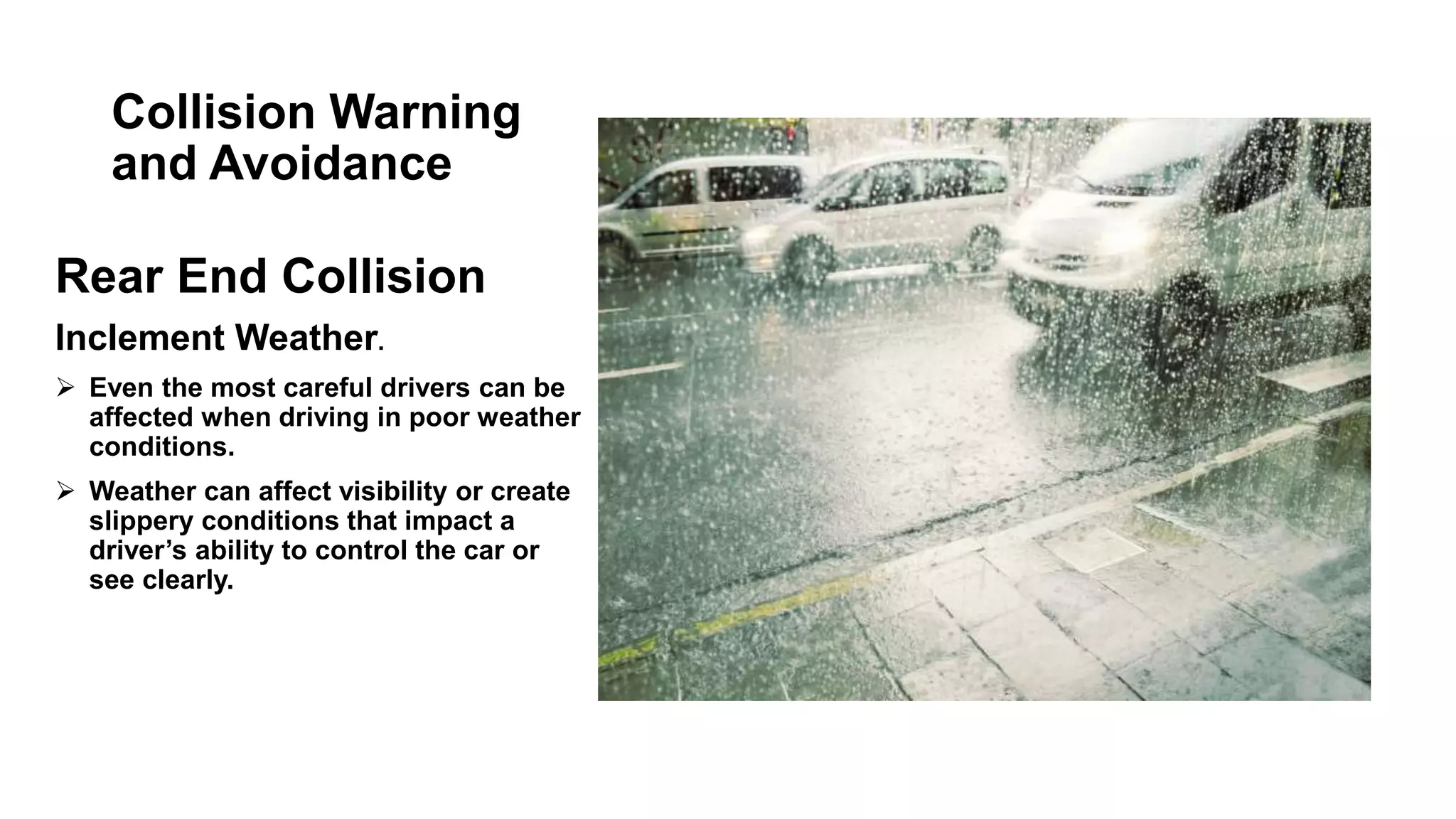
Inclement Weather.
 Even the most careful drivers can be
affected when driving in poor weather
conditions.
 Weather can affect visibility or create
slippery conditions that impact a
driver’s ability to control the car or
see clearly.
Collision Warning
and Avoidance
Rear End Collision
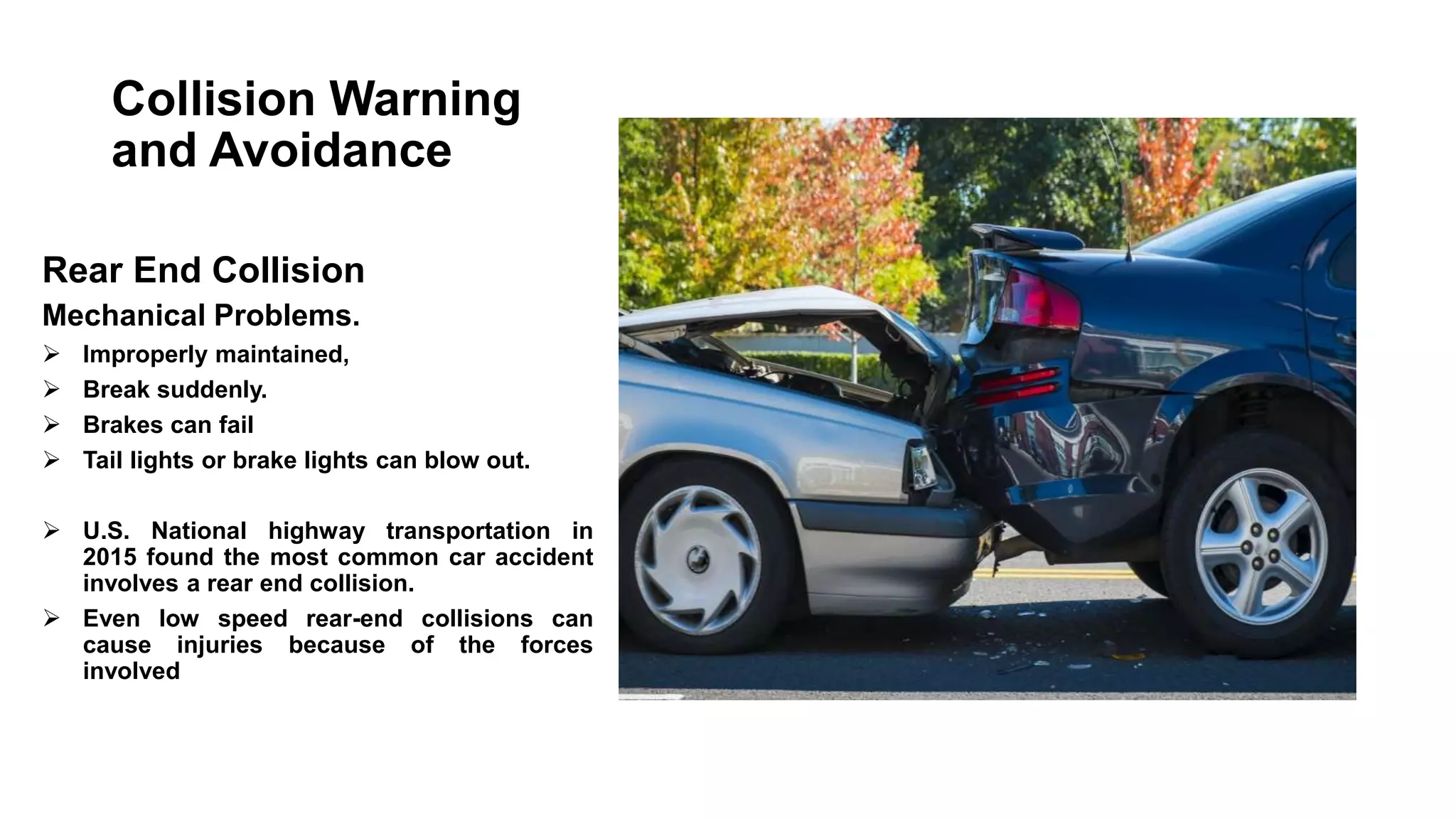
Mechanical Problems.
 Improperly maintained,
 Break suddenly.
 Brakes can fail
 Tail lights or brake lights can blow out.
 U.S. National highway transportation in
2015 found the most common car accident
involves a rear end collision.
 Even low speed rear-end collisions can
cause injuries because of the forces
involved
Collision Warning
and Avoidance
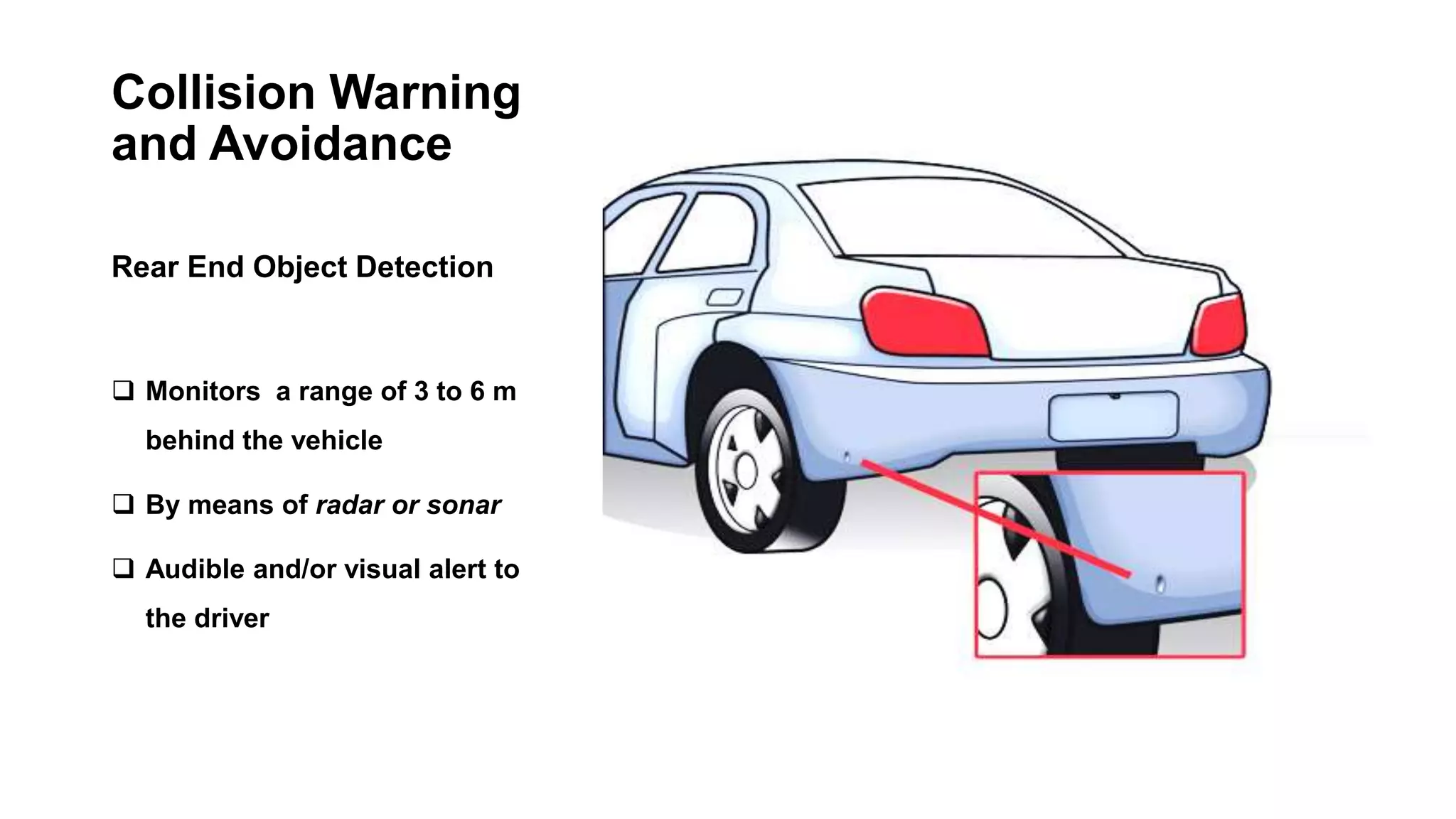
Rear End Object Detection
 Monitors a range of 3 to 6 m
behind the vehicle
 By means of radar or sonar
 Audible and/or visual alert to
the driver
Collision Warning
and Avoidance
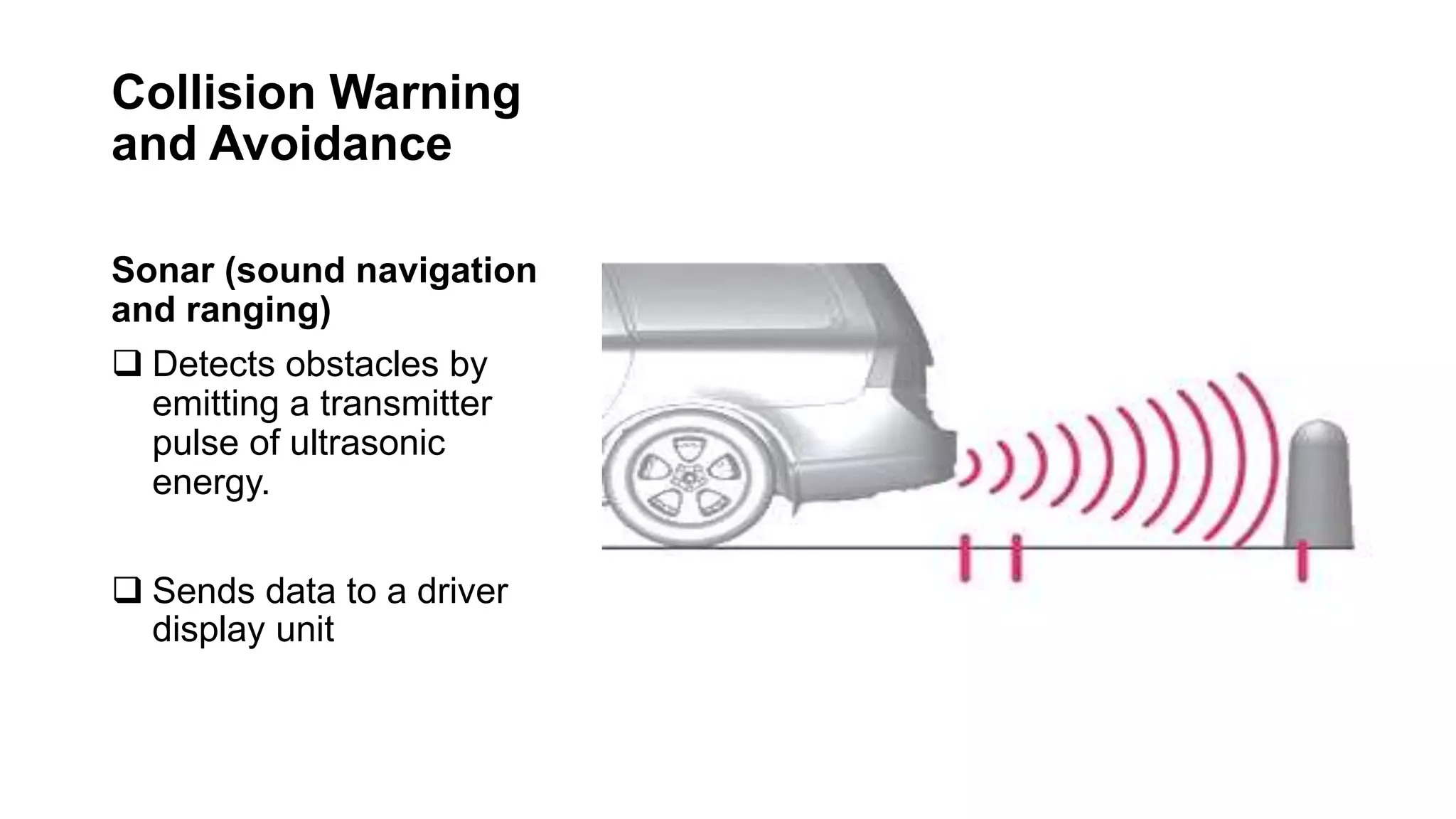
Sonar (sound navigation
and ranging)
 Detects obstacles by
emitting a transmitter
pulse of ultrasonic
energy.
 Sends data to a driver
display unit
Collision Warning
and Avoidance
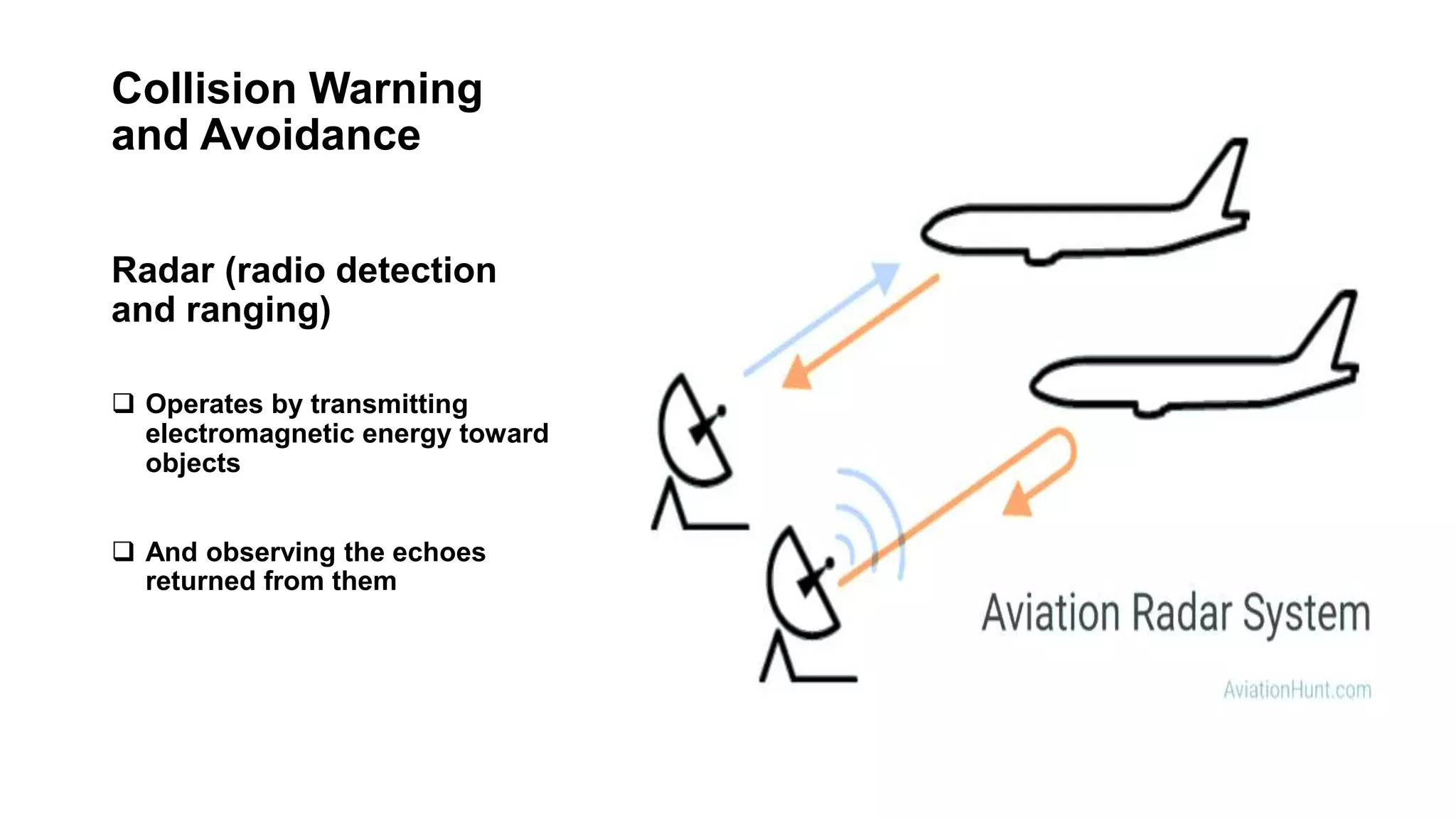
Radar (radio detection
and ranging)
 Operates by transmitting
electromagnetic energy toward
objects
 And observing the echoes
returned from them
Collision Warning
and Avoidance
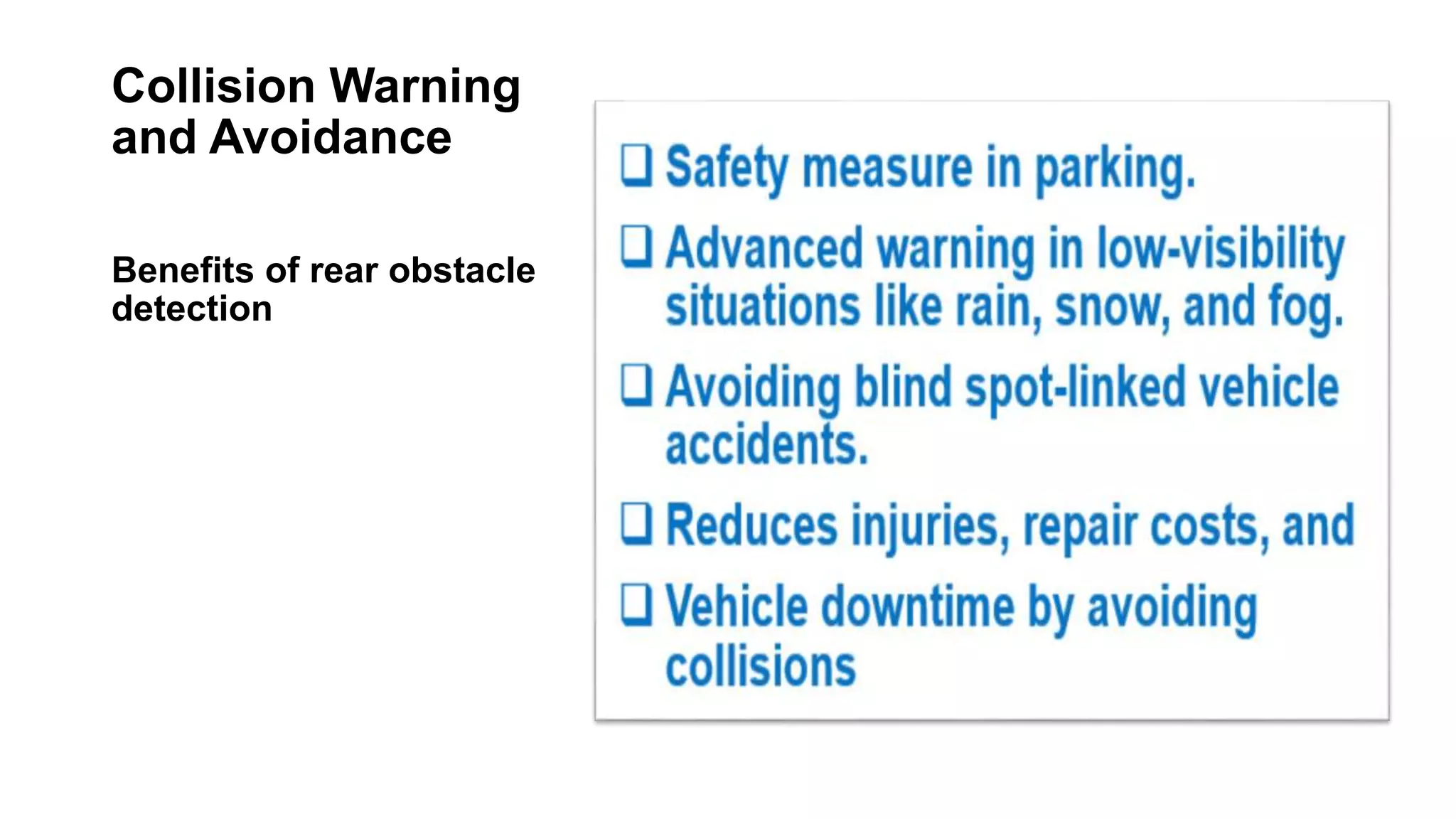
Benefits of rear obstacle
detection
Collision Warning
and Avoidance
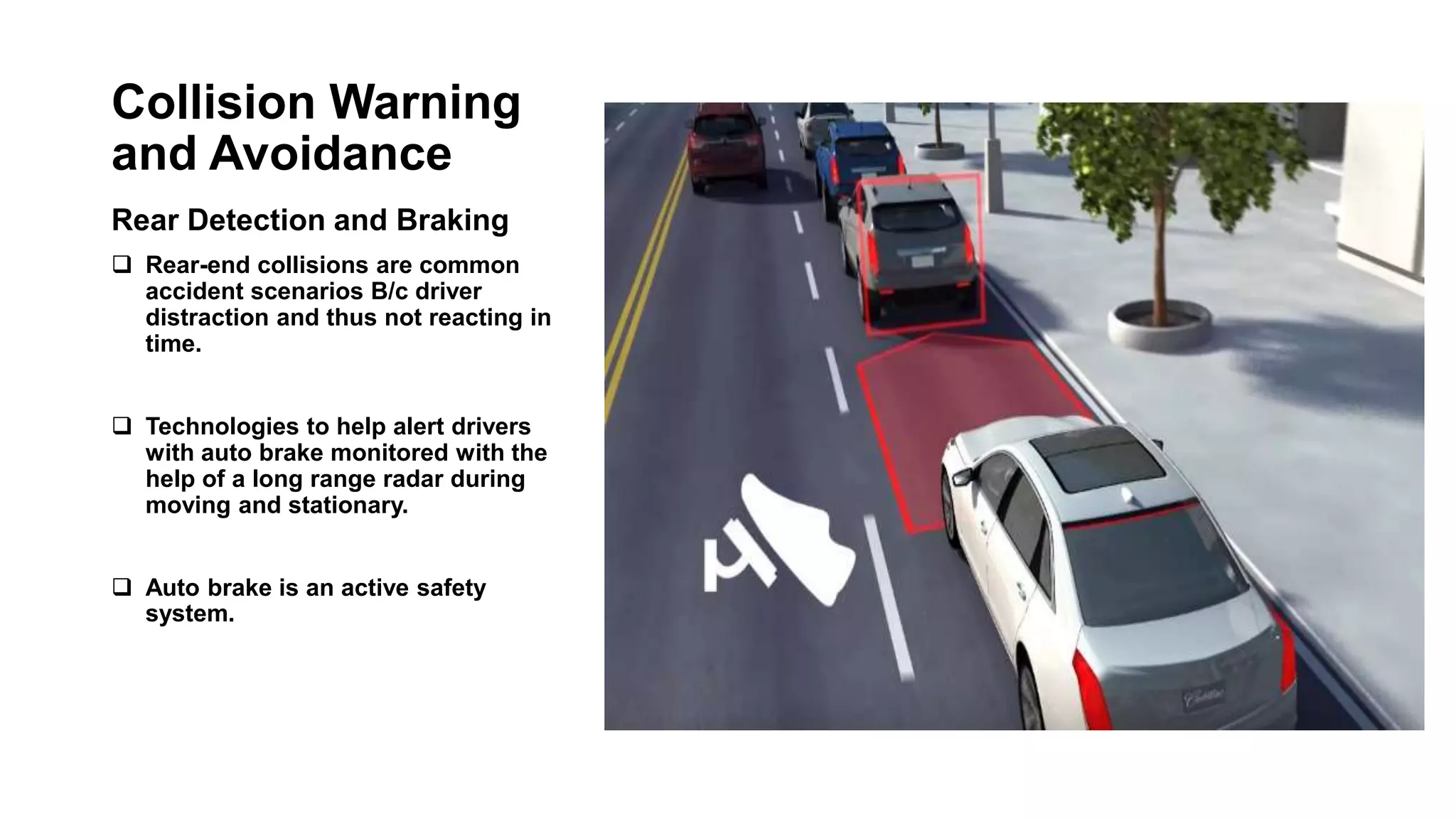
Rear Detection and Braking
 Rear-end collisions are common
accident scenarios B/c driver
distraction and thus not reacting in
time.
 Technologies to help alert drivers
with auto brake monitored with the
help of a long range radar during
moving and stationary.
 Auto brake is an active safety
system.
Collision Warning
and Avoidance
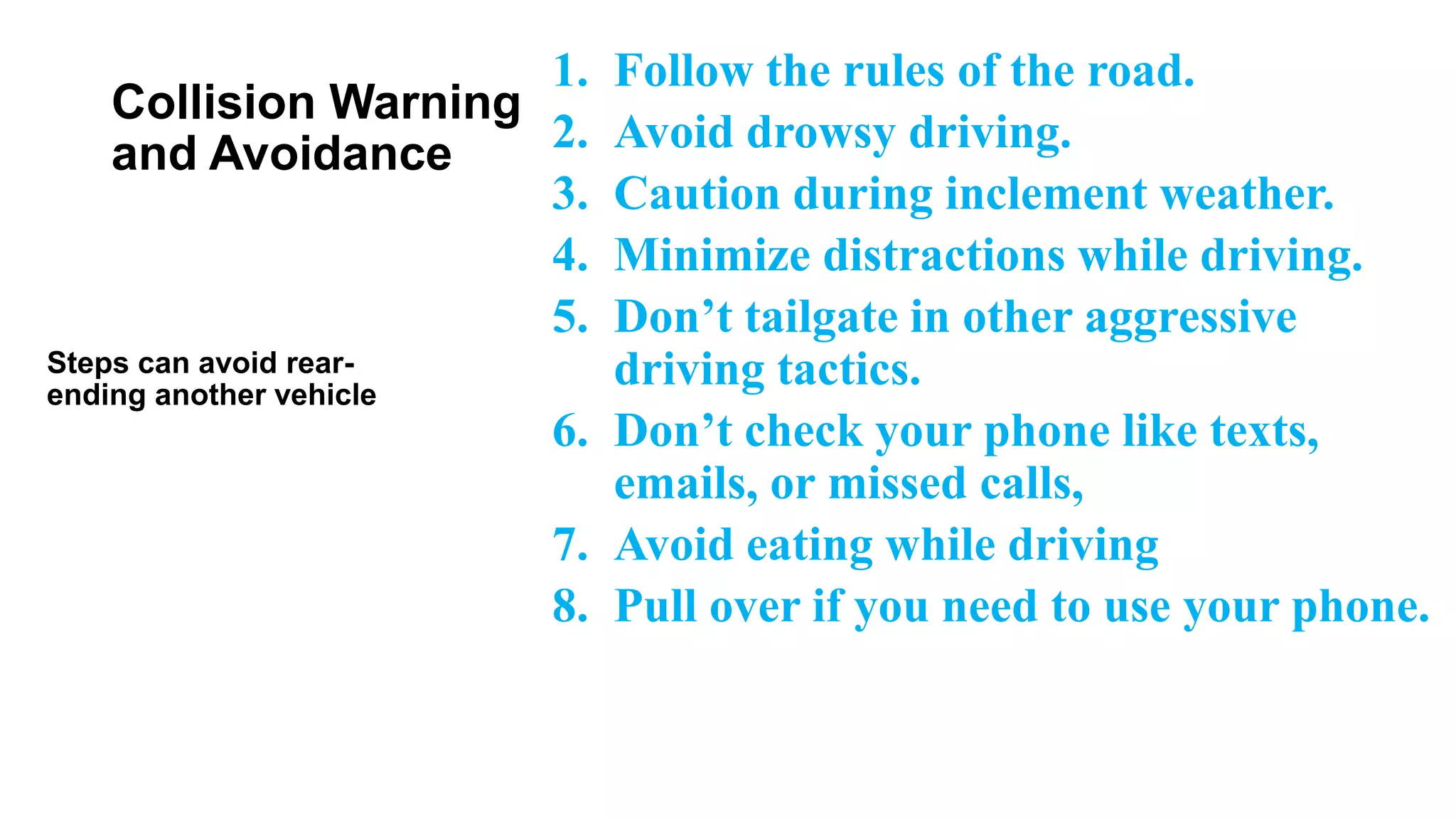
1. Follow the rules of the road.
2. Avoid drowsy driving.
3. Caution during inclement weather.
4. Minimize distractions while driving.
5. Don’t tailgate in other aggressive
driving tactics.
6. Don’t check your phone like texts,
emails, or missed calls,
7. Avoid eating while driving
8. Pull over if you need to use your phone.
Steps can avoid rear-
ending another vehicle
Like
Comment

Collision warning and avoidance

  • 1.
    Collision Warning and Avoidance ForwardCollision Warning  Visual and audible warning that the driver is too close to the vehicle in front. The Rear Collision Warning System  Visual and audible warns drivers when collision with an object behind by sensors in the rear bumper.
  • 2.
    Collision Warning and Avoidance AdaptiveCruise Control (ACC)  Slows down and speeds up automatically to maintain a safe distance from the vehicles ahead  This facility has to be activated by the driver. Lane-Keeping Devices  Time to collision in safety-critical lane changes are normally much less than one second. Since mean driver reaction time is about one second, there is not sufficient time for a driver to respond to a warning before crashing.
  • 3.
    Collision Warning and Avoidance CollisionWarning  Monitors vehicle speed  Front speed  d/t between vehicle  general monitor driving environment
  • 4.
    Collision Warning and Avoidance Ifvehicle get too close the warn you by Light Beeps Vibrations of your seat Tighten your seat belt Applying the brakes
  • 5.
    Collision Warning and Avoidance Varioustechnology and sensors it uses RADAR ( all- weather) LIDAR (laser) SONAR CAMERA GPS
  • 6.
    Collision Warning and Avoidance Speedand distance sensors  Forward collision warning use both speed and distance calculations  Type of distance sensor uses radar to detect traffic ahead  Some systems use lasers OR cameras  Slow or stopped vehicles in the same lane
  • 7.
    Collision Warning and Avoidance RearEnd Collision  It is common vehicle accidents There are many different ways Distracted Driving.  This could mean a driver was texting, talking on the phone, checking e-mail, changing the radio station, or even eating while driving. Anything that takes the driver’s attention away from the road for even one second can cause a rear-end collision.
  • 8.
    Collision Warning and Avoidance RearEnd Collision Quick Change in Speed.  When the driver in front needs to hit the brakes suddenly, so the car behind must react quickly.  If the driver in back does not notice that the driver in front has slammed on his brakes, there is a high chance of a rear-end accident
  • 9.
    Collision Warning and Avoidance RearEnd Collision Inclement Weather.  Even the most careful drivers can be affected when driving in poor weather conditions.  Weather can affect visibility or create slippery conditions that impact a driver’s ability to control the car or see clearly.
  • 10.
    Collision Warning and Avoidance RearEnd Collision Mechanical Problems.  Improperly maintained,  Break suddenly.  Brakes can fail  Tail lights or brake lights can blow out.  U.S. National highway transportation in 2015 found the most common car accident involves a rear end collision.  Even low speed rear-end collisions can cause injuries because of the forces involved
  • 11.
    Collision Warning and Avoidance RearEnd Object Detection  Monitors a range of 3 to 6 m behind the vehicle  By means of radar or sonar  Audible and/or visual alert to the driver
  • 12.
    Collision Warning and Avoidance Sonar(sound navigation and ranging)  Detects obstacles by emitting a transmitter pulse of ultrasonic energy.  Sends data to a driver display unit
  • 13.
    Collision Warning and Avoidance Radar(radio detection and ranging)  Operates by transmitting electromagnetic energy toward objects  And observing the echoes returned from them
  • 14.
    Collision Warning and Avoidance Benefitsof rear obstacle detection
  • 15.
    Collision Warning and Avoidance RearDetection and Braking  Rear-end collisions are common accident scenarios B/c driver distraction and thus not reacting in time.  Technologies to help alert drivers with auto brake monitored with the help of a long range radar during moving and stationary.  Auto brake is an active safety system.
  • 16.
    Collision Warning and Avoidance 1.Follow the rules of the road. 2. Avoid drowsy driving. 3. Caution during inclement weather. 4. Minimize distractions while driving. 5. Don’t tailgate in other aggressive driving tactics. 6. Don’t check your phone like texts, emails, or missed calls, 7. Avoid eating while driving 8. Pull over if you need to use your phone. Steps can avoid rear- ending another vehicle
  • 17.

Editor's Notes

  • #6 radio detection and ranging, light detection and ranging,