Safety Concepts
Passive Safety Systems
 Passive safety become active during
an accident,
 Reduce the risk of injury during the
time of impact
Passive Safety
Air Bag (AB)
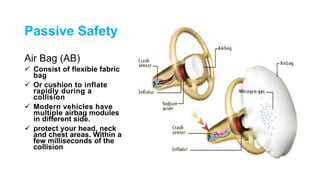
 Consist of flexible fabric
bag
 Or cushion to inflate
rapidly during a
collision
 Modern vehicles have
multiple airbag modules
in different side.
 protect your head, neck
and chest areas. Within a
few milliseconds of the
collision
Passive Safety
Air Bag (AB)
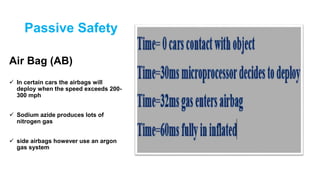
 In certain cars the airbags will
deploy when the speed exceeds 200-
300 mph
 Sodium azide produces lots of
nitrogen gas
 side airbags however use an argon
gas system
Passive Safety
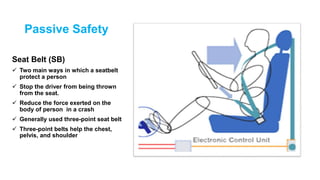
Seat Belt (SB)
 Two main ways in which a seatbelt
protect a person
 Stop the driver from being thrown
from the seat.
 Reduce the force exerted on the
body of person in a crash
 Generally used three-point seat belt
 Three-point belts help the chest,
pelvis, and shoulder
Passive Safety
Occupant Sensing Systems
 Detect who is sitting in the
passenger seat
 On/off switch for airbags
Passive Safety
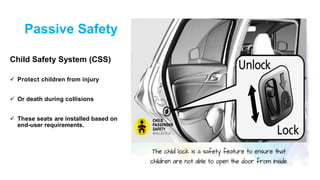
Child Safety System (CSS)
 Protect children from injury
 Or death during collisions
 These seats are installed based on
end-user requirements.
Passive Safety
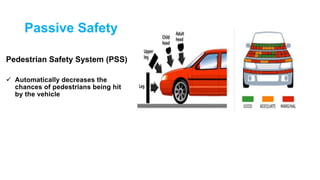
Pedestrian Safety System (PSS)
 Automatically decreases the
chances of pedestrians being hit
by the vehicle
Passive Safety
Head up display
 Projects images on the
windscreen
Passive Safety
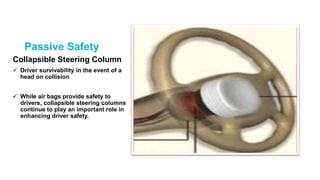
Collapsible Steering Column
 Driver survivability in the event of a
head on collision
 While air bags provide safety to
drivers, collapsible steering columns
continue to play an important role in
enhancing driver safety.

cars safety concept

  • 1.
    Safety Concepts Passive SafetySystems  Passive safety become active during an accident,  Reduce the risk of injury during the time of impact
  • 2.
    Passive Safety Air Bag(AB)  Consist of flexible fabric bag  Or cushion to inflate rapidly during a collision  Modern vehicles have multiple airbag modules in different side.  protect your head, neck and chest areas. Within a few milliseconds of the collision
  • 3.
    Passive Safety Air Bag(AB)  In certain cars the airbags will deploy when the speed exceeds 200- 300 mph  Sodium azide produces lots of nitrogen gas  side airbags however use an argon gas system
  • 4.
    Passive Safety Seat Belt(SB)  Two main ways in which a seatbelt protect a person  Stop the driver from being thrown from the seat.  Reduce the force exerted on the body of person in a crash  Generally used three-point seat belt  Three-point belts help the chest, pelvis, and shoulder
  • 5.
    Passive Safety Occupant SensingSystems  Detect who is sitting in the passenger seat  On/off switch for airbags
  • 6.
    Passive Safety Child SafetySystem (CSS)  Protect children from injury  Or death during collisions  These seats are installed based on end-user requirements.
  • 7.
    Passive Safety Pedestrian SafetySystem (PSS)  Automatically decreases the chances of pedestrians being hit by the vehicle
  • 8.
    Passive Safety Head updisplay  Projects images on the windscreen
  • 9.
    Passive Safety Collapsible SteeringColumn  Driver survivability in the event of a head on collision  While air bags provide safety to drivers, collapsible steering columns continue to play an important role in enhancing driver safety.