Een interpretatie van
Organization Development (1992)
W. Warner Burke
A Rough Guide To Organizational
Development
Goals
 Burke: to provide an overview of the field of
organization development (OD)
 Alexander: Cherry picked to create an overview of
Burke
Ch. 1 What is organization development?
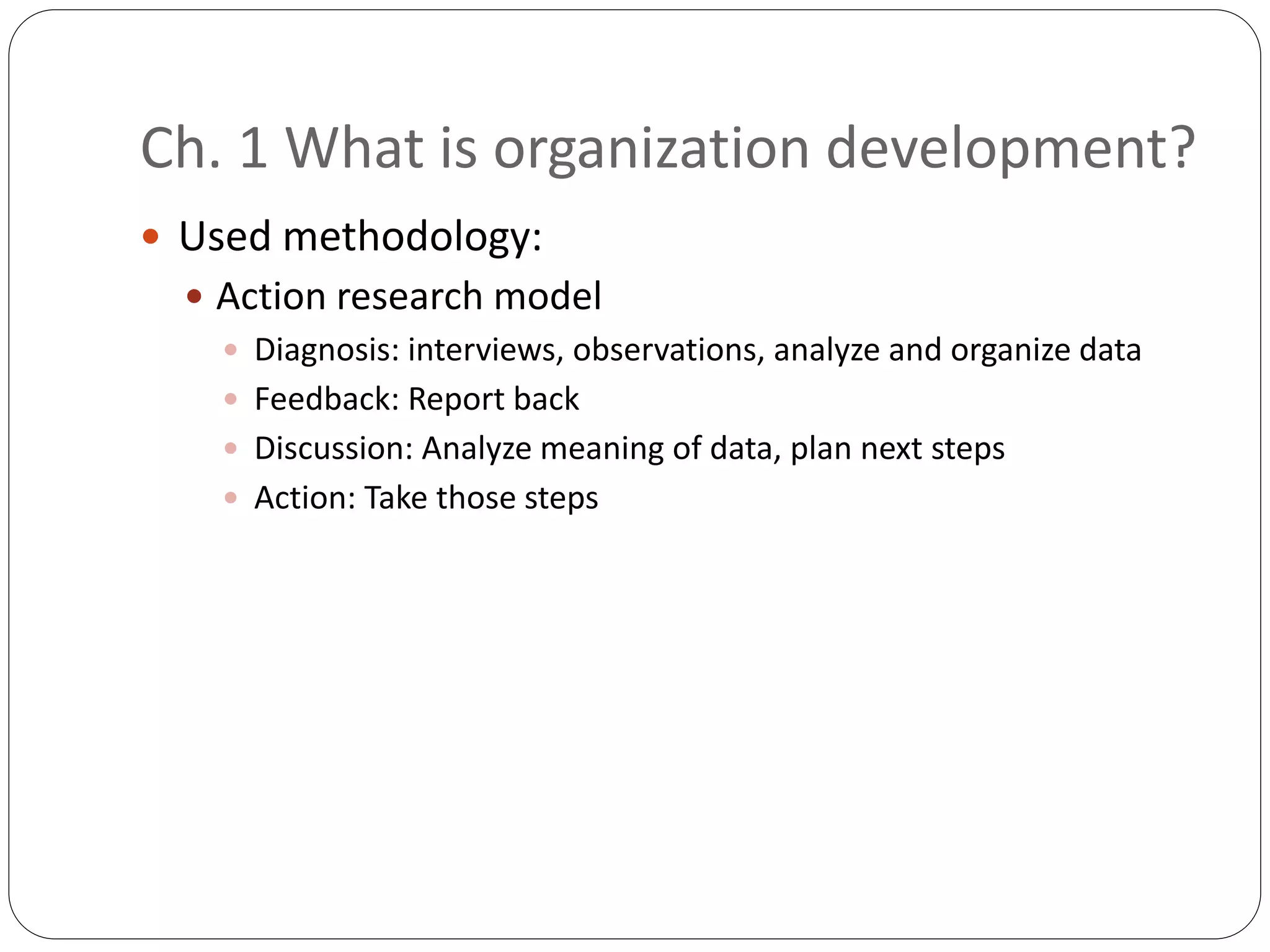
 Used methodology:
 Action research model
 Diagnosis: interviews, observations, analyze and organize data
 Feedback: Report back
 Discussion: Analyze meaning of data, plan next steps
 Action: Take those steps
Ch. 1 What is organization development?
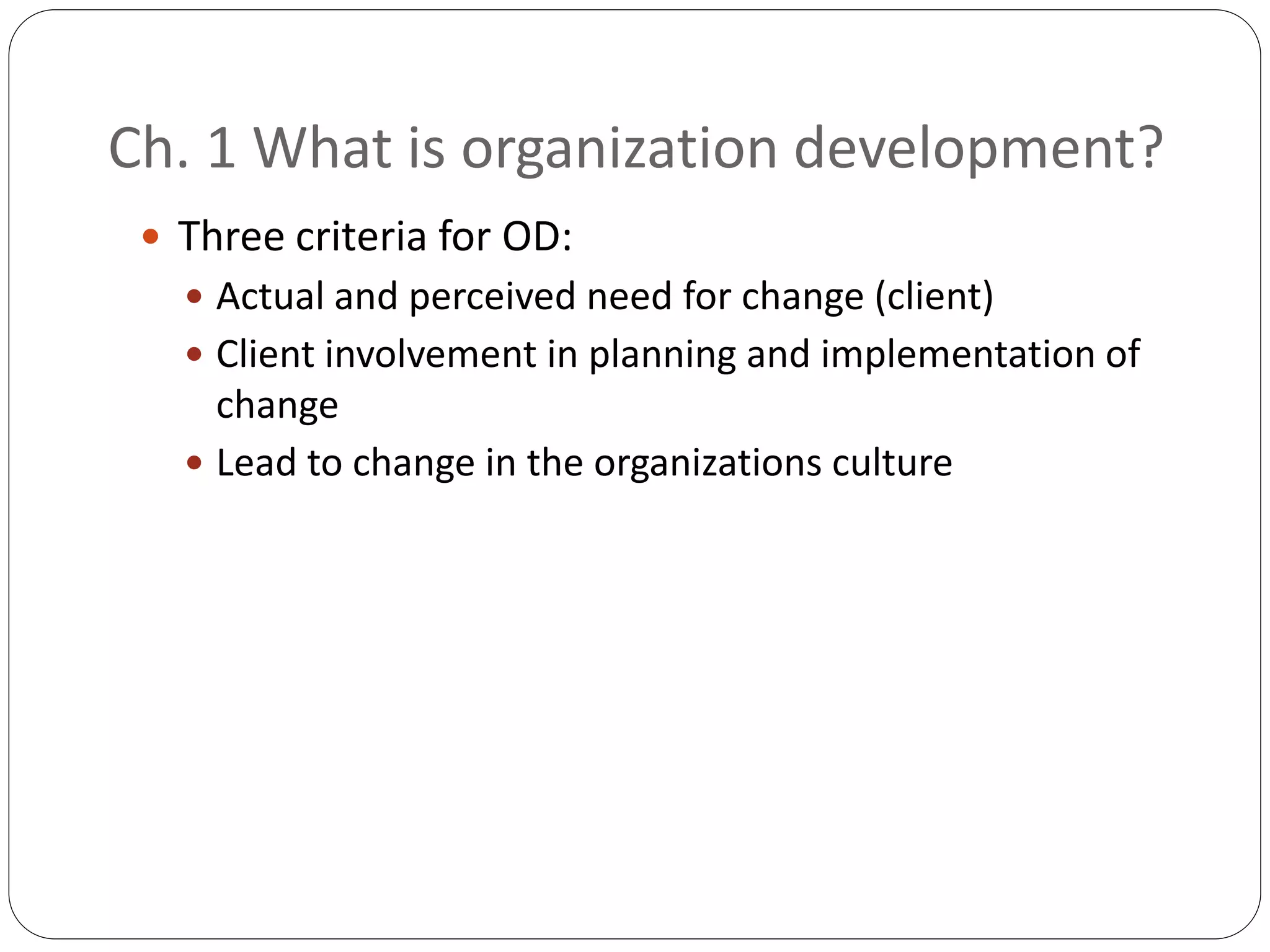
 Three criteria for OD:
 Actual and perceived need for change (client)
 Client involvement in planning and implementation of
change
 Lead to change in the organizations culture
Ch. 1 What is organization development?
Inspirerende quotes:
 Organization development is a process of fundamental
change in an organizations culture
 Not only good rapport, but also a sound basis of trust to
discover the essence of organizational culture
 OD is a process of bringing to the surface those implicit
behavioural patterns that are helping and hindering
development.
Ch. 1 What is organization
development?
 Your role always starts as a facilitator
 Then two camps:
 The contingent camp
 Only facilitate change
 The normative camp
 The consultant should recommend specific directions for change
Ch. 3 Where did OD come from?
 Not birth, but evolution
 Three precursors:
 Sensitivity training
 Group learning (NTL), team building
 Sociotechnical systems
 O.D. considers both the social system as the technical system
 Survey feedback
 Questionnaire, feedback in phases, give meaning
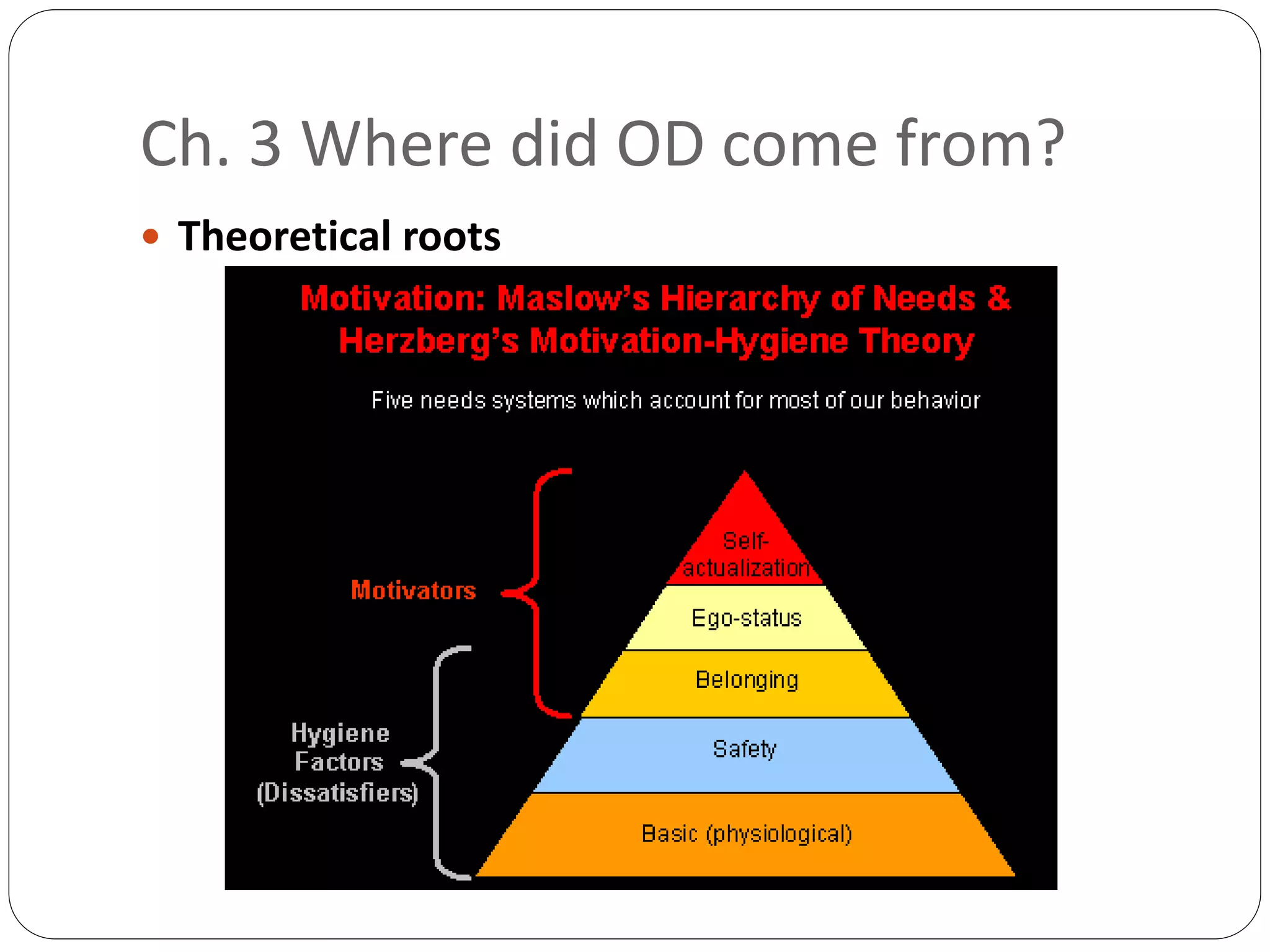
Ch. 3 Where did OD come from?
 Theoretical roots
Ch. 3 Where did OD come from?
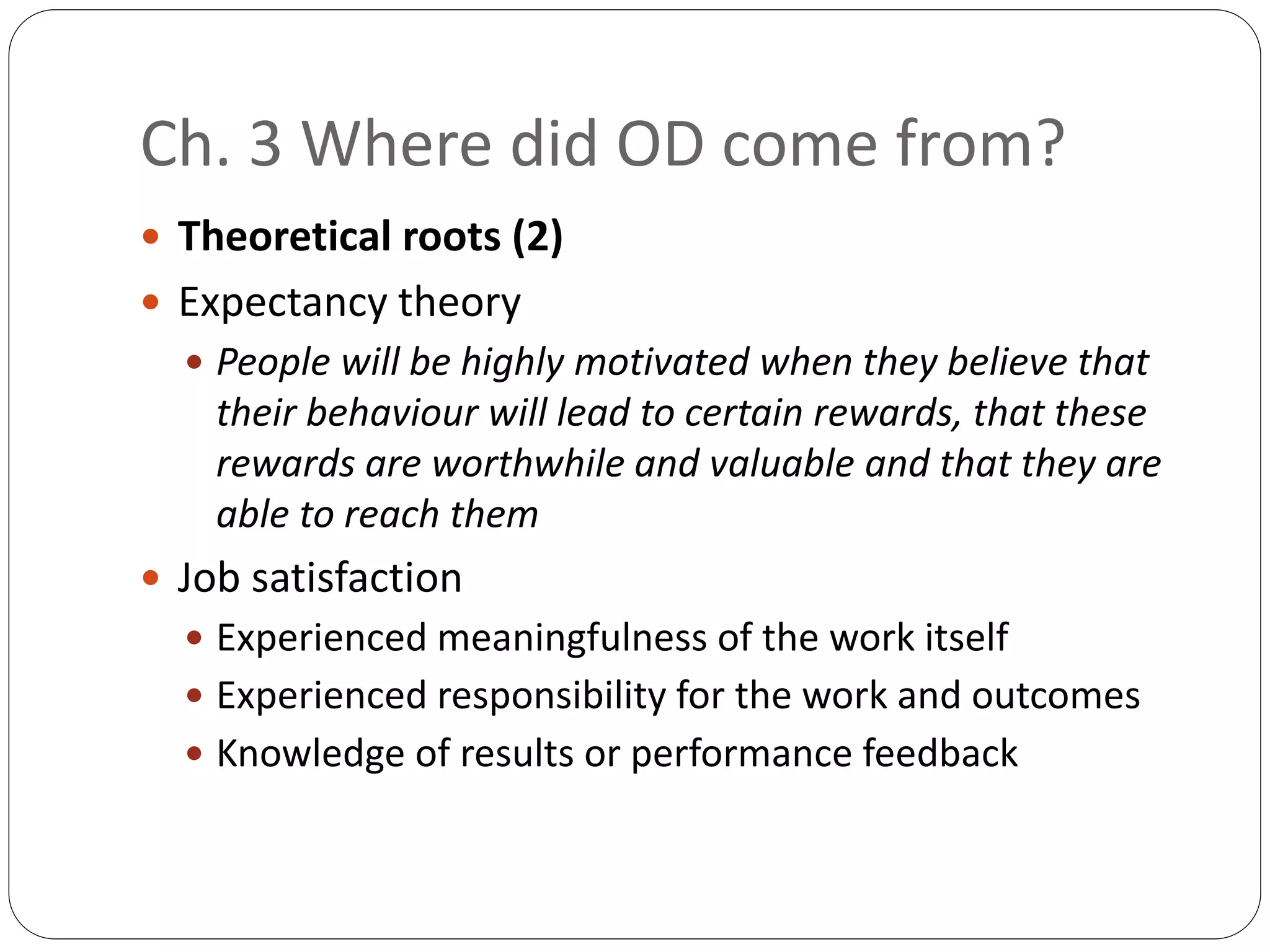
 Theoretical roots (2)
 Expectancy theory
 People will be highly motivated when they believe that
their behaviour will lead to certain rewards, that these
rewards are worthwhile and valuable and that they are
able to reach them
 Job satisfaction
 Experienced meaningfulness of the work itself
 Experienced responsibility for the work and outcomes
 Knowledge of results or performance feedback
Ch. 3 Where did OD come from?
Theoretical roots (3)
Ch. 3 Where did OD come from?
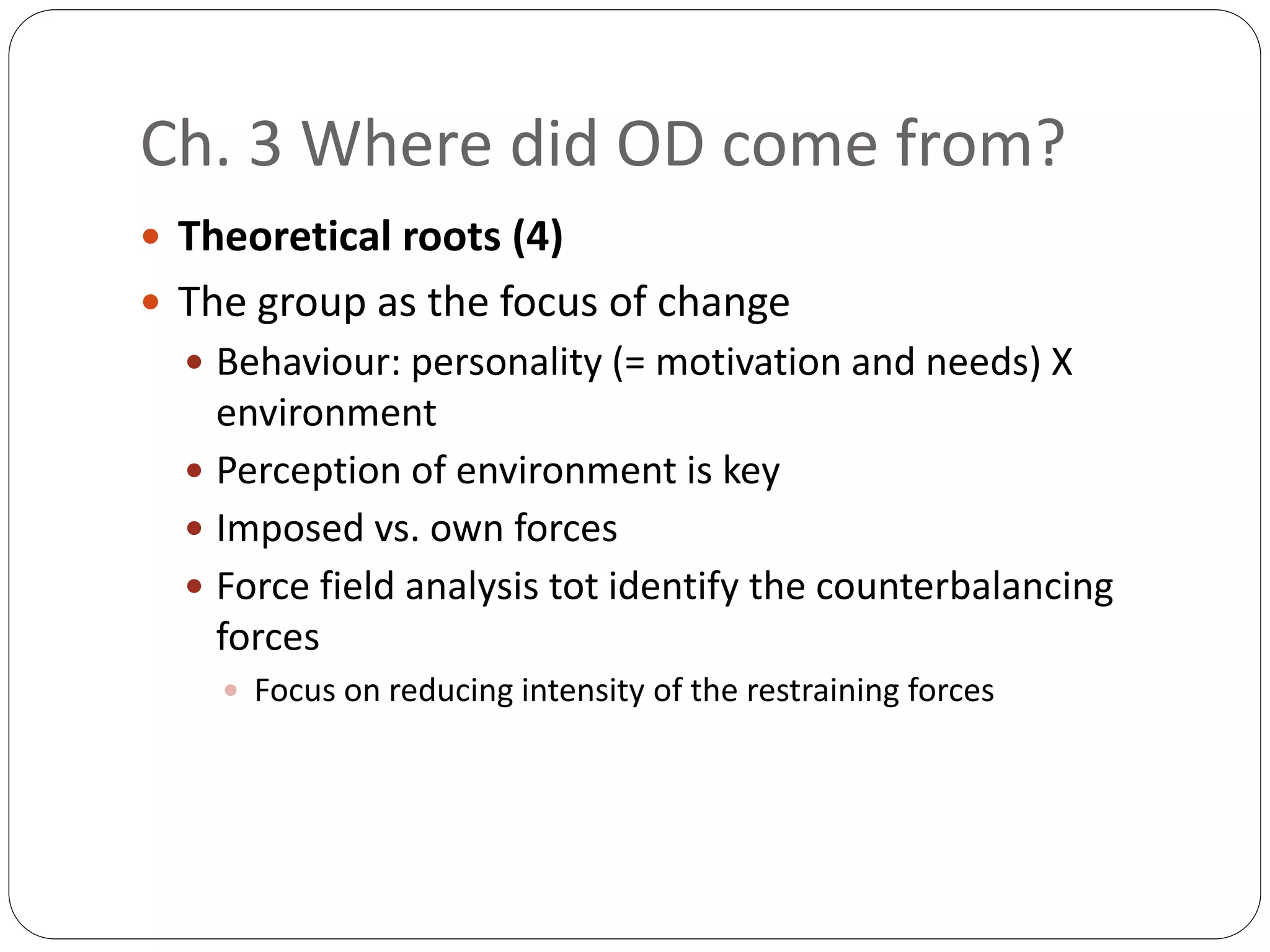
 Theoretical roots (4)
 The group as the focus of change
 Behaviour: personality (= motivation and needs) X
environment
 Perception of environment is key
 Imposed vs. own forces
 Force field analysis tot identify the counterbalancing
forces
 Focus on reducing intensity of the restraining forces
Ch. 3 Where did OD come from?
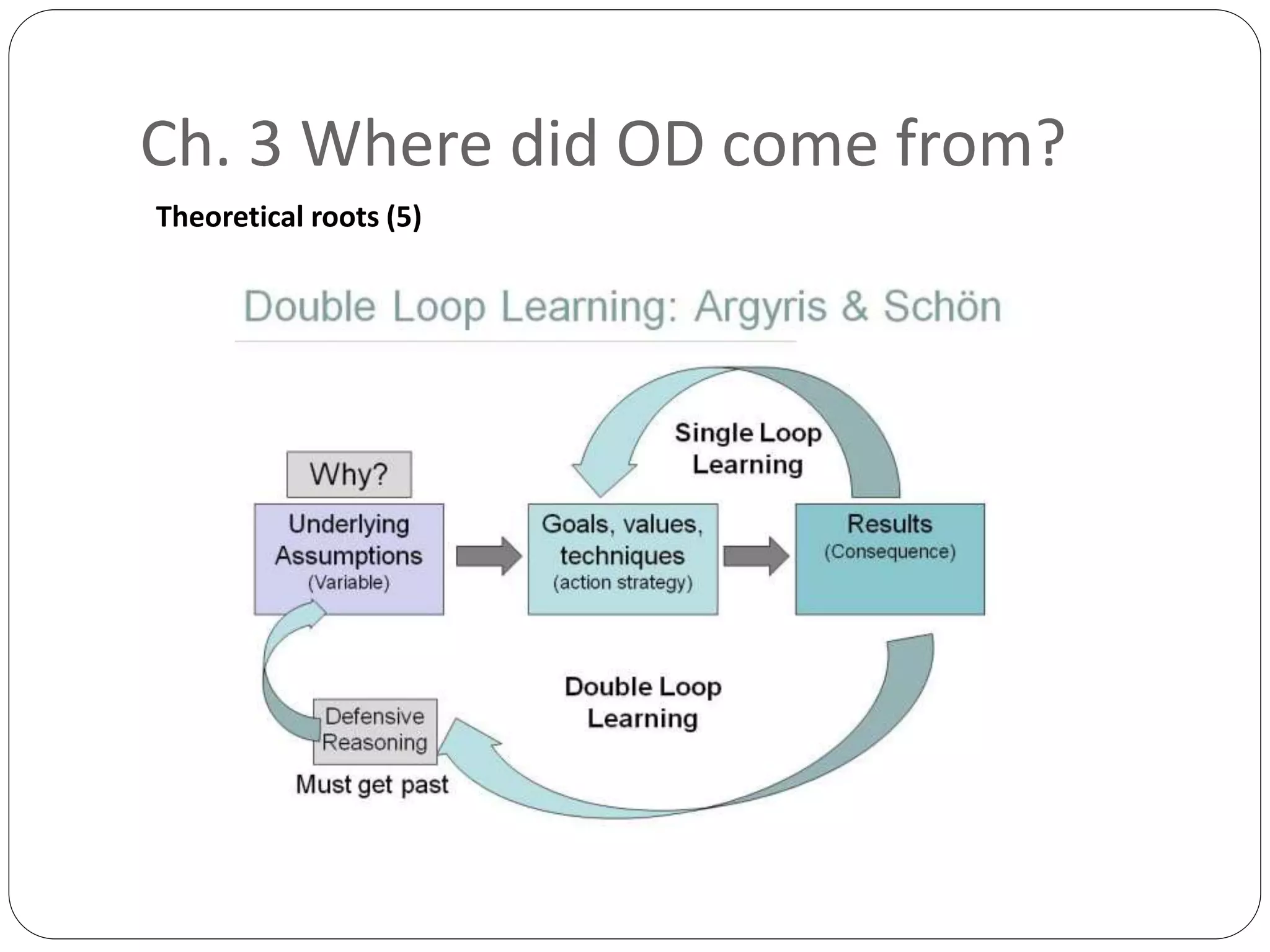
Theoretical roots (5)
Ch. 3 Where did OD come from?
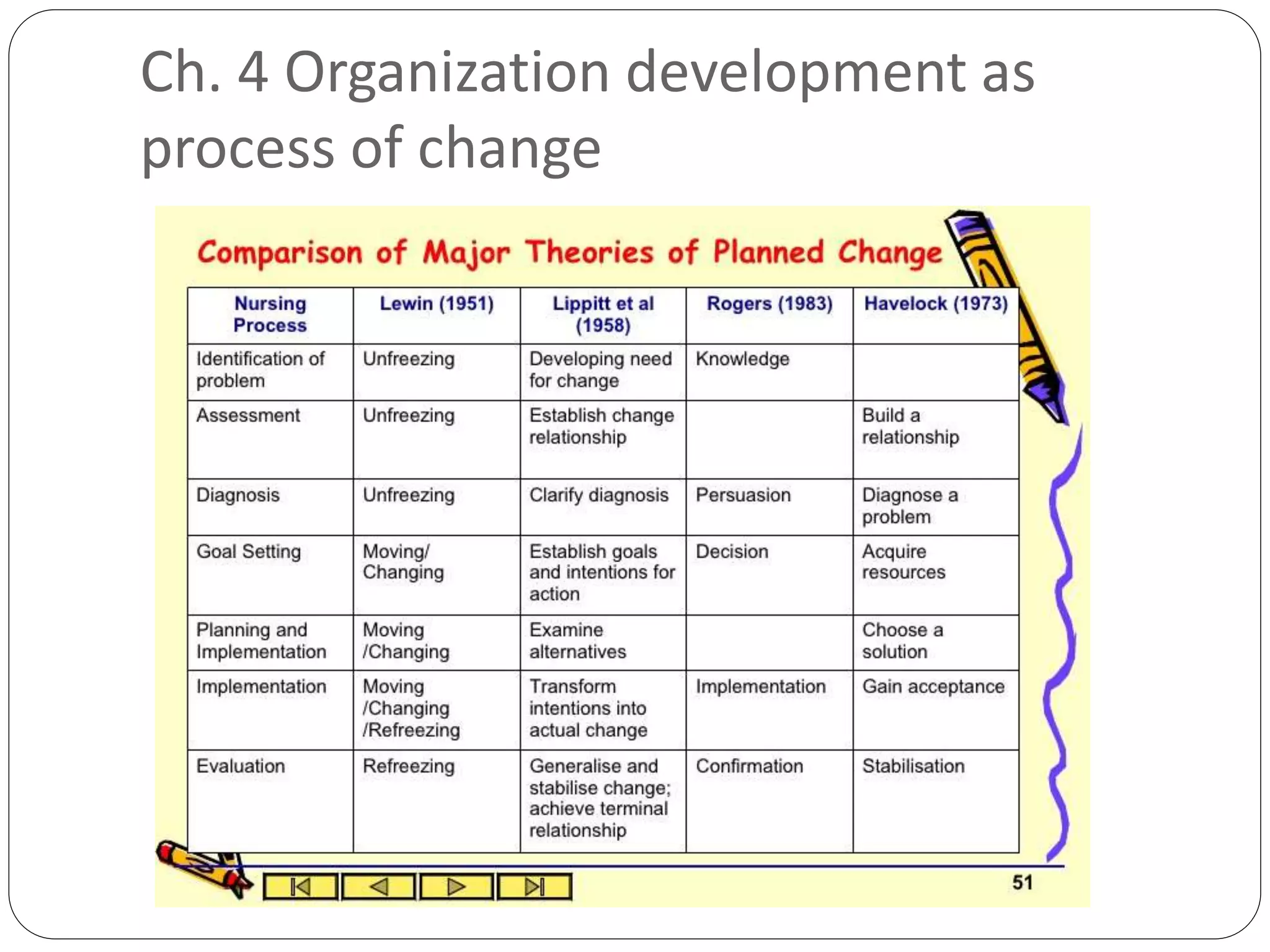
 Theoretical roots (6)
 Group assumptions - Bion
 Participative management – Likert
 The contingency theory – Lawrence and Lorsch
 The organization as a family - Levinson
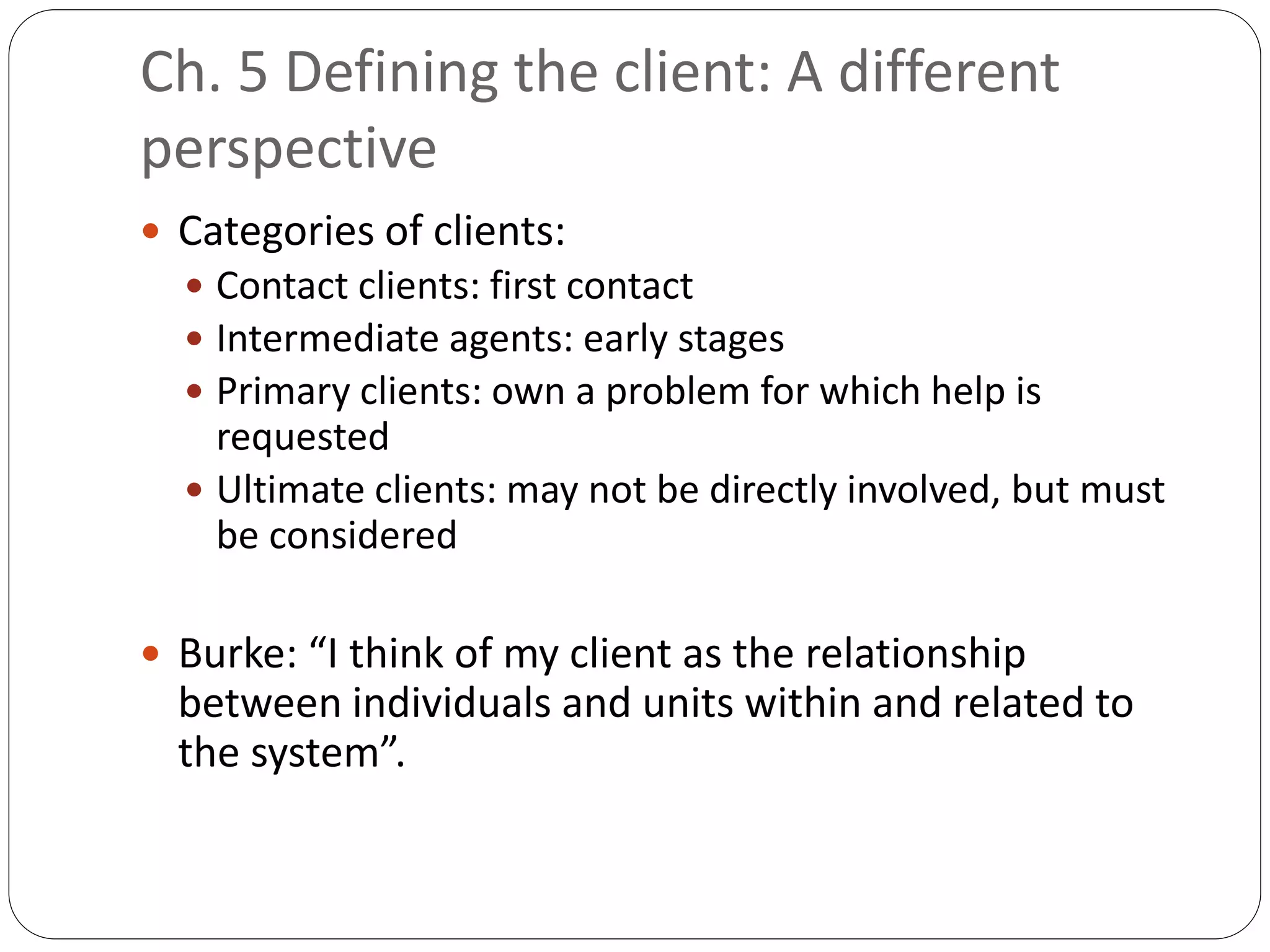
Ch. 4 Organization development as
process of change
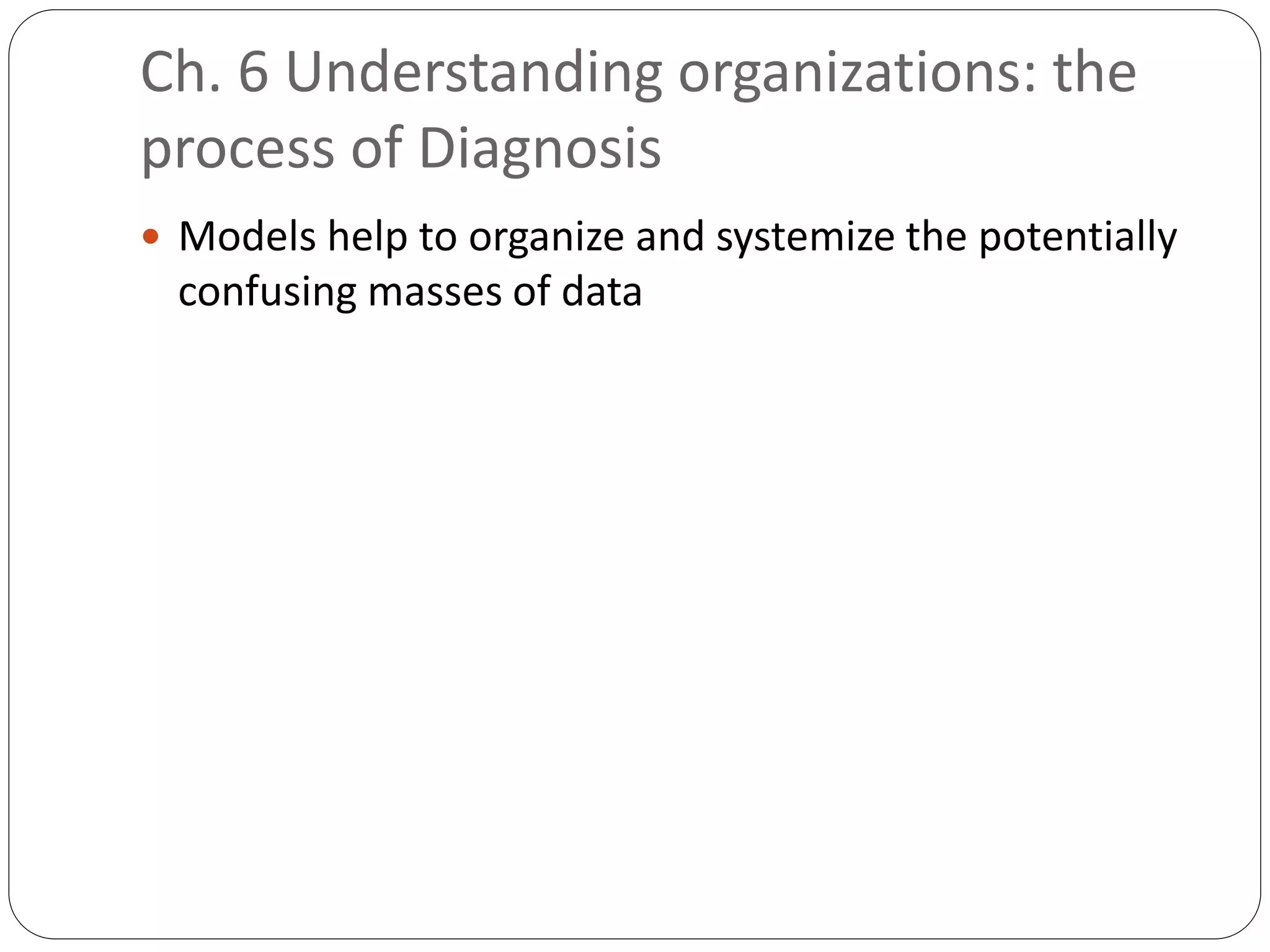
Ch. 5 Defining the client: A different
perspective
 Categories of clients:
 Contact clients: first contact
 Intermediate agents: early stages
 Primary clients: own a problem for which help is
requested
 Ultimate clients: may not be directly involved, but must
be considered
 Burke: “I think of my client as the relationship
between individuals and units within and related to
the system”.
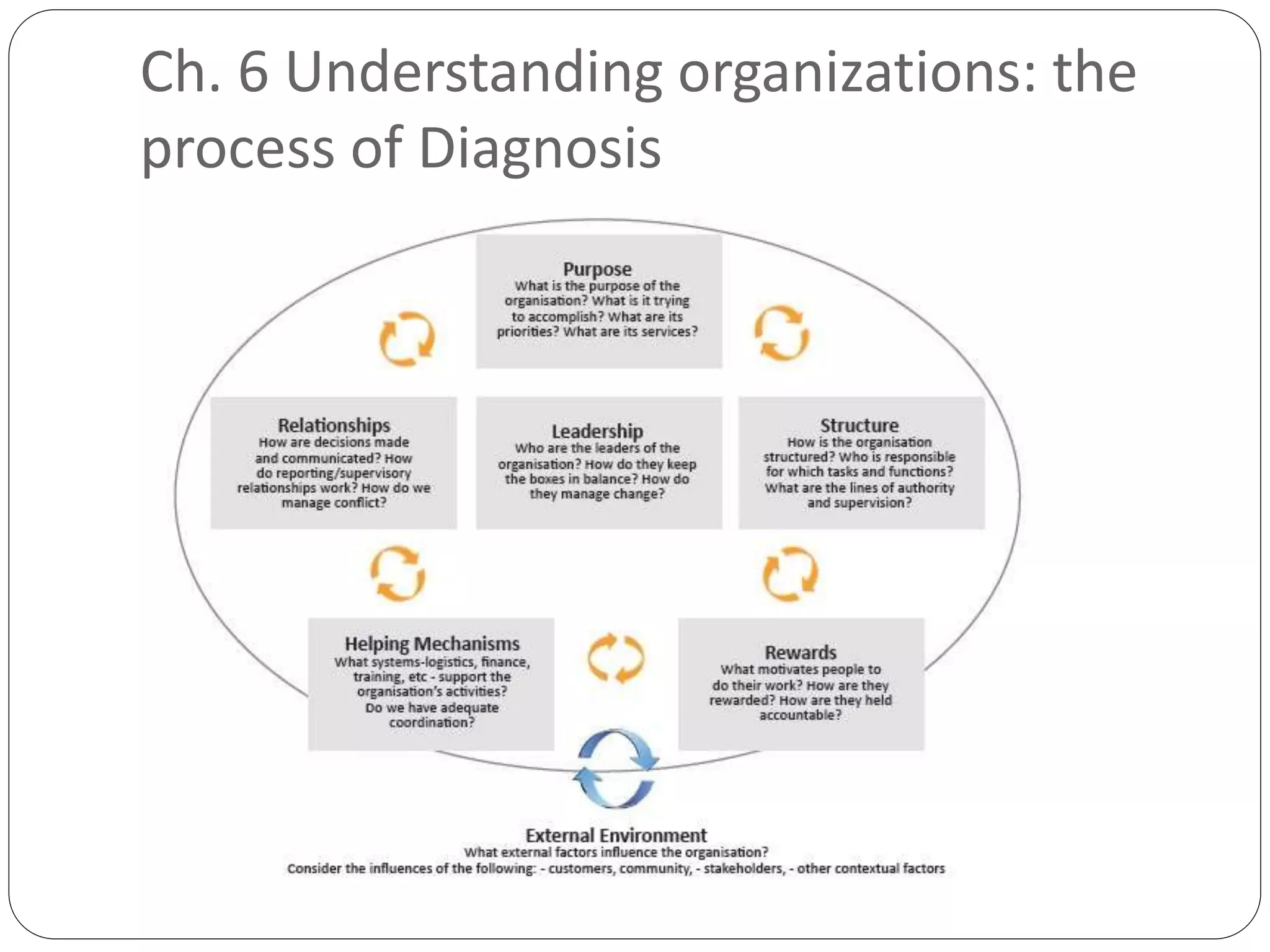
Ch. 6 Understanding organizations: the
process of Diagnosis
 Models help to organize and systemize the potentially
confusing masses of data
Ch. 6 Understanding organizations: the
process of Diagnosis
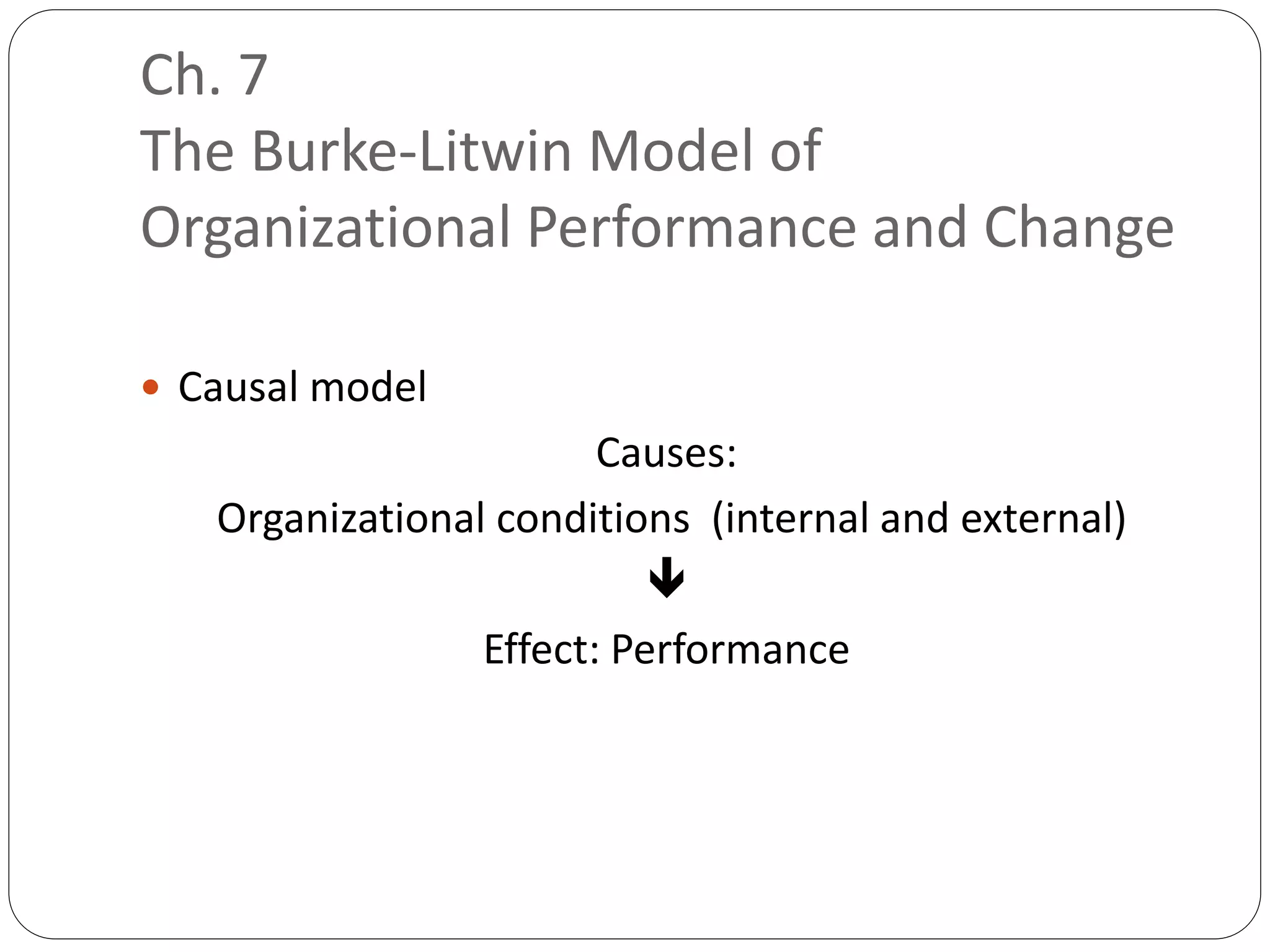
Ch. 7
The Burke-Litwin Model of
Organizational Performance and Change
 Causal model
Causes:
Organizational conditions (internal and external)

Effect: Performance
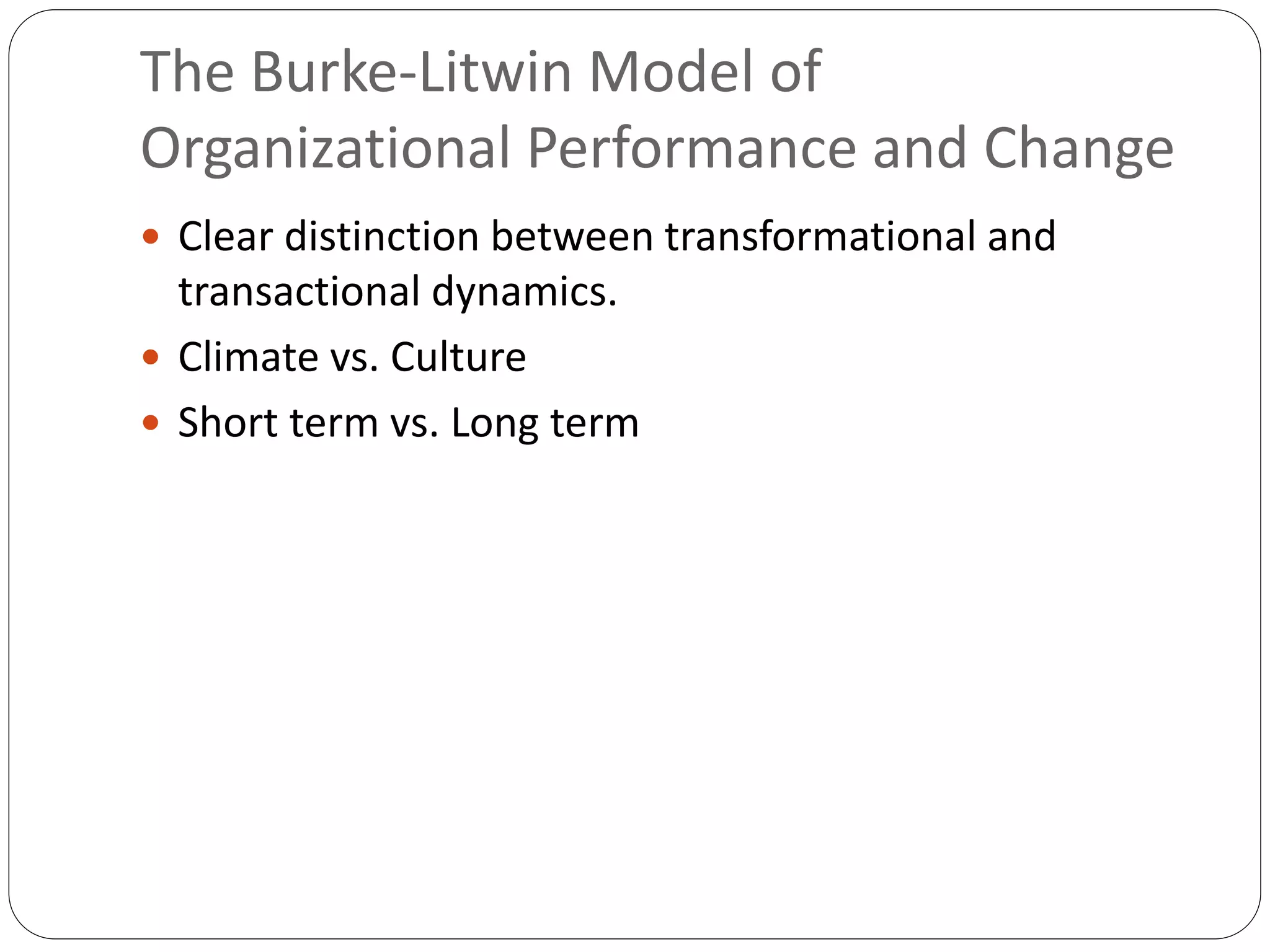
The Burke-Litwin Model of
Organizational Performance and Change
 Clear distinction between transformational and
transactional dynamics.
 Climate vs. Culture
 Short term vs. Long term
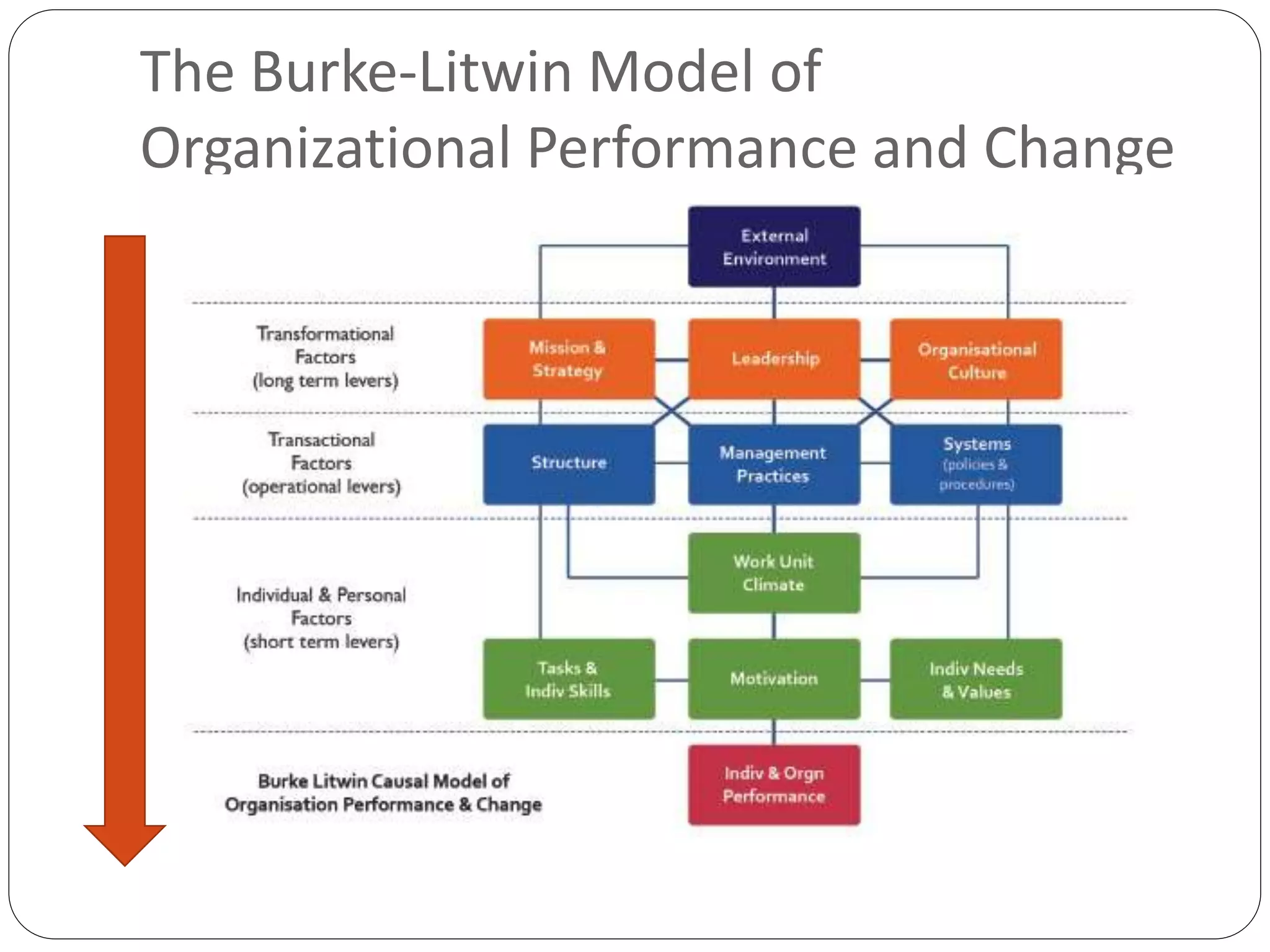
The Burke-Litwin Model of
Organizational Performance and Change
Ch.8 Planning and Managing Change
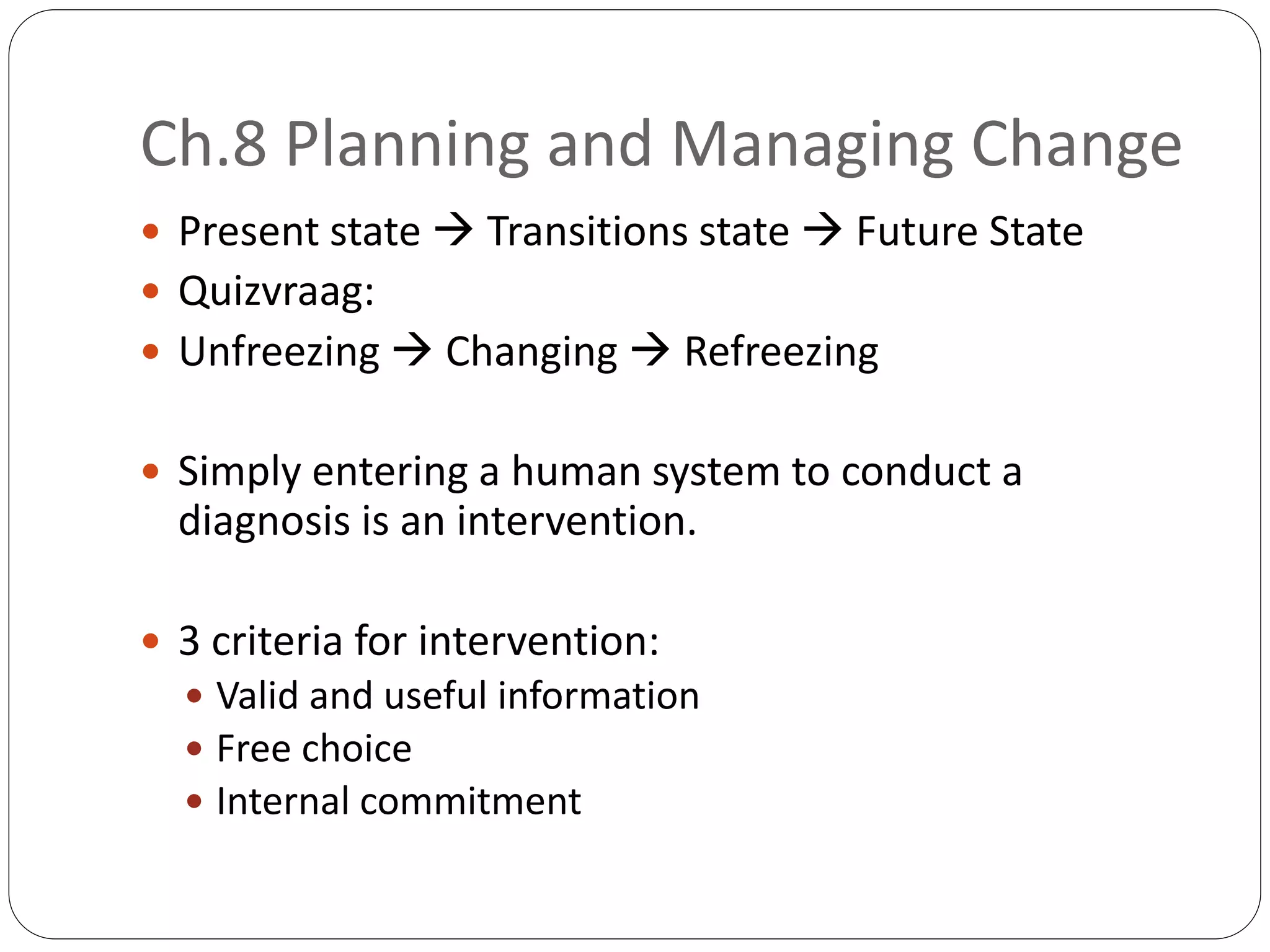
 Present state  Transitions state  Future State
 Quizvraag:
 Unfreezing  Changing  Refreezing
 Simply entering a human system to conduct a
diagnosis is an intervention.
 3 criteria for intervention:
 Valid and useful information
 Free choice
 Internal commitment
Ch.8 Planning and Managing Change
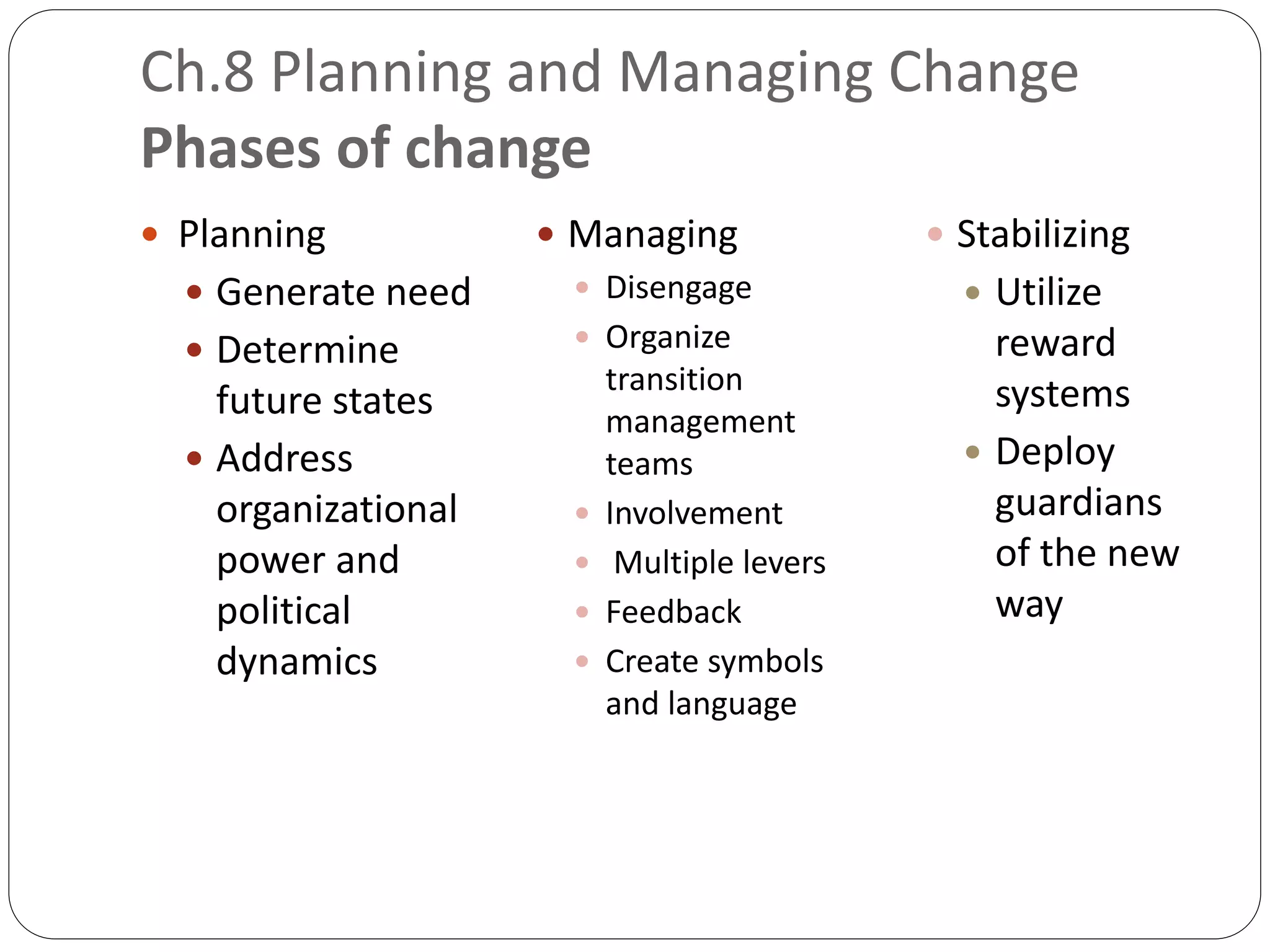
Phases of change
 Planning
 Generate need
 Determine
future states
 Address
organizational
power and
political
dynamics
 Managing
 Disengage
 Organize
transition
management
teams
 Involvement
 Multiple levers
 Feedback
 Create symbols
and language
 Stabilizing
 Utilize
reward
systems
 Deploy
guardians
of the new
way
Ch.8 Planning and Managing Change
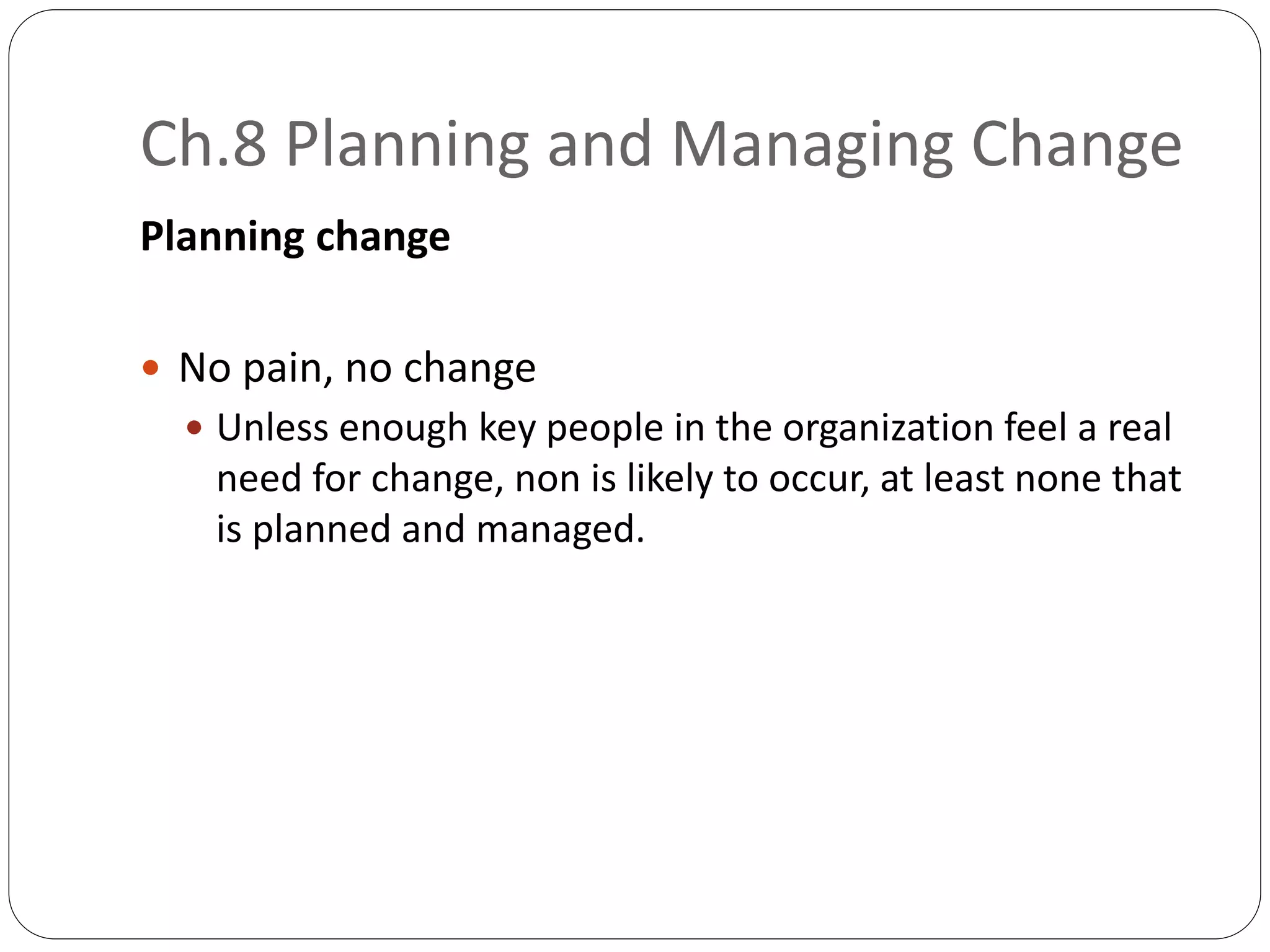
Planning change
 No pain, no change
 Unless enough key people in the organization feel a real
need for change, non is likely to occur, at least none that
is planned and managed.
Ch.8 Planning and Managing Change
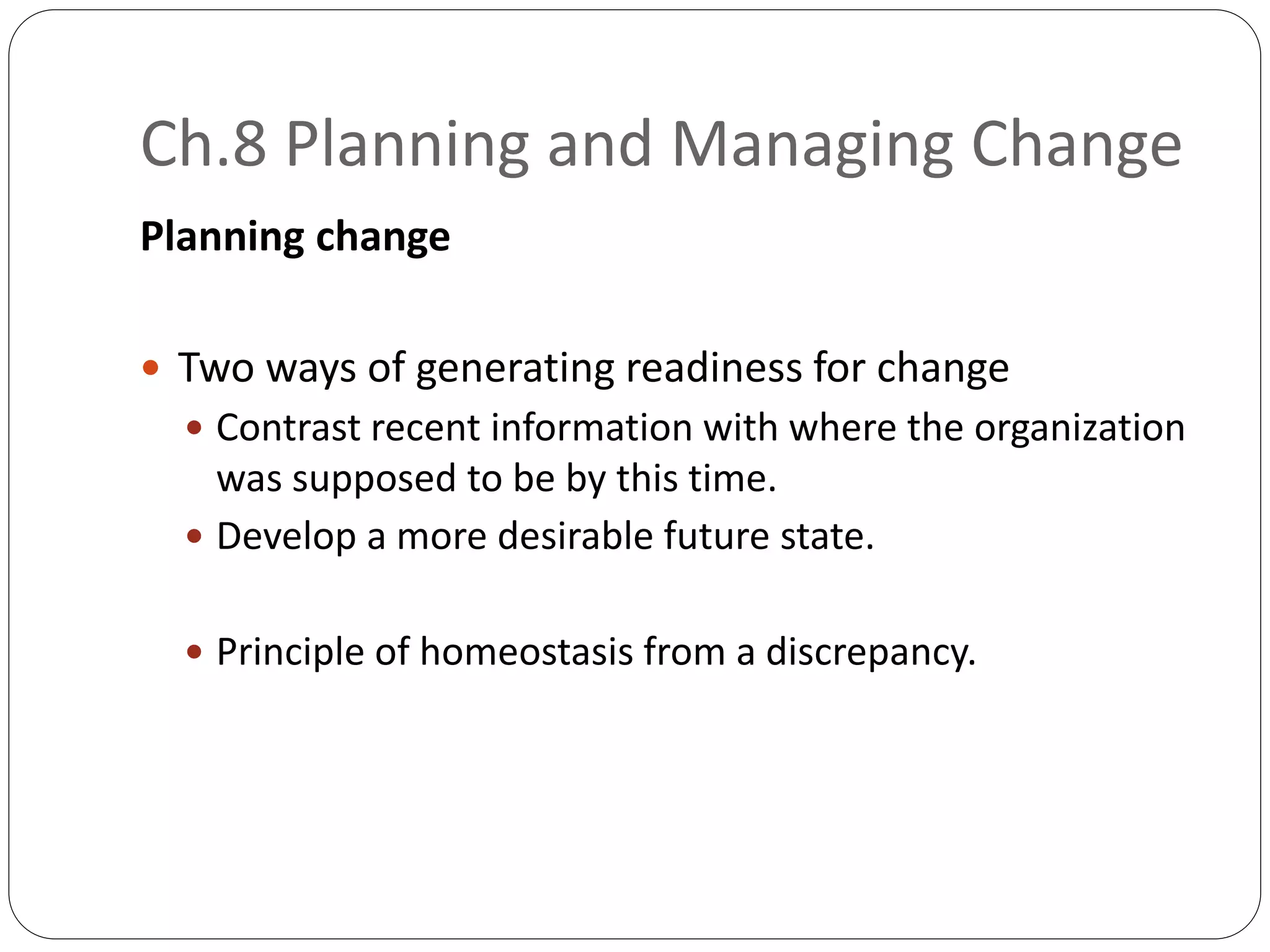
Planning change
 Two ways of generating readiness for change
 Contrast recent information with where the organization
was supposed to be by this time.
 Develop a more desirable future state.
 Principle of homeostasis from a discrepancy.
Ch.8 Planning and Managing Change
Planning change
 Leadership:
 Plan for the future in place
 Communicate the plan adequately
 Generate support with the organization
 Formal vs. Informal leaders
 The political process:
 “How will the change affect me?”
Ch.8 Planning and Managing Change
Managing the change process
 Change is sloppy – people never do exactly as we plan.
 Murphy’s law – if anything can go wrong, it will.
 Helpful principles and guidelines:
 Disengagement from the past
 Unfinished business
 Pride
 Communication
Ch.8 Planning and Managing Change
 Managing the change process
 Organize transitions management teams
 Involvement
 Focus on group level change
 Many paths lead to Rome
 Multiple leverage or systems
 Feedback
 Symbols and language
 Stabilizing the change
Ch.8 Planning and Managing Change
Theory about culture change
 Values
 Attitudes
 Behaviour
Ch.8 Planning and Managing Change
Measuring Progress of the Change Effort
 Four ways to tell:
 The nature of problems has changed
 Complaints about the change progress (meta grumbles)
 Issues, concerns and progress reports become part of
the agenda for regular meetings
 Special events held from time to time that assess
progress of the change effort
Ch. 9 Does OD work
Possible pressures to evaluation
 The manager or decision maker:
 Not necessary or not scientifically measured
 The organization members
 Takes too much valuable time
 The consultant or researcher might be interested in
other factors than the client
Ch. 9 Does OD work
Reasons for conduction the evaluation phase:
 Forces the objectives of the change effort
 Clarification of the change outcomes
 Clarification how to be measured
 Forces specify about implementations
 Helps signal many of the problems and obstacles to be
anticipated
 Facilitates planning for next steps if organizational
improvement
Ch. 10 The OD consultant
 Marginality
 Technical vs. Process orientated
 Activities boundary and membership boundary
 Loneliness and anxiety
 Joining helps
 Staying removed helps
 Both lessen effectiveness as a consultant
Ch. 10 The OD consultant
Consultants abilities
 Tolerate ambiguity
 Influence
 Confront difficult issues
 Support and nurture others
 Listen well and empathize
 Recognize one’s own feelings and intuitions quickly
 Conceptualize
 Discover and mobilize human energy
 Teach or create learning opportunities
 Maintain a sense of humour

A Rough Guide to Organizational Development

  • 1.
    Een interpretatie van OrganizationDevelopment (1992) W. Warner Burke A Rough Guide To Organizational Development
  • 2.
    Goals  Burke: toprovide an overview of the field of organization development (OD)  Alexander: Cherry picked to create an overview of Burke
  • 3.
    Ch. 1 Whatis organization development?  Used methodology:  Action research model  Diagnosis: interviews, observations, analyze and organize data  Feedback: Report back  Discussion: Analyze meaning of data, plan next steps  Action: Take those steps
  • 4.
    Ch. 1 Whatis organization development?  Three criteria for OD:  Actual and perceived need for change (client)  Client involvement in planning and implementation of change  Lead to change in the organizations culture
  • 5.
    Ch. 1 Whatis organization development? Inspirerende quotes:  Organization development is a process of fundamental change in an organizations culture  Not only good rapport, but also a sound basis of trust to discover the essence of organizational culture  OD is a process of bringing to the surface those implicit behavioural patterns that are helping and hindering development.
  • 6.
    Ch. 1 Whatis organization development?  Your role always starts as a facilitator  Then two camps:  The contingent camp  Only facilitate change  The normative camp  The consultant should recommend specific directions for change
  • 7.
    Ch. 3 Wheredid OD come from?  Not birth, but evolution  Three precursors:  Sensitivity training  Group learning (NTL), team building  Sociotechnical systems  O.D. considers both the social system as the technical system  Survey feedback  Questionnaire, feedback in phases, give meaning
  • 8.
    Ch. 3 Wheredid OD come from?  Theoretical roots
  • 9.
    Ch. 3 Wheredid OD come from?  Theoretical roots (2)  Expectancy theory  People will be highly motivated when they believe that their behaviour will lead to certain rewards, that these rewards are worthwhile and valuable and that they are able to reach them  Job satisfaction  Experienced meaningfulness of the work itself  Experienced responsibility for the work and outcomes  Knowledge of results or performance feedback
  • 10.
    Ch. 3 Wheredid OD come from? Theoretical roots (3)
  • 11.
    Ch. 3 Wheredid OD come from?  Theoretical roots (4)  The group as the focus of change  Behaviour: personality (= motivation and needs) X environment  Perception of environment is key  Imposed vs. own forces  Force field analysis tot identify the counterbalancing forces  Focus on reducing intensity of the restraining forces
  • 12.
    Ch. 3 Wheredid OD come from? Theoretical roots (5)
  • 13.
    Ch. 3 Wheredid OD come from?  Theoretical roots (6)  Group assumptions - Bion  Participative management – Likert  The contingency theory – Lawrence and Lorsch  The organization as a family - Levinson
  • 14.
    Ch. 4 Organizationdevelopment as process of change
  • 15.
    Ch. 5 Definingthe client: A different perspective  Categories of clients:  Contact clients: first contact  Intermediate agents: early stages  Primary clients: own a problem for which help is requested  Ultimate clients: may not be directly involved, but must be considered  Burke: “I think of my client as the relationship between individuals and units within and related to the system”.
  • 16.
    Ch. 6 Understandingorganizations: the process of Diagnosis  Models help to organize and systemize the potentially confusing masses of data
  • 17.
    Ch. 6 Understandingorganizations: the process of Diagnosis
  • 18.
    Ch. 7 The Burke-LitwinModel of Organizational Performance and Change  Causal model Causes: Organizational conditions (internal and external)  Effect: Performance
  • 19.
    The Burke-Litwin Modelof Organizational Performance and Change  Clear distinction between transformational and transactional dynamics.  Climate vs. Culture  Short term vs. Long term
  • 20.
    The Burke-Litwin Modelof Organizational Performance and Change
  • 21.
    Ch.8 Planning andManaging Change  Present state  Transitions state  Future State  Quizvraag:  Unfreezing  Changing  Refreezing  Simply entering a human system to conduct a diagnosis is an intervention.  3 criteria for intervention:  Valid and useful information  Free choice  Internal commitment
  • 22.
    Ch.8 Planning andManaging Change Phases of change  Planning  Generate need  Determine future states  Address organizational power and political dynamics  Managing  Disengage  Organize transition management teams  Involvement  Multiple levers  Feedback  Create symbols and language  Stabilizing  Utilize reward systems  Deploy guardians of the new way
  • 23.
    Ch.8 Planning andManaging Change Planning change  No pain, no change  Unless enough key people in the organization feel a real need for change, non is likely to occur, at least none that is planned and managed.
  • 24.
    Ch.8 Planning andManaging Change Planning change  Two ways of generating readiness for change  Contrast recent information with where the organization was supposed to be by this time.  Develop a more desirable future state.  Principle of homeostasis from a discrepancy.
  • 25.
    Ch.8 Planning andManaging Change Planning change  Leadership:  Plan for the future in place  Communicate the plan adequately  Generate support with the organization  Formal vs. Informal leaders  The political process:  “How will the change affect me?”
  • 26.
    Ch.8 Planning andManaging Change Managing the change process  Change is sloppy – people never do exactly as we plan.  Murphy’s law – if anything can go wrong, it will.  Helpful principles and guidelines:  Disengagement from the past  Unfinished business  Pride  Communication
  • 27.
    Ch.8 Planning andManaging Change  Managing the change process  Organize transitions management teams  Involvement  Focus on group level change  Many paths lead to Rome  Multiple leverage or systems  Feedback  Symbols and language  Stabilizing the change
  • 28.
    Ch.8 Planning andManaging Change Theory about culture change  Values  Attitudes  Behaviour
  • 29.
    Ch.8 Planning andManaging Change Measuring Progress of the Change Effort  Four ways to tell:  The nature of problems has changed  Complaints about the change progress (meta grumbles)  Issues, concerns and progress reports become part of the agenda for regular meetings  Special events held from time to time that assess progress of the change effort
  • 30.
    Ch. 9 DoesOD work Possible pressures to evaluation  The manager or decision maker:  Not necessary or not scientifically measured  The organization members  Takes too much valuable time  The consultant or researcher might be interested in other factors than the client
  • 31.
    Ch. 9 DoesOD work Reasons for conduction the evaluation phase:  Forces the objectives of the change effort  Clarification of the change outcomes  Clarification how to be measured  Forces specify about implementations  Helps signal many of the problems and obstacles to be anticipated  Facilitates planning for next steps if organizational improvement
  • 32.
    Ch. 10 TheOD consultant  Marginality  Technical vs. Process orientated  Activities boundary and membership boundary  Loneliness and anxiety  Joining helps  Staying removed helps  Both lessen effectiveness as a consultant
  • 33.
    Ch. 10 TheOD consultant Consultants abilities  Tolerate ambiguity  Influence  Confront difficult issues  Support and nurture others  Listen well and empathize  Recognize one’s own feelings and intuitions quickly  Conceptualize  Discover and mobilize human energy  Teach or create learning opportunities  Maintain a sense of humour

Editor's Notes

  • #6 A significant aspect of the organization will never be the same.
  • #7 What the client deems critical is the start of the consulation, not what the consultant considers important. Ik denk dat jouw meerwaarde in de combinatie van het faciliteren en het richting aangeven ligt. Hier moet een goede fit tussen zitten.
  • #8 Groups: primary source of informatio for learning is the behavior of the group members themsvelves. The feedback received and given becomes a source of personal insight and development.
  • #18 A key aspect is the gap between the formal dimensions and its informal policies. The larger the gap, the more likely its ineffective.
  • #21 External environment: Any outside condition or situation that influences the performance of the organization. These conditions include such thing as marketplaces, world financial conditions, political / governmental circumstances etc. Mission and strategy: What employees believe is the central purpose of the organization and how the organization intends to achieve that purpose over an extended time. Leadership: Executive behaviour that provides direction and encourages other to take needed action. For purpose gathering, this box includes perceptions of executive practices and values. Culture: “The way we do things around here”. Culture is the collection of overt and covert rules, values, and principles that guide organizational behaviour and that have been strongly influenced by history, custom, and practice. Structure: The arrangement of functions and people into specific areas and level of responsibility, decision making authority, and relationships. Structures assures effective implementation of the organizations mission and strategy. Management practices: What managers do in the normal course of events to use human and material resources at their disposal to carry out the organizations strategy. Systems: Standardized policies and mechanism that are designed to facilitate work. Systems primarily manifest themselves in the organizations reward system and in control systems such as the organizations management information system, goal and budget development and human resource allocation. Climate: The collective current impressions, expectations, and feelings of the members of local work units. These in turn affect members 'relations with supervisors, with one another and with other units. Task requirements and indiv. Skills: job person match Individual needs and values: the specific psychological factors that provide desire and worth for individual actions or thoughts. Motivation: Aroused behavioural tendencies to move towards goals, take needed actions and persist until satisfaction is attained. This is the net resultant motivation; the resultant net energy generated by the sum of achievement, power, affection, discovery and other important human motives. Individual and organizational performance: The outcomes or results with indicators of effort and achievement. Such indicators might include productivity, customer or staff satisfaction, profit, and service quality.
  • #22 Valid and useful information: The information gathered accurately reflects what people in the organization perceive and feel. If valid information is obtained, it will reflect a need. Free choice: Locus of decision making is in the client system. There is a choice. Internal commitment: The client owns the choice made and feels responsible for implementing it.
  • #25 Sometimes the need for change is clear, sometimes it needs to be generated.
  • #27 Disengagement: Say goodbye to certain ways of working, from a program, project, or product, location, or people. Unfinished business: When new ways are imposed people will spend energy trying to deal with the incompleteness. Resistance often reflects energy devoted to closure attempts. Pride: People build feelings of personal pride after a period of years in a particular job. People need to feel worthwile. Recogniztion that people had worked on important products or services is important to make sure energy is focused on their wounded pride. Communication: It’s difficult to communicate too much, however the content is as important. Communicating what will remain the same is as important as communicating what will be different.
  • #28 1 Large complex change will not manage itself. It may be wise to appoint a person to manage the transition full time with others on a part time basis. 2 For any given change goal there will be likely be multiple path to that goal. Involve organizational members in the planning how to reach those goals is critical. 3 Changing the organizational chart wont do the job. In large systems there are many subsystems. Change one, others will be affected. 4 Provide feedback to members about progress, regardless of how minor the progress way be. 5 Its beneficial to have some symbol, acronym, or slogan to represent the change goals. Using a symbol may help not only to simplify and clarify the change goal but to capture organizational members’ imagination and enthusiasm as well. 6 Inform people about what will not change  Anchor. Reinforce new ‘right’ behaviours and directions. Place ‘norm carries’ strategically in the organization.
  • #29 1 Rank according to the degree of diffculty to change: Values, hardest. Behavior, least difficutl. 2 Culture change through the least difficult aspect to change: behavior 3 Determine what is the new culture 4 Identitfy desired behavior 5 Train managers 6 Reward when they deploy the practices As managers begin to move in the desired direction, they get rewarded for doing so. As they behave and gert rewarded every time, they begin to believe that this new way of managing is actually a good thing. If they believe it is good then a value has been affected, and values, in part, comprise culture.
  • #33 The OD consultant is neither too technically orientated nor too process-orientated. The OD consultant operates within the boundary of these tow models of consultation. Activities: The OD consultant must help but is not directly involved. Membership: The OD consultant is never quite in nor quite out. Involved enough to understand the feelings and perceptions yet distant enough to be able to see the feeling and perceptions for what they are.