Collagen  The everyday name is collagen.  Collagen  is a fibrous protein with a large and complex structure. it is a natural substance found in all the connective tissues in our bodies: bones, skin, etc; it is crucial in providing the structure for all of our internal organs.  As it gives our body tissues structure, firmness and strength. Also as you age, collagen decreases in the body causing wrinkles and joint weakening.
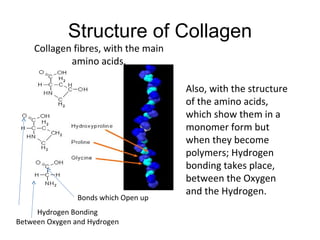
Structure of Collagen Also, with the structure of the amino acids, which show them in a monomer form but when they become polymers; Hydrogen bonding takes place, between the Oxygen and the Hydrogen. Collagen fibres, with the main amino acids. Bonds which Open up Hydrogen Bonding Between Oxygen and Hydrogen
Hydrogen Bonding This structure is showing the hydrogen bonds in the collagen atom.  Here is the molecular formula: C2H5NOC5H9NOC5H10NO2. This is also the structural formula of Collagen.
Bond dissociation enthalpies The hydrogen bonds come from the peptide (short polymers of amino acids) NH groups of the glycine. The enthalpy for this  −393.7 ± 1.5 kJ/mol  The enthalpy for the intermolecular bonds is 70 J/g.
Melting & Boiling points Its melting point depends on the animal that it came from, for example human collagen (type IV) is 48 ° C. Collagen from pigs and cows melt at 37 ° C, and collagen from fish and plants melts under 20 ° C It’s boiling point is between 150-190 ° C depending on the type of collagen.
Other Physical Data Its relative molecular mass is 255 It has a glass transition temperature of 135 °C and a degradation temperature of 433 °C  It’s solubility depends on the type, but generally it isn’t very soluble.
Collagen: Chemical Data Fibroblasts are the agents which produce collagen. This is the connective tissue cell that creates and emits collagen fibers. Collagen forms inside and outside a cell usually in mammals. Collagen formed outside a cell becomes a part of a network structure or  a part of a collagen fiber.  The collagen inside the cell is created and then sent by process called exocytosis, outside the cell, where it is required.  If collagen formation is slowed down or totally stopped; it could cause  diseases of skin, such as Scleroderma. Collagen from cows could contain mad cow disease. Chemical Properties---Collagen is a fibre, or when fully grown, a mesh of fibres together. Rich in amino acids-lysine, proline, hydroxylysine and hydroxyproline. Common pattern between the amino acids: lysine-hydroxylysine-proline and lysine-hydroxylysine-hydroxyproline.
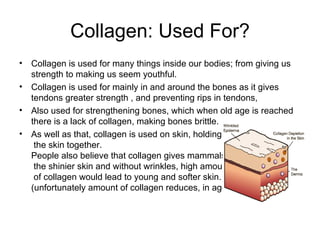
Collagen: Used For? Collagen is used for many things inside our bodies; from giving us strength to making us seem youthful. Collagen is used for mainly in and around the bones as it gives tendons greater strength , and preventing rips in tendons, Also used for strengthening bones, which when old age is reached there is a lack of collagen, making bones brittle. As well as that, collagen is used on skin, holding  the skin together. People also believe that collagen gives mammals  the shinier skin and without wrinkles, high amount  of collagen would lead to young and softer skin.  (unfortunately amount of collagen reduces, in ageing)
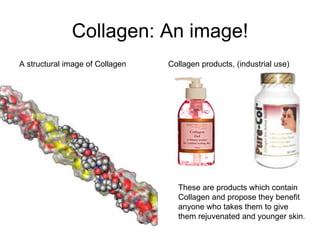
Collagen: An image! A structural image of Collagen Collagen products, (industrial use) These are products which contain Collagen and propose they benefit anyone who takes them to give them rejuvenated and younger skin.
Collagen: Chemical/Physical Data Suitability High melting point so it does not denature due to your body temperature.  It is not very soluble so it does not dissolve in nearby blood vessels and gets carried away in the body.  It contains glycerine which provides it with strong hydrogen bonds due to the NH groups.
Collagen: Hydrogen Bonds Suitability The Hydrogen bonds in Collagen are very useful for the bonds between the different amino acids and also good because it keeps them tightly together in a ‘mesh of fibres’. Which again is good and well suited for its uses because collagen is used in tendons and bones mainly for its strength, which it gains from the hydrogen bonds. As well as that collagen is also used  in skin, shown in the image in the slide ‘Collagen: Used For?’ and because it has the hydrogen bonds it keeps it all together (amino acids), giving it the elasticity and the ability to go back into the original shape, which is another reason why it is suited for tendons as they are rubbery and not fixed in one shape so they can be stretched and squashed without ripping.

Collagen

  • 1.
    Collagen Theeveryday name is collagen. Collagen is a fibrous protein with a large and complex structure. it is a natural substance found in all the connective tissues in our bodies: bones, skin, etc; it is crucial in providing the structure for all of our internal organs. As it gives our body tissues structure, firmness and strength. Also as you age, collagen decreases in the body causing wrinkles and joint weakening.
  • 2.
    Structure of CollagenAlso, with the structure of the amino acids, which show them in a monomer form but when they become polymers; Hydrogen bonding takes place, between the Oxygen and the Hydrogen. Collagen fibres, with the main amino acids. Bonds which Open up Hydrogen Bonding Between Oxygen and Hydrogen
  • 3.
    Hydrogen Bonding Thisstructure is showing the hydrogen bonds in the collagen atom. Here is the molecular formula: C2H5NOC5H9NOC5H10NO2. This is also the structural formula of Collagen.
  • 4.
    Bond dissociation enthalpiesThe hydrogen bonds come from the peptide (short polymers of amino acids) NH groups of the glycine. The enthalpy for this −393.7 ± 1.5 kJ/mol The enthalpy for the intermolecular bonds is 70 J/g.
  • 5.
    Melting & Boilingpoints Its melting point depends on the animal that it came from, for example human collagen (type IV) is 48 ° C. Collagen from pigs and cows melt at 37 ° C, and collagen from fish and plants melts under 20 ° C It’s boiling point is between 150-190 ° C depending on the type of collagen.
  • 6.
    Other Physical DataIts relative molecular mass is 255 It has a glass transition temperature of 135 °C and a degradation temperature of 433 °C It’s solubility depends on the type, but generally it isn’t very soluble.
  • 7.
    Collagen: Chemical DataFibroblasts are the agents which produce collagen. This is the connective tissue cell that creates and emits collagen fibers. Collagen forms inside and outside a cell usually in mammals. Collagen formed outside a cell becomes a part of a network structure or a part of a collagen fiber. The collagen inside the cell is created and then sent by process called exocytosis, outside the cell, where it is required. If collagen formation is slowed down or totally stopped; it could cause diseases of skin, such as Scleroderma. Collagen from cows could contain mad cow disease. Chemical Properties---Collagen is a fibre, or when fully grown, a mesh of fibres together. Rich in amino acids-lysine, proline, hydroxylysine and hydroxyproline. Common pattern between the amino acids: lysine-hydroxylysine-proline and lysine-hydroxylysine-hydroxyproline.
  • 8.
    Collagen: Used For?Collagen is used for many things inside our bodies; from giving us strength to making us seem youthful. Collagen is used for mainly in and around the bones as it gives tendons greater strength , and preventing rips in tendons, Also used for strengthening bones, which when old age is reached there is a lack of collagen, making bones brittle. As well as that, collagen is used on skin, holding the skin together. People also believe that collagen gives mammals the shinier skin and without wrinkles, high amount of collagen would lead to young and softer skin. (unfortunately amount of collagen reduces, in ageing)
  • 9.
    Collagen: An image!A structural image of Collagen Collagen products, (industrial use) These are products which contain Collagen and propose they benefit anyone who takes them to give them rejuvenated and younger skin.
  • 10.
    Collagen: Chemical/Physical DataSuitability High melting point so it does not denature due to your body temperature. It is not very soluble so it does not dissolve in nearby blood vessels and gets carried away in the body. It contains glycerine which provides it with strong hydrogen bonds due to the NH groups.
  • 11.
    Collagen: Hydrogen BondsSuitability The Hydrogen bonds in Collagen are very useful for the bonds between the different amino acids and also good because it keeps them tightly together in a ‘mesh of fibres’. Which again is good and well suited for its uses because collagen is used in tendons and bones mainly for its strength, which it gains from the hydrogen bonds. As well as that collagen is also used in skin, shown in the image in the slide ‘Collagen: Used For?’ and because it has the hydrogen bonds it keeps it all together (amino acids), giving it the elasticity and the ability to go back into the original shape, which is another reason why it is suited for tendons as they are rubbery and not fixed in one shape so they can be stretched and squashed without ripping.