POLYMER
POLYMER
1. POLYAMIDE
2. COLLAGEN
2
POLYAMIDE
 A polyamide is a macromolecule with repeating
units linked by amide bonds
 Polyamides occur both naturally and artificially
 Examples of naturally polyamides are proteins, such as
wool and silk
 Artificially polyamides can be made through step-
growth polymerization or solid-phase synthesis ,such as
Nylons
3
History of Polyamides
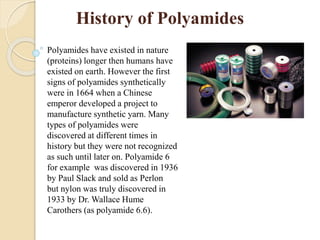
Polyamides have existed in nature
(proteins) longer then humans have
existed on earth. However the first
signs of polyamides synthetically
were in 1664 when a Chinese
emperor developed a project to
manufacture synthetic yarn. Many
types of polyamides were
discovered at different times in
history but they were not recognized
as such until later on. Polyamide 6
for example was discovered in 1936
by Paul Slack and sold as Perlon
but nylon was truly discovered in
1933 by Dr. Wallace Hume
Carothers (as polyamide 6.6).
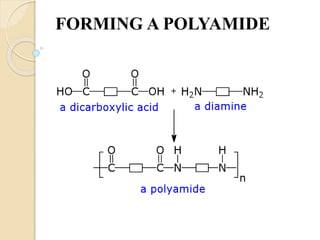
FORMING A POLYAMIDE
PROPERTIES
 Physical properties
Mechanical properties
Tensile strength is 160-210(MPa)
Density : 1.14gm/c.c
Elongation at break : 15-45%
6
 Melting point : 215oC
 Ability to protest friction : Excellent
 Ability to protest heat : up to 150oC
Chemical Properties
 Acids: it has not enough ability against acidic
action.
 Basic. Basic does not cause harm
 have enough ability against alkali.
 Effect of bleaching Strong oxidizing agent is
harmful
7
BIOCOMPATIBILITY
 Biocompatibility test results met the acceptance criteria
for ISO 10993.
 Cytotoxicity testing showed that the material is nontoxic
 “Tests for Local Effects after Implantation:” Both a two-
week and 12-week duration test was performed to assess
the in vitro cytotoxicity of medical devices
8
APPLICATION
 Clinical usages
 Used as sutures
 Dental Application
 Cable insulation for medical devices
 Automotive Applications
 Electrical/Electronic Applications
9
REFERENCES
 Lopez DG, Mitre IG, Fernandez JF, Merino JC, Pastor JM. Influence of Clay modification process in
PA6-layered silicate nanocomposite properties. Polymer. 2005; 46(8):2758-2765.
 Yu S, Zhao J, Chen G, Juay YK, Yong MS. The characteristics of polyamide layered-silicate
nanocomposites.Materials Processing Technology. 2007; 192-193:410-414.
 Chin IJ, Albrecht TT, Kim HC, Russel T, Wang J. On exfoliation of montmorillonite in epoxy. Polymer.
2001; 42(13):5947-5952.
 Okamoto M, Morita S, Kotaka T. Dispersed structure and ionic conductivity of smectic clay/polymer
nanocomposite. Polymer. 2001; 42(6):2685-2688.
 Fornes TD, Yoon PJ, Hunter DL, Keskkula H, Paul DR. Effect of organoclay structure on nylon 6
nanocomposite morphology and properties. Polymer. 2002; 43(22):5915-5933.

 Delozier DM, Orwoll RA, Cahoon JF, Johnston NJ, Smith JG, Connel JW. Preparation and
Characterization of polyimide/organoclay nanocomposites. Polymer. 2002; 43(3):813-822.
 Araújo EM, Barbosa R, Rodrigues AWB, Melo TJA, Ito EN. Processing and characterization of
polyethylene/Brazilian Clay nanocomposites. Materials Science and Engineering A. 2007; 445-
446:141-147.
10
COLLAGEN
 Collagen is a family of highly developed fibrous
proteins found in all multicellular animals. It is the most
abundant proteins found in mammals, it is 25 percent of
the total protein mass.
 Collagen is the main fibrous component of skin, bone,
tendon, cartilage .
 Collagen is a natural protein that provides our bodies
with structural support
11
STRUCTURE OF COLLAGEN
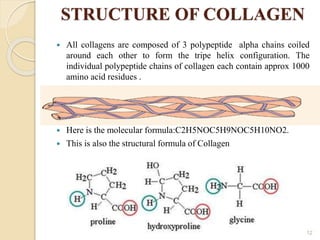
 All collagens are composed of 3 polypeptide alpha chains coiled
around each other to form the tripe helix configuration. The
individual polypeptide chains of collagen each contain approx 1000
amino acid residues .
 Here is the molecular formula:C2H5NOC5H9NOC5H10NO2.
 This is also the structural formula of Collagen
12
FORMATION OF COLLAGEN
 Collagen contains specific amino acids – Glycine,
Proline, Hydroxyproline and Arginine. These amino
acids have a regular arrangement in each of the three
chains of these collagen subunits.
 The sequence often follows the pattern Gly-Pro-X or
Gly-X-Hyp,
where X may be any of various other amino acid
residues.
13
PROPERTIES
Physical properties
 It’s boiling point is between 150-190°C depending on the type
of collagen
 Its relative molecular mass is 255
 It has a glass transition temperature of 135 °C and a
degradation temperature of 433 °C
 It’s solubility depends on the type, but generally it isn’t very
soluble.
Chemical Properties
 Collagen is a fibre, or when fully grown, a mesh of fibres
together.
 Rich in amino acids-Glysine, proline, hydroxylysine and
hydroxyproline
14
TYPES OF COLLAGEN
 The collagen family consists of 28 members and these are classified
Variations are due to …..
1. Differences in the assembly of basic polypeptide chains
2. Different lengths of the helix
3. Various interruptions in the helix and
4. Differences in the terminations of the helical domains
15
Functions
16
Type Function
I Provides tensile strength to connective tissue
II Provides tensile strength to connective tissue
III Forms structural framework of spleen, liver, smooth
muscle, adipose tissue. Provides tensile strength to
connective tissue
IV Forms meshwork of the lamina densa of the basal
lamina to provide support and filtration
V Provides tensile strength, associated with type I
collagen, also with placental ground substance.
1
7
VI Bridging between cells and matrix
VII Forms anchoring fibrils that fasten lamina
densa to underlying lamina reticularis
VIII Tissue support, porous meshwork, provide
compressive strength
IX Associates with type II collagen fibers
18
X Calcium binding
XI Provides tensile strength, controlling lateral growth
of type II
XII Associated with type I collagen fibers
XIII Cell matrix
XIV Modulates fibril interactions
XV Proteolytic release of antiangiogenic factor
19
XVI Unknown
XVII Cell to matrix attachment
XVIII Proteolytic release of antiangiogenic factor
XIX formation of hippocampal synapses
XXIV Regulation of type I fibrillogenesis, marker
of osteoblast differentiation and bone
formation
XXVII cartilage calcification, Association with
type II fibrils (?)
BIOMEDICALAPPLICATIONS
 Collagen is regarded as one of the most useful biomaterials.
 The excellent biocompatibility and safety due to its biological
characteristics, such as
◦ biodegradability
◦ biocompatibility
◦ weak antigenicity.
20
USES
 To repair tissues such as bone, tendon, ligament, skin,
vascular and connective tissues.
 Drug delivery applications: to develop scaffolds for delivery
of genes, cell, growth factors, anesthetics, antibiotics etc.
 Tissue augmentation: For use in plastic surgery
 To enhance blood coagulation and platelet activation
 To enhance durability of allograft tissues.
 In guided tissue regeneration.
 Artificial skin.
21
ADVANTAGES
 Can be used for the generation of bone substitutes,
 wound dressings, nerve regeneration.
 For use as a research tool to study diseases such as diabetes,
 Non-antigenic.
 Biodegradable and bio-reabsorbable.
 Non-toxic and biocompatible.
 Biological plastic due to high tensile strength and minimal
expressibility.
 Hemostatic — promotes blood coagulation.
 Formulated in a number of different forms.
 Biodegradability can be regulated by cross-linking.
 Easily modifiable to produce materials as desired by utilizing its
functional groups.
 Compatible with synthetic polymers.
22
DISADVANTAGES
 High cost of pure type I collagen.
 Variability of isolated collagen.
 Hydrophilicity which leads to swelling.
 Complex handling properties.
23
REFERENCES
 http://www.biochem.wisc.edu/faculty/raines/lab/pdfs/Sh
oulders2009a.pdf
 http://www.biochemj.org/bj/260/0463/2600463.pdf
 http://www.springerlink.com/content/jpwre2yqeywjla28/
 www.cliniccare.com.au/documents/stimulation-of-
collagen-synthesis.pdf
 http://jcb.rupress.org/content/25/1/69.full.pdf
24
25

natural polymer

  • 1.
  • 2.
  • 3.
    POLYAMIDE  A polyamideis a macromolecule with repeating units linked by amide bonds  Polyamides occur both naturally and artificially  Examples of naturally polyamides are proteins, such as wool and silk  Artificially polyamides can be made through step- growth polymerization or solid-phase synthesis ,such as Nylons 3
  • 4.
    History of Polyamides Polyamideshave existed in nature (proteins) longer then humans have existed on earth. However the first signs of polyamides synthetically were in 1664 when a Chinese emperor developed a project to manufacture synthetic yarn. Many types of polyamides were discovered at different times in history but they were not recognized as such until later on. Polyamide 6 for example was discovered in 1936 by Paul Slack and sold as Perlon but nylon was truly discovered in 1933 by Dr. Wallace Hume Carothers (as polyamide 6.6).
  • 5.
  • 6.
    PROPERTIES  Physical properties Mechanicalproperties Tensile strength is 160-210(MPa) Density : 1.14gm/c.c Elongation at break : 15-45% 6
  • 7.
     Melting point: 215oC  Ability to protest friction : Excellent  Ability to protest heat : up to 150oC Chemical Properties  Acids: it has not enough ability against acidic action.  Basic. Basic does not cause harm  have enough ability against alkali.  Effect of bleaching Strong oxidizing agent is harmful 7
  • 8.
    BIOCOMPATIBILITY  Biocompatibility testresults met the acceptance criteria for ISO 10993.  Cytotoxicity testing showed that the material is nontoxic  “Tests for Local Effects after Implantation:” Both a two- week and 12-week duration test was performed to assess the in vitro cytotoxicity of medical devices 8
  • 9.
    APPLICATION  Clinical usages Used as sutures  Dental Application  Cable insulation for medical devices  Automotive Applications  Electrical/Electronic Applications 9
  • 10.
    REFERENCES  Lopez DG,Mitre IG, Fernandez JF, Merino JC, Pastor JM. Influence of Clay modification process in PA6-layered silicate nanocomposite properties. Polymer. 2005; 46(8):2758-2765.  Yu S, Zhao J, Chen G, Juay YK, Yong MS. The characteristics of polyamide layered-silicate nanocomposites.Materials Processing Technology. 2007; 192-193:410-414.  Chin IJ, Albrecht TT, Kim HC, Russel T, Wang J. On exfoliation of montmorillonite in epoxy. Polymer. 2001; 42(13):5947-5952.  Okamoto M, Morita S, Kotaka T. Dispersed structure and ionic conductivity of smectic clay/polymer nanocomposite. Polymer. 2001; 42(6):2685-2688.  Fornes TD, Yoon PJ, Hunter DL, Keskkula H, Paul DR. Effect of organoclay structure on nylon 6 nanocomposite morphology and properties. Polymer. 2002; 43(22):5915-5933.   Delozier DM, Orwoll RA, Cahoon JF, Johnston NJ, Smith JG, Connel JW. Preparation and Characterization of polyimide/organoclay nanocomposites. Polymer. 2002; 43(3):813-822.  Araújo EM, Barbosa R, Rodrigues AWB, Melo TJA, Ito EN. Processing and characterization of polyethylene/Brazilian Clay nanocomposites. Materials Science and Engineering A. 2007; 445- 446:141-147. 10
  • 11.
    COLLAGEN  Collagen isa family of highly developed fibrous proteins found in all multicellular animals. It is the most abundant proteins found in mammals, it is 25 percent of the total protein mass.  Collagen is the main fibrous component of skin, bone, tendon, cartilage .  Collagen is a natural protein that provides our bodies with structural support 11
  • 12.
    STRUCTURE OF COLLAGEN All collagens are composed of 3 polypeptide alpha chains coiled around each other to form the tripe helix configuration. The individual polypeptide chains of collagen each contain approx 1000 amino acid residues .  Here is the molecular formula:C2H5NOC5H9NOC5H10NO2.  This is also the structural formula of Collagen 12
  • 13.
    FORMATION OF COLLAGEN Collagen contains specific amino acids – Glycine, Proline, Hydroxyproline and Arginine. These amino acids have a regular arrangement in each of the three chains of these collagen subunits.  The sequence often follows the pattern Gly-Pro-X or Gly-X-Hyp, where X may be any of various other amino acid residues. 13
  • 14.
    PROPERTIES Physical properties  It’sboiling point is between 150-190°C depending on the type of collagen  Its relative molecular mass is 255  It has a glass transition temperature of 135 °C and a degradation temperature of 433 °C  It’s solubility depends on the type, but generally it isn’t very soluble. Chemical Properties  Collagen is a fibre, or when fully grown, a mesh of fibres together.  Rich in amino acids-Glysine, proline, hydroxylysine and hydroxyproline 14
  • 15.
    TYPES OF COLLAGEN The collagen family consists of 28 members and these are classified Variations are due to ….. 1. Differences in the assembly of basic polypeptide chains 2. Different lengths of the helix 3. Various interruptions in the helix and 4. Differences in the terminations of the helical domains 15
  • 16.
    Functions 16 Type Function I Providestensile strength to connective tissue II Provides tensile strength to connective tissue III Forms structural framework of spleen, liver, smooth muscle, adipose tissue. Provides tensile strength to connective tissue IV Forms meshwork of the lamina densa of the basal lamina to provide support and filtration V Provides tensile strength, associated with type I collagen, also with placental ground substance.
  • 17.
    1 7 VI Bridging betweencells and matrix VII Forms anchoring fibrils that fasten lamina densa to underlying lamina reticularis VIII Tissue support, porous meshwork, provide compressive strength IX Associates with type II collagen fibers
  • 18.
    18 X Calcium binding XIProvides tensile strength, controlling lateral growth of type II XII Associated with type I collagen fibers XIII Cell matrix XIV Modulates fibril interactions XV Proteolytic release of antiangiogenic factor
  • 19.
    19 XVI Unknown XVII Cellto matrix attachment XVIII Proteolytic release of antiangiogenic factor XIX formation of hippocampal synapses XXIV Regulation of type I fibrillogenesis, marker of osteoblast differentiation and bone formation XXVII cartilage calcification, Association with type II fibrils (?)
  • 20.
    BIOMEDICALAPPLICATIONS  Collagen isregarded as one of the most useful biomaterials.  The excellent biocompatibility and safety due to its biological characteristics, such as ◦ biodegradability ◦ biocompatibility ◦ weak antigenicity. 20
  • 21.
    USES  To repairtissues such as bone, tendon, ligament, skin, vascular and connective tissues.  Drug delivery applications: to develop scaffolds for delivery of genes, cell, growth factors, anesthetics, antibiotics etc.  Tissue augmentation: For use in plastic surgery  To enhance blood coagulation and platelet activation  To enhance durability of allograft tissues.  In guided tissue regeneration.  Artificial skin. 21
  • 22.
    ADVANTAGES  Can beused for the generation of bone substitutes,  wound dressings, nerve regeneration.  For use as a research tool to study diseases such as diabetes,  Non-antigenic.  Biodegradable and bio-reabsorbable.  Non-toxic and biocompatible.  Biological plastic due to high tensile strength and minimal expressibility.  Hemostatic — promotes blood coagulation.  Formulated in a number of different forms.  Biodegradability can be regulated by cross-linking.  Easily modifiable to produce materials as desired by utilizing its functional groups.  Compatible with synthetic polymers. 22
  • 23.
    DISADVANTAGES  High costof pure type I collagen.  Variability of isolated collagen.  Hydrophilicity which leads to swelling.  Complex handling properties. 23
  • 24.
    REFERENCES  http://www.biochem.wisc.edu/faculty/raines/lab/pdfs/Sh oulders2009a.pdf  http://www.biochemj.org/bj/260/0463/2600463.pdf http://www.springerlink.com/content/jpwre2yqeywjla28/  www.cliniccare.com.au/documents/stimulation-of- collagen-synthesis.pdf  http://jcb.rupress.org/content/25/1/69.full.pdf 24
  • 25.

Editor's Notes

  • #22 Cultured skin substitutes developed on collagen lattices as a support for epithelial growth 2. controlled release of drug