FRIT 7739: Collaborative Unit on Digital Citizenship- Ashley Miller
1
Learner Analysis
Introduction
The targeted group for my unit of instruction consists of sixth grade
students at Glynn Middle School in Brunswick, Georgia. This is a
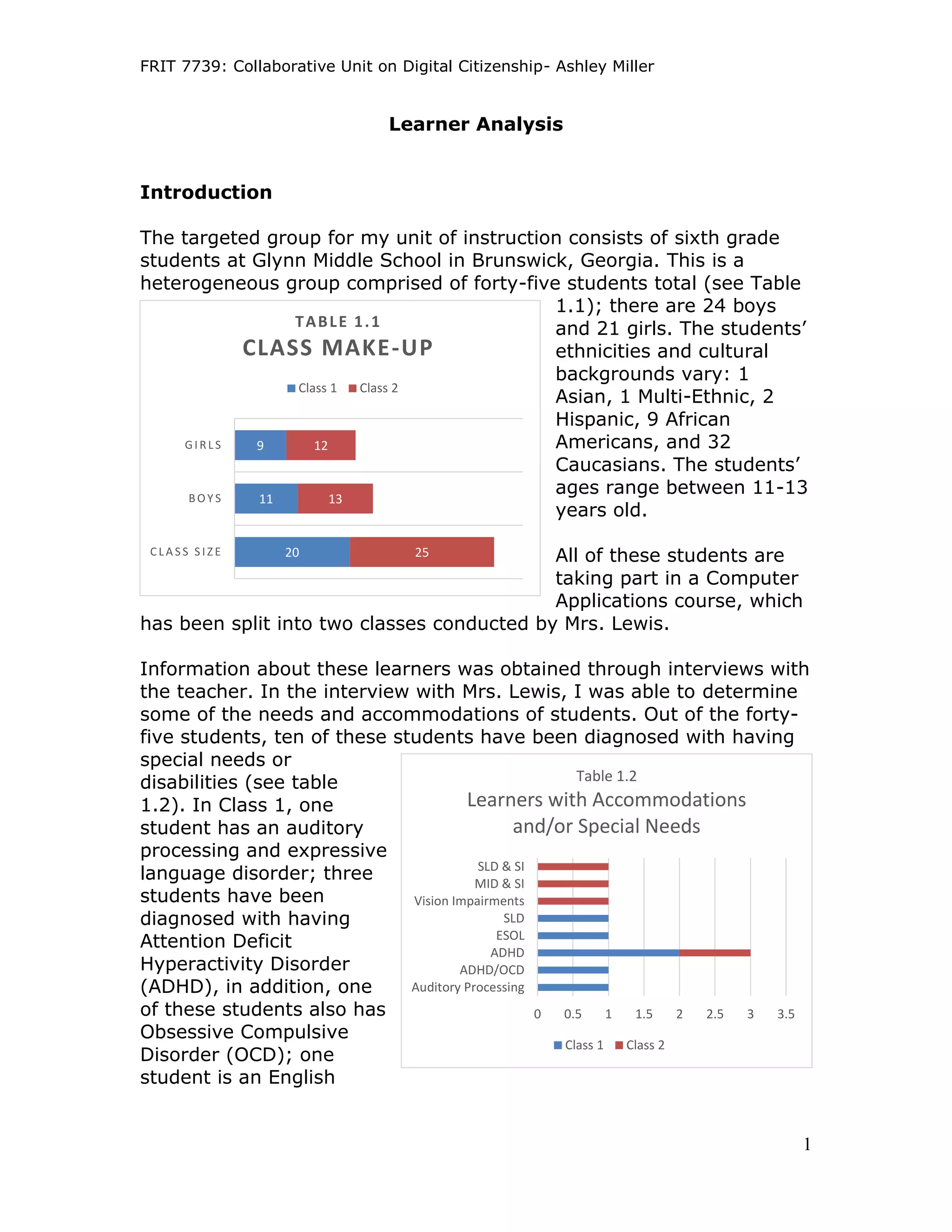
heterogeneous group comprised of forty-five students total (see Table
1.1); there are 24 boys
and 21 girls. The students’
ethnicities and cultural
backgrounds vary: 1
Asian, 1 Multi-Ethnic, 2
Hispanic, 9 African
Americans, and 32
Caucasians. The students’
ages range between 11-13
years old.
All of these students are
taking part in a Computer
Applications course, which
has been split into two classes conducted by Mrs. Lewis.
Information about these learners was obtained through interviews with
the teacher. In the interview with Mrs. Lewis, I was able to determine
some of the needs and accommodations of students. Out of the forty-
five students, ten of these students have been diagnosed with having
special needs or
disabilities (see table
1.2). In Class 1, one
student has an auditory
processing and expressive
language disorder; three
students have been
diagnosed with having
Attention Deficit
Hyperactivity Disorder
(ADHD), in addition, one
of these students also has
Obsessive Compulsive
Disorder (OCD); one
student is an English
20
11
9
25
13
12
C LA S S S IZE
BOY S
GIRLS
TABLE 1.1
CLASS MAKE-UP
Class 1 Class 2
0 0.5 1 1.5 2 2.5 3 3.5
Auditory Processing
ADHD/OCD
ADHD
ESOL
SLD
Vision Impairments
MID & SI
SLD & SI
Table 1.2
Learners with Accommodations
and/or Special Needs
Class 1 Class 2
FRIT 7739: Collaborative Unit on Digital Citizenship- Ashley Miller
2
Speaker of Other Languages (ESOL); and one student has a Specific
Learning Disability (SLD).
In Class 2, one student has vision impairments; one student has
ADHD; one student has a Mild Intellectual Disability and Speech
Impairment (SI), and one student has SI and SLD.
As stated in the Executive Summary for Glynn Middle School,
“Special education and English Speakers of Other Languages are
served through a collaborative model. GMS also has classrooms
which serve students who are mildly intellectually disable, and
these students receive a portion of their instruction in a self-
contained setting but also in inclusion settings in the areas of
science and social studies (Blackstone, 2014).”
This information would help me in the creation of my unit of
instruction.
Entry Skills and Prior Knowledge
The skills and prior knowledge of the students was obtained through
observation and interviews. Some of the skills are but not limited to:
 Able to log onto a computer
 Typing, although not proficient
 Basic search engine use
 Know how to use mouse and keyboard
 Various aspects of Internet Safety and Digital Citizenship
Here I must state that during my time of interview and observation,
Mrs. Lewis was showing her students videos about some aspects of
digital citizenship such as cyberbullying. She welcomed any additional
lessons that I could provide to her students because as she stated,
“It doesn’t hurt for the students to hear this information over
and over. Any topic you choose would be beneficial because
they [the students] need to learn and understand these
concepts. They do not realize how important this information is
(personal communication, February 4, 2016).”
Attitudes toward Content and General Learning Preferences
Through observation and student/teacher interaction, the learners
seemed to show a preference for hands-on activities in which they
could utilize their computers. The students enjoyed seeing the
Brainpop videos that were shown, and attempting to answer the
FRIT 7739: Collaborative Unit on Digital Citizenship- Ashley Miller
3
quizzes at the end of each video as a class. The students also were
observed to enjoy fast-paced, colorful games, such as the typing
games they completed in the class.
As for attitudes toward the content, through observation a lot of the
students seemed bored with the topics. When class time was over,
students did not waste any time in getting out of the classroom. So as
to further determine the knowledge of the students and to help guide
my choice of digital citizenship topic, an evaluation of the students
technology use will be conducted.
FRIT 7739: Collaborative Unit on Digital Citizenship- Ashley Miller
4
References
Blackstone, M., (2014). Executive Summary Glynn Middle School (pp.
2-3, Rep.).
AdvanED. Retrieved April 2, 2016, from http://www.advanc-
ed.org/oasis2/u/par/accreditation/summary/pdf;jsessionid=3AA
7C02B255A28024AA4B95CCC7FE05F?institutionId=21289

Collaborative Unit- Learner Analysis

  • 1.
    FRIT 7739: CollaborativeUnit on Digital Citizenship- Ashley Miller 1 Learner Analysis Introduction The targeted group for my unit of instruction consists of sixth grade students at Glynn Middle School in Brunswick, Georgia. This is a heterogeneous group comprised of forty-five students total (see Table 1.1); there are 24 boys and 21 girls. The students’ ethnicities and cultural backgrounds vary: 1 Asian, 1 Multi-Ethnic, 2 Hispanic, 9 African Americans, and 32 Caucasians. The students’ ages range between 11-13 years old. All of these students are taking part in a Computer Applications course, which has been split into two classes conducted by Mrs. Lewis. Information about these learners was obtained through interviews with the teacher. In the interview with Mrs. Lewis, I was able to determine some of the needs and accommodations of students. Out of the forty- five students, ten of these students have been diagnosed with having special needs or disabilities (see table 1.2). In Class 1, one student has an auditory processing and expressive language disorder; three students have been diagnosed with having Attention Deficit Hyperactivity Disorder (ADHD), in addition, one of these students also has Obsessive Compulsive Disorder (OCD); one student is an English 20 11 9 25 13 12 C LA S S S IZE BOY S GIRLS TABLE 1.1 CLASS MAKE-UP Class 1 Class 2 0 0.5 1 1.5 2 2.5 3 3.5 Auditory Processing ADHD/OCD ADHD ESOL SLD Vision Impairments MID & SI SLD & SI Table 1.2 Learners with Accommodations and/or Special Needs Class 1 Class 2
  • 2.
    FRIT 7739: CollaborativeUnit on Digital Citizenship- Ashley Miller 2 Speaker of Other Languages (ESOL); and one student has a Specific Learning Disability (SLD). In Class 2, one student has vision impairments; one student has ADHD; one student has a Mild Intellectual Disability and Speech Impairment (SI), and one student has SI and SLD. As stated in the Executive Summary for Glynn Middle School, “Special education and English Speakers of Other Languages are served through a collaborative model. GMS also has classrooms which serve students who are mildly intellectually disable, and these students receive a portion of their instruction in a self- contained setting but also in inclusion settings in the areas of science and social studies (Blackstone, 2014).” This information would help me in the creation of my unit of instruction. Entry Skills and Prior Knowledge The skills and prior knowledge of the students was obtained through observation and interviews. Some of the skills are but not limited to:  Able to log onto a computer  Typing, although not proficient  Basic search engine use  Know how to use mouse and keyboard  Various aspects of Internet Safety and Digital Citizenship Here I must state that during my time of interview and observation, Mrs. Lewis was showing her students videos about some aspects of digital citizenship such as cyberbullying. She welcomed any additional lessons that I could provide to her students because as she stated, “It doesn’t hurt for the students to hear this information over and over. Any topic you choose would be beneficial because they [the students] need to learn and understand these concepts. They do not realize how important this information is (personal communication, February 4, 2016).” Attitudes toward Content and General Learning Preferences Through observation and student/teacher interaction, the learners seemed to show a preference for hands-on activities in which they could utilize their computers. The students enjoyed seeing the Brainpop videos that were shown, and attempting to answer the
  • 3.
    FRIT 7739: CollaborativeUnit on Digital Citizenship- Ashley Miller 3 quizzes at the end of each video as a class. The students also were observed to enjoy fast-paced, colorful games, such as the typing games they completed in the class. As for attitudes toward the content, through observation a lot of the students seemed bored with the topics. When class time was over, students did not waste any time in getting out of the classroom. So as to further determine the knowledge of the students and to help guide my choice of digital citizenship topic, an evaluation of the students technology use will be conducted.
  • 4.
    FRIT 7739: CollaborativeUnit on Digital Citizenship- Ashley Miller 4 References Blackstone, M., (2014). Executive Summary Glynn Middle School (pp. 2-3, Rep.). AdvanED. Retrieved April 2, 2016, from http://www.advanc- ed.org/oasis2/u/par/accreditation/summary/pdf;jsessionid=3AA 7C02B255A28024AA4B95CCC7FE05F?institutionId=21289