+
       Yong Ping              Aisha


         Shahirah          Syarifah


             The Proposal
               for Ms Rita.
    An Ed-Psychological Case Study.
How we are going to present our case

     Defining our Problem
     Meeting the Problem
     +
     Analysis of the Problem
          Level of Development
          How Students Learn
     Pedagogical Solutions proposed for Ms. Rita
+
    The Scenario
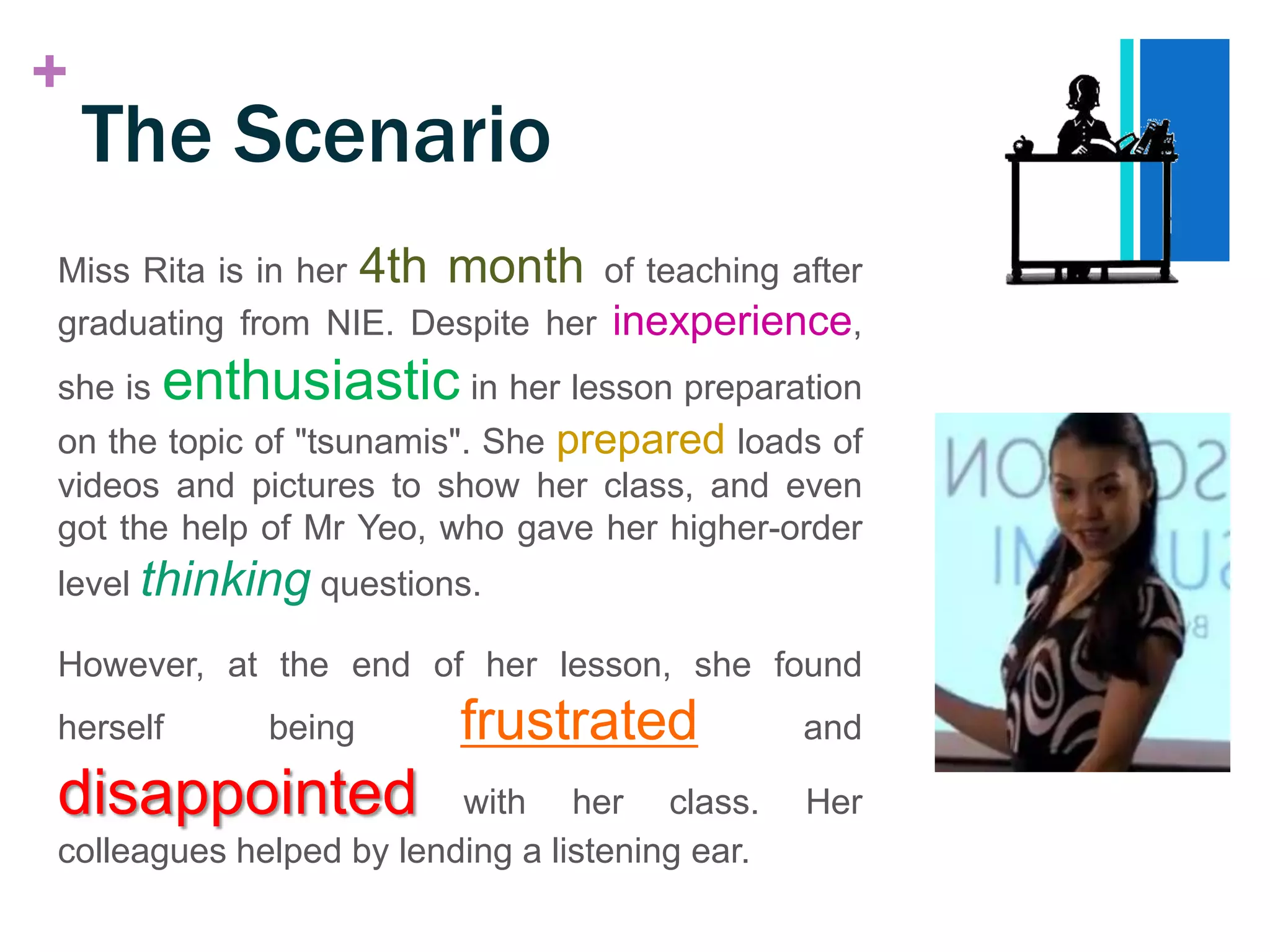
Miss Rita is in her 4th month of teaching after
graduating from NIE. Despite her inexperience,
she is   enthusiastic in her lesson preparation
on the topic of "tsunamis". She prepared loads of
videos and pictures to show her class, and even
got the help of Mr Yeo, who gave her higher-order
level thinking questions.

However, at the end of her lesson, she found
herself       being      frustrated             and

disappointed             with her class.        Her
colleagues helped by lending a listening ear.
+
    Meeting the Problem
                                   We aim to…


 Help Ms Rita to understand Sec 2 students'
     level of cognitive development
     learning process

 Suggestions for Ms Rita to improve her teaching pedagogies
+


             ANALYSIS
    LEVEL OF DEVELOPMENT
+
    Level of Development
    Secondary 2 Students’
    Level of Cognitive Development


       Formal Operational Stage (aged 11 to Adult)               Piaget
       Formal thinking, as opposed to concrete operational thinking

       Thinking of most high school students is still concrete
        operational.

       Many students lack the concrete experiences which are
        required to think at the level of abstraction.

        Teachers to realize this and provide these experiences for
        the students
+
    Level of Development
    Application to our situation


       Students are not able to relate to the concept

       Ms Rita assumed sufficient prior knowledge                      Piaget
       Ms Rita did not provide prerequisite knowledge
           “Come on, Ms Lim, they are sec 2 students, these should be part of
            their general knowledge. You know, to my horror, some of them
            don‟t even know what a tsunami is! Haven‟t they heard of the 2004
            tsunami catastrophe?”
+                                                       Piaget
    Level of Development
    Piaget on Pedagogical Application


     Teachers to be mindful of students’ developmental needs

      Provide concrete experiences & help in linking
      Social interaction; a powerful tool
      Designing of learning experiences to bridge development


     Without necessary guidance, students are unable to learn effectively.

     Importance of engaging prior knowledge is emphasized.
+
    Level of Development


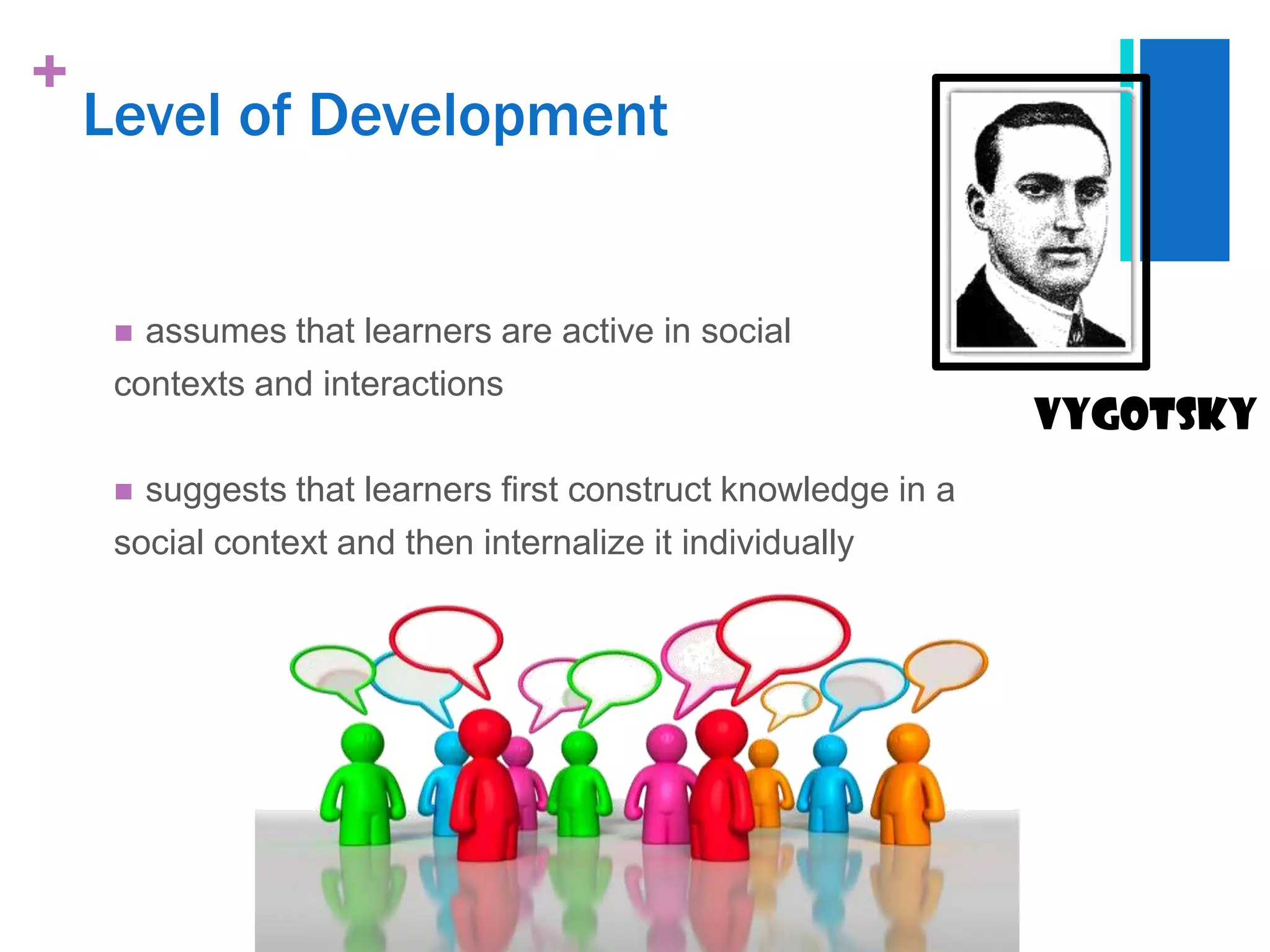
      assumes that learners are active in social
     contexts and interactions
                                                               vygotsky
      suggests that learners first construct knowledge in a
     social context and then internalize it individually
+
    Level of Development
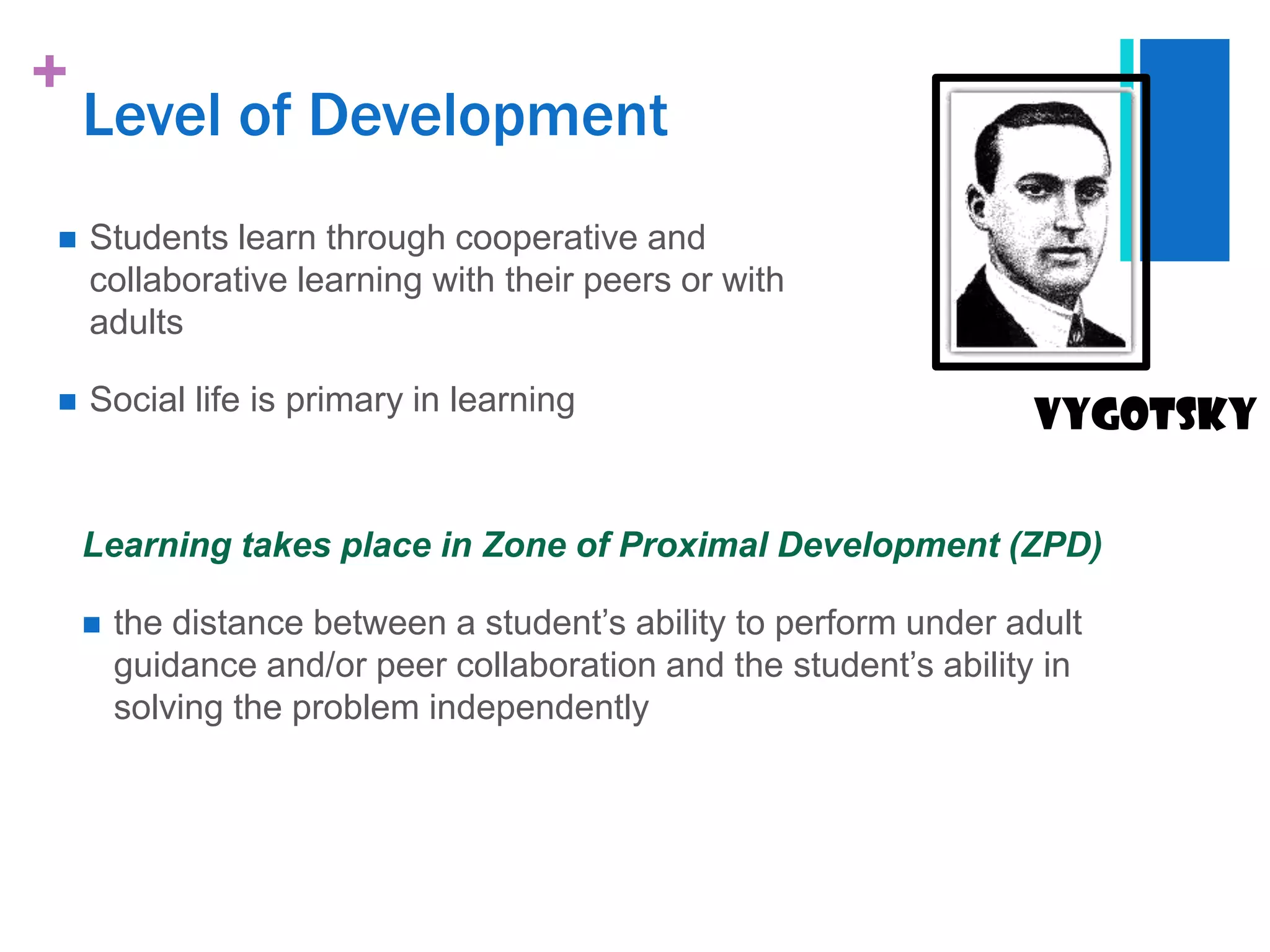
   Students learn through cooperative and
    collaborative learning with their peers or with
    adults

   Social life is primary in learning
                                                                   vygotsky


    Learning takes place in Zone of Proximal Development (ZPD)

       the distance between a student‟s ability to perform under adult
        guidance and/or peer collaboration and the student‟s ability in
        solving the problem independently
+


            ANALYSIS
    HOW STUDENTS LEARN
+
    How Students Learn
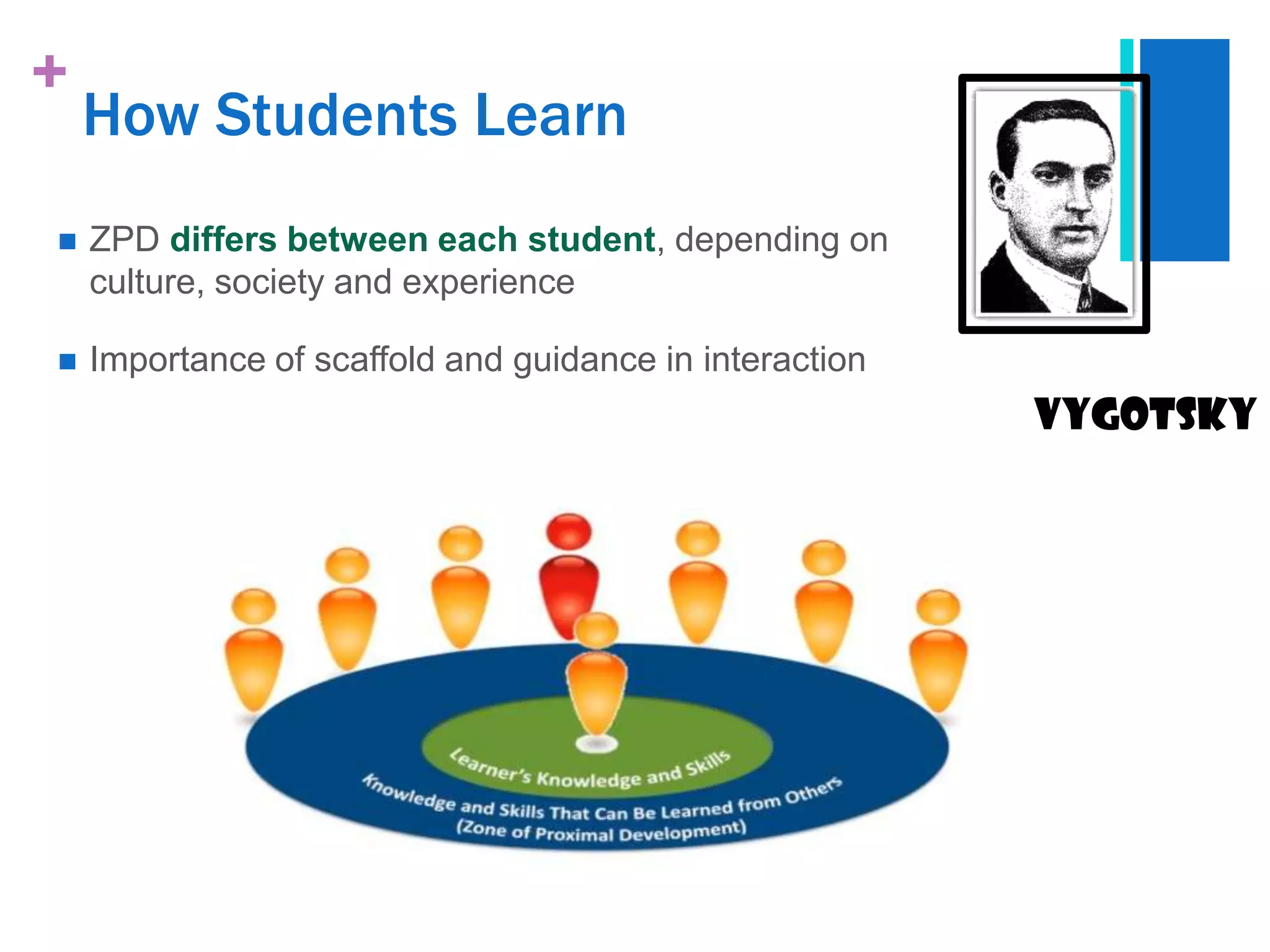
   ZPD differs between each student, depending on
    culture, society and experience

   Importance of scaffold and guidance in interaction
                                                         vygotsky
+ How Students Learn
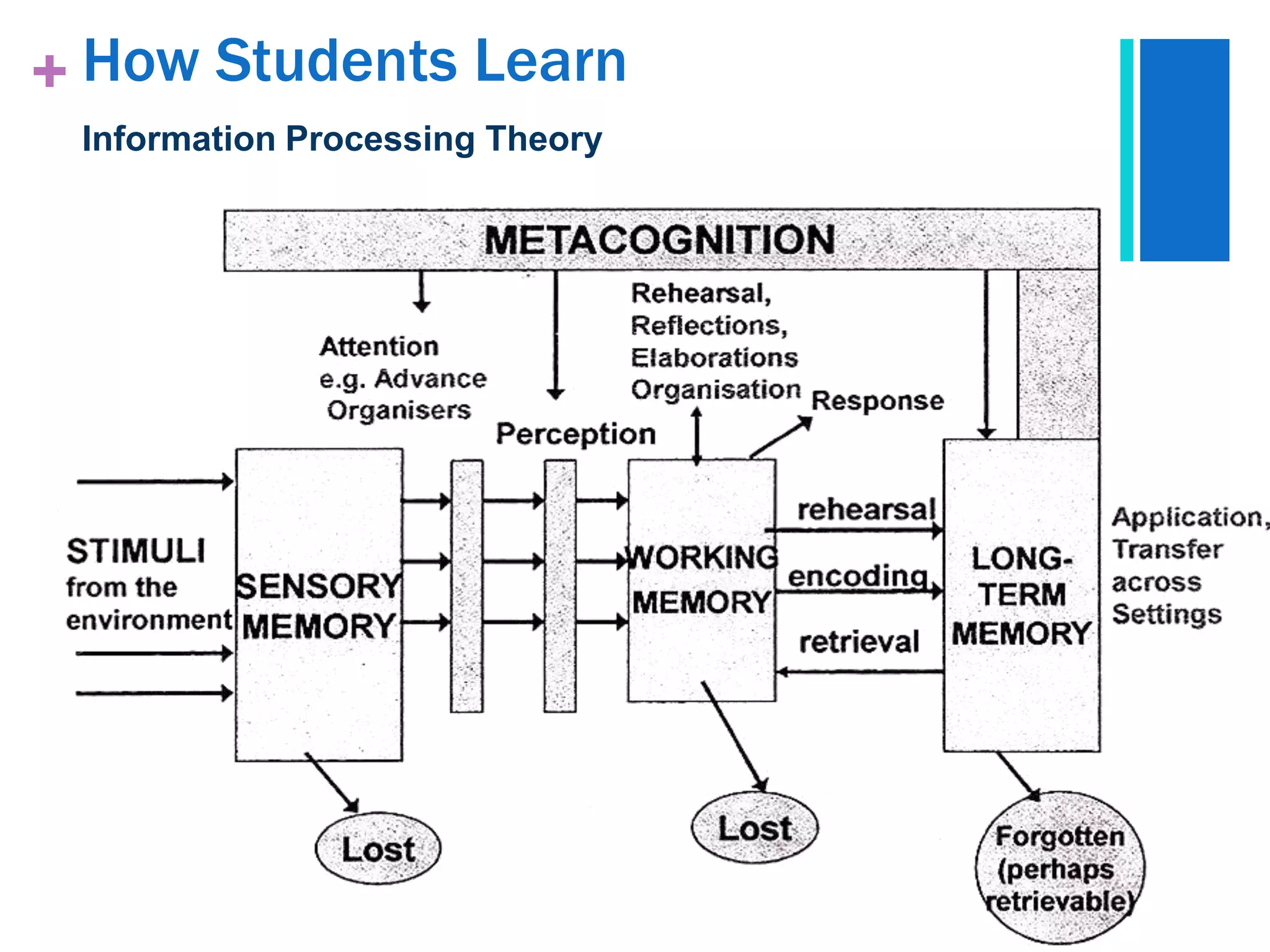
 Information Processing Theory
+ How Students Learn
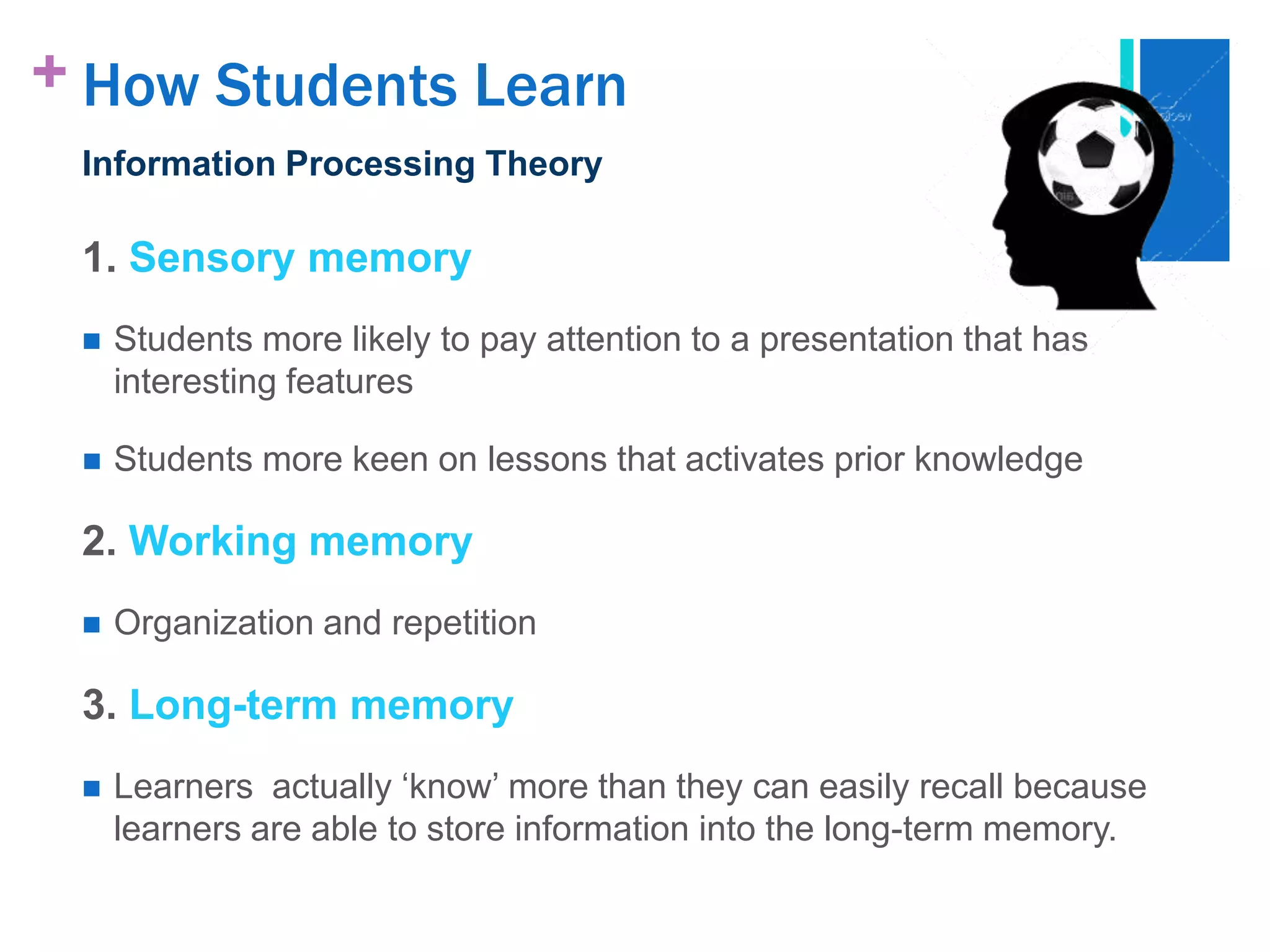
 Information Processing Theory

 1. Sensory memory
    Students more likely to pay attention to a presentation that has
     interesting features

    Students more keen on lessons that activates prior knowledge

 2. Working memory
    Organization and repetition

 3. Long-term memory
    Learners actually „know‟ more than they can easily recall because
     learners are able to store information into the long-term memory.
+
    How Students Learn

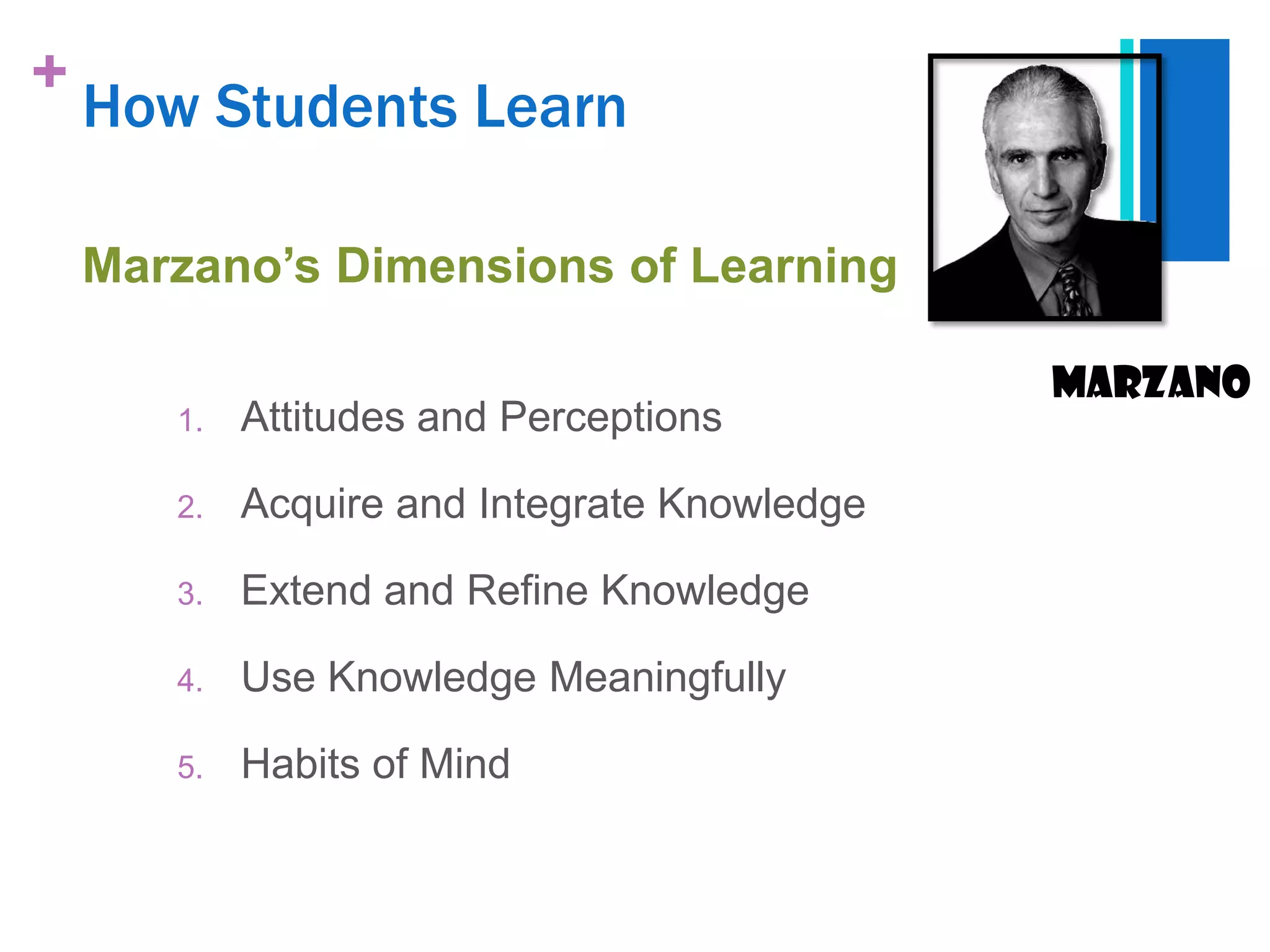
    Marzano’s Dimensions of Learning

                                              Marzano
       1.   Attitudes and Perceptions

       2.   Acquire and Integrate Knowledge

       3.   Extend and Refine Knowledge

       4.   Use Knowledge Meaningfully

       5.   Habits of Mind
+
    How Students Learn

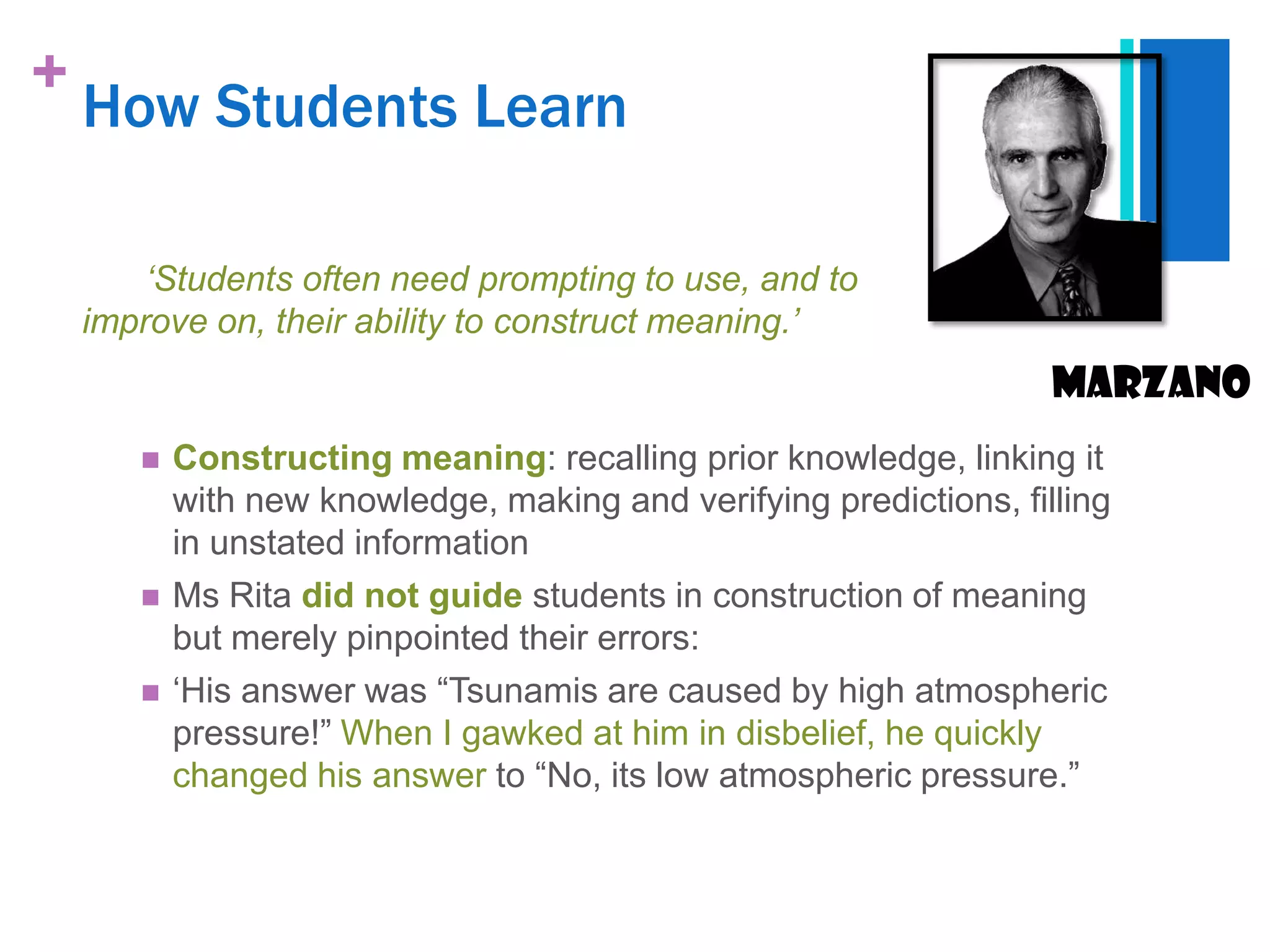
        „Students often need prompting to use, and to
    improve on, their ability to construct meaning.‟
                                                                    Marzano
          Constructing meaning: recalling prior knowledge, linking it
           with new knowledge, making and verifying predictions, filling
           in unstated information
          Ms Rita did not guide students in construction of meaning
           but merely pinpointed their errors:
          „His answer was “Tsunamis are caused by high atmospheric
           pressure!” When I gawked at him in disbelief, he quickly
           changed his answer to “No, its low atmospheric pressure.”
+
    How Students Learn
                                                         Marzano


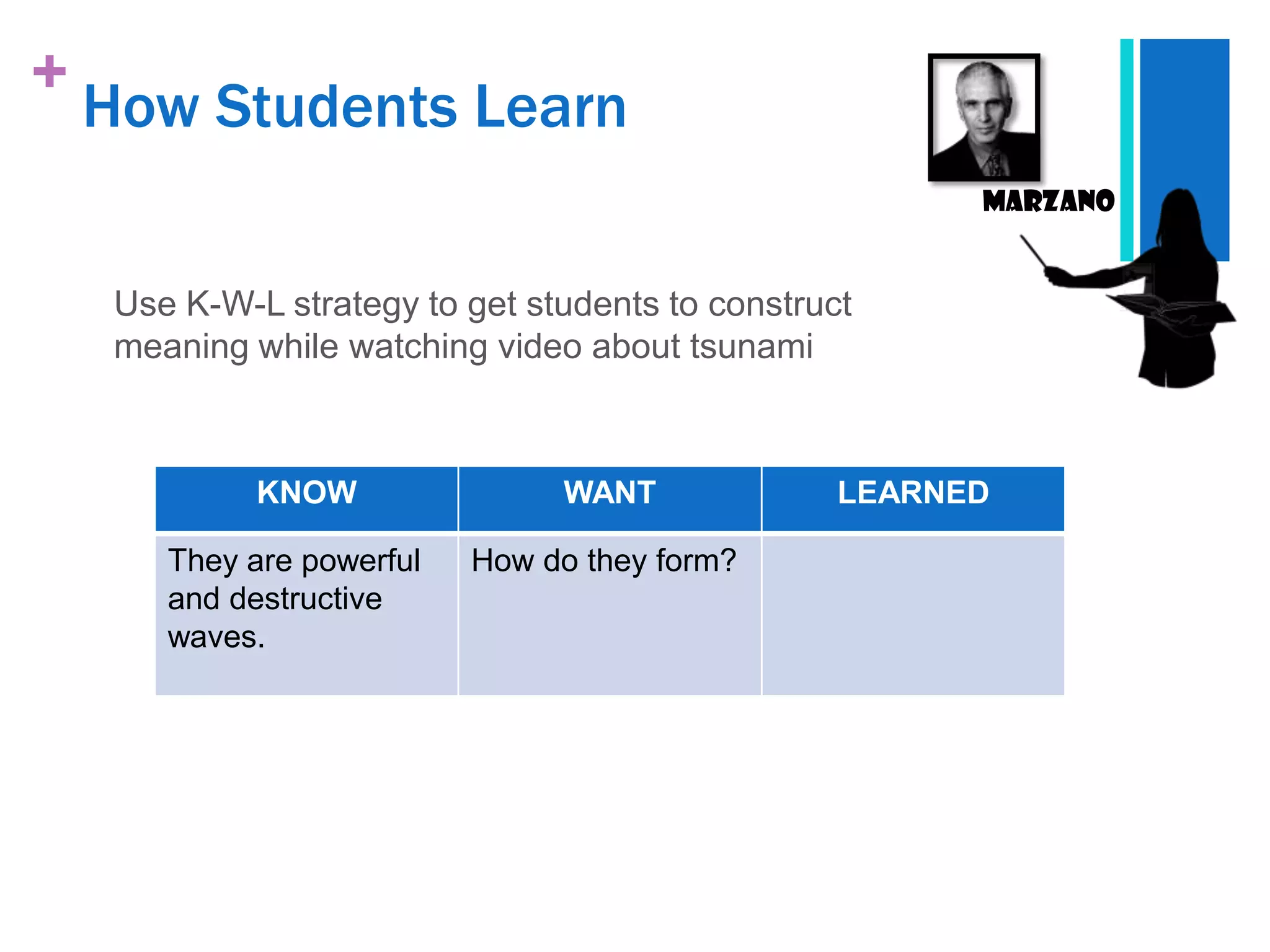
     Use K-W-L strategy to get students to construct
     meaning while watching video about tsunami


              KNOW               WANT              LEARNED

        They are powerful   How do they form?
        and destructive
        waves.
+


    THE PROPOSAL
+ The Proposal


    build upon the students' prior knowledge of tsunami and have them
     share with each other

    probe the students with basic knowledge questions before
     jumping into higher order questions.

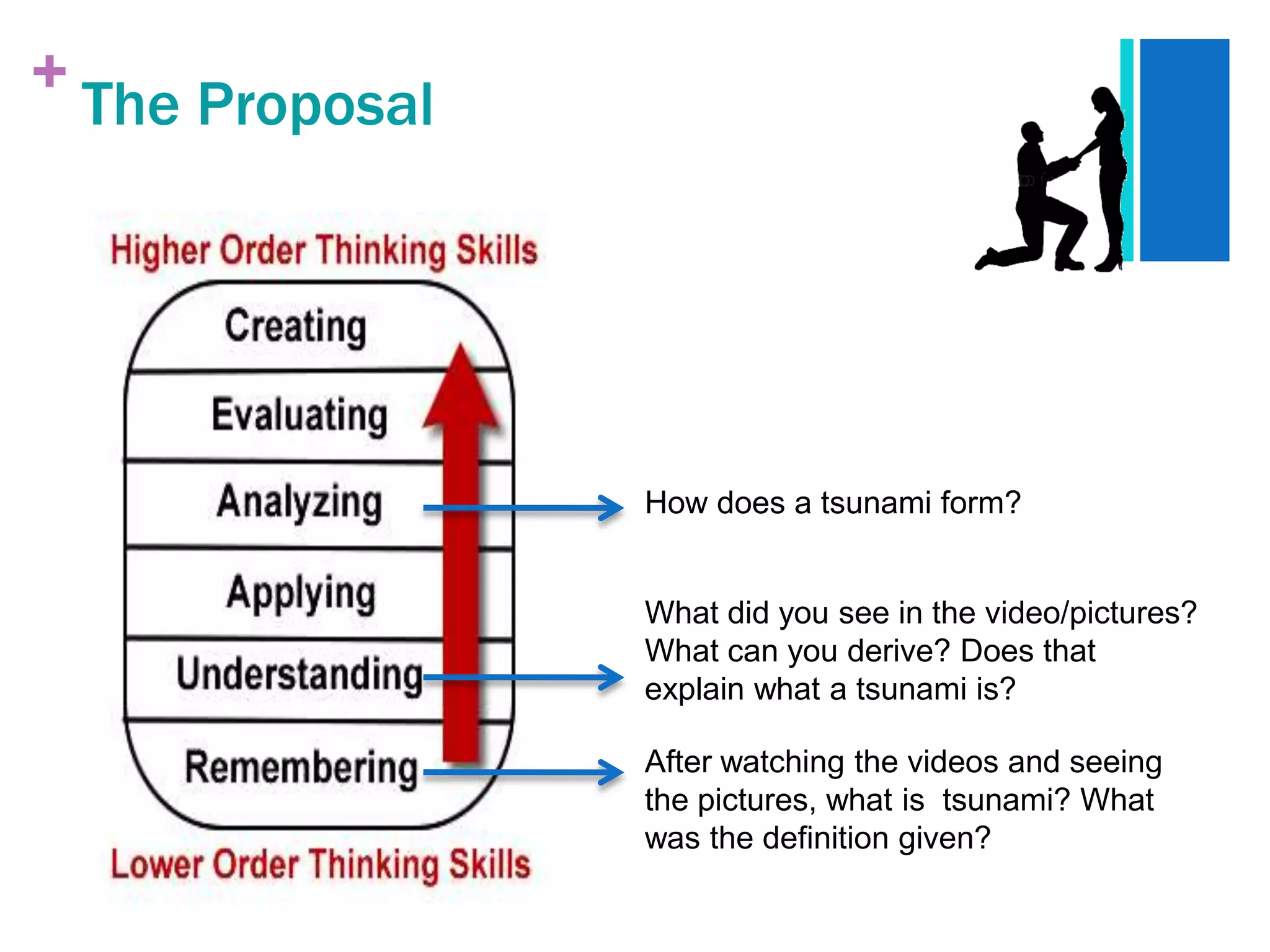
    Use Bloom’s Taxonomy to present the knowledge needed

    Question - “How does a tsunami form?” This would require students
     to comprehend what happens in a tsunami before they are able to
     answer how tsunamis are formed.
+ The Proposal


                 How does a tsunami form?


                 What did you see in the video/pictures?
                 What can you derive? Does that
                 explain what a tsunami is?

                 After watching the videos and seeing
                 the pictures, what is tsunami? What
                 was the definition given?
+ The Proposal


    Ms Rita should get students to think on what made them give the
     answers – right or wrong.

    understanding is more powerful than merely telling them that their
     answer is wrong

    through questioning in class and reasoning, other students could
     take note and learn from the mistakes made by their peers or even
     learn from the explanation of their peers,

    falling back to Vygotsky‟s theory - learners learn through social
     interaction since students are generally better able to internalize
     verbal communication.
+
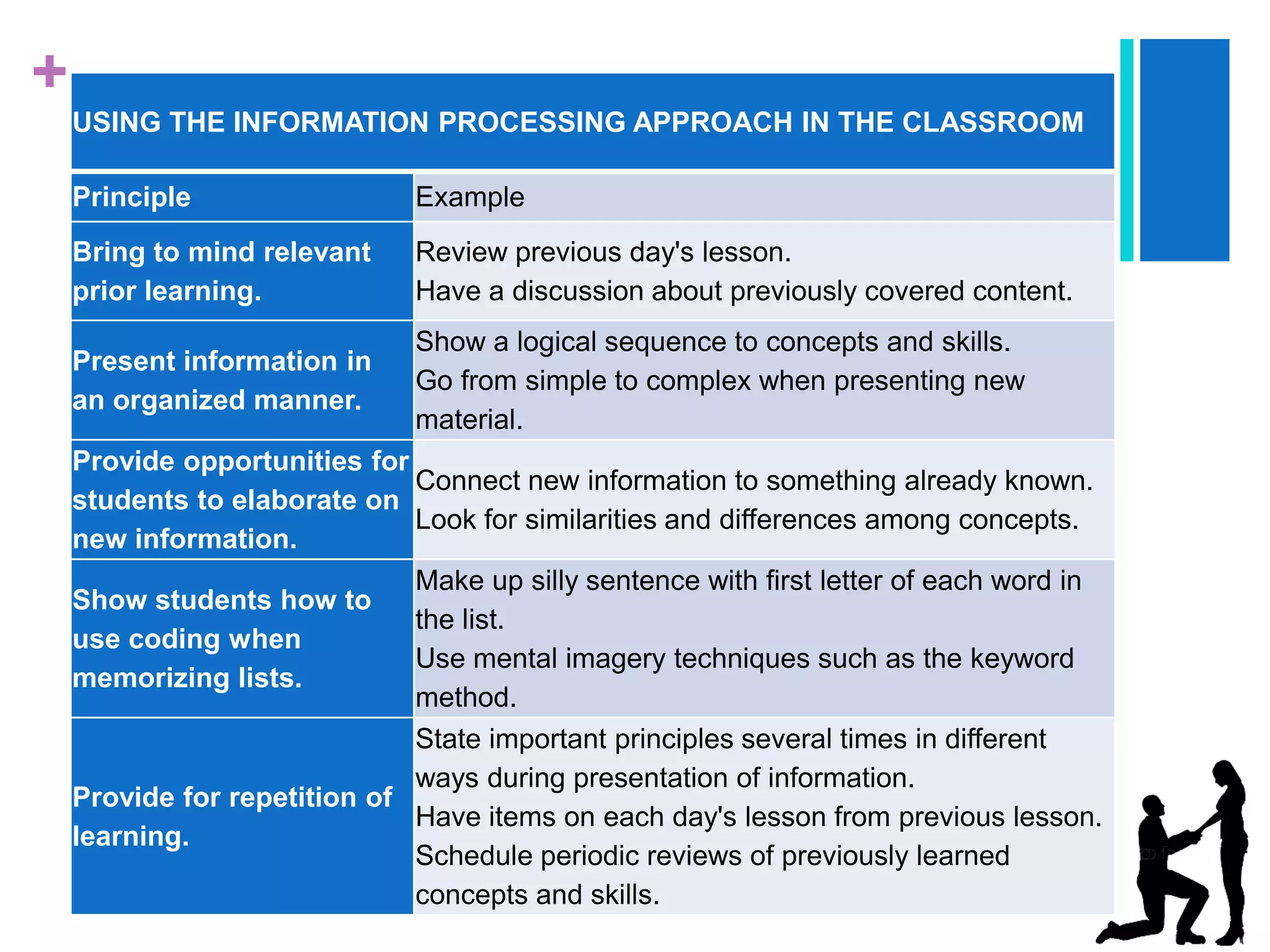
    USING THE INFORMATION PROCESSING APPROACH IN THE CLASSROOM

    Principle                  Example
    Bring to mind relevant     Review previous day's lesson.
    prior learning.            Have a discussion about previously covered content.
                               Show a logical sequence to concepts and skills.
    Present information in
                               Go from simple to complex when presenting new
    an organized manner.
                               material.
    Provide opportunities for
                              Connect new information to something already known.
    students to elaborate on
                              Look for similarities and differences among concepts.
    new information.
                              Make up silly sentence with first letter of each word in
    Show students how to
                              the list.
    use coding when
                              Use mental imagery techniques such as the keyword
    memorizing lists.
                              method.
                              State important principles several times in different
                              ways during presentation of information.
    Provide for repetition of
                              Have items on each day's lesson from previous lesson.
    learning.
                              Schedule periodic reviews of previously learned
                              concepts and skills.
+

PBL - Scenario 3

  • 1.
    + Yong Ping Aisha Shahirah Syarifah The Proposal for Ms Rita. An Ed-Psychological Case Study.
  • 2.
    How we aregoing to present our case Defining our Problem Meeting the Problem + Analysis of the Problem Level of Development How Students Learn Pedagogical Solutions proposed for Ms. Rita
  • 3.
    + The Scenario Miss Rita is in her 4th month of teaching after graduating from NIE. Despite her inexperience, she is enthusiastic in her lesson preparation on the topic of "tsunamis". She prepared loads of videos and pictures to show her class, and even got the help of Mr Yeo, who gave her higher-order level thinking questions. However, at the end of her lesson, she found herself being frustrated and disappointed with her class. Her colleagues helped by lending a listening ear.
  • 4.
    + Meeting the Problem We aim to…  Help Ms Rita to understand Sec 2 students'  level of cognitive development  learning process  Suggestions for Ms Rita to improve her teaching pedagogies
  • 5.
    + ANALYSIS LEVEL OF DEVELOPMENT
  • 6.
    + Level of Development Secondary 2 Students’ Level of Cognitive Development  Formal Operational Stage (aged 11 to Adult) Piaget  Formal thinking, as opposed to concrete operational thinking  Thinking of most high school students is still concrete operational.  Many students lack the concrete experiences which are required to think at the level of abstraction.  Teachers to realize this and provide these experiences for the students
  • 7.
    + Level of Development Application to our situation  Students are not able to relate to the concept  Ms Rita assumed sufficient prior knowledge Piaget  Ms Rita did not provide prerequisite knowledge  “Come on, Ms Lim, they are sec 2 students, these should be part of their general knowledge. You know, to my horror, some of them don‟t even know what a tsunami is! Haven‟t they heard of the 2004 tsunami catastrophe?”
  • 8.
    + Piaget Level of Development Piaget on Pedagogical Application  Teachers to be mindful of students’ developmental needs  Provide concrete experiences & help in linking  Social interaction; a powerful tool  Designing of learning experiences to bridge development Without necessary guidance, students are unable to learn effectively. Importance of engaging prior knowledge is emphasized.
  • 9.
    + Level of Development  assumes that learners are active in social contexts and interactions vygotsky  suggests that learners first construct knowledge in a social context and then internalize it individually
  • 10.
    + Level of Development  Students learn through cooperative and collaborative learning with their peers or with adults  Social life is primary in learning vygotsky Learning takes place in Zone of Proximal Development (ZPD)  the distance between a student‟s ability to perform under adult guidance and/or peer collaboration and the student‟s ability in solving the problem independently
  • 11.
    + ANALYSIS HOW STUDENTS LEARN
  • 12.
    + How Students Learn  ZPD differs between each student, depending on culture, society and experience  Importance of scaffold and guidance in interaction vygotsky
  • 13.
    + How StudentsLearn Information Processing Theory
  • 14.
    + How StudentsLearn Information Processing Theory 1. Sensory memory  Students more likely to pay attention to a presentation that has interesting features  Students more keen on lessons that activates prior knowledge 2. Working memory  Organization and repetition 3. Long-term memory  Learners actually „know‟ more than they can easily recall because learners are able to store information into the long-term memory.
  • 15.
    + How Students Learn Marzano’s Dimensions of Learning Marzano 1. Attitudes and Perceptions 2. Acquire and Integrate Knowledge 3. Extend and Refine Knowledge 4. Use Knowledge Meaningfully 5. Habits of Mind
  • 16.
    + How Students Learn „Students often need prompting to use, and to improve on, their ability to construct meaning.‟ Marzano  Constructing meaning: recalling prior knowledge, linking it with new knowledge, making and verifying predictions, filling in unstated information  Ms Rita did not guide students in construction of meaning but merely pinpointed their errors:  „His answer was “Tsunamis are caused by high atmospheric pressure!” When I gawked at him in disbelief, he quickly changed his answer to “No, its low atmospheric pressure.”
  • 17.
    + How Students Learn Marzano Use K-W-L strategy to get students to construct meaning while watching video about tsunami KNOW WANT LEARNED They are powerful How do they form? and destructive waves.
  • 18.
    + THE PROPOSAL
  • 19.
    + The Proposal  build upon the students' prior knowledge of tsunami and have them share with each other  probe the students with basic knowledge questions before jumping into higher order questions.  Use Bloom’s Taxonomy to present the knowledge needed  Question - “How does a tsunami form?” This would require students to comprehend what happens in a tsunami before they are able to answer how tsunamis are formed.
  • 20.
    + The Proposal How does a tsunami form? What did you see in the video/pictures? What can you derive? Does that explain what a tsunami is? After watching the videos and seeing the pictures, what is tsunami? What was the definition given?
  • 21.
    + The Proposal  Ms Rita should get students to think on what made them give the answers – right or wrong.  understanding is more powerful than merely telling them that their answer is wrong  through questioning in class and reasoning, other students could take note and learn from the mistakes made by their peers or even learn from the explanation of their peers,  falling back to Vygotsky‟s theory - learners learn through social interaction since students are generally better able to internalize verbal communication.
  • 22.
    + USING THE INFORMATION PROCESSING APPROACH IN THE CLASSROOM Principle Example Bring to mind relevant Review previous day's lesson. prior learning. Have a discussion about previously covered content. Show a logical sequence to concepts and skills. Present information in Go from simple to complex when presenting new an organized manner. material. Provide opportunities for Connect new information to something already known. students to elaborate on Look for similarities and differences among concepts. new information. Make up silly sentence with first letter of each word in Show students how to the list. use coding when Use mental imagery techniques such as the keyword memorizing lists. method. State important principles several times in different ways during presentation of information. Provide for repetition of Have items on each day's lesson from previous lesson. learning. Schedule periodic reviews of previously learned concepts and skills.
  • 23.