“ Peer-to-Peer Collaborative Learning Framework for Improving Learning Process in Engineering Education” Sabu M. Thampi LBSITW, Poojappura
Today, in several parts of India,  students, and (teachers) often struggle with the pace of the fast developing technology.  Though talented, they lack resources and exposure, and their skills are inadequate.  They are capable of producing excellent work but lack competent guidance.
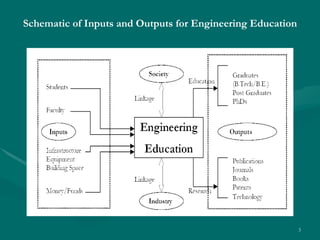
Schematic of Inputs and Outputs for Engineering Education
“ Tell me and I forget.  Show me and I remember.  Involve me and I understand . ” -Chinese proverb
Objectives of the Project The project aims to develop and deploy a Peer-to-Peer Network (P2P) to link Engineering Colleges in Kerala  To improve  collaborative learning .  To provide adequate resources To provide communication facilities  To provide effective guidance etc…
Present scenario -Rote learning   Learning involves the acquisition of knowledge. The teaching methods being followed in majority of educational institutions in India are very old and emphasis is laid on  passing examinations with high percentage.  The Education System is generally  marks-based .  The teacher provides the knowledge and shares it with the students.  Rote learning is a learning technique which  avoids understanding of a subject and instead focuses on memorization .  The major practice involved in rote learning is  learning by repetition . The idea is that one will be able to quickly recall the meaning of the material the more one repeats it.
Rote learning  hinders the student’s creativity  hampers the overall development of their personality.  the qualities of graduates coming out from the institutions are not up to the mark.  According to a report, only 25% of them are employable.  Serious research and development is concentrated in a few institutions.  This demands a great change in the teaching - learning process.
Collaborative Learning? The term “collaborative Learning” refers to an instruction method in which students at various performance levels  work together  in small groups toward a common goal.  Students are responsible for one another’s learning as well as their own. Thus, the  success of one student helps other students to be successful.   Collaborative learning activities can include collaborative writing,  group projects , and other activities.  Collaborative learning helps to understand complex concepts, increase problem-solving skills, enhance creativity, and help to develop positive attitude towards learning.
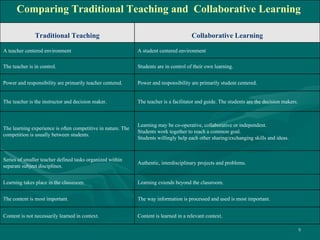
Content is learned in a relevant context.  Content is not necessarily learned in context.   The way information is processed and used is most important.  The content is most important. Learning extends beyond the classroom. Learning takes place in the classroom. Authentic, interdisciplinary projects and problems. Series of smaller teacher defined tasks organized within separate subject disciplines. Learning may be co-operative, collaborative or independent.  Students work together to reach a common goal.  Students willingly help each other sharing/exchanging skills and ideas.   The learning experience is often competitive in nature. The competition is usually between students.  The teacher is a facilitator and guide. The students are the decision makers. The teacher is the instructor and decision maker. Power and responsibility are primarily student centered. Power and responsibility are primarily teacher centered. Students are in control of their own learning. The teacher is in control. A student centered environment A teacher centered environment Collaborative Learning Traditional Teaching Comparing Traditional Teaching and  Collaborative Learning
Key Points  -  Collaborative learning Longer retention than traditional learning Students conduct their research independently and use group meetings to share information By working together we increase our knowledge and understanding of the world We develop skills by watching others, practicing and getting feedback on our efforts.
E-learning Institutions use their websites for updating information related to various courses, for giving assignments, and for conducting tests.  No in-person interaction takes place  – no group work. E-Learning lessons are generally designed to guide students through information or to help students perform in specific tasks.  The present e-learning techniques are almost website based and  eliminates peer-to-peer learning .
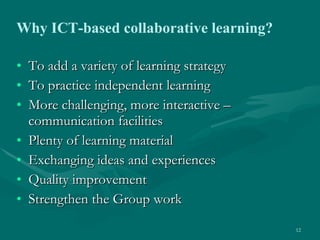
To add a variety of learning strategy To practice independent learning More challenging, more interactive – communication facilities Plenty of learning material  Exchanging ideas and experiences Quality improvement Strengthen the Group work Why ICT-based collaborative learning?
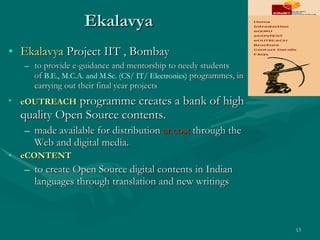
Ekalavya Ekalavya  Project IIT , Bombay to provide e-guidance and mentorship to needy students of  B.E., M.C.A. and M.Sc. (CS/ IT/ Electronics)  programmes, in carrying out their final year projects eOUTREACH  programme creates a bank of high quality Open Source contents.  made available for distribution  at cost  through the Web and digital media.  eCONTENT   to create Open Source digital contents in Indian languages through translation and new writings
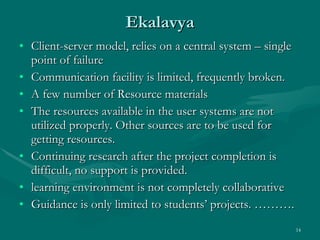
Ekalavya Client-server model, relies on a central system – single point of failure Communication facility is limited, frequently broken. A few number of Resource materials The resources available in the user systems are not utilized properly. Other sources are to be used for getting resources. Continuing research after the project completion is difficult, no support is provided. learning environment is not completely collaborative Guidance is only limited to students’ projects. ……….
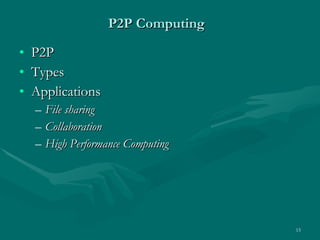
P2P Computing  P2P Types Applications File sharing Collaboration  High Performance Computing
Why P2P for Collaborative Learning? Unstructured, overlay network Supports thousands of nodes – random topology Costly additional hardware or software systems are not required for implementing P2P framework P2P Network does not relies on central systems Allows utilization of resources from all the user systems. Dynamic nature of nodes Provides effective utilization of ICT Students learn best when they are actively involved in the process.
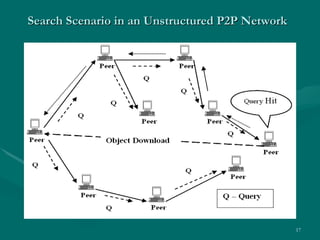
Search Scenario in an Unstructured P2P Network
Existing P2P Based Collaborative Systems Some specialized applications are  COMTELLA, and EDUTELLA.   The COMTELLA system was developed at the University of Saskatchewan to support graduate students in the laboratory to share research papers found on-line.  COMTELLA uses an extension of the Gnutella protocol, and is fully distributed.  Each user needs to download a client application called  servent , which allows sharing new papers with the community and searching for papers shared by oneself and by the other users.  EDUTELLA is a peer to peer network for searching semantic web metadata.  files, are not actually shared in the network rather than the information that describes what the data is about, i.e. the metadata.  The EDUTELLA Query Language (QEL) is primarily designed for exchange of queries.
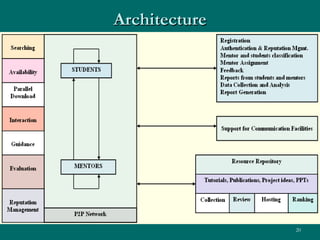
Proposed P2P Based Collaborative Learning System Browser based system, Java, windows and Linux Unstructured P2P  e-mail-cc to teachers, (chatting – copy to teachers) file sharing  Authentication, trust management, monitoring  data collection and analysis  classification of users  Exchanging learning materials / uploading and downloading materials  searching, replication  Online test, Quiz, Online assignments, problem selection  project guidance and monitoring…. Separate systems for hosting reports, publications, course notes etc, classification of resources, ranking of publications, copyright Registration – captcha, verification All the operations through an exclusive software installed in the participating peers (students, faculty, staff etc.)
Architecture
Benefits Learning process is more enjoyable  Learners: more independent and more responsible  Collaborative research  Increased degree of interaction, communication  Improvement in thinking and problem-solving skills  Ability to actively identify, formulate, and solve problems essential for a successful career  Students are not competing with each other; more likely to actively help each other learn  Collection of resource materials Proper authentication and reputation management Improvement of academic quality Publications
Details of equipment required   Desktops – 03 nos  Laptop -  01 no. Laser Printer – 01 no. Scanner – 01 no. Software 1 KVA UPS -01 no. Furniture
The Team Project Advisor Dr. Chandra Sekaran K Professor , Dept. of Computer Engineering National Institute of Technology Karnataka Surathkal, Karnataka E-mail: kch@nitk.ac.in Principal Coordinator   Sabu M. Thampi, Asst. Professor, CSED, LBSITW Co-investigators   Smt. Anitha Kumari. S, Asst. Professor, CSED, LBSITW Shri. Abdul Rahman M, Senior Lecturer, CSED, LBSITW Institution   L.B.S Institute of Technology for Women Poojappura, Trivandrum -12 Ph: 0471-2349232 Fax: 0471-2343395
Budget details Total: Rupees Ten Lakhs Sixteen Thousand and Four Hundred Only 10,16,400.00 2,27,700.00 2,15,600.00 5,73,100.00 92400.00 20700.00 19600.00 52100.00 6. Institutional over head (10%) 30000.00 10000.00 10000.00 10000.00 5. Contingencies 30000.00 10000.00 10000.00 10000.00 4. Travel 336000.00 6,000.00 5,000.00 3,25000.00 3. Equipment 60000.00 25,000.00 15,000.00 20,000.00 2. Consumables 360000.00 108000.00 1,20,000.00 36,000.00 1,20,000.00 36,000.00 1,20,000.00 36,000.00 1.Manpower Project fellow @Rs. 10,000/- PM  Technical assistant @ Rs 3000/- P.M Total (Rs.) 3 rd  Year 2 nd  Year 1 st  Year Item
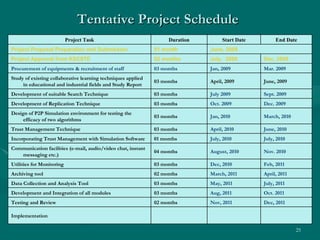
Tentative Project Schedule   Implementation Dec, 2011 Nov, 2011 02 months Testing and Review Oct. 2011 Aug, 2011 03 months Development and Integration of all modules July, 2011 May, 2011 03 months Data Collection and Analysis Tool April, 2011 March, 2011 02 months Archiving tool Feb, 2011 Dec, 2010 03 months Utilities for Monitoring  Nov. 2010 August, 2010 04 months Communication facilities (e-mail, audio/video chat, instant messaging etc.) July, 2010 July, 2010 01 months Incorporating Trust Management with Simulation Software June, 2010 April, 2010 03 months Trust Management Technique March, 2010 Jan, 2010 03 months Design of P2P Simulation environment for testing the efficacy of two algorithms Dec. 2009 Oct. 2009 03 months Development of Replication Technique Sept. 2009 July 2009 03 months Development of suitable Search Technique June, 2009 April, 2009 03 months Study of existing collaborative learning techniques applied in educational and industrial fields and Study Report Mar. 2009 Jan, 2009 03 months Procurement of equipments & recruitment of staff Dec, 2008 July,  2008  02 months Project Approval from KSCSTE June, 2008 01 month Project Proposal Preparation and Submission End Date Start Date Duration Project Task
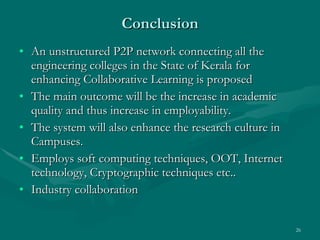
Conclusion An unstructured P2P network connecting all the engineering colleges in the State of Kerala for enhancing Collaborative Learning is proposed The main outcome will be the increase in academic quality and thus increase in employability.  The system will also enhance the research culture in Campuses.  Employs soft computing techniques, OOT, Internet technology, Cryptographic techniques etc.. Industry collaboration
Thank You

COLLABORATIVE LEARNING AND P2P NETWORKS

  • 1.
    “ Peer-to-Peer CollaborativeLearning Framework for Improving Learning Process in Engineering Education” Sabu M. Thampi LBSITW, Poojappura
  • 2.
    Today, in severalparts of India, students, and (teachers) often struggle with the pace of the fast developing technology. Though talented, they lack resources and exposure, and their skills are inadequate. They are capable of producing excellent work but lack competent guidance.
  • 3.
    Schematic of Inputsand Outputs for Engineering Education
  • 4.
    “ Tell meand I forget. Show me and I remember. Involve me and I understand . ” -Chinese proverb
  • 5.
    Objectives of theProject The project aims to develop and deploy a Peer-to-Peer Network (P2P) to link Engineering Colleges in Kerala To improve collaborative learning . To provide adequate resources To provide communication facilities To provide effective guidance etc…
  • 6.
    Present scenario -Rotelearning Learning involves the acquisition of knowledge. The teaching methods being followed in majority of educational institutions in India are very old and emphasis is laid on passing examinations with high percentage. The Education System is generally marks-based . The teacher provides the knowledge and shares it with the students. Rote learning is a learning technique which avoids understanding of a subject and instead focuses on memorization . The major practice involved in rote learning is learning by repetition . The idea is that one will be able to quickly recall the meaning of the material the more one repeats it.
  • 7.
    Rote learning hinders the student’s creativity hampers the overall development of their personality. the qualities of graduates coming out from the institutions are not up to the mark. According to a report, only 25% of them are employable. Serious research and development is concentrated in a few institutions. This demands a great change in the teaching - learning process.
  • 8.
    Collaborative Learning? Theterm “collaborative Learning” refers to an instruction method in which students at various performance levels work together in small groups toward a common goal. Students are responsible for one another’s learning as well as their own. Thus, the success of one student helps other students to be successful. Collaborative learning activities can include collaborative writing, group projects , and other activities. Collaborative learning helps to understand complex concepts, increase problem-solving skills, enhance creativity, and help to develop positive attitude towards learning.
  • 9.
    Content is learnedin a relevant context.  Content is not necessarily learned in context.   The way information is processed and used is most important.  The content is most important. Learning extends beyond the classroom. Learning takes place in the classroom. Authentic, interdisciplinary projects and problems. Series of smaller teacher defined tasks organized within separate subject disciplines. Learning may be co-operative, collaborative or independent. Students work together to reach a common goal. Students willingly help each other sharing/exchanging skills and ideas.  The learning experience is often competitive in nature. The competition is usually between students. The teacher is a facilitator and guide. The students are the decision makers. The teacher is the instructor and decision maker. Power and responsibility are primarily student centered. Power and responsibility are primarily teacher centered. Students are in control of their own learning. The teacher is in control. A student centered environment A teacher centered environment Collaborative Learning Traditional Teaching Comparing Traditional Teaching and  Collaborative Learning
  • 10.
    Key Points - Collaborative learning Longer retention than traditional learning Students conduct their research independently and use group meetings to share information By working together we increase our knowledge and understanding of the world We develop skills by watching others, practicing and getting feedback on our efforts.
  • 11.
    E-learning Institutions usetheir websites for updating information related to various courses, for giving assignments, and for conducting tests. No in-person interaction takes place – no group work. E-Learning lessons are generally designed to guide students through information or to help students perform in specific tasks. The present e-learning techniques are almost website based and eliminates peer-to-peer learning .
  • 12.
    To add avariety of learning strategy To practice independent learning More challenging, more interactive – communication facilities Plenty of learning material Exchanging ideas and experiences Quality improvement Strengthen the Group work Why ICT-based collaborative learning?
  • 13.
    Ekalavya Ekalavya Project IIT , Bombay to provide e-guidance and mentorship to needy students of  B.E., M.C.A. and M.Sc. (CS/ IT/ Electronics)  programmes, in carrying out their final year projects eOUTREACH  programme creates a bank of high quality Open Source contents. made available for distribution at cost through the Web and digital media. eCONTENT   to create Open Source digital contents in Indian languages through translation and new writings
  • 14.
    Ekalavya Client-server model,relies on a central system – single point of failure Communication facility is limited, frequently broken. A few number of Resource materials The resources available in the user systems are not utilized properly. Other sources are to be used for getting resources. Continuing research after the project completion is difficult, no support is provided. learning environment is not completely collaborative Guidance is only limited to students’ projects. ……….
  • 15.
    P2P Computing P2P Types Applications File sharing Collaboration High Performance Computing
  • 16.
    Why P2P forCollaborative Learning? Unstructured, overlay network Supports thousands of nodes – random topology Costly additional hardware or software systems are not required for implementing P2P framework P2P Network does not relies on central systems Allows utilization of resources from all the user systems. Dynamic nature of nodes Provides effective utilization of ICT Students learn best when they are actively involved in the process.
  • 17.
    Search Scenario inan Unstructured P2P Network
  • 18.
    Existing P2P BasedCollaborative Systems Some specialized applications are COMTELLA, and EDUTELLA. The COMTELLA system was developed at the University of Saskatchewan to support graduate students in the laboratory to share research papers found on-line. COMTELLA uses an extension of the Gnutella protocol, and is fully distributed. Each user needs to download a client application called servent , which allows sharing new papers with the community and searching for papers shared by oneself and by the other users. EDUTELLA is a peer to peer network for searching semantic web metadata. files, are not actually shared in the network rather than the information that describes what the data is about, i.e. the metadata. The EDUTELLA Query Language (QEL) is primarily designed for exchange of queries.
  • 19.
    Proposed P2P BasedCollaborative Learning System Browser based system, Java, windows and Linux Unstructured P2P e-mail-cc to teachers, (chatting – copy to teachers) file sharing Authentication, trust management, monitoring data collection and analysis classification of users Exchanging learning materials / uploading and downloading materials searching, replication Online test, Quiz, Online assignments, problem selection project guidance and monitoring…. Separate systems for hosting reports, publications, course notes etc, classification of resources, ranking of publications, copyright Registration – captcha, verification All the operations through an exclusive software installed in the participating peers (students, faculty, staff etc.)
  • 20.
  • 21.
    Benefits Learning processis more enjoyable Learners: more independent and more responsible Collaborative research Increased degree of interaction, communication Improvement in thinking and problem-solving skills Ability to actively identify, formulate, and solve problems essential for a successful career Students are not competing with each other; more likely to actively help each other learn Collection of resource materials Proper authentication and reputation management Improvement of academic quality Publications
  • 22.
    Details of equipmentrequired Desktops – 03 nos Laptop - 01 no. Laser Printer – 01 no. Scanner – 01 no. Software 1 KVA UPS -01 no. Furniture
  • 23.
    The Team ProjectAdvisor Dr. Chandra Sekaran K Professor , Dept. of Computer Engineering National Institute of Technology Karnataka Surathkal, Karnataka E-mail: kch@nitk.ac.in Principal Coordinator Sabu M. Thampi, Asst. Professor, CSED, LBSITW Co-investigators Smt. Anitha Kumari. S, Asst. Professor, CSED, LBSITW Shri. Abdul Rahman M, Senior Lecturer, CSED, LBSITW Institution L.B.S Institute of Technology for Women Poojappura, Trivandrum -12 Ph: 0471-2349232 Fax: 0471-2343395
  • 24.
    Budget details Total:Rupees Ten Lakhs Sixteen Thousand and Four Hundred Only 10,16,400.00 2,27,700.00 2,15,600.00 5,73,100.00 92400.00 20700.00 19600.00 52100.00 6. Institutional over head (10%) 30000.00 10000.00 10000.00 10000.00 5. Contingencies 30000.00 10000.00 10000.00 10000.00 4. Travel 336000.00 6,000.00 5,000.00 3,25000.00 3. Equipment 60000.00 25,000.00 15,000.00 20,000.00 2. Consumables 360000.00 108000.00 1,20,000.00 36,000.00 1,20,000.00 36,000.00 1,20,000.00 36,000.00 1.Manpower Project fellow @Rs. 10,000/- PM Technical assistant @ Rs 3000/- P.M Total (Rs.) 3 rd Year 2 nd Year 1 st Year Item
  • 25.
    Tentative Project Schedule Implementation Dec, 2011 Nov, 2011 02 months Testing and Review Oct. 2011 Aug, 2011 03 months Development and Integration of all modules July, 2011 May, 2011 03 months Data Collection and Analysis Tool April, 2011 March, 2011 02 months Archiving tool Feb, 2011 Dec, 2010 03 months Utilities for Monitoring Nov. 2010 August, 2010 04 months Communication facilities (e-mail, audio/video chat, instant messaging etc.) July, 2010 July, 2010 01 months Incorporating Trust Management with Simulation Software June, 2010 April, 2010 03 months Trust Management Technique March, 2010 Jan, 2010 03 months Design of P2P Simulation environment for testing the efficacy of two algorithms Dec. 2009 Oct. 2009 03 months Development of Replication Technique Sept. 2009 July 2009 03 months Development of suitable Search Technique June, 2009 April, 2009 03 months Study of existing collaborative learning techniques applied in educational and industrial fields and Study Report Mar. 2009 Jan, 2009 03 months Procurement of equipments & recruitment of staff Dec, 2008 July, 2008 02 months Project Approval from KSCSTE June, 2008 01 month Project Proposal Preparation and Submission End Date Start Date Duration Project Task
  • 26.
    Conclusion An unstructuredP2P network connecting all the engineering colleges in the State of Kerala for enhancing Collaborative Learning is proposed The main outcome will be the increase in academic quality and thus increase in employability. The system will also enhance the research culture in Campuses. Employs soft computing techniques, OOT, Internet technology, Cryptographic techniques etc.. Industry collaboration
  • 27.