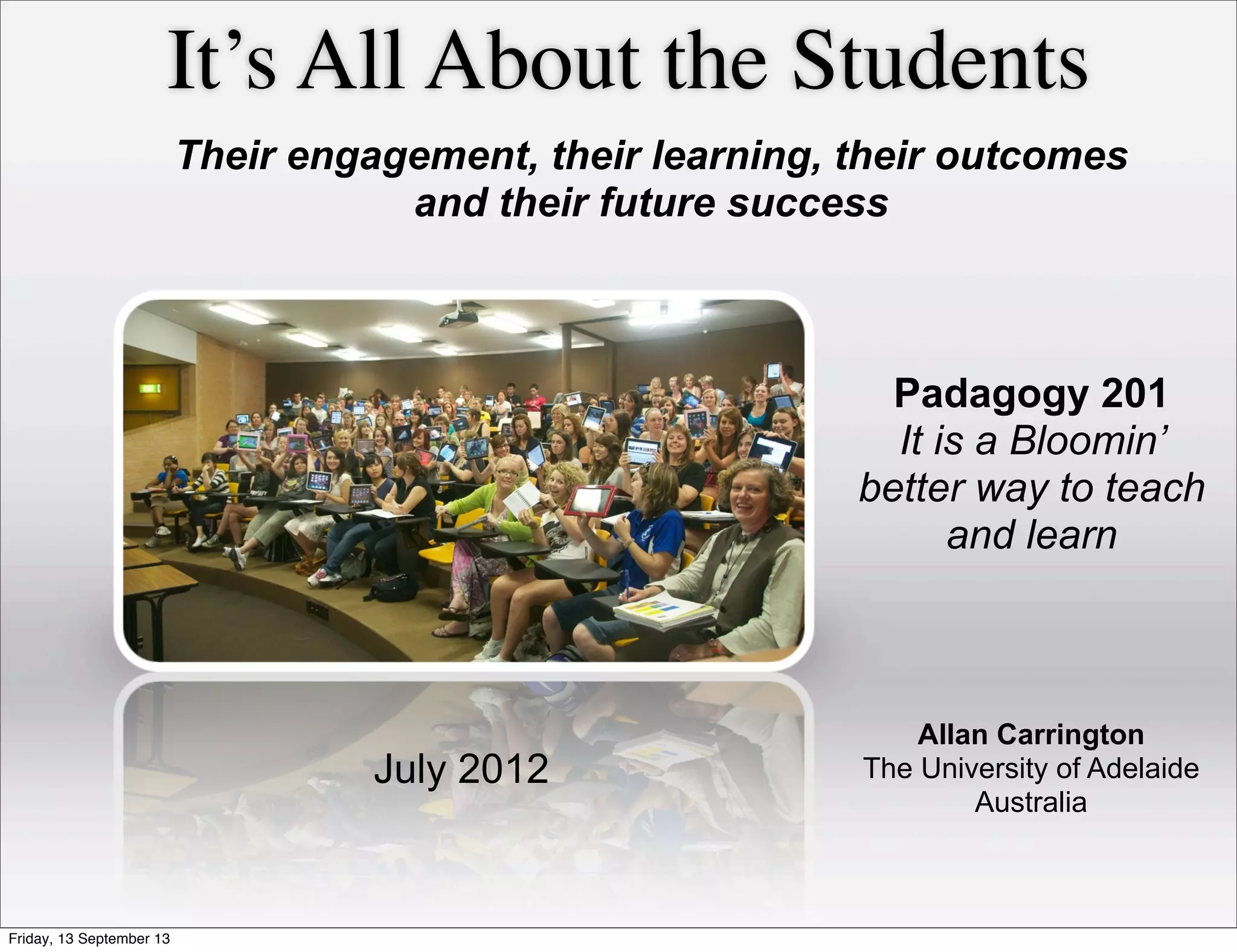
It’s All About the Students
Allan Carrington
The University of Adelaide
Australia
July 2012
Their engagement, their learning, their outcomes
and their future success
Padagogy 201
It is a Bloomin’
better way to teach
and learn
Friday, 13 September 13
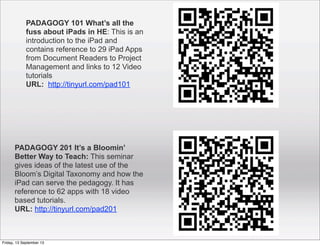
PADAGOGY 101 What’s all the
fuss about iPads in HE: This is an
introduction to the iPad and
contains reference to 29 iPad Apps
from Document Readers to Project
Management and links to 12 Video
tutorials
URL: http://tinyurl.com/pad101
PADAGOGY 201 It’s a Bloomin’
Better Way to Teach: This seminar
gives ideas of the latest use of the
Bloom’s Digital Taxonomy and how the
iPad can serve the pedagogy. It has
reference to 62 apps with 18 video
based tutorials.
URL: http://tinyurl.com/pad201
Friday, 13 September 13
Introducing Allan
University of Adelaide
CLPD Adelaide South Australia
Telephone: +61 402468777
Email: allan.carrington@adelaide.edu.au
• Learning Designer with the CLPD
• Two Masters Degrees - Education (online) &
Interactive Multimedia
• Apple Distinguished Educator: ADE class of 2009
• Winner 2011 Uni Adelaide Award for Excellence in
Support of the Student Experience
• Background in printing, publishing, web development
& educational multimedia
• Worked in corporate & VET sectors
• Travelled to 20+ countries & led schools in Hawaii,
Texas & Paraguay
• Taught communications, market research, print
production & using the internet for education
• Passion for online collaboration & facilitation
Friday, 13 September 13
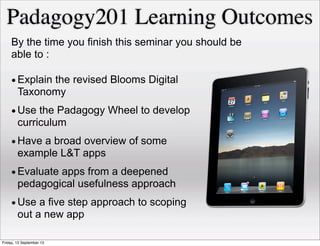
•Explain the revised Blooms Digital
Taxonomy
•Use the Padagogy Wheel to develop
curriculum
•Have a broad overview of some
example L&T apps
•Evaluate apps from a deepened
pedagogical usefulness approach
•Use a five step approach to scoping
out a new app
By the time you finish this seminar you should be
able to :
Padagogy201 Learning Outcomes
Friday, 13 September 13
ReflectionYour iPhone or iPad, on you MAC or PC
http://www.reflectionapp.com
Friday, 13 September 13
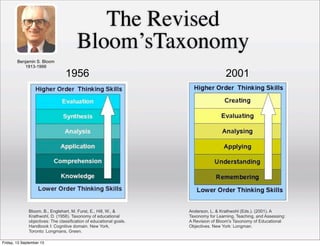
The Revised
Bloom’sTaxonomy
Bloom, B., Englehart, M. Furst, E., Hill, W., &
Krathwohl, D. (1956). Taxonomy of educational
objectives: The classification of educational goals.
Handbook I: Cognitive domain. New York,
Toronto: Longmans, Green.
Benjamin S. Bloom
1913-1999
1956 2001
Anderson, L. & Krathwohl (Eds.). (2001). A
Taxonomy for Learning, Teaching, and Assessing:
A Revision of Bloom's Taxonomy of Educational
Objectives. New York: Longman.
Friday, 13 September 13
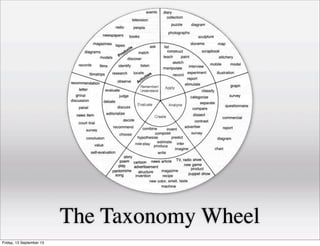
The Taxonomy Wheel
Friday, 13 September 13
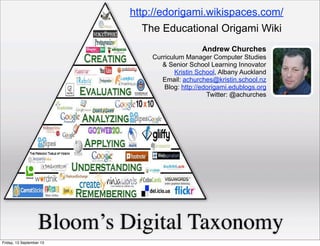
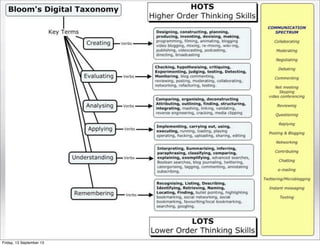
Bloom’s Digital Taxonomy
Andrew Churches
Curriculum Manager Computer Studies
& Senior School Learning Innovator
Kristin School, Albany Auckland
Email: achurches@kristin.school.nz
Blog: http://edorigami.edublogs.org
Twitter: @achurches
The Educational Origami Wiki
http://edorigami.wikispaces.com/
Friday, 13 September 13
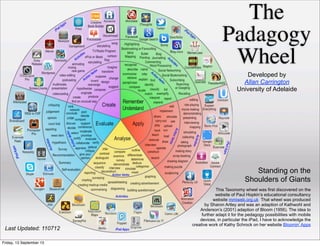
The
Padagogy
Wheel
This Taxonomy wheel was first discovered on the
website of Paul Hopkin’s educational consultancy
website mmiweb.org.uk That wheel was produced
by Sharon Artley and was an adaption of Kathwohl and
Anderson’s (2001) adaption of Bloom (1956). The idea to
further adapt it for the pedagogy possibilities with mobile
devices, in particular the iPad, I have to acknowledge the
creative work of Kathy Schrock on her website Bloomin’ Apps
Standing on the
Shoulders of Giants
Developed by
Allan Carrington
University of Adelaide
Last Updated: 110712
Friday, 13 September 13
Activities: Highlighting • Blog Journalling • Commenting • Social Networking • Social Bookmarking • Bullet Pointing •
Mind Mapping • Recalling • Bookmarking or Favouriting • Word Processing • Subscribing • Searching or Googling
Remembering: Retrieving,
recalling, or recognising
knowledge from memory.
Remembering is when memory
is used to produce definitions,
facts, or lists, or recite or retrieve
material.
Understanding: Constructing
meaning from different types of
functions be they written or
graphic messages
Remember and Understand
Anderson and Krathwohl’s
Taxonomy 2000
50 secs
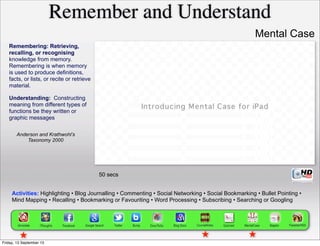
Mental Case
Friday, 13 September 13
Activities: Highlighting • Blog Journalling • Commenting • Social Networking • Social Bookmarking • Bullet Pointing •
Mind Mapping • Recalling • Bookmarking or Favouriting • Word Processing • Subscribing • Searching or Googling
Remembering: Retrieving,
recalling, or recognising
knowledge from memory.
Remembering is when memory
is used to produce definitions,
facts, or lists, or recite or retrieve
material.
Remember and Understand
Anderson and Krathwohl’s
Taxonomy 2000
2.43 mins
Understanding: Constructing
meaning from different types of
functions be they written or
graphic messages
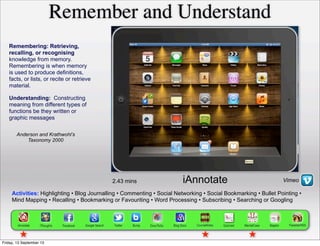
VimeoiAnnotate
Friday, 13 September 13
Activities: Highlighting • Blog Journalling • Commenting • Social Networking • Social Bookmarking • Bullet Pointing •
Mind Mapping • Recalling • Bookmarking or Favouriting • Word Processing • Subscribing • Searching or Googling
Remembering: Retrieving,
recalling, or recognising
knowledge from memory.
Remembering is when memory
is used to produce definitions,
facts, or lists, or recite or retrieve
material.
Remember and Understand
Anderson and Krathwohl’s
Taxonomy 2000
2.13 mins
Understanding: Constructing
meaning from different types of
functions be they written or
graphic messages
Vimeo
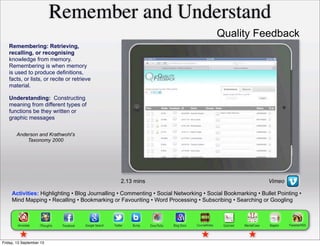
Quality Feedback
Friday, 13 September 13
Remembering: Retrieving,
recalling, or recognising
knowledge from memory.
Remembering is when memory
is used to produce definitions,
facts, or lists, or recite or retrieve
material.
Remember and Understand
Anderson and Krathwohl’s
Taxonomy 2000
1.56 mins
Understanding: Constructing
meaning from different types of
functions be they written or
graphic messages
Activities: Highlighting • Blog Journalling • Commenting • Social Networking • Social Bookmarking • Bullet Pointing •
Mind Mapping • Recalling • Bookmarking or Favouriting • Word Processing • Subscribing • Searching or Googling
Friday, 13 September 13
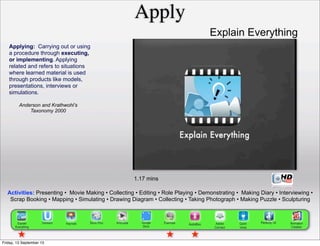
Apply
Anderson and Krathwohl’s
Taxonomy 2000
1.17 mins
Applying: Carrying out or using
a procedure through executing,
or implementing. Applying
related and refers to situations
where learned material is used
through products like models,
presentations, interviews or
simulations.
Activities: Presenting • Movie Making • Collecting • Editing • Role Playing • Demonstrating • Making Diary • Interviewing •
Scrap Booking • Mapping • Simulating • Drawing Diagram • Collecting • Taking Photograph • Making Puzzle • Sculpturing
Explain Everything
Friday, 13 September 13
Apply
Anderson and Krathwohl’s
Taxonomy 2000
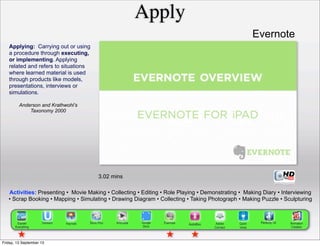
3.02 mins
Applying: Carrying out or using
a procedure through executing,
or implementing. Applying
related and refers to situations
where learned material is used
through products like models,
presentations, interviews or
simulations.
Activities: Presenting • Movie Making • Collecting • Editing • Role Playing • Demonstrating • Making Diary • Interviewing
• Scrap Booking • Mapping • Simulating • Drawing Diagram • Collecting • Taking Photograph • Making Puzzle • Sculpturing
Evernote
Friday, 13 September 13
Apply
Anderson and Krathwohl’s
Taxonomy 2000
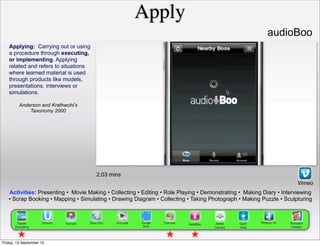
2.03 mins
Applying: Carrying out or using
a procedure through executing,
or implementing. Applying
related and refers to situations
where learned material is used
through products like models,
presentations, interviews or
simulations.
Activities: Presenting • Movie Making • Collecting • Editing • Role Playing • Demonstrating • Making Diary • Interviewing
• Scrap Booking • Mapping • Simulating • Drawing Diagram • Collecting • Taking Photograph • Making Puzzle • Sculpturing
Vimeo
audioBoo
Friday, 13 September 13
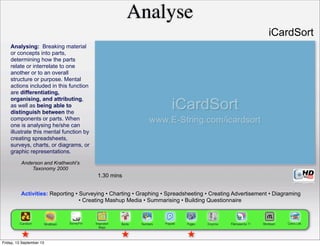
Analyse
Anderson and Krathwohl’s
Taxonomy 2000
1.30 mins
Analysing: Breaking material
or concepts into parts,
determining how the parts
relate or interrelate to one
another or to an overall
structure or purpose. Mental
actions included in this function
are differentiating,
organising, and attributing,
as well as being able to
distinguish between the
components or parts. When
one is analysing he/she can
illustrate this mental function by
creating spreadsheets,
surveys, charts, or diagrams, or
graphic representations.
Activities: Reporting • Surveying • Charting • Graphing • Spreadsheeting • Creating Advertisement • Diagraming
• Creating Mashup Media • Summarising • Building Questionnaire
iCardSort
Friday, 13 September 13
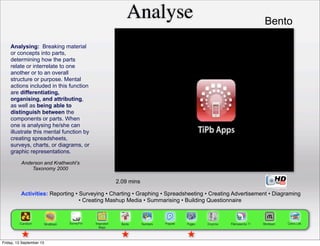
Analyse
Anderson and Krathwohl’s
Taxonomy 2000
Analysing: Breaking material
or concepts into parts,
determining how the parts
relate or interrelate to one
another or to an overall
structure or purpose. Mental
actions included in this function
are differentiating,
organising, and attributing,
as well as being able to
distinguish between the
components or parts. When
one is analysing he/she can
illustrate this mental function by
creating spreadsheets,
surveys, charts, or diagrams, or
graphic representations.
Activities: Reporting • Surveying • Charting • Graphing • Spreadsheeting • Creating Advertisement • Diagraming
• Creating Mashup Media • Summarising • Building Questionnaire
2.09 mins
Bento
Friday, 13 September 13
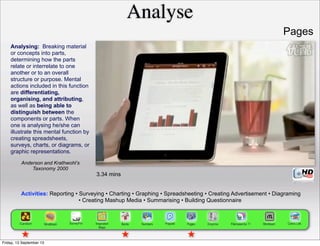
Analyse
Anderson and Krathwohl’s
Taxonomy 2000
Analysing: Breaking material
or concepts into parts,
determining how the parts
relate or interrelate to one
another or to an overall
structure or purpose. Mental
actions included in this function
are differentiating,
organising, and attributing,
as well as being able to
distinguish between the
components or parts. When
one is analysing he/she can
illustrate this mental function by
creating spreadsheets,
surveys, charts, or diagrams, or
graphic representations.
3.34 mins
Pages
Activities: Reporting • Surveying • Charting • Graphing • Spreadsheeting • Creating Advertisement • Diagraming
• Creating Mashup Media • Summarising • Building Questionnaire
Friday, 13 September 13
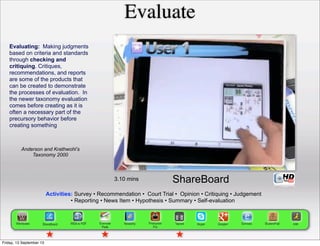
Evaluate
Anderson and Krathwohl’s
Taxonomy 2000
3.10 mins
Evaluating: Making judgments
based on criteria and standards
through checking and
critiquing. Critiques,
recommendations, and reports
are some of the products that
can be created to demonstrate
the processes of evaluation. In
the newer taxonomy evaluation
comes before creating as it is
often a necessary part of the
precursory behavior before
creating something
Activities: Survey • Recommendation • Court Trial • Opinion • Critiquing • Judgement
• Reporting • News Item • Hypothesis • Summary • Self-evaluation
ShareBoard
Friday, 13 September 13
Evaluate
Anderson and Krathwohl’s
Taxonomy 2000
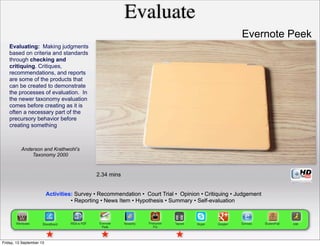
2.34 mins
Evaluating: Making judgments
based on criteria and standards
through checking and
critiquing. Critiques,
recommendations, and reports
are some of the products that
can be created to demonstrate
the processes of evaluation. In
the newer taxonomy evaluation
comes before creating as it is
often a necessary part of the
precursory behavior before
creating something
Activities: Survey • Recommendation • Court Trial • Opinion • Critiquing • Judgement
• Reporting • News Item • Hypothesis • Summary • Self-evaluation
Evernote Peek
Activities: Survey • Recommendation • Court Trial • Opinion • Critiquing • Judgement
• Reporting • News Item • Hypothesis • Summary • Self-evaluation
Friday, 13 September 13
Evaluate
Anderson and Krathwohl’s
Taxonomy 2000
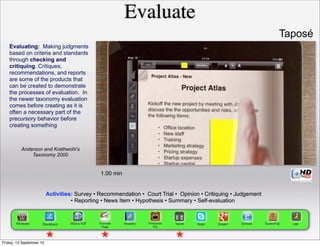
1.00 min
Evaluating: Making judgments
based on criteria and standards
through checking and
critiquing. Critiques,
recommendations, and reports
are some of the products that
can be created to demonstrate
the processes of evaluation. In
the newer taxonomy evaluation
comes before creating as it is
often a necessary part of the
precursory behavior before
creating something
Activities: Survey • Recommendation • Court Trial • Opinion • Critiquing • Judgement
• Reporting • News Item • Hypothesis • Summary • Self-evaluation
Taposé
Activities: Survey • Recommendation • Court Trial • Opinion • Critiquing • Judgement
• Reporting • News Item • Hypothesis • Summary • Self-evaluation
Friday, 13 September 13
Create
Anderson and Krathwohl’s
Taxonomy 2000
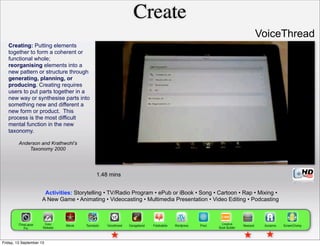
1.48 mins
Activities: Storytelling • TV/Radio Program • ePub or iBook • Song • Cartoon • Rap • Mixing •
A New Game • Animating • Videocasting • Multimedia Presentation • Video Editing • Podcasting
Creating: Putting elements
together to form a coherent or
functional whole;
reorganising elements into a
new pattern or structure through
generating, planning, or
producing. Creating requires
users to put parts together in a
new way or synthesise parts into
something new and different a
new form or product. This
process is the most difficult
mental function in the new
taxonomy.
VoiceThread
Friday, 13 September 13
Create
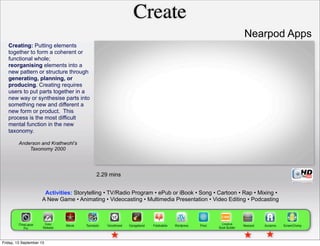
2.29 mins
Activities: Storytelling • TV/Radio Program • ePub or iBook • Song • Cartoon • Rap • Mixing •
A New Game • Animating • Videocasting • Multimedia Presentation • Video Editing • Podcasting
Anderson and Krathwohl’s
Taxonomy 2000
Creating: Putting elements
together to form a coherent or
functional whole;
reorganising elements into a
new pattern or structure through
generating, planning, or
producing. Creating requires
users to put parts together in a
new way or synthesise parts into
something new and different a
new form or product. This
process is the most difficult
mental function in the new
taxonomy.
Nearpod Apps
Friday, 13 September 13
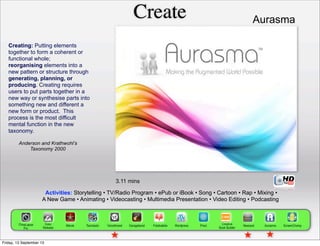
Create
3.11 mins
Activities: Storytelling • TV/Radio Program • ePub or iBook • Song • Cartoon • Rap • Mixing •
A New Game • Animating • Videocasting • Multimedia Presentation • Video Editing • Podcasting
Anderson and Krathwohl’s
Taxonomy 2000
Creating: Putting elements
together to form a coherent or
functional whole;
reorganising elements into a
new pattern or structure through
generating, planning, or
producing. Creating requires
users to put parts together in a
new way or synthesise parts into
something new and different a
new form or product. This
process is the most difficult
mental function in the new
taxonomy.
Aurasma
Activities: Storytelling • TV/Radio Program • ePub or iBook • Song • Cartoon • Rap • Mixing •
A New Game • Animating • Videocasting • Multimedia Presentation • Video Editing • Podcasting
Friday, 13 September 13
The Great Race
Frederick Chew
Learning Designer
University of Adelaide
Roseworthy Campus
School of Veterinary Science O week student activity to
get to know the campus and each other
The “race” was actually a way to get the
students to learn their way around the campus
on their own. We created a digital tour by
using apps that we had them download onto
their iPads. The students were in groups of 5
and worked together to solve clues to get them
to all of the race sites. Many of the sites
had tasks they had to perform or questions
they had to answer. We had them tweet their
answers along the way on an open channel.
Another objective was to get them comfortable
using their iPads. All new 1st year students in
the Faculty of Science receive iPads and some
instructors incorporate their use into
the classroom.
The last objective was to get students to meet
other students and to get them to work together
toward a goal. To encourage participation we
gave out prizes for the team with the most
correct clues and the team with the most
creative team picture.
Friday, 13 September 13
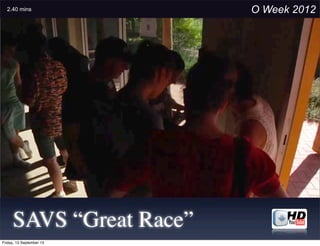
SAVS “Great Race”
O Week 20122.40 mins
Friday, 13 September 13
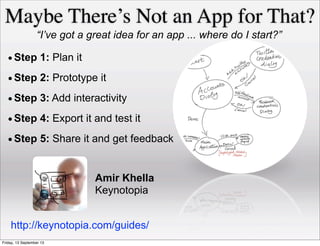
Maybe There’s Not an App for That?
“I’ve got a great idea for an app ... where do I start?”
•Step 1: Plan it
•Step 2: Prototype it
•Step 3: Add interactivity
•Step 4: Export it and test it
•Step 5: Share it and get feedback
Amir Khella
Keynotopia
http://keynotopia.com/guides/
Friday, 13 September 13
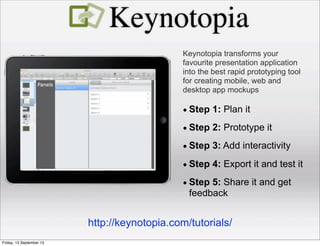
Keynotopia
Keynotopia transforms your
favourite presentation application
into the best rapid prototyping tool
for creating mobile, web and
desktop app mockups
http://keynotopia.com/tutorials/
• Step 1: Plan it
• Step 2: Prototype it
• Step 3: Add interactivity
• Step 4: Export it and test it
• Step 5: Share it and get
feedback
Friday, 13 September 13

Padagogy201 Seminar

  • 1.
    It’s All Aboutthe Students Allan Carrington The University of Adelaide Australia July 2012 Their engagement, their learning, their outcomes and their future success Padagogy 201 It is a Bloomin’ better way to teach and learn Friday, 13 September 13
  • 2.
    PADAGOGY 101 What’sall the fuss about iPads in HE: This is an introduction to the iPad and contains reference to 29 iPad Apps from Document Readers to Project Management and links to 12 Video tutorials URL: http://tinyurl.com/pad101 PADAGOGY 201 It’s a Bloomin’ Better Way to Teach: This seminar gives ideas of the latest use of the Bloom’s Digital Taxonomy and how the iPad can serve the pedagogy. It has reference to 62 apps with 18 video based tutorials. URL: http://tinyurl.com/pad201 Friday, 13 September 13
  • 3.
    Introducing Allan University ofAdelaide CLPD Adelaide South Australia Telephone: +61 402468777 Email: allan.carrington@adelaide.edu.au • Learning Designer with the CLPD • Two Masters Degrees - Education (online) & Interactive Multimedia • Apple Distinguished Educator: ADE class of 2009 • Winner 2011 Uni Adelaide Award for Excellence in Support of the Student Experience • Background in printing, publishing, web development & educational multimedia • Worked in corporate & VET sectors • Travelled to 20+ countries & led schools in Hawaii, Texas & Paraguay • Taught communications, market research, print production & using the internet for education • Passion for online collaboration & facilitation Friday, 13 September 13
  • 4.
    •Explain the revisedBlooms Digital Taxonomy •Use the Padagogy Wheel to develop curriculum •Have a broad overview of some example L&T apps •Evaluate apps from a deepened pedagogical usefulness approach •Use a five step approach to scoping out a new app By the time you finish this seminar you should be able to : Padagogy201 Learning Outcomes Friday, 13 September 13
  • 5.
    ReflectionYour iPhone oriPad, on you MAC or PC http://www.reflectionapp.com Friday, 13 September 13
  • 6.
    The Revised Bloom’sTaxonomy Bloom, B.,Englehart, M. Furst, E., Hill, W., & Krathwohl, D. (1956). Taxonomy of educational objectives: The classification of educational goals. Handbook I: Cognitive domain. New York, Toronto: Longmans, Green. Benjamin S. Bloom 1913-1999 1956 2001 Anderson, L. & Krathwohl (Eds.). (2001). A Taxonomy for Learning, Teaching, and Assessing: A Revision of Bloom's Taxonomy of Educational Objectives. New York: Longman. Friday, 13 September 13
  • 7.
  • 8.
    Bloom’s Digital Taxonomy AndrewChurches Curriculum Manager Computer Studies & Senior School Learning Innovator Kristin School, Albany Auckland Email: achurches@kristin.school.nz Blog: http://edorigami.edublogs.org Twitter: @achurches The Educational Origami Wiki http://edorigami.wikispaces.com/ Friday, 13 September 13
  • 9.
  • 10.
    The Padagogy Wheel This Taxonomy wheelwas first discovered on the website of Paul Hopkin’s educational consultancy website mmiweb.org.uk That wheel was produced by Sharon Artley and was an adaption of Kathwohl and Anderson’s (2001) adaption of Bloom (1956). The idea to further adapt it for the pedagogy possibilities with mobile devices, in particular the iPad, I have to acknowledge the creative work of Kathy Schrock on her website Bloomin’ Apps Standing on the Shoulders of Giants Developed by Allan Carrington University of Adelaide Last Updated: 110712 Friday, 13 September 13
  • 11.
    Activities: Highlighting •Blog Journalling • Commenting • Social Networking • Social Bookmarking • Bullet Pointing • Mind Mapping • Recalling • Bookmarking or Favouriting • Word Processing • Subscribing • Searching or Googling Remembering: Retrieving, recalling, or recognising knowledge from memory. Remembering is when memory is used to produce definitions, facts, or lists, or recite or retrieve material. Understanding: Constructing meaning from different types of functions be they written or graphic messages Remember and Understand Anderson and Krathwohl’s Taxonomy 2000 50 secs Mental Case Friday, 13 September 13
  • 12.
    Activities: Highlighting •Blog Journalling • Commenting • Social Networking • Social Bookmarking • Bullet Pointing • Mind Mapping • Recalling • Bookmarking or Favouriting • Word Processing • Subscribing • Searching or Googling Remembering: Retrieving, recalling, or recognising knowledge from memory. Remembering is when memory is used to produce definitions, facts, or lists, or recite or retrieve material. Remember and Understand Anderson and Krathwohl’s Taxonomy 2000 2.43 mins Understanding: Constructing meaning from different types of functions be they written or graphic messages VimeoiAnnotate Friday, 13 September 13
  • 13.
    Activities: Highlighting •Blog Journalling • Commenting • Social Networking • Social Bookmarking • Bullet Pointing • Mind Mapping • Recalling • Bookmarking or Favouriting • Word Processing • Subscribing • Searching or Googling Remembering: Retrieving, recalling, or recognising knowledge from memory. Remembering is when memory is used to produce definitions, facts, or lists, or recite or retrieve material. Remember and Understand Anderson and Krathwohl’s Taxonomy 2000 2.13 mins Understanding: Constructing meaning from different types of functions be they written or graphic messages Vimeo Quality Feedback Friday, 13 September 13
  • 14.
    Remembering: Retrieving, recalling, orrecognising knowledge from memory. Remembering is when memory is used to produce definitions, facts, or lists, or recite or retrieve material. Remember and Understand Anderson and Krathwohl’s Taxonomy 2000 1.56 mins Understanding: Constructing meaning from different types of functions be they written or graphic messages Activities: Highlighting • Blog Journalling • Commenting • Social Networking • Social Bookmarking • Bullet Pointing • Mind Mapping • Recalling • Bookmarking or Favouriting • Word Processing • Subscribing • Searching or Googling Friday, 13 September 13
  • 15.
    Apply Anderson and Krathwohl’s Taxonomy2000 1.17 mins Applying: Carrying out or using a procedure through executing, or implementing. Applying related and refers to situations where learned material is used through products like models, presentations, interviews or simulations. Activities: Presenting • Movie Making • Collecting • Editing • Role Playing • Demonstrating • Making Diary • Interviewing • Scrap Booking • Mapping • Simulating • Drawing Diagram • Collecting • Taking Photograph • Making Puzzle • Sculpturing Explain Everything Friday, 13 September 13
  • 16.
    Apply Anderson and Krathwohl’s Taxonomy2000 3.02 mins Applying: Carrying out or using a procedure through executing, or implementing. Applying related and refers to situations where learned material is used through products like models, presentations, interviews or simulations. Activities: Presenting • Movie Making • Collecting • Editing • Role Playing • Demonstrating • Making Diary • Interviewing • Scrap Booking • Mapping • Simulating • Drawing Diagram • Collecting • Taking Photograph • Making Puzzle • Sculpturing Evernote Friday, 13 September 13
  • 17.
    Apply Anderson and Krathwohl’s Taxonomy2000 2.03 mins Applying: Carrying out or using a procedure through executing, or implementing. Applying related and refers to situations where learned material is used through products like models, presentations, interviews or simulations. Activities: Presenting • Movie Making • Collecting • Editing • Role Playing • Demonstrating • Making Diary • Interviewing • Scrap Booking • Mapping • Simulating • Drawing Diagram • Collecting • Taking Photograph • Making Puzzle • Sculpturing Vimeo audioBoo Friday, 13 September 13
  • 18.
    Analyse Anderson and Krathwohl’s Taxonomy2000 1.30 mins Analysing: Breaking material or concepts into parts, determining how the parts relate or interrelate to one another or to an overall structure or purpose. Mental actions included in this function are differentiating, organising, and attributing, as well as being able to distinguish between the components or parts. When one is analysing he/she can illustrate this mental function by creating spreadsheets, surveys, charts, or diagrams, or graphic representations. Activities: Reporting • Surveying • Charting • Graphing • Spreadsheeting • Creating Advertisement • Diagraming • Creating Mashup Media • Summarising • Building Questionnaire iCardSort Friday, 13 September 13
  • 19.
    Analyse Anderson and Krathwohl’s Taxonomy2000 Analysing: Breaking material or concepts into parts, determining how the parts relate or interrelate to one another or to an overall structure or purpose. Mental actions included in this function are differentiating, organising, and attributing, as well as being able to distinguish between the components or parts. When one is analysing he/she can illustrate this mental function by creating spreadsheets, surveys, charts, or diagrams, or graphic representations. Activities: Reporting • Surveying • Charting • Graphing • Spreadsheeting • Creating Advertisement • Diagraming • Creating Mashup Media • Summarising • Building Questionnaire 2.09 mins Bento Friday, 13 September 13
  • 20.
    Analyse Anderson and Krathwohl’s Taxonomy2000 Analysing: Breaking material or concepts into parts, determining how the parts relate or interrelate to one another or to an overall structure or purpose. Mental actions included in this function are differentiating, organising, and attributing, as well as being able to distinguish between the components or parts. When one is analysing he/she can illustrate this mental function by creating spreadsheets, surveys, charts, or diagrams, or graphic representations. 3.34 mins Pages Activities: Reporting • Surveying • Charting • Graphing • Spreadsheeting • Creating Advertisement • Diagraming • Creating Mashup Media • Summarising • Building Questionnaire Friday, 13 September 13
  • 21.
    Evaluate Anderson and Krathwohl’s Taxonomy2000 3.10 mins Evaluating: Making judgments based on criteria and standards through checking and critiquing. Critiques, recommendations, and reports are some of the products that can be created to demonstrate the processes of evaluation. In the newer taxonomy evaluation comes before creating as it is often a necessary part of the precursory behavior before creating something Activities: Survey • Recommendation • Court Trial • Opinion • Critiquing • Judgement • Reporting • News Item • Hypothesis • Summary • Self-evaluation ShareBoard Friday, 13 September 13
  • 22.
    Evaluate Anderson and Krathwohl’s Taxonomy2000 2.34 mins Evaluating: Making judgments based on criteria and standards through checking and critiquing. Critiques, recommendations, and reports are some of the products that can be created to demonstrate the processes of evaluation. In the newer taxonomy evaluation comes before creating as it is often a necessary part of the precursory behavior before creating something Activities: Survey • Recommendation • Court Trial • Opinion • Critiquing • Judgement • Reporting • News Item • Hypothesis • Summary • Self-evaluation Evernote Peek Activities: Survey • Recommendation • Court Trial • Opinion • Critiquing • Judgement • Reporting • News Item • Hypothesis • Summary • Self-evaluation Friday, 13 September 13
  • 23.
    Evaluate Anderson and Krathwohl’s Taxonomy2000 1.00 min Evaluating: Making judgments based on criteria and standards through checking and critiquing. Critiques, recommendations, and reports are some of the products that can be created to demonstrate the processes of evaluation. In the newer taxonomy evaluation comes before creating as it is often a necessary part of the precursory behavior before creating something Activities: Survey • Recommendation • Court Trial • Opinion • Critiquing • Judgement • Reporting • News Item • Hypothesis • Summary • Self-evaluation Taposé Activities: Survey • Recommendation • Court Trial • Opinion • Critiquing • Judgement • Reporting • News Item • Hypothesis • Summary • Self-evaluation Friday, 13 September 13
  • 24.
    Create Anderson and Krathwohl’s Taxonomy2000 1.48 mins Activities: Storytelling • TV/Radio Program • ePub or iBook • Song • Cartoon • Rap • Mixing • A New Game • Animating • Videocasting • Multimedia Presentation • Video Editing • Podcasting Creating: Putting elements together to form a coherent or functional whole; reorganising elements into a new pattern or structure through generating, planning, or producing. Creating requires users to put parts together in a new way or synthesise parts into something new and different a new form or product. This process is the most difficult mental function in the new taxonomy. VoiceThread Friday, 13 September 13
  • 25.
    Create 2.29 mins Activities: Storytelling• TV/Radio Program • ePub or iBook • Song • Cartoon • Rap • Mixing • A New Game • Animating • Videocasting • Multimedia Presentation • Video Editing • Podcasting Anderson and Krathwohl’s Taxonomy 2000 Creating: Putting elements together to form a coherent or functional whole; reorganising elements into a new pattern or structure through generating, planning, or producing. Creating requires users to put parts together in a new way or synthesise parts into something new and different a new form or product. This process is the most difficult mental function in the new taxonomy. Nearpod Apps Friday, 13 September 13
  • 26.
    Create 3.11 mins Activities: Storytelling• TV/Radio Program • ePub or iBook • Song • Cartoon • Rap • Mixing • A New Game • Animating • Videocasting • Multimedia Presentation • Video Editing • Podcasting Anderson and Krathwohl’s Taxonomy 2000 Creating: Putting elements together to form a coherent or functional whole; reorganising elements into a new pattern or structure through generating, planning, or producing. Creating requires users to put parts together in a new way or synthesise parts into something new and different a new form or product. This process is the most difficult mental function in the new taxonomy. Aurasma Activities: Storytelling • TV/Radio Program • ePub or iBook • Song • Cartoon • Rap • Mixing • A New Game • Animating • Videocasting • Multimedia Presentation • Video Editing • Podcasting Friday, 13 September 13
  • 27.
    The Great Race FrederickChew Learning Designer University of Adelaide Roseworthy Campus School of Veterinary Science O week student activity to get to know the campus and each other The “race” was actually a way to get the students to learn their way around the campus on their own. We created a digital tour by using apps that we had them download onto their iPads. The students were in groups of 5 and worked together to solve clues to get them to all of the race sites. Many of the sites had tasks they had to perform or questions they had to answer. We had them tweet their answers along the way on an open channel. Another objective was to get them comfortable using their iPads. All new 1st year students in the Faculty of Science receive iPads and some instructors incorporate their use into the classroom. The last objective was to get students to meet other students and to get them to work together toward a goal. To encourage participation we gave out prizes for the team with the most correct clues and the team with the most creative team picture. Friday, 13 September 13
  • 28.
    SAVS “Great Race” OWeek 20122.40 mins Friday, 13 September 13
  • 29.
    Maybe There’s Notan App for That? “I’ve got a great idea for an app ... where do I start?” •Step 1: Plan it •Step 2: Prototype it •Step 3: Add interactivity •Step 4: Export it and test it •Step 5: Share it and get feedback Amir Khella Keynotopia http://keynotopia.com/guides/ Friday, 13 September 13
  • 30.
    Keynotopia Keynotopia transforms your favouritepresentation application into the best rapid prototyping tool for creating mobile, web and desktop app mockups http://keynotopia.com/tutorials/ • Step 1: Plan it • Step 2: Prototype it • Step 3: Add interactivity • Step 4: Export it and test it • Step 5: Share it and get feedback Friday, 13 September 13