



Student Success in Online Courses using the
            Mentoring Model
                     UNISA
                    Pretoria
                14 February 2013

               Margaret Korosec
• The Question

• Overview
  • Student attributes and examples
  • Course attributes and examples
  • Support attributes and examples

•   Recommendations and discussion
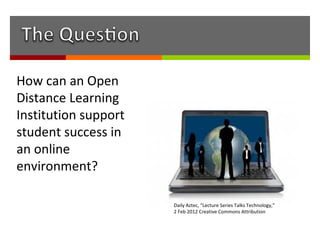
How can an Open
Distance Learning
Institution support
student success in
an online
environment?

                      Daily Aztec, “Lecture Series Talks Technology,”
                      2 Feb 2012 Creative Commons Attribution
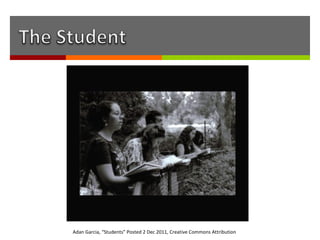
Adan Garcia, “Students” Posted 2 Dec 2011, Creative Commons Attribution
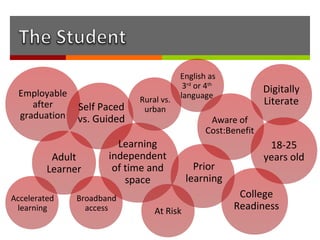
English as
                                         3rd or 4th           Digitally
 Employable                             language
    after                   Rural vs.                         Literate
               Self Paced    urban
 graduation    vs. Guided                       Aware of
                                               Cost:Benefit
                        Learning                               18-25
          Adult       independent                             years old
         Learner       of time and          Prior
                          space           learning
Accelerated    Broadband                               College
 learning        access         At Risk               Readiness
Generation IP: 2025
From the UNISA Open Distance Learning Policy:

"Appropriate use of technology is essential to the
survival of the institution as a global player”
(UNISA, 2008, p. 6).
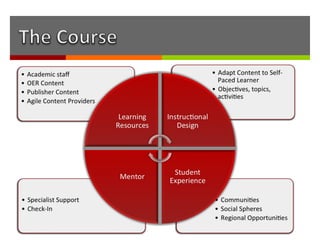
•   Part of a virtual learning environment
•   Learning resource integration
•   Embedded knowledge checks
•   Student engagement tracking and reporting
•   Adaptive environment
•   Changes based on evidence
•   Technology is transparent
Technology allows a glimpse into student activity
and performance within an online course; no
student should reach the assessment only to
realize they are not prepared to pass.
Examples in practice from WGU:
•Single-sign on capability with all resource
providers;
•103 books converted to e-books and delivered
onto one platform for streamlined learning
experience and usage tracking.
•Webtexts, OER resources, simulations
On your mobile device, please go to your
  web browser and type in the
  following:

        m.socrative.com
Room number:
               914598
“A teacher in the future will become more like a
mentor.”
           President of MIT at the 2013 World
           Economic Forum (Hellweg, 2013).
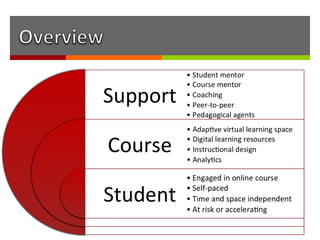
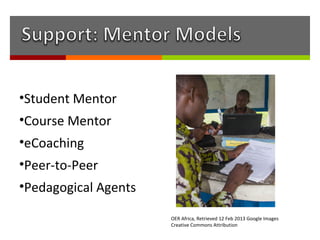
•Student Mentor
•Course Mentor
•eCoaching
•Peer-to-Peer
•Pedagogical Agents

                      OER Africa, Retrieved 12 Feb 2013 Google Images
                      Creative Commons Attribution
Student mentor supports student(s) throughout
duration of the course or degree program.
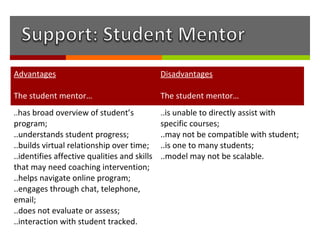
Student mentor supports student(s) throughout duration of the
Advantages                      Disadvantages
course or degree program.
The student mentor…                           The student mentor…
..has broad overview of student’s             ..is unable to directly assist with
program;                                      specific courses;
..understands student progress;               ..may not be compatible with student;
..builds virtual relationship over time;      ..is one to many students;
..identifies affective qualities and skills   ..model may not be scalable.
that may need coaching intervention;
..helps navigate online program;
..engages through chat, telephone,
email;
..does not evaluate or assess;
..interaction with student tracked.
Course mentor supports student throughout
duration of one course.

Similar to UNISA e-tutor.
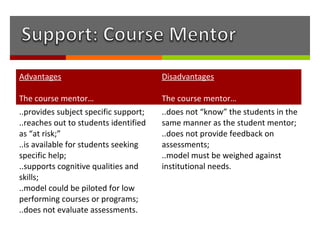
Advantages                             Disadvantages

The course mentor…                     The course mentor…
..provides subject specific support;   ..does not “know” the students in the
..reaches out to students identified   same manner as the student mentor;
as “at risk;”                          ..does not provide feedback on
..is available for students seeking    assessments;
specific help;                         ..model must be weighed against
..supports cognitive qualities and     institutional needs.
skills;
..model could be piloted for low
performing courses or programs;
..does not evaluate assessments.
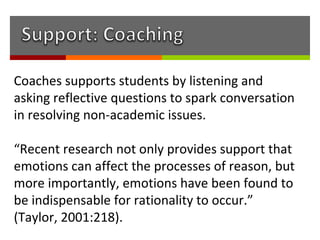
Coaches supports students by listening and
asking reflective questions to spark conversation
in resolving non-academic issues.

“Recent research not only provides support that
emotions can affect the processes of reason, but
more importantly, emotions have been found to
be indispensable for rationality to occur.”
(Taylor, 2001:218).
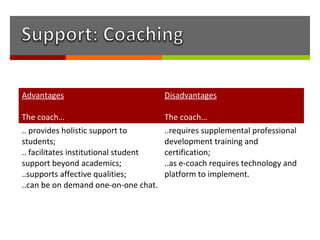
Advantages                             Disadvantages

The coach…                             The coach…
.. provides holistic support to        ..requires supplemental professional
students;                              development training and
.. facilitates institutional student   certification;
support beyond academics;              ..as e-coach requires technology and
..supports affective qualities;        platform to implement.
..can be on demand one-on-one chat.
Peer-to-peer support is organized interface
between students.
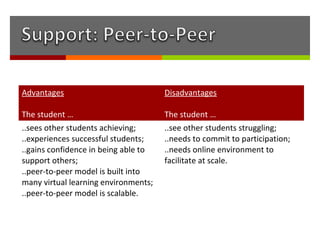
Advantages                            Disadvantages

The student …                         The student …
..sees other students achieving;      ..see other students struggling;
..experiences successful students;    ..needs to commit to participation;
..gains confidence in being able to   ..needs online environment to
support others;                       facilitate at scale.
..peer-to-peer model is built into
many virtual learning environments;
..peer-to-peer model is scalable.
Pedagogical agents are digital avatars that are
programmed to respond based on student
performance data within the online course.
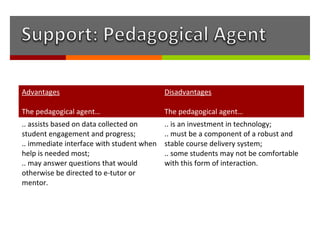
Advantages                                 Disadvantages

The pedagogical agent…                     The pedagogical agent…
.. assists based on data collected on      .. is an investment in technology;
student engagement and progress;           .. must be a component of a robust and
.. immediate interface with student when   stable course delivery system;
help is needed most;                       .. some students may not be comfortable
.. may answer questions that would         with this form of interaction.
otherwise be directed to e-tutor or
mentor.
 Western Governors University

 Formative assessment within webtext
  (online course) provides course and student
  mentors with progress dashboard. Helps
  mentors direct attention to those in need.
 Purdue University Signals Project

 Formative assessment is ‘near’ real time
   enabling feedback closer to the point of
   assessment. Multiple points are aggregated
   to generate a student profile that signals
   the need for intervention or provides kudos
   for progress (Purdue, 2013; Sharples et al.,
   2012) .
 Southern New Hampshire University

 Introduced predictive models of success
  based on individual student profiles and
  demographics. This helps support staff to
  set realistic expectations for success.
 Coursera

 Massive Online Open Courses represent not
  only a shift to traditional education but also
  a unique model where learning is
  independent of time and space, peer-to-
  peer mentoring is built into the
  infrastructure and analytics enhance
  personalized learning.
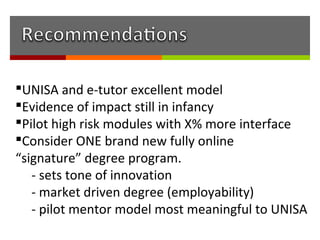
UNISA and e-tutor excellent model
Evidence of impact still in infancy
Pilot high risk modules with X% more interface
Consider ONE brand new fully online
“signature” degree program.
   - sets tone of innovation
   - market driven degree (employability)
   - pilot mentor model most meaningful to UNISA



     Thank you!
  Margaret Korosec
mdkorosec@gmail.com
    @mdkorosec

UNISA Presentation 2013: Student success in online courses using the mentoring model

  • 1.
     Student Success inOnline Courses using the Mentoring Model UNISA Pretoria 14 February 2013 Margaret Korosec
  • 2.
    • The Question •Overview • Student attributes and examples • Course attributes and examples • Support attributes and examples • Recommendations and discussion
  • 3.
    How can anOpen Distance Learning Institution support student success in an online environment? Daily Aztec, “Lecture Series Talks Technology,” 2 Feb 2012 Creative Commons Attribution
  • 5.
    Adan Garcia, “Students”Posted 2 Dec 2011, Creative Commons Attribution
  • 6.
    English as 3rd or 4th Digitally Employable language after Rural vs. Literate Self Paced urban graduation vs. Guided Aware of Cost:Benefit Learning 18-25 Adult independent years old Learner of time and Prior space learning Accelerated Broadband College learning access At Risk Readiness
  • 7.
  • 8.
    From the UNISAOpen Distance Learning Policy: "Appropriate use of technology is essential to the survival of the institution as a global player” (UNISA, 2008, p. 6).
  • 9.
    Part of a virtual learning environment • Learning resource integration • Embedded knowledge checks • Student engagement tracking and reporting • Adaptive environment • Changes based on evidence • Technology is transparent
  • 11.
    Technology allows aglimpse into student activity and performance within an online course; no student should reach the assessment only to realize they are not prepared to pass.
  • 12.
    Examples in practicefrom WGU: •Single-sign on capability with all resource providers; •103 books converted to e-books and delivered onto one platform for streamlined learning experience and usage tracking. •Webtexts, OER resources, simulations
  • 13.
    On your mobiledevice, please go to your web browser and type in the following: m.socrative.com Room number: 914598
  • 14.
    “A teacher inthe future will become more like a mentor.” President of MIT at the 2013 World Economic Forum (Hellweg, 2013).
  • 15.
    •Student Mentor •Course Mentor •eCoaching •Peer-to-Peer •PedagogicalAgents OER Africa, Retrieved 12 Feb 2013 Google Images Creative Commons Attribution
  • 16.
    Student mentor supportsstudent(s) throughout duration of the course or degree program.
  • 17.
    Student mentor supportsstudent(s) throughout duration of the Advantages Disadvantages course or degree program. The student mentor… The student mentor… ..has broad overview of student’s ..is unable to directly assist with program; specific courses; ..understands student progress; ..may not be compatible with student; ..builds virtual relationship over time; ..is one to many students; ..identifies affective qualities and skills ..model may not be scalable. that may need coaching intervention; ..helps navigate online program; ..engages through chat, telephone, email; ..does not evaluate or assess; ..interaction with student tracked.
  • 18.
    Course mentor supportsstudent throughout duration of one course. Similar to UNISA e-tutor.
  • 19.
    Advantages Disadvantages The course mentor… The course mentor… ..provides subject specific support; ..does not “know” the students in the ..reaches out to students identified same manner as the student mentor; as “at risk;” ..does not provide feedback on ..is available for students seeking assessments; specific help; ..model must be weighed against ..supports cognitive qualities and institutional needs. skills; ..model could be piloted for low performing courses or programs; ..does not evaluate assessments.
  • 20.
    Coaches supports studentsby listening and asking reflective questions to spark conversation in resolving non-academic issues. “Recent research not only provides support that emotions can affect the processes of reason, but more importantly, emotions have been found to be indispensable for rationality to occur.” (Taylor, 2001:218).
  • 21.
    Advantages Disadvantages The coach… The coach… .. provides holistic support to ..requires supplemental professional students; development training and .. facilitates institutional student certification; support beyond academics; ..as e-coach requires technology and ..supports affective qualities; platform to implement. ..can be on demand one-on-one chat.
  • 22.
    Peer-to-peer support isorganized interface between students.
  • 23.
    Advantages Disadvantages The student … The student … ..sees other students achieving; ..see other students struggling; ..experiences successful students; ..needs to commit to participation; ..gains confidence in being able to ..needs online environment to support others; facilitate at scale. ..peer-to-peer model is built into many virtual learning environments; ..peer-to-peer model is scalable.
  • 24.
    Pedagogical agents aredigital avatars that are programmed to respond based on student performance data within the online course.
  • 25.
    Advantages Disadvantages The pedagogical agent… The pedagogical agent… .. assists based on data collected on .. is an investment in technology; student engagement and progress; .. must be a component of a robust and .. immediate interface with student when stable course delivery system; help is needed most; .. some students may not be comfortable .. may answer questions that would with this form of interaction. otherwise be directed to e-tutor or mentor.
  • 26.
     Western GovernorsUniversity  Formative assessment within webtext (online course) provides course and student mentors with progress dashboard. Helps mentors direct attention to those in need.
  • 27.
     Purdue UniversitySignals Project  Formative assessment is ‘near’ real time enabling feedback closer to the point of assessment. Multiple points are aggregated to generate a student profile that signals the need for intervention or provides kudos for progress (Purdue, 2013; Sharples et al., 2012) .
  • 28.
     Southern NewHampshire University  Introduced predictive models of success based on individual student profiles and demographics. This helps support staff to set realistic expectations for success.
  • 29.
     Coursera  MassiveOnline Open Courses represent not only a shift to traditional education but also a unique model where learning is independent of time and space, peer-to- peer mentoring is built into the infrastructure and analytics enhance personalized learning.
  • 30.
    UNISA and e-tutorexcellent model Evidence of impact still in infancy Pilot high risk modules with X% more interface Consider ONE brand new fully online “signature” degree program. - sets tone of innovation - market driven degree (employability) - pilot mentor model most meaningful to UNISA
  • 31.
    Thank you! Margaret Korosec mdkorosec@gmail.com @mdkorosec

Editor's Notes

  • #2 SOCRATIVE: www.socrative.com/ VIDEO: http://quietube.com/ www.youtube.com Generation IP: 2025 Bloom’s: http://edorigami.wikispaces.com/
  • #4 Publisher name, “photo title”, date uploaded via Flickr, Creative Commons License
  • #5 This model of student support ONLY works if the course and course learning resources are online.
  • #6 Transition from adult population to high school graduates. College readiness Student centered learning
  • #9 Bloom’s Digital Taxonomy: http://edorigami.wikispaces.com/ QUESTION: part of curriculum design? DISS (Directorate for Instruction and Student Support? Investment into sustainable technologies Pass rate (through put rates First year experience
  • #10 Bloom’s Digital Taxonomy: http://edorigami.wikispaces.com/ QUESTION: part of curriculum design? DISS (Directorate for Instruction and Student Support? Investment into sustainable technologies Pass rate (through put rates) First year experience
  • #12 LINK TO COURSESMART ARTICLE:
  • #13 LINK TO COURSESMART ARTICLE
  • #14 Please select your college. In your opinion, what is the value of the UNISA undergraduate degree? Do you feel students need more academic support than is currently given? In your opinion, are UNISA students prepared for online course delivery? How strongly do you feel you are prepared to teach in an online environment?
  • #19 For example, course mentor was not required to reach out to students
  • #20 For example, course mentor was not required to reach out to students
  • #21 “ Recent research not only provides support that emotions can affect the processes of reason, but more importantly, emotions have been found to be indispensable for rationality to occur” (Taylor 2001:218)
  • #22 “ Recent research not only provides support that emotions can affect the processes of reason, but more importantly, emotions have been found to be indispensable for rationality to occur” (Taylor 2001:218)
  • #31 Sloan Consortium and Penn State offering free webinar on navigating new HE demands and bringing leadership onboard. “Market forces, new and emerging technologies, and the demands of today’s learners for convenience and flexibility are impacting the operational and strategic direction of many institutions.