
The A to Z of Veggies Dr. Patti Nagai Horticulture Educator UW Extension - Racine County
The Veggie Alphabet A  ASPARAGUS B BEAN C CARROT D DANDELION E EGGPLANT F FARMING G GARLIC H  HARVESTING  I  IRISH POTATO J JICAMA K KOHLRABI L LETTUCE M MELON  N  NUTRITION
The Veggie Alphabet O OKRA & ONION P PEPPER Q QUALITY R RADISH  S SWEET CORN T TOMATOES U USDA V VEGETABLE  GARDEN W  WINTER  SQUASH X XXX SEX Y YEAR ROUND  HARVEST Z ZUCCHINI
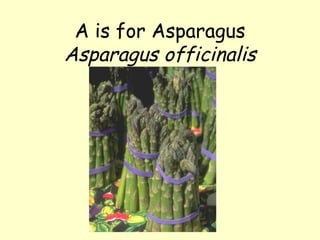
A is for Asparagus Asparagus officinalis
Asparagus Facts Family:  Liliaceae Type:  Perennial Native:  Europe and Western Asia America:  Introduced in 1600s Folk Medicinal Use:  Jaundice  Nutritional Value:  5 spears = 25 calories Vitamin A 10% Vitamin C 15% Calcium 2% Iron 2% Fat 0g Sodium 0mg Carbohydrates 4g Protein 2 g
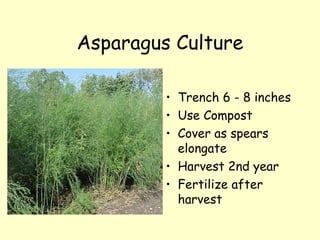
Asparagus Culture Trench 6 - 8 inches  Use Compost Cover as spears  elongate Harvest 2nd year Fertilize after harvest
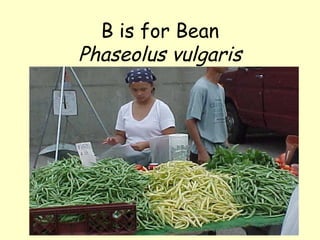
B is for Bean Phaseolus vulgaris
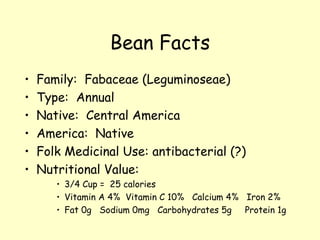
Bean Facts Family:  Fabaceae (Leguminoseae) Type:  Annual Native:  Central America America:  Native Folk Medicinal Use: antibacterial (?) Nutritional Value:  3/4 Cup =  25 calories Vitamin A 4%  Vitamin C 10%  Calcium 4%  Iron 2% Fat 0g  Sodium 0mg  Carbohydrates 5g  Protein 1g
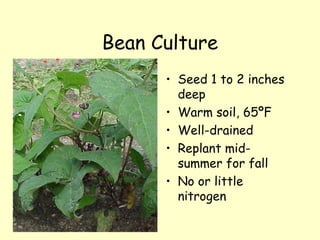
Bean Culture Seed 1 to 2 inches deep  Warm soil, 65ºF Well-drained Replant mid-summer for fall No or little nitrogen
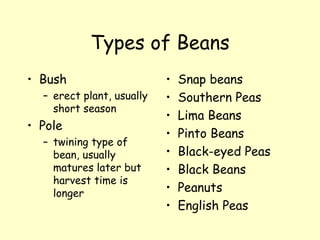
Types of Beans Bush erect plant, usually short season Pole twining type of bean, usually matures later but harvest time is longer Snap beans Southern Peas Lima Beans Pinto Beans Black-eyed Peas Black Beans Peanuts English Peas
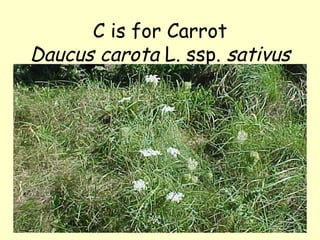
C is for Carrot Daucus carota  L. ssp.  sativus
Carrot Facts Family:  Apiaceae Type:  Biennial Native:  Europe and Western Asia America:  Introduced in 1700s Folk Medicinal Use:  seeds - birth control Nutritional Value:  7 inches = 35 calories Vitamin A 270% Vitamin C 10%  Calcium 2% Iron 0% Fat 0g  Sodium 40mg  Carbohydrates 8g  Protein 1g
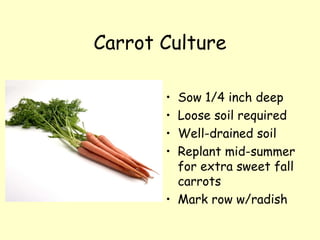
Carrot Culture Sow 1/4 inch deep Loose soil required Well-drained soil Replant mid-summer for extra sweet fall carrots Mark row w/radish
Types of Carrots Danvers medium to long with broad shoulders and sharp taper Imperator more slender and slightly longer than Danvers type Nantes nearly cylindrical with no taper, fairly rounded at ends Chantenay medium to short with a slight taper and blunt end
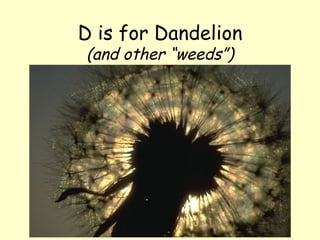
D is for Dandelion (and other “weeds”)
Dandelion Facts Family:  Asteraceae Type:  Perennial Native:  probably  Europe Folk Medicinal Use:  fever and as diuretic Nutritional Value:  High in Vitamin A, Vitamin C, Calcium and other minerals Yellow petals can be used for food coloring
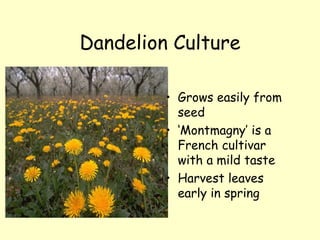
Dandelion Culture Grows easily from seed ‘ Montmagny’ is a French cultivar with a mild taste Harvest leaves early in spring
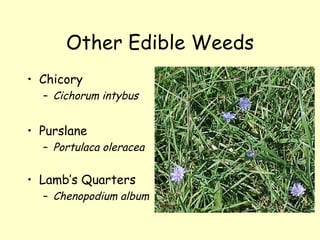
Other Edible Weeds Chicory Cichorum intybus Purslane Portulaca oleracea Lamb’s Quarters Chenopodium album
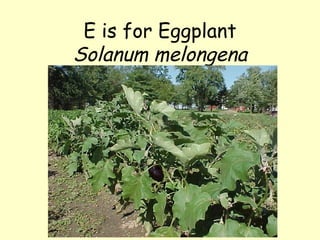
E is for Eggplant Solanum melongena
Eggplant Facts Family:  Solanaceae Type:  Annual Native:  Tropics America:  Introduced early as ornamental Folk Medicinal Use: alkaloids (?) Nutritional Value:  1/5 = 25 calories Vitamin A 0% Vitamin C 2%  Calcium 0% Iron 2% Fat 0g  Sodium 0mg  Carbohydrates 5g  Protein 1g
Eggplant Culture Large, healthy transplants Warm season Chilling sensitive Well-drained soil Bees helpful
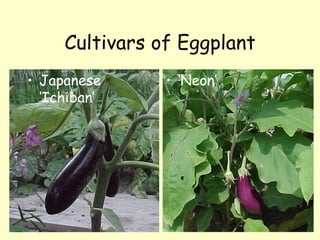
Cultivars of Eggplant Japanese ‘Ichiban’ ‘ Neon’
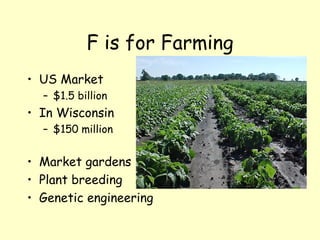
F is for Farming US Market $1.5 billion In Wisconsin $150 million  Market gardens Plant breeding Genetic engineering
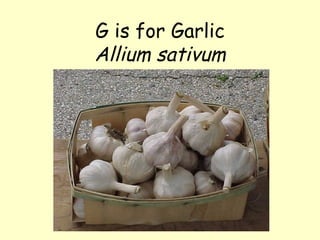
G is for Garlic Allium sativum
Garlic Facts Family:  Alliaceae Type:  Bulbous perennial Native:  Middle Asia America:  1700s (?) Folk Medicinal Use: colds, warding off evil Nutritional Value:  1 clove =  5 calories Vitamin A 0% Vitamin C 2%  Calcium 0% Iron 0% Fat 0g  Sodium  0mg  Carbohydrates 1g  Protein 0g
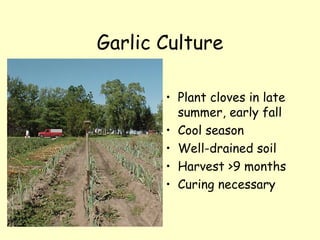
Garlic Culture Plant cloves in late summer, early fall Cool season Well-drained soil Harvest >9 months Curing necessary
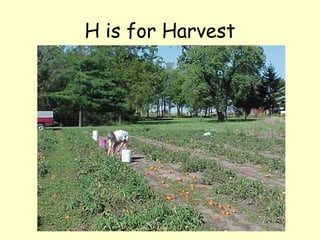
H is for Harvest
Harvest Facts Depends on taste and timeliness Fruit Vegetables :  immature and mature Leaf and Stem Vegetables  : slightly immature is preferable Floral Vegetables :  Hand harvest when head size is right Roots, Tubers and Bulb Vegetables :  various stages of development
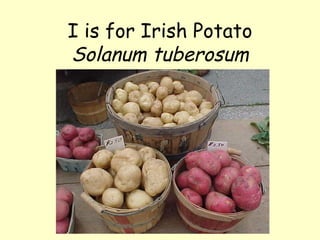
I is for Irish Potato Solanum tuberosum
Irish Potato Facts Family:  Solanaceae Type:  Tuberous perennial Native:  America Folk Medicinal Use: pimples and burns Nutritional Value:  1 medium =  100 calories Vitamin A 0% Vitamin C 45%  Calcium 2% Iron 8% Fat 0g  Sodium  0mg  Carbohydrates 26g  Protein 4g
Irish Potato Culture Plant certified seed tubers or pieces Cool season Well-drained soil Low pH Skin set occurs after vines die
J is for Jicama Pachyrrhizus erosus
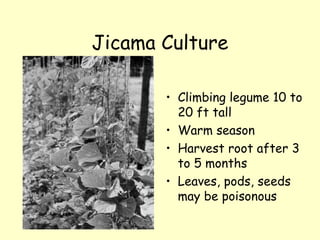
Jicama Culture Climbing legume 10 to 20 ft tall Warm season Harvest root after 3 to 5 months Leaves, pods, seeds may be poisonous
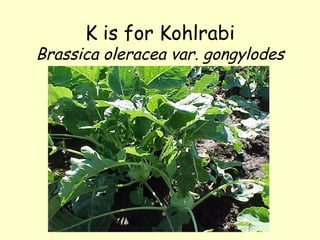
K is for Kohlrabi Brassica oleracea var. gongylodes
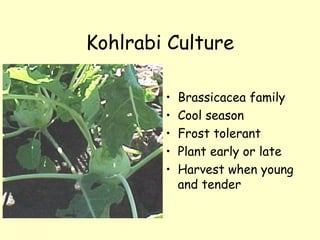
Kohlrabi Culture Brassicacea family Cool season Frost tolerant Plant early or late Harvest when young and tender
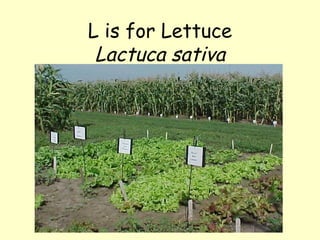
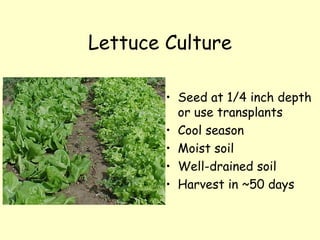
L is for Lettuce Lactuca sativa
Lettuce Facts Family:  Asteraceae Type:  Herbaceous Annual Native:  Mediteranean Basin America:  a long time Folk Medicinal Use: lactucopicrin (?) Nutritional Value (leaf lettuce):  1 1/2 cups =  15 calories Vitamin A 40% Vitamin C 6%  Calcium 4% Iron 0% Fat 0g  Sodium 30mg  Carbohydrates 4g  Protein 1g
Lettuce Culture Seed at 1/4 inch depth or use transplants Cool season Moist soil Well-drained soil Harvest in ~50 days
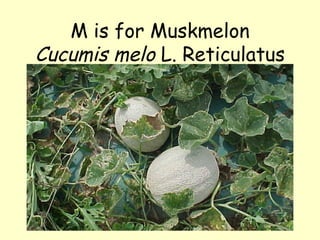
M is for Muskmelon Cucumis melo  L. Reticulatus
Muskmelon Facts Family:  Cucurbitaceae Type:  Annual Native:  Persia America:  1400s Folk Medicinal Use: ? Nutritional Value: 1/4 melon =  50 calories Vitamin A 100% Vitamin C 80%  Calcium 2% Iron 2% Fat 0g  Sodium 25mg  Carbohydrates 12g  Protein 1g
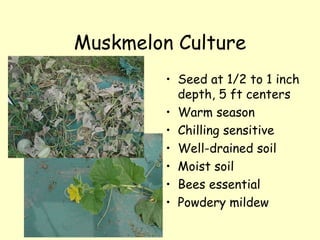
Muskmelon Culture Seed at 1/2 to 1 inch depth, 5 ft centers Warm season Chilling sensitive Well-drained soil Moist soil Bees essential Powdery mildew
N is for Nutrition Vitamin C Vitamin A - Carotenes Vitamin E Vitamin B6 Minerals Fiber Terpenes Carotenoids Phytosterols Phenols Isoflavones Thiols Glucosinolates Allylic sulfides Indoles
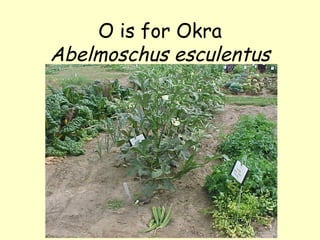
O is for Okra Abelmoschus esculentus
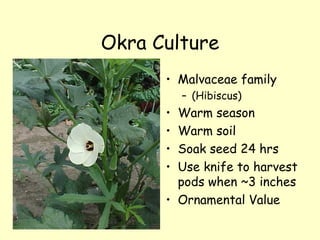
Okra Culture Malvaceae family (Hibiscus) Warm season Warm soil Soak seed 24 hrs Use knife to harvest pods when ~3 inches Ornamental Value
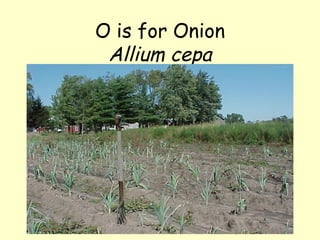
O is for Onion Allium cepa
Onion Facts Family:  Alliaceae Type:  Herbaceous Biennial Native:  Southern Asia America:  1400s Folk Medicinal Use: antibiotic Nutritional Value:  1 1/2 cups =  15 calories Vitamin A 40% Vitamin C 6%  Calcium 4% Iron 0% Fat 0g  Sodium 30mg  Carbohydrates 4g  Protein 1g
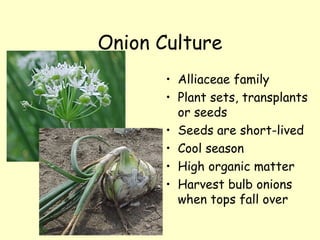
Onion Culture Alliaceae family Plant sets, transplants or seeds Seeds are short-lived Cool season High organic matter Harvest bulb onions when tops fall over
P is for Pepper Capsicum annuum
Pepper Facts Family:  Solanaceae Type:  Annual (or perennial) Native:  Central America, Central Mexico America:  1700s (?) Folk Medicinal Use: colds Nutritional Value (green bell pepper):  1 medium pepper =  30 calories Vitamin A 8% Vitamin C 190%  Calcium 2% Iron 2% Fat 0g  Sodium  0mg  Carbohydrates 7g  Protein 1g
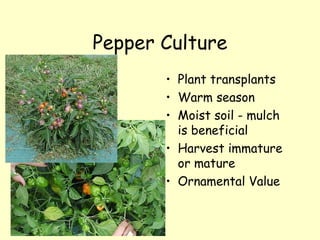
Pepper Culture Plant transplants Warm season Moist soil - mulch is beneficial Harvest immature or mature Ornamental Value
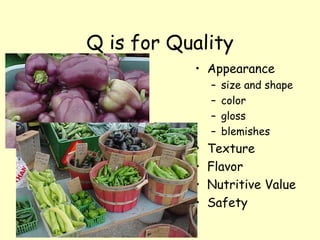
Q is for Quality Appearance size and shape color gloss blemishes Texture Flavor Nutritive Value Safety
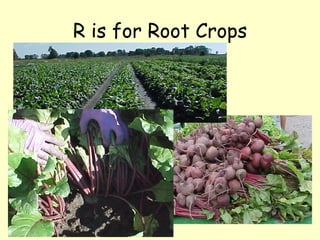
R is for Root Crops
Root Crop Facts Families:  Apiaceae (carrot, parsnip) Chenopodiaceae (beet) Brassicaceae (turnip, rutabaga)  Convolvulaceae (sweet potato) Nutritional Value (beet):  1 medium beet =  50 calories Vitamin A 0% Vitamin C 4%  Calcium 0% Iron 0% Fat 0.5g  Sodium 150mg  Carbohydrate 11g  Protein 1g
Root Crop Culture Seed or slips (sweet potato) Loose soil essential - sandy loam Warm Season sweet potato ( Ipomea batatas ) Cool Season radish ( Raphanus sativus ) beets ( Beta vulgaris ) carrots ( Daucus carota )
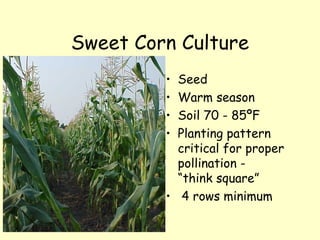
S is for Sweet Corn Zea mays
Sweet Corn Facts Family:  Poaceae Type:  Annual grass Native:  Central America <3500 B.C. America:  63 varieties by 1900 Nutritional Value:  1 ear =  80 calories Vitamin A 2% Vitamin C 10%  Calcium 0% Iron 2% Fat 1g  Sodium  0mg  Carbohydrates 18g  Protein 3g
Sweet Corn Culture Seed Warm season Soil 70 - 85ºF Planting pattern critical for proper pollination -  “think square” 4 rows minimum
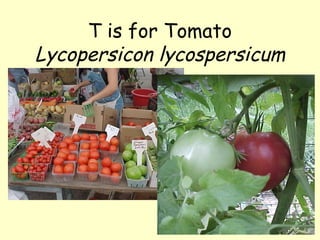
T is for Tomato Lycopersicon lycospersicum
Tomato Facts Family:  Solanaceae Type:  Annual Native:  Peru or Bolivia America:  1710 Folk Medicinal Use: insect repellent Nutritional Value: 1 medium tomato =  35 calories Vitamin A 20% Vitamin C 40%  Calcium 2% Iron 2% Fat 0.5g  Sodium  5mg  Carbohydrates 7g  Protein 1g
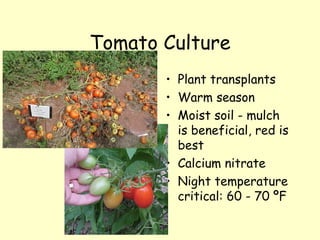
Tomato Culture Plant transplants Warm season Moist soil - mulch is beneficial, red is best Calcium nitrate Night temperature critical: 60 - 70 ºF
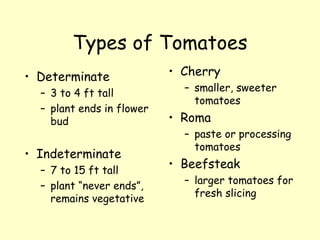
Types of Tomatoes Cherry smaller, sweeter tomatoes Roma paste or processing tomatoes Beefsteak larger tomatoes for fresh slicing Determinate 3 to 4 ft tall plant ends in flower bud Indeterminate 7 to 15 ft tall plant “never ends”, remains vegetative
U is for USDA United States Department of Agriculture Agricultural Marketing Service Fresh Products of Fruits and Vegetables Grade Fresh Produce at point of shipping 150 official grade standards used
V is for Vegetable Gardens Garden to meet your needs Garden to help others Garden for fresher produce Garden for organic produce Garden for specialty crops Garden for the pure joy
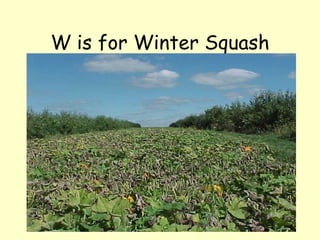
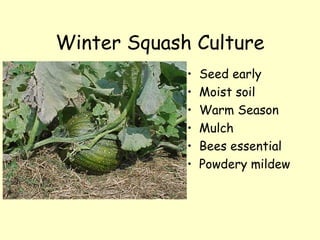
W is for Winter Squash
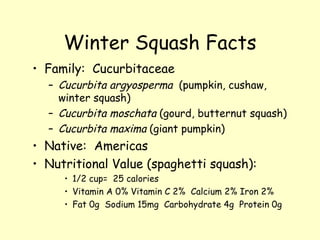
Winter Squash Facts Family:  Cucurbitaceae Cucurbita argyosperma   (pumpkin, cushaw, winter squash) Cucurbita moschata  (gourd, butternut squash) Cucurbita maxima  (giant pumpkin) Native:  Americas  Nutritional Value (spaghetti squash):  1/2 cup=  25 calories Vitamin A 0% Vitamin C 2%  Calcium 2% Iron 2% Fat 0g  Sodium 15mg  Carbohydrate 4g  Protein 0g
Winter Squash Culture Seed early Moist soil Warm Season Mulch Bees essential Powdery mildew
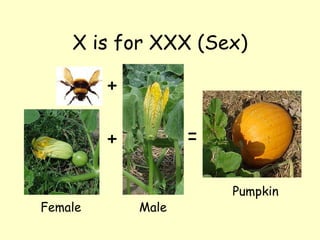
X is for XXX (Sex) = + Female Male Pumpkin +
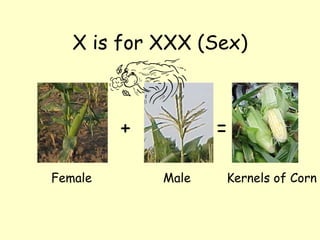
X is for XXX (Sex) = + Female Male Kernels of Corn
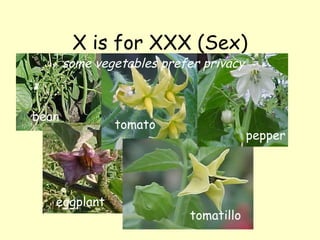
X is for XXX (Sex) = + eggplant bean tomato tomatillo pepper some vegetables prefer privacy
Y is for Year Round Gardening Know Your Last Frost Date in Spring Warm the soil - plastic  Mulch after soil is warm Cloches Greenhouses Cool Season Crops Know Your First Frost Date in Fall Plant fall garden in August  Windowsills and artificial lights
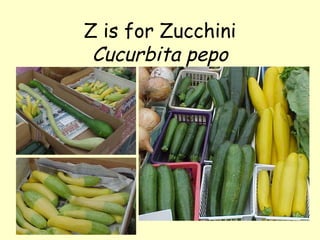
Z is for Zucchini Cucurbita pepo
Zucchini Facts Family:  Cucurbitaceae Type:  Annual Native:  Mexico (?) to Italy America:  ? Nutritional Value:  1/2 medium squash = 20 calories Vitamin A 6% Vitamin C 30%  Calcium 2% Iron 2% Fat 0g  Sodium  0mg  Carbohydrates 4g  Protein 1g
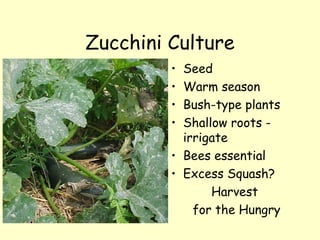
Zucchini Culture Seed Warm season Bush-type plants Shallow roots - irrigate Bees essential Excess Squash? Harvest for the Hungry
Veggie References Vegetable Crops  by Dennis Decoteau Manual of Minor Vegetables  by James M. Stephens Vegetable Gardening in the Midwest by C.E. Voigt and J.S. Vandemark Extension Bulletin A8IL1331 Vegetable Cultivars and Planting Guide - 2000  by Helen Harrison  UW Extension Bulletin A1653
The A to Z of Veggies Dr. Patti Nagai Horticulture Educator UW Extension - Racine County 14200 Washington Avenue Sturtevant, WI  53177 Phone:  262-886-8460 e-mail:  [email_address]

A to Z veggies

  • 1.
    The A toZ of Veggies Dr. Patti Nagai Horticulture Educator UW Extension - Racine County
  • 2.
    The Veggie AlphabetA ASPARAGUS B BEAN C CARROT D DANDELION E EGGPLANT F FARMING G GARLIC H HARVESTING I IRISH POTATO J JICAMA K KOHLRABI L LETTUCE M MELON N NUTRITION
  • 3.
    The Veggie AlphabetO OKRA & ONION P PEPPER Q QUALITY R RADISH S SWEET CORN T TOMATOES U USDA V VEGETABLE GARDEN W WINTER SQUASH X XXX SEX Y YEAR ROUND HARVEST Z ZUCCHINI
  • 4.
    A is forAsparagus Asparagus officinalis
  • 5.
    Asparagus Facts Family: Liliaceae Type: Perennial Native: Europe and Western Asia America: Introduced in 1600s Folk Medicinal Use: Jaundice Nutritional Value: 5 spears = 25 calories Vitamin A 10% Vitamin C 15% Calcium 2% Iron 2% Fat 0g Sodium 0mg Carbohydrates 4g Protein 2 g
  • 6.
    Asparagus Culture Trench6 - 8 inches Use Compost Cover as spears elongate Harvest 2nd year Fertilize after harvest
  • 7.
    B is forBean Phaseolus vulgaris
  • 8.
    Bean Facts Family: Fabaceae (Leguminoseae) Type: Annual Native: Central America America: Native Folk Medicinal Use: antibacterial (?) Nutritional Value: 3/4 Cup = 25 calories Vitamin A 4% Vitamin C 10% Calcium 4% Iron 2% Fat 0g Sodium 0mg Carbohydrates 5g Protein 1g
  • 9.
    Bean Culture Seed1 to 2 inches deep Warm soil, 65ºF Well-drained Replant mid-summer for fall No or little nitrogen
  • 10.
    Types of BeansBush erect plant, usually short season Pole twining type of bean, usually matures later but harvest time is longer Snap beans Southern Peas Lima Beans Pinto Beans Black-eyed Peas Black Beans Peanuts English Peas
  • 11.
    C is forCarrot Daucus carota L. ssp. sativus
  • 12.
    Carrot Facts Family: Apiaceae Type: Biennial Native: Europe and Western Asia America: Introduced in 1700s Folk Medicinal Use: seeds - birth control Nutritional Value: 7 inches = 35 calories Vitamin A 270% Vitamin C 10% Calcium 2% Iron 0% Fat 0g Sodium 40mg Carbohydrates 8g Protein 1g
  • 13.
    Carrot Culture Sow1/4 inch deep Loose soil required Well-drained soil Replant mid-summer for extra sweet fall carrots Mark row w/radish
  • 14.
    Types of CarrotsDanvers medium to long with broad shoulders and sharp taper Imperator more slender and slightly longer than Danvers type Nantes nearly cylindrical with no taper, fairly rounded at ends Chantenay medium to short with a slight taper and blunt end
  • 15.
    D is forDandelion (and other “weeds”)
  • 16.
    Dandelion Facts Family: Asteraceae Type: Perennial Native: probably Europe Folk Medicinal Use: fever and as diuretic Nutritional Value: High in Vitamin A, Vitamin C, Calcium and other minerals Yellow petals can be used for food coloring
  • 17.
    Dandelion Culture Growseasily from seed ‘ Montmagny’ is a French cultivar with a mild taste Harvest leaves early in spring
  • 18.
    Other Edible WeedsChicory Cichorum intybus Purslane Portulaca oleracea Lamb’s Quarters Chenopodium album
  • 19.
    E is forEggplant Solanum melongena
  • 20.
    Eggplant Facts Family: Solanaceae Type: Annual Native: Tropics America: Introduced early as ornamental Folk Medicinal Use: alkaloids (?) Nutritional Value: 1/5 = 25 calories Vitamin A 0% Vitamin C 2% Calcium 0% Iron 2% Fat 0g Sodium 0mg Carbohydrates 5g Protein 1g
  • 21.
    Eggplant Culture Large,healthy transplants Warm season Chilling sensitive Well-drained soil Bees helpful
  • 22.
    Cultivars of EggplantJapanese ‘Ichiban’ ‘ Neon’
  • 23.
    F is forFarming US Market $1.5 billion In Wisconsin $150 million Market gardens Plant breeding Genetic engineering
  • 24.
    G is forGarlic Allium sativum
  • 25.
    Garlic Facts Family: Alliaceae Type: Bulbous perennial Native: Middle Asia America: 1700s (?) Folk Medicinal Use: colds, warding off evil Nutritional Value: 1 clove = 5 calories Vitamin A 0% Vitamin C 2% Calcium 0% Iron 0% Fat 0g Sodium 0mg Carbohydrates 1g Protein 0g
  • 26.
    Garlic Culture Plantcloves in late summer, early fall Cool season Well-drained soil Harvest >9 months Curing necessary
  • 27.
    H is forHarvest
  • 28.
    Harvest Facts Dependson taste and timeliness Fruit Vegetables : immature and mature Leaf and Stem Vegetables : slightly immature is preferable Floral Vegetables : Hand harvest when head size is right Roots, Tubers and Bulb Vegetables : various stages of development
  • 29.
    I is forIrish Potato Solanum tuberosum
  • 30.
    Irish Potato FactsFamily: Solanaceae Type: Tuberous perennial Native: America Folk Medicinal Use: pimples and burns Nutritional Value: 1 medium = 100 calories Vitamin A 0% Vitamin C 45% Calcium 2% Iron 8% Fat 0g Sodium 0mg Carbohydrates 26g Protein 4g
  • 31.
    Irish Potato CulturePlant certified seed tubers or pieces Cool season Well-drained soil Low pH Skin set occurs after vines die
  • 32.
    J is forJicama Pachyrrhizus erosus
  • 33.
    Jicama Culture Climbinglegume 10 to 20 ft tall Warm season Harvest root after 3 to 5 months Leaves, pods, seeds may be poisonous
  • 34.
    K is forKohlrabi Brassica oleracea var. gongylodes
  • 35.
    Kohlrabi Culture Brassicaceafamily Cool season Frost tolerant Plant early or late Harvest when young and tender
  • 36.
    L is forLettuce Lactuca sativa
  • 37.
    Lettuce Facts Family: Asteraceae Type: Herbaceous Annual Native: Mediteranean Basin America: a long time Folk Medicinal Use: lactucopicrin (?) Nutritional Value (leaf lettuce): 1 1/2 cups = 15 calories Vitamin A 40% Vitamin C 6% Calcium 4% Iron 0% Fat 0g Sodium 30mg Carbohydrates 4g Protein 1g
  • 38.
    Lettuce Culture Seedat 1/4 inch depth or use transplants Cool season Moist soil Well-drained soil Harvest in ~50 days
  • 39.
    M is forMuskmelon Cucumis melo L. Reticulatus
  • 40.
    Muskmelon Facts Family: Cucurbitaceae Type: Annual Native: Persia America: 1400s Folk Medicinal Use: ? Nutritional Value: 1/4 melon = 50 calories Vitamin A 100% Vitamin C 80% Calcium 2% Iron 2% Fat 0g Sodium 25mg Carbohydrates 12g Protein 1g
  • 41.
    Muskmelon Culture Seedat 1/2 to 1 inch depth, 5 ft centers Warm season Chilling sensitive Well-drained soil Moist soil Bees essential Powdery mildew
  • 42.
    N is forNutrition Vitamin C Vitamin A - Carotenes Vitamin E Vitamin B6 Minerals Fiber Terpenes Carotenoids Phytosterols Phenols Isoflavones Thiols Glucosinolates Allylic sulfides Indoles
  • 43.
    O is forOkra Abelmoschus esculentus
  • 44.
    Okra Culture Malvaceaefamily (Hibiscus) Warm season Warm soil Soak seed 24 hrs Use knife to harvest pods when ~3 inches Ornamental Value
  • 45.
    O is forOnion Allium cepa
  • 46.
    Onion Facts Family: Alliaceae Type: Herbaceous Biennial Native: Southern Asia America: 1400s Folk Medicinal Use: antibiotic Nutritional Value: 1 1/2 cups = 15 calories Vitamin A 40% Vitamin C 6% Calcium 4% Iron 0% Fat 0g Sodium 30mg Carbohydrates 4g Protein 1g
  • 47.
    Onion Culture Alliaceaefamily Plant sets, transplants or seeds Seeds are short-lived Cool season High organic matter Harvest bulb onions when tops fall over
  • 48.
    P is forPepper Capsicum annuum
  • 49.
    Pepper Facts Family: Solanaceae Type: Annual (or perennial) Native: Central America, Central Mexico America: 1700s (?) Folk Medicinal Use: colds Nutritional Value (green bell pepper): 1 medium pepper = 30 calories Vitamin A 8% Vitamin C 190% Calcium 2% Iron 2% Fat 0g Sodium 0mg Carbohydrates 7g Protein 1g
  • 50.
    Pepper Culture Planttransplants Warm season Moist soil - mulch is beneficial Harvest immature or mature Ornamental Value
  • 51.
    Q is forQuality Appearance size and shape color gloss blemishes Texture Flavor Nutritive Value Safety
  • 52.
    R is forRoot Crops
  • 53.
    Root Crop FactsFamilies: Apiaceae (carrot, parsnip) Chenopodiaceae (beet) Brassicaceae (turnip, rutabaga) Convolvulaceae (sweet potato) Nutritional Value (beet): 1 medium beet = 50 calories Vitamin A 0% Vitamin C 4% Calcium 0% Iron 0% Fat 0.5g Sodium 150mg Carbohydrate 11g Protein 1g
  • 54.
    Root Crop CultureSeed or slips (sweet potato) Loose soil essential - sandy loam Warm Season sweet potato ( Ipomea batatas ) Cool Season radish ( Raphanus sativus ) beets ( Beta vulgaris ) carrots ( Daucus carota )
  • 55.
    S is forSweet Corn Zea mays
  • 56.
    Sweet Corn FactsFamily: Poaceae Type: Annual grass Native: Central America <3500 B.C. America: 63 varieties by 1900 Nutritional Value: 1 ear = 80 calories Vitamin A 2% Vitamin C 10% Calcium 0% Iron 2% Fat 1g Sodium 0mg Carbohydrates 18g Protein 3g
  • 57.
    Sweet Corn CultureSeed Warm season Soil 70 - 85ºF Planting pattern critical for proper pollination - “think square” 4 rows minimum
  • 58.
    T is forTomato Lycopersicon lycospersicum
  • 59.
    Tomato Facts Family: Solanaceae Type: Annual Native: Peru or Bolivia America: 1710 Folk Medicinal Use: insect repellent Nutritional Value: 1 medium tomato = 35 calories Vitamin A 20% Vitamin C 40% Calcium 2% Iron 2% Fat 0.5g Sodium 5mg Carbohydrates 7g Protein 1g
  • 60.
    Tomato Culture Planttransplants Warm season Moist soil - mulch is beneficial, red is best Calcium nitrate Night temperature critical: 60 - 70 ºF
  • 61.
    Types of TomatoesCherry smaller, sweeter tomatoes Roma paste or processing tomatoes Beefsteak larger tomatoes for fresh slicing Determinate 3 to 4 ft tall plant ends in flower bud Indeterminate 7 to 15 ft tall plant “never ends”, remains vegetative
  • 62.
    U is forUSDA United States Department of Agriculture Agricultural Marketing Service Fresh Products of Fruits and Vegetables Grade Fresh Produce at point of shipping 150 official grade standards used
  • 63.
    V is forVegetable Gardens Garden to meet your needs Garden to help others Garden for fresher produce Garden for organic produce Garden for specialty crops Garden for the pure joy
  • 64.
    W is forWinter Squash
  • 65.
    Winter Squash FactsFamily: Cucurbitaceae Cucurbita argyosperma (pumpkin, cushaw, winter squash) Cucurbita moschata (gourd, butternut squash) Cucurbita maxima (giant pumpkin) Native: Americas Nutritional Value (spaghetti squash): 1/2 cup= 25 calories Vitamin A 0% Vitamin C 2% Calcium 2% Iron 2% Fat 0g Sodium 15mg Carbohydrate 4g Protein 0g
  • 66.
    Winter Squash CultureSeed early Moist soil Warm Season Mulch Bees essential Powdery mildew
  • 67.
    X is forXXX (Sex) = + Female Male Pumpkin +
  • 68.
    X is forXXX (Sex) = + Female Male Kernels of Corn
  • 69.
    X is forXXX (Sex) = + eggplant bean tomato tomatillo pepper some vegetables prefer privacy
  • 70.
    Y is forYear Round Gardening Know Your Last Frost Date in Spring Warm the soil - plastic Mulch after soil is warm Cloches Greenhouses Cool Season Crops Know Your First Frost Date in Fall Plant fall garden in August Windowsills and artificial lights
  • 71.
    Z is forZucchini Cucurbita pepo
  • 72.
    Zucchini Facts Family: Cucurbitaceae Type: Annual Native: Mexico (?) to Italy America: ? Nutritional Value: 1/2 medium squash = 20 calories Vitamin A 6% Vitamin C 30% Calcium 2% Iron 2% Fat 0g Sodium 0mg Carbohydrates 4g Protein 1g
  • 73.
    Zucchini Culture SeedWarm season Bush-type plants Shallow roots - irrigate Bees essential Excess Squash? Harvest for the Hungry
  • 74.
    Veggie References VegetableCrops by Dennis Decoteau Manual of Minor Vegetables by James M. Stephens Vegetable Gardening in the Midwest by C.E. Voigt and J.S. Vandemark Extension Bulletin A8IL1331 Vegetable Cultivars and Planting Guide - 2000 by Helen Harrison UW Extension Bulletin A1653
  • 75.
    The A toZ of Veggies Dr. Patti Nagai Horticulture Educator UW Extension - Racine County 14200 Washington Avenue Sturtevant, WI 53177 Phone: 262-886-8460 e-mail: [email_address]