Brassica oleracea var. capitata
CABBAGE
S A M H I G G I N B O T T O M U N I V E R S I T Y
OF AGRCULTURE
TECHNOLOGY AND SCIENCES
Department of Genetics and Plant Breeding
SHUATS
Submitted to :
Dr. G.M. LAL
Assistant Professor
Presented by :
N. SANDEEP
M.Sc. (GPB)
20MSCGPB122
HOVS-711
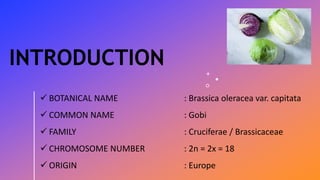
INTRODUCTION
 BOTANICAL NAME : Brassica oleracea var. capitata
 COMMON NAME : Gobi
 FAMILY : Cruciferae / Brassicaceae
 CHROMOSOME NUMBER : 2n = 2x = 18
 ORIGIN : Europe
ORIGIN
• Origin-South and Western part of Europe
• Native to Europe, growing along the cost of the North sea
• Annual world production -21million tones of fresh heads from 1.1 million hectares
• Cabbage was originated from a wild non-heading type plant Brassica oleracea var. sylvestris Syn.
(Brassica sylverstris) commonly known as wild cliff cabbage or cole worts.
• The real headed cabbage was evolved in Germany.
• The savoy cabbage originated in Italy and spread to France and Germany in the sixteenth and
seventeenth centuries.
• At present, cabbage is grown in Caribbean countries, Indonesia, Malaysia, Central East and West
America.
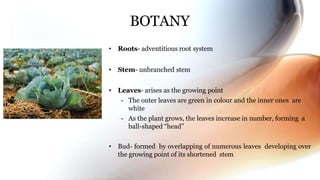
BOTANY
• Roots- adventitious root system
• Stem- unbranched stem
• Leaves- arises as the growing point
- The outer leaves are green in colour and the inner ones are
white
- As the plant grows, the leaves increase in number, forming a
ball-shaped “head”
• Bud- formed by overlapping of numerous leaves developing over
the growing point of its shortened stem
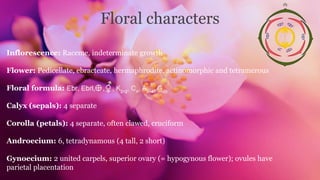
Inflorescence: Raceme, indeterminate growth
Flower: Pedicellate, ebracteate, hermaphrodite, actinomorphic and tetramerous
Floral formula:
Calyx (sepals): 4 separate
Corolla (petals): 4 separate, often clawed, cruciform
Androecium: 6, tetradynamous (4 tall, 2 short)
Gynoecium: 2 united carpels, superior ovary (= hypogynous flower); ovules have
parietal placentation
Floral characters
TAXONOMY
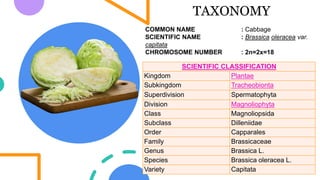
COMMON NAME : Cabbage
SCIENTIFIC NAME : Brassica oleracea var.
capitata
CHROMOSOME NUMBER : 2n=2x=18
SCIENTIFIC CLASSIFICATION
Kingdom Plantae
Subkingdom Tracheobionta
Superdivision Spermatophyta
Division Magnoliophyta
Class Magnoliopsida
Subclass Dilleniidae
Order Capparales
Family Brassicaceae
Genus Brassica L.
Species Brassica oleracea L.
Variety Capitata
Cytology of Cabbage
 Cabbage has a somatic chromosome number of 18 and its genome is c
 It is a secondary polyploid with basic chromosome number 6
 Three basic chromosomes are present in duplicate and remainder are single i.e. ABBCCDEEF = 9
 Molecular genetic work, using restriction fragment length polymorphisms (RFLPs), suggests that
this picture may be an over-simplification
 In the course of constructing an RFLP map in B. oleracea, there is evidence of duplicate loci
which mapped to different chromosomes
 It might be difficult to identify the possible structure of a lower chromosome number progenitor
or to determine if B. oleracea evolved by duplication of loci and complex rearrangements
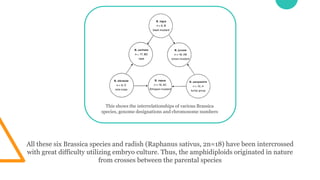
This shows the interrelationships of various Brassica
species, genome designations and chromosome numbers
All these six Brassica species and radish (Raphanus sativus, 2n=18) have been intercrossed
with great difficulty utilizing embryo culture. Thus, the amphidiploids originated in nature
from crosses between the parental species
 The cabbage genome size is approximately 603 Mb
 As a diploid species, B. oleracea underwent a whole-genome triplication (WGT) event, followed
by two whole-genome duplication (WGD) event and a specific WGT of the Brassicacea lineage,
thus becoming a model for studies on polyploid genome evolution
 Currently, two B. oleracea genomes based on next-generation sequencing (NGS) technology are
available: the TO1000 (kale-like; B. oleracea var. alboglabra) assembly and the 02-12
(cabbage; B. oleracea var. capitata) assembly, but their errors and gaps make them difficult to use
for many studies.
 Recently, B. oleracea L. var. italica (broccoli) genome assembly was completed using long reads
and optical maps. Broccoli and cabbage belong to Brassica species, however their growth,
morphology and molecular levels is extremely variable, showing the importance of generating
several genome assemblies for different morphotypes of B. oleracea.
 Up to now, there is still no high quality, comprehensive assembled cabbage (B.
oleracea var. capitata) genome, which hinders greatly basic genetics and genomics research, as
well as crop improvement. Thus generating an accurate cabbage genome assembly is crucial.
Genetics of Cabbage
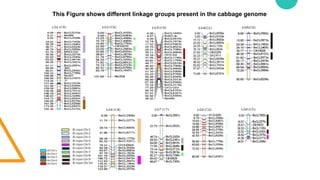
This Figure shows different linkage groups present in the cabbage genome
BREEDING OBJECTIVES
 Higher yield
 Longer staying capacity in the field after head formation
 Narrow, short, and soft core
 Shorter stem
 Cultivars suitable to grow under mild winter
 Storage ability
 Head compactness
Contd….
 Resistance to diseases
• Club root (Xanthomonas campestris)
• Downy mildew (Peronospora parasitica)
• Fusarium yellows
• Leaf spots
• Leaf Blight (Alternaria brassicola)
• Ring spot
• Black rot
 Insect resistance
• From diamondback moth (Plutella
xylostella)
• cabbage moth (Mamestra brassicae)
• cabbage root fly (Delia radicum)
• cabbage maggot (Hylemya brassicae)
• cabbage white butterfly(Pieris rapae)
www.website.com
Breeding Methods of Cabbage
o Open-pollinated Cultivars
o Hybrid Cultivars
 Mass selection
 Inbreeding (in cultivars with low level of self-incompatibility and inbreeding
depression)
Open-pollinated Cultivars
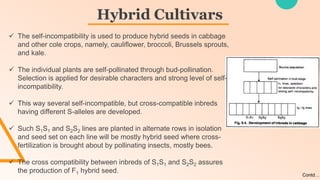
 The self-incompatibility is used to produce hybrid seeds in cabbage
and other cole crops, namely, cauliflower, broccoli, Brussels sprouts,
and kale.
 The individual plants are self-pollinated through bud-pollination.
Selection is applied for desirable characters and strong level of self-
incompatibility.
 This way several self-incompatible, but cross-compatible inbreds
having different S-alleles are developed.
 Such S1S1 and S2S2 lines are planted in alternate rows in isolation
and seed set on each line will be mostly hybrid seed where cross-
fertilization is brought about by pollinating insects, mostly bees.
 The cross compatibility between inbreds of S1S1 and S2S2 assures
the production of F1 hybrid seed.
Hybrid Cultivars
Contd…
Cabbage hybrids could be of following kinds:
Single Cross:
• This is a cross between two inbreds.
• Single cross hybrids are more uniform than hybrids produced from double/top crosses.
Double Cross:
• A cross between two single crosses is known as double cross.
• Four homozygous inbreds are required to produce a double cross, for example, (S1S1 x S2S2)
X (S3S3 x S4S4).
• In this system, seed is harvested from both the single crosses which themselves are vigorous
and therefore, cost of hybrid seed is reduced.
Top Cross:
• This is a cross between a single self-incompatible inbred line as female and a good open-
pollinated cultivar as pollen parent.
• Till late eighties, most of the cabbage hybrids produced in United States were top crosses.
• It is easy to breed self-incompatible lines of cabbage through continuous
self-pollination and selection.
• When two self-incompatible lines are used as parents to produce hybrids,
the reciprocal crossed seeds can be harvested as hybrids.
• In 1950, the first cabbage hybrid in the world was developed in Japan using
self-incompatible lines. This hybrid was known as Nagaoka No. 1.
Breeding by Utilisation of Self-Incompatible Lines
Contd….
The superior self-incompatible lines for hybrid seed production should have following
characters:
1. Stable self-incompatibility
2. High seed set after self-pollination at bud stage
3. Favourable economic characteristics
4. Desirable combining ability
5. Almost all cabbage hybrid seeds are produced using self-incompatible lines all over the world.
Now CMS system is also being used.
THANK YOU
for your attention

Cabbage: Origin, Taxonomy, Botany, genetics, cytogenetics, breeding objectives and methods

  • 1.
    Brassica oleracea var.capitata CABBAGE S A M H I G G I N B O T T O M U N I V E R S I T Y OF AGRCULTURE TECHNOLOGY AND SCIENCES Department of Genetics and Plant Breeding SHUATS Submitted to : Dr. G.M. LAL Assistant Professor Presented by : N. SANDEEP M.Sc. (GPB) 20MSCGPB122 HOVS-711
  • 2.
    INTRODUCTION  BOTANICAL NAME: Brassica oleracea var. capitata  COMMON NAME : Gobi  FAMILY : Cruciferae / Brassicaceae  CHROMOSOME NUMBER : 2n = 2x = 18  ORIGIN : Europe
  • 3.
    ORIGIN • Origin-South andWestern part of Europe • Native to Europe, growing along the cost of the North sea • Annual world production -21million tones of fresh heads from 1.1 million hectares • Cabbage was originated from a wild non-heading type plant Brassica oleracea var. sylvestris Syn. (Brassica sylverstris) commonly known as wild cliff cabbage or cole worts. • The real headed cabbage was evolved in Germany. • The savoy cabbage originated in Italy and spread to France and Germany in the sixteenth and seventeenth centuries. • At present, cabbage is grown in Caribbean countries, Indonesia, Malaysia, Central East and West America.
  • 4.
    BOTANY • Roots- adventitiousroot system • Stem- unbranched stem • Leaves- arises as the growing point - The outer leaves are green in colour and the inner ones are white - As the plant grows, the leaves increase in number, forming a ball-shaped “head” • Bud- formed by overlapping of numerous leaves developing over the growing point of its shortened stem
  • 5.
    Inflorescence: Raceme, indeterminategrowth Flower: Pedicellate, ebracteate, hermaphrodite, actinomorphic and tetramerous Floral formula: Calyx (sepals): 4 separate Corolla (petals): 4 separate, often clawed, cruciform Androecium: 6, tetradynamous (4 tall, 2 short) Gynoecium: 2 united carpels, superior ovary (= hypogynous flower); ovules have parietal placentation Floral characters
  • 6.
    TAXONOMY COMMON NAME :Cabbage SCIENTIFIC NAME : Brassica oleracea var. capitata CHROMOSOME NUMBER : 2n=2x=18 SCIENTIFIC CLASSIFICATION Kingdom Plantae Subkingdom Tracheobionta Superdivision Spermatophyta Division Magnoliophyta Class Magnoliopsida Subclass Dilleniidae Order Capparales Family Brassicaceae Genus Brassica L. Species Brassica oleracea L. Variety Capitata
  • 7.
    Cytology of Cabbage Cabbage has a somatic chromosome number of 18 and its genome is c  It is a secondary polyploid with basic chromosome number 6  Three basic chromosomes are present in duplicate and remainder are single i.e. ABBCCDEEF = 9  Molecular genetic work, using restriction fragment length polymorphisms (RFLPs), suggests that this picture may be an over-simplification  In the course of constructing an RFLP map in B. oleracea, there is evidence of duplicate loci which mapped to different chromosomes  It might be difficult to identify the possible structure of a lower chromosome number progenitor or to determine if B. oleracea evolved by duplication of loci and complex rearrangements
  • 8.
    This shows theinterrelationships of various Brassica species, genome designations and chromosome numbers All these six Brassica species and radish (Raphanus sativus, 2n=18) have been intercrossed with great difficulty utilizing embryo culture. Thus, the amphidiploids originated in nature from crosses between the parental species
  • 9.
     The cabbagegenome size is approximately 603 Mb  As a diploid species, B. oleracea underwent a whole-genome triplication (WGT) event, followed by two whole-genome duplication (WGD) event and a specific WGT of the Brassicacea lineage, thus becoming a model for studies on polyploid genome evolution  Currently, two B. oleracea genomes based on next-generation sequencing (NGS) technology are available: the TO1000 (kale-like; B. oleracea var. alboglabra) assembly and the 02-12 (cabbage; B. oleracea var. capitata) assembly, but their errors and gaps make them difficult to use for many studies.  Recently, B. oleracea L. var. italica (broccoli) genome assembly was completed using long reads and optical maps. Broccoli and cabbage belong to Brassica species, however their growth, morphology and molecular levels is extremely variable, showing the importance of generating several genome assemblies for different morphotypes of B. oleracea.  Up to now, there is still no high quality, comprehensive assembled cabbage (B. oleracea var. capitata) genome, which hinders greatly basic genetics and genomics research, as well as crop improvement. Thus generating an accurate cabbage genome assembly is crucial. Genetics of Cabbage
  • 10.
    This Figure showsdifferent linkage groups present in the cabbage genome
  • 11.
    BREEDING OBJECTIVES  Higheryield  Longer staying capacity in the field after head formation  Narrow, short, and soft core  Shorter stem  Cultivars suitable to grow under mild winter  Storage ability  Head compactness Contd….
  • 12.
     Resistance todiseases • Club root (Xanthomonas campestris) • Downy mildew (Peronospora parasitica) • Fusarium yellows • Leaf spots • Leaf Blight (Alternaria brassicola) • Ring spot • Black rot  Insect resistance • From diamondback moth (Plutella xylostella) • cabbage moth (Mamestra brassicae) • cabbage root fly (Delia radicum) • cabbage maggot (Hylemya brassicae) • cabbage white butterfly(Pieris rapae)
  • 13.
    www.website.com Breeding Methods ofCabbage o Open-pollinated Cultivars o Hybrid Cultivars
  • 14.
     Mass selection Inbreeding (in cultivars with low level of self-incompatibility and inbreeding depression) Open-pollinated Cultivars
  • 15.
     The self-incompatibilityis used to produce hybrid seeds in cabbage and other cole crops, namely, cauliflower, broccoli, Brussels sprouts, and kale.  The individual plants are self-pollinated through bud-pollination. Selection is applied for desirable characters and strong level of self- incompatibility.  This way several self-incompatible, but cross-compatible inbreds having different S-alleles are developed.  Such S1S1 and S2S2 lines are planted in alternate rows in isolation and seed set on each line will be mostly hybrid seed where cross- fertilization is brought about by pollinating insects, mostly bees.  The cross compatibility between inbreds of S1S1 and S2S2 assures the production of F1 hybrid seed. Hybrid Cultivars Contd…
  • 16.
    Cabbage hybrids couldbe of following kinds: Single Cross: • This is a cross between two inbreds. • Single cross hybrids are more uniform than hybrids produced from double/top crosses. Double Cross: • A cross between two single crosses is known as double cross. • Four homozygous inbreds are required to produce a double cross, for example, (S1S1 x S2S2) X (S3S3 x S4S4). • In this system, seed is harvested from both the single crosses which themselves are vigorous and therefore, cost of hybrid seed is reduced. Top Cross: • This is a cross between a single self-incompatible inbred line as female and a good open- pollinated cultivar as pollen parent. • Till late eighties, most of the cabbage hybrids produced in United States were top crosses.
  • 17.
    • It iseasy to breed self-incompatible lines of cabbage through continuous self-pollination and selection. • When two self-incompatible lines are used as parents to produce hybrids, the reciprocal crossed seeds can be harvested as hybrids. • In 1950, the first cabbage hybrid in the world was developed in Japan using self-incompatible lines. This hybrid was known as Nagaoka No. 1. Breeding by Utilisation of Self-Incompatible Lines Contd….
  • 18.
    The superior self-incompatiblelines for hybrid seed production should have following characters: 1. Stable self-incompatibility 2. High seed set after self-pollination at bud stage 3. Favourable economic characteristics 4. Desirable combining ability 5. Almost all cabbage hybrid seeds are produced using self-incompatible lines all over the world. Now CMS system is also being used.
  • 19.