Roman Empire
Early History
• 500 BCE
 – Drive out Etruscans, establish Republic
 – Patricians vs. Plebians
• 5th-3rd cent. BCE
 – Republic becomes more democratic,
   achieving reforms harmoniously for the
   good of the Republic
Wars
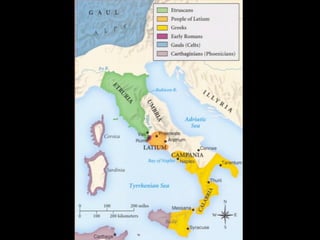
• 340-270 BCE: Conquered Italian
  peninsula
  –Powerful armies
  –Ability to move troops
  –Wise treatment of conquered
   peoples
Wars
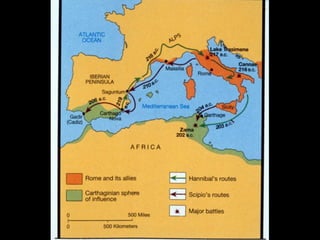
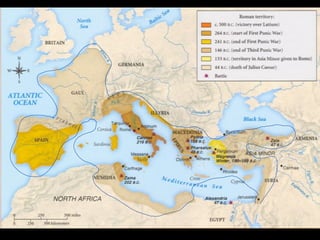
• 264-146: Conquered W. Medit –
  Carthage Commercial Empire
 –Punic Wars
   •Sicily
   •Hannibal defeated, conquer
    Spain and N. Africa
   •Carthage itself
Problems with Expanded Republic
• Wealth gap
• Small farmers disappear, estates and
  slaves appear
• High number of unemployed form
  allegiance with generals who promise
  improvements instead of republic
Rise of Christianity
• Grew slowly for two centuries
• Message of equality, love and
  salvation resonated with lower
  classes
• By late third century, was a
  sizeable minority
Technology

• Bridge building
• Ballistic weapons
• Aqueducts
• Arches and domes
• Concrete
Republic to Dictatorship
• Civil wars, generals battle
  – Marius v. Sulla
• 60 BCE Triumvirate (Caesar-general, Pompey-
  general, Crassus-wealthy noble)
• Caesar popularity up because of victories in
  Gaul
• 49 BCE
  – Senate orders Caesar to disband army because fear
    of his popularity
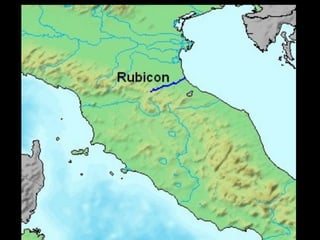
  – Caesar crosses the Rubicon
• Assassination in 44 BCE
Republic to Dictatorship
• Octavian (Caesar’s grand
  nephew) and Mark Antony def.
  Brutus and Cassius
• Octavian def. Mark Antony
• Octavian becomes absolute
  ruler of Rome
27 BCE-476 CE
     Empire/Military dictatorship
• Octavian accepts the title Augustus
• Augustus’ accomplishments
  – Maintained peace
  – Provided stable govt
  – Established fair taxation
  – Encouraged science, art and literature
  – Constructed many roads
• But…
  – Any real democracy is gone, Rome run by an
    emperor, Senate bends to his whims
27 BCE-476 CE
    Empire/Military dictatorship
• 180 CE to 284 CE
 –Tiberius, Caligula, and
  Nero…the less said about
  them the better.
27 BCE-476 CE
     Empire/Military dictatorship
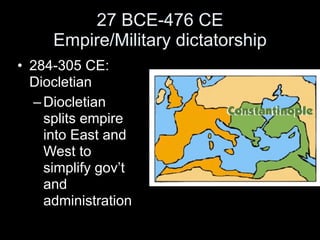
• 284-305 CE:
  Diocletian
   – Diocletian
     splits empire
     into East and
     West to
     simplify gov’t
     and
     administration
27 BCE-476 CE
   Empire/Military dictatorship
• 312-337 CE: Constantine
  –Reunites empire by force
  –Moves capital to Constantinople
  –Ends persecution of Christians
   (Edict of Milan in 313)
  –Converts to Christianity at end of
   life
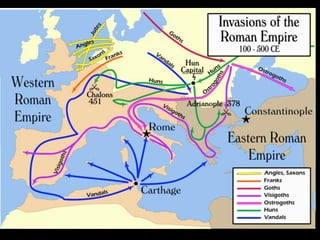
Barbaric Tribes Destroy Western
• Germanic (Teutonic) Tribes
  exert pressure 1st-4th c. CE
• Huns Invade Europe 4th-5th c.
  CE
• Germanic Tribes 4th-5th c. CE
• 476 CE Germanic mercenaries
  overthrow last emperor of Rome
476 CE: End of Western Empire
• Fall Attributed to:
  – Political
     • Inefficient and corrupt
     • Empire too vast
     • Rivalries and infighting
  – Economic
     • Small farmers no longer independent, lost
       incentive to increase production and improve
       methods
     • Heavy, unjust taxation
     • Unemployment due to use of slaves
476 CE: End of Western Empire
• Fall Attributed to
  – Social
     • Interested in luxury or survival
     • Sharp class distinctions

Overviewofthe romanempire

  • 1.
  • 3.
    Early History • 500BCE – Drive out Etruscans, establish Republic – Patricians vs. Plebians • 5th-3rd cent. BCE – Republic becomes more democratic, achieving reforms harmoniously for the good of the Republic
  • 4.
    Wars • 340-270 BCE:Conquered Italian peninsula –Powerful armies –Ability to move troops –Wise treatment of conquered peoples
  • 5.
    Wars • 264-146: ConqueredW. Medit – Carthage Commercial Empire –Punic Wars •Sicily •Hannibal defeated, conquer Spain and N. Africa •Carthage itself
  • 7.
    Problems with ExpandedRepublic • Wealth gap • Small farmers disappear, estates and slaves appear • High number of unemployed form allegiance with generals who promise improvements instead of republic
  • 8.
    Rise of Christianity •Grew slowly for two centuries • Message of equality, love and salvation resonated with lower classes • By late third century, was a sizeable minority
  • 9.
    Technology • Bridge building •Ballistic weapons • Aqueducts • Arches and domes • Concrete
  • 10.
    Republic to Dictatorship •Civil wars, generals battle – Marius v. Sulla • 60 BCE Triumvirate (Caesar-general, Pompey- general, Crassus-wealthy noble) • Caesar popularity up because of victories in Gaul • 49 BCE – Senate orders Caesar to disband army because fear of his popularity – Caesar crosses the Rubicon • Assassination in 44 BCE
  • 13.
    Republic to Dictatorship •Octavian (Caesar’s grand nephew) and Mark Antony def. Brutus and Cassius • Octavian def. Mark Antony • Octavian becomes absolute ruler of Rome
  • 14.
    27 BCE-476 CE Empire/Military dictatorship • Octavian accepts the title Augustus • Augustus’ accomplishments – Maintained peace – Provided stable govt – Established fair taxation – Encouraged science, art and literature – Constructed many roads • But… – Any real democracy is gone, Rome run by an emperor, Senate bends to his whims
  • 15.
    27 BCE-476 CE Empire/Military dictatorship • 180 CE to 284 CE –Tiberius, Caligula, and Nero…the less said about them the better.
  • 16.
    27 BCE-476 CE Empire/Military dictatorship • 284-305 CE: Diocletian – Diocletian splits empire into East and West to simplify gov’t and administration
  • 17.
    27 BCE-476 CE Empire/Military dictatorship • 312-337 CE: Constantine –Reunites empire by force –Moves capital to Constantinople –Ends persecution of Christians (Edict of Milan in 313) –Converts to Christianity at end of life
  • 19.
    Barbaric Tribes DestroyWestern • Germanic (Teutonic) Tribes exert pressure 1st-4th c. CE • Huns Invade Europe 4th-5th c. CE • Germanic Tribes 4th-5th c. CE • 476 CE Germanic mercenaries overthrow last emperor of Rome
  • 21.
    476 CE: Endof Western Empire • Fall Attributed to: – Political • Inefficient and corrupt • Empire too vast • Rivalries and infighting – Economic • Small farmers no longer independent, lost incentive to increase production and improve methods • Heavy, unjust taxation • Unemployment due to use of slaves
  • 22.
    476 CE: Endof Western Empire • Fall Attributed to – Social • Interested in luxury or survival • Sharp class distinctions

Editor's Notes

  • #2 Patrick BelottAlbert Einstein High School, Kensington, MDPatrick_Belott@mcpsmd.org\n
  • #3 \n
  • #4 At first, RR was an aristocracy, with power in the hands of wealthy nobles, the patricians. Rest of the Roman people, farmers and laborers were known as plebians and excluded from government.\nGained right to 1) elect tribunes empowered to veto actions of the consuls and the Senate 2) enact laws in the peoples assemblies 3) hold all govt offices. Also Roman law was codified.\n
  • #5 Roman citizen-soldiers felt deeply responsible to their Republic. They fought not for a despot but for their own freedom, land and government.\n \nSecured allegiance of conquered peoples by granting Roman citizenship in exchange for troops\n
  • #6 \n
  • #7 \n
  • #8 Nobles acquired huge estates in the new provinces; merchants filled new army contracts, found new markets to trade in; govt officials in the new provinces abuses new privileges and amassed fortunes at expense of subjects\nSmall independent farmers were forced to devote time to military service to defend expanded republic landowners bought up their land and consolidated them into huge estates called Latifundia (whose owners preferred cash crops to staple crops) Owners found new sources of slave labor peasants abanded land and migrated to cities city workers suffered serious unemployment\nSmall farmer was the backbone of Russian army, as he disappeared, citizen-soldiers who were loyal to the state, were replaced by professional soldiers, fighting for pay and booty, loyal to their commanders\n
  • #9 Developed hierarchy of priests nad bishops\nDerisively called a “slave religion” by some elites\n
  • #10 \n
  • #11 Common people wanted reform, since the elite were now wealthy and powerful, they no longer wanted compromise civil war between generals wrecked the Republic\nTriumvirate\n“Punitive devastations completed human, economic, and ecological disaster probably unequalled until the conquest of the Americas”\nStabbed by close friend and senator Brutus “et tu Brute”\n
  • #12 \n
  • #13 \n
  • #14 \n
  • #15 Augustus meaning holy or sacred majesty\nEdward Gibbon in Decline and Fall of the Roman Empire says that this time period from 27 BCE to 180 CE, the “Augustan Age” or the Pax Romana (Roman Peace) was the single finest period in human history\nPeople were generally happy despite loss of democracy but Do dogs protest when they're served their dinner? \n
  • #16 \n
  • #17 Diocletian was the last emperor to actively persecute Christians\n
  • #18 \n
  • #19 \n
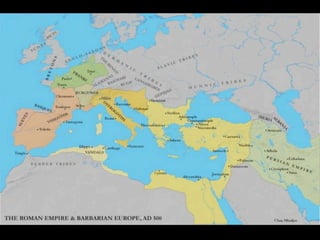
  • #20  - Primitive, warlike\n Attracted to fertile land, wealth, benefits of civilization\n Thwarted by Romans \n\n- Central Asia, terrorized Europe\n Atilla, “Scourge of God” ravaged Europe, turned back but\n Weakened Rome, hasten downfall\n \n - Mass migrations couldn’t be stop, Roman govt too enfeeble\n Tribes est kingdoms within empire\n Visigoths-Spain\n Ostrogoths-Italy\n Franks-Gaul\n Saxons-Britain\n
  • #21 \n
  • #22 Did not command peoples loyalty\nToo big, primative communication and transportation could not be governered from one city\nCaused many civil wars as no sucessors, had to fight\n\nWorked on estates for someone else…why improve?\nDestroyed ambition to work...people chose to quit work all together bc taxes were so high\n
  • #23 Wealthy wanted more wealth and protect what they had, poor just wanted to survive…early Roman ideals of patriotism, service to the state and morality were gone\nUpper classes wealthy and educated, lower classes poor and ignorant\n