The Cold War
NATO/Warsaw pact
Kaija Lazda
1945-1991
Crowder 3rd
Timeline of Events
August 6, 1945- United States dropped bomb on Hiroshima
August 14, 1945- End of World War II
June 24, 1948- The Berlin blockade begins
April 4, 1949- NATO is formed
May 12 1949- Berlin blockade ends
June 1950-July 1953- Korean war begins and ends
May 1955- Warsaw Pact formed
May 1960- U.S. spy plane was shot down over Soviet territory
November 1960- John F. Kennedy became president
April 1961- Bay of Pigs
August 13,17- The border or Berlin is closed off;construction begins of the Berlin Wall
October 1962- Cuban Missile Crisis
November 1963- President Kennedy assassinated
July 20, 1969- Apollo 11 wins space race by landing on the moon
November 1989- Fall of the Berlin Wall
December 1989- Soviet empire along with the communist governments of Czechoslovakia,Rumania,
and Bulgaria fall.
August 1991- End of Soviet Union The cold war comes to an end.
Overview
 The Cold War began to form after World War II. The
disagreements started between 1947-1951. The
world split into two large organizations NATO (North
Atlantic Treaty Organization) and the Warsaw pact.
Many people believed at that time that a nuclear
war would start. The main tensions were between
The Soviet Union (“Russia”) and The United States.
Both sides and their allies were building up their
weapons but did not use them. It was a fight
between political systems for power.
Important People
 Nikita Kruschev (1894-1971)
 John F. Kennedy (1917-1963)
 Ronald Reagan(1911-2004)
 Mikhail Gorbachev(1931- )
Nikita Khrushchev (1894-1971)
 After Joseph Stalin died Nikita
Khrushchev became chief director
of the Soviet Union. He was a
strong believer in the communist
party, and he became the First
Secretary from September 7, 1953
to October 14, 1964. Khrushchev
was Premier of the Soviet Union
from March 27, 1958 to October
14, 1964. He was born on April 17,
1894 and died on September 11,
1971 when he was 77 years old. He
was notorious for his rudeness of
interrupting speeches and
removing his shoe to bang it on the
podium during debates at the
United Nations.
Nikita Khrushchev
John F. Kennedy (1917-1963)
 John F. Kennedy was the 35th
President of the United States.
He was in office from January
20, 1961 until November 22,
1963. Kennedy was the
president during the Bay of
Pigs, Cuban Missile Crisis, the
building of the Berlin Wall, the
Vietnam war and the American
Civil rights movement. On
November 22,1963 Kennedy was
in Dallas, Texas and was
assassinated. John F. Kennedy
Ronald Reagan(1911-2004)
 Ronald Reagan became the
40th president of the United
States on January 20, 1981
and left office on January 20,
1989. He was the governor of
California from 1967 to 1975.
Regan served two terms also
partly during the cold war.
He ordered a massive military
buildup while racing against
the Soviet Union. He later
spoke with Mikhail Gorbachev
and they shrunk the US and
Russia's nuclear weaponry.
Ronald Reagan
Mikhail Gorbachev(1931- )
 Mikhail Gorbachev is the
leader of the Union of Social-
Democrats. He used to be
the General Secretary of the
Communist Party of the
Soviet Union, he was also
head of the USSR. Gorbachev
was awarded the Nobel
Peace Prize in 1990. He had
helped end the Cold War and
the Communist Party of the
Soviet Union. Mikhail
Gorbachev was born March 2,
1931 and he is still alive. Mikhail Gorbachev
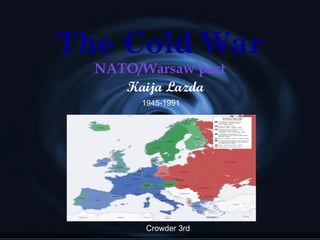
The US vs. the Soviet Union
NATO- Blue
Warsaw Pact- RED
Russia became communist
and also captured many
countries:
Armenia, Azerbaijan, Belarus,
Estonia, Georgia,
Kazakhstan, Kyrgyzstan,
Latvia, Lithuania, Moldova,
Tajikistan, Turkmenistan,
Ukraine, Uzbekistan.
Together with the Russian
Federation these fifteen
republics formed the USSR.The United States also was
affected by the Cold War
because of the Bay of Pigs
an the Cuban Missile crisis.
Lots of the conflict
happened in Germany
because it had borders with
allies of the Warsaw Pact
and NATO.
How it started
 Capitalists and Communists had been clashing
since the Russian revolution but the
disagreements got worse after World War II.
Germany had been split up into many parts when
World War II ended. The Soviet Union had the east
bit which also had Berlin. The United States,
France, Britain, and The Soviet Union all had a
part of Berlin. The Soviet Union wanted the rest
of Berlin and that’s how the Berlin Blockade got
started.
Primary Source
 Khrushchev wrote to Kennedy twice about the Cuban missile crisis.
The first letter was sent on October 26, 1962 and contained the
statement that if the United States agreed not to attack Cuba then
the Soviet Union would take the weapons out.Below is part of the
first letter.
 “Why have we proceeded to assist Cuba with military and
economic aid? The answer is: We have proceeded to do so
only for reasons of humanitarianism. At one time, our
people itself had a revolution, when Russia was still a
backwards country. We were attacked then. We were the
target of attack by many countries. The USA participated in
that adventure. This had been recorded by our participants
in the aggression against our country. A whole book has
been written about this by General Graves, who, at that
time, commanded the US Expeditionary Corps. Graves called
it ‘The American Adventure in Siberia.”
 Kruschev wrote a second letter to Kennedy which was more
aggressive and asking him about the missiles stationed in Turkey
pointing at Russia.
Letters from Khrushchev to Kennedy
Berlin Blockade
The Soviet Union wanted all of Berlin. At that time
the United States,the Soviet Union, France, and
Great Britain all occupied some part of Berlin. On
June 24, 1948 the Soviet Union blocked off all roads
and rail roads entering and leaving East Germany.
The other countries were not able to access their
part of Berlin. The people in Berlin were starving so
the United States and Britain started sending airlifts
of food. They ultimately lasted 321 days. A plane
took off every three minutes to bring the food and
medicine. The blockade ended May 11, 1949.
The Forming of NATO
 The North Atlantic Treaty Organization include
twelve nations that have an alliance. These
include The United States and The United
Kingdome. NATO was officially formed on April 4,
1949. They all signed the North Atlantic Treaty.
After the fall of communism NATO has become a
political force rather than a military force.
The NATO flag.
The Formation of the
Warsaw Pact
 Warsaw Treaty of Friendship,
Cooperation, and mutual
assistance was formed on May
14, 1955 in Warsaw, Poland.
The Warsaw Pact was formed
the same year that NATO was
announced and is thought to
have been created due to
NATO’s formation. There
were eight members of this
pact. This pact is ,since 1991,
extinct or “nonexistent”. Warsaw poster
Bay of Pigs
 On April 15, 1961 aircrafts flew over
Cuba attempting to wipe out Castro’s
air force. It was supposed to look like
it was only Cuban exiles. The attack
might have worked if the second and
third air strikes had not been
cancelled. The mission was overall
unsuccessful.
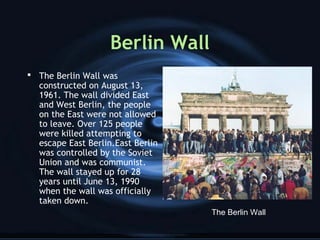
Berlin Wall
 The Berlin Wall was
constructed on August 13,
1961. The wall divided East
and West Berlin, the people
on the East were not allowed
to leave. Over 125 people
were killed attempting to
escape East Berlin.East Berlin
was controlled by the Soviet
Union and was communist.
The wall stayed up for 28
years until June 13, 1990
when the wall was officially
taken down.
The Berlin Wall
Space Race
 The Space Race was race
between the United States
and the Soviet Union to see
who could explore outer
space first. When the Soviets
launched Sputnik the whole
race slowly began. The
Apollo 11 mission by the
United States was very
successful and was watched
by 500million people around
the world. Landing on the moon
How it Ended
 Economic reforms were made by Mikhail
Gorbachev when he became head of the
Soviet Union. His new policies were called
perestroika. Gorbachev and Reagan worked
together to eliminate nuclear weapons.
Demonstration started in East Germany and
the Soviet republics began rebelling.
Citations
 Hillstrom, Kevin. The Cold War. Detroit: Primary Sourcebook
Series, 2006. 253-263.
 "Timeline of the Cold War." Think Quest. 29 Nov. 2007
<http://library.thinkquest.org/10826/timeline.htm>.
 "NATO." Audifaz. 29 Nov. 2007
<http://www.audifaz.com/coldwar/nato.htm>.
 "Nikita Khrushchev." Spartacus Educational. 29 Nov. 2007
<http://www.spartacus.schoolnet.co.uk/RUSkhrushchev.htm>.
 "Mikhail Gorbachev." Britannica. 29 Nov. 2007
<http://www.Britannica.com/eb/article-9037405>.
 Sewell, Mike. The Cold War. Cambridge: Cambridge University
P, 2002.

Cold war

  • 1.
    The Cold War NATO/Warsawpact Kaija Lazda 1945-1991 Crowder 3rd
  • 2.
    Timeline of Events August6, 1945- United States dropped bomb on Hiroshima August 14, 1945- End of World War II June 24, 1948- The Berlin blockade begins April 4, 1949- NATO is formed May 12 1949- Berlin blockade ends June 1950-July 1953- Korean war begins and ends May 1955- Warsaw Pact formed May 1960- U.S. spy plane was shot down over Soviet territory November 1960- John F. Kennedy became president April 1961- Bay of Pigs August 13,17- The border or Berlin is closed off;construction begins of the Berlin Wall October 1962- Cuban Missile Crisis November 1963- President Kennedy assassinated July 20, 1969- Apollo 11 wins space race by landing on the moon November 1989- Fall of the Berlin Wall December 1989- Soviet empire along with the communist governments of Czechoslovakia,Rumania, and Bulgaria fall. August 1991- End of Soviet Union The cold war comes to an end.
  • 3.
    Overview  The ColdWar began to form after World War II. The disagreements started between 1947-1951. The world split into two large organizations NATO (North Atlantic Treaty Organization) and the Warsaw pact. Many people believed at that time that a nuclear war would start. The main tensions were between The Soviet Union (“Russia”) and The United States. Both sides and their allies were building up their weapons but did not use them. It was a fight between political systems for power.
  • 4.
    Important People  NikitaKruschev (1894-1971)  John F. Kennedy (1917-1963)  Ronald Reagan(1911-2004)  Mikhail Gorbachev(1931- )
  • 5.
    Nikita Khrushchev (1894-1971) After Joseph Stalin died Nikita Khrushchev became chief director of the Soviet Union. He was a strong believer in the communist party, and he became the First Secretary from September 7, 1953 to October 14, 1964. Khrushchev was Premier of the Soviet Union from March 27, 1958 to October 14, 1964. He was born on April 17, 1894 and died on September 11, 1971 when he was 77 years old. He was notorious for his rudeness of interrupting speeches and removing his shoe to bang it on the podium during debates at the United Nations. Nikita Khrushchev
  • 6.
    John F. Kennedy(1917-1963)  John F. Kennedy was the 35th President of the United States. He was in office from January 20, 1961 until November 22, 1963. Kennedy was the president during the Bay of Pigs, Cuban Missile Crisis, the building of the Berlin Wall, the Vietnam war and the American Civil rights movement. On November 22,1963 Kennedy was in Dallas, Texas and was assassinated. John F. Kennedy
  • 7.
    Ronald Reagan(1911-2004)  RonaldReagan became the 40th president of the United States on January 20, 1981 and left office on January 20, 1989. He was the governor of California from 1967 to 1975. Regan served two terms also partly during the cold war. He ordered a massive military buildup while racing against the Soviet Union. He later spoke with Mikhail Gorbachev and they shrunk the US and Russia's nuclear weaponry. Ronald Reagan
  • 8.
    Mikhail Gorbachev(1931- ) Mikhail Gorbachev is the leader of the Union of Social- Democrats. He used to be the General Secretary of the Communist Party of the Soviet Union, he was also head of the USSR. Gorbachev was awarded the Nobel Peace Prize in 1990. He had helped end the Cold War and the Communist Party of the Soviet Union. Mikhail Gorbachev was born March 2, 1931 and he is still alive. Mikhail Gorbachev
  • 9.
    The US vs.the Soviet Union NATO- Blue Warsaw Pact- RED Russia became communist and also captured many countries: Armenia, Azerbaijan, Belarus, Estonia, Georgia, Kazakhstan, Kyrgyzstan, Latvia, Lithuania, Moldova, Tajikistan, Turkmenistan, Ukraine, Uzbekistan. Together with the Russian Federation these fifteen republics formed the USSR.The United States also was affected by the Cold War because of the Bay of Pigs an the Cuban Missile crisis. Lots of the conflict happened in Germany because it had borders with allies of the Warsaw Pact and NATO.
  • 10.
    How it started Capitalists and Communists had been clashing since the Russian revolution but the disagreements got worse after World War II. Germany had been split up into many parts when World War II ended. The Soviet Union had the east bit which also had Berlin. The United States, France, Britain, and The Soviet Union all had a part of Berlin. The Soviet Union wanted the rest of Berlin and that’s how the Berlin Blockade got started.
  • 11.
    Primary Source  Khrushchevwrote to Kennedy twice about the Cuban missile crisis. The first letter was sent on October 26, 1962 and contained the statement that if the United States agreed not to attack Cuba then the Soviet Union would take the weapons out.Below is part of the first letter.  “Why have we proceeded to assist Cuba with military and economic aid? The answer is: We have proceeded to do so only for reasons of humanitarianism. At one time, our people itself had a revolution, when Russia was still a backwards country. We were attacked then. We were the target of attack by many countries. The USA participated in that adventure. This had been recorded by our participants in the aggression against our country. A whole book has been written about this by General Graves, who, at that time, commanded the US Expeditionary Corps. Graves called it ‘The American Adventure in Siberia.”  Kruschev wrote a second letter to Kennedy which was more aggressive and asking him about the missiles stationed in Turkey pointing at Russia. Letters from Khrushchev to Kennedy
  • 12.
    Berlin Blockade The SovietUnion wanted all of Berlin. At that time the United States,the Soviet Union, France, and Great Britain all occupied some part of Berlin. On June 24, 1948 the Soviet Union blocked off all roads and rail roads entering and leaving East Germany. The other countries were not able to access their part of Berlin. The people in Berlin were starving so the United States and Britain started sending airlifts of food. They ultimately lasted 321 days. A plane took off every three minutes to bring the food and medicine. The blockade ended May 11, 1949.
  • 13.
    The Forming ofNATO  The North Atlantic Treaty Organization include twelve nations that have an alliance. These include The United States and The United Kingdome. NATO was officially formed on April 4, 1949. They all signed the North Atlantic Treaty. After the fall of communism NATO has become a political force rather than a military force. The NATO flag.
  • 14.
    The Formation ofthe Warsaw Pact  Warsaw Treaty of Friendship, Cooperation, and mutual assistance was formed on May 14, 1955 in Warsaw, Poland. The Warsaw Pact was formed the same year that NATO was announced and is thought to have been created due to NATO’s formation. There were eight members of this pact. This pact is ,since 1991, extinct or “nonexistent”. Warsaw poster
  • 15.
    Bay of Pigs On April 15, 1961 aircrafts flew over Cuba attempting to wipe out Castro’s air force. It was supposed to look like it was only Cuban exiles. The attack might have worked if the second and third air strikes had not been cancelled. The mission was overall unsuccessful.
  • 16.
    Berlin Wall  TheBerlin Wall was constructed on August 13, 1961. The wall divided East and West Berlin, the people on the East were not allowed to leave. Over 125 people were killed attempting to escape East Berlin.East Berlin was controlled by the Soviet Union and was communist. The wall stayed up for 28 years until June 13, 1990 when the wall was officially taken down. The Berlin Wall
  • 17.
    Space Race  TheSpace Race was race between the United States and the Soviet Union to see who could explore outer space first. When the Soviets launched Sputnik the whole race slowly began. The Apollo 11 mission by the United States was very successful and was watched by 500million people around the world. Landing on the moon
  • 18.
    How it Ended Economic reforms were made by Mikhail Gorbachev when he became head of the Soviet Union. His new policies were called perestroika. Gorbachev and Reagan worked together to eliminate nuclear weapons. Demonstration started in East Germany and the Soviet republics began rebelling.
  • 19.
    Citations  Hillstrom, Kevin.The Cold War. Detroit: Primary Sourcebook Series, 2006. 253-263.  "Timeline of the Cold War." Think Quest. 29 Nov. 2007 <http://library.thinkquest.org/10826/timeline.htm>.  "NATO." Audifaz. 29 Nov. 2007 <http://www.audifaz.com/coldwar/nato.htm>.  "Nikita Khrushchev." Spartacus Educational. 29 Nov. 2007 <http://www.spartacus.schoolnet.co.uk/RUSkhrushchev.htm>.  "Mikhail Gorbachev." Britannica. 29 Nov. 2007 <http://www.Britannica.com/eb/article-9037405>.  Sewell, Mike. The Cold War. Cambridge: Cambridge University P, 2002.