The Universal Declaration of
Human Rights- 1948
 Whereas recognition of the inherent dignity and
of the equal and inalienable rights of all members
of the human family is the foundation of
freedom, justice and peace in the world,
 Whereas disregard and contempt for human
rights have resulted in barbarous acts which have
outraged the conscience of mankind, and the
advent of a world in which human beings shall
enjoy freedom of speech and belief and freedom
from fear and want has been proclaimed as the
highest aspiration of the common people,
The Universal Declaration of
Human Rights- 1948
 All human beings are born free and equal
in dignity and rights. They are endowed
with reason and conscience and should act
towards one another in a spirit of
brotherhood.
 Everyone is entitled to all the rights and
freedoms set forth in this Declaration,
without distinction of any kind, such as
race, colour, sex, language, religion,
political or other opinion, national or social
origin, property, birth or other status
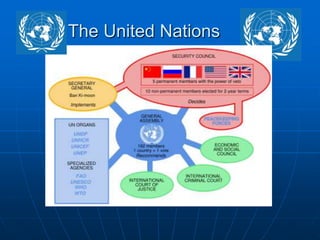
The United Nations
United Nations Created
 Peace keeping organization
 General Assembly
 Security Council- power to
investigate and settle disputes
• 5 permanent members (US, USSR,
China, France, GB)- each has the veto
power
Was the United Nations able
to keep the peace?
IDK…
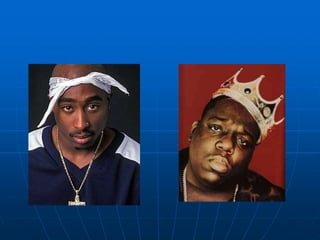
There are lots of rivalries
today!
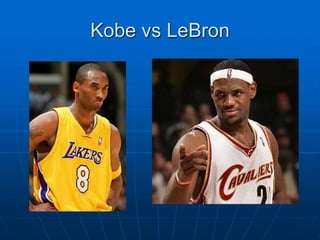
Kobe vs LeBron
Duke vs UNC
McDonald’s vs Burger King
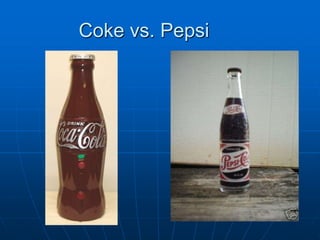
Coke vs. Pepsi
Rangers vs Devils
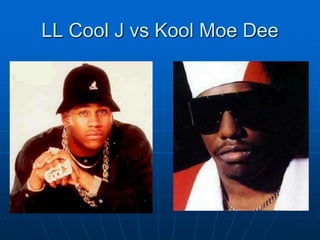
LL Cool J vs Kool Moe Dee
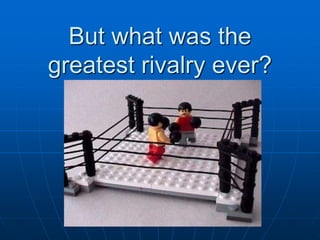
But what was the
greatest rivalry ever?
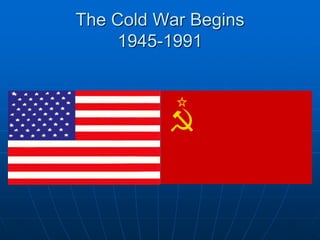
The Cold War Begins
1945-1991
Cold War Characterisitcs
 A political, strategic and ideological
struggle between the US and the
USSR that spread throughout the
world-Europe, Asia, Africa and Latin
America.
 Each side denied the others right to
exist.
 Each side used propaganda against
the other.
Why did allies become enemies?
 Allied powers: US, USSR, GB, F
 But… U.S. and USSR not happy with
one another…
• U.S. mad at USSR Non-aggression pact
with Hitler
• Stalin was mad that the US hadn’t
invaded Europe before 1944
• failure of the Soviet Union to withdraw
from Eastern Europe
Soviet dominance over Eastern
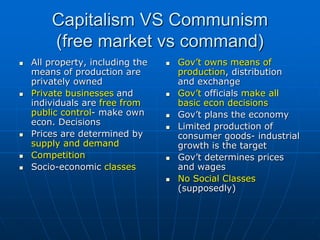
Capitalism VS Communism
(free market vs command)
 All property, including the
means of production are
privately owned
 Private businesses and
individuals are free from
public control- make own
econ. Decisions
 Prices are determined by
supply and demand
 Competition
 Socio-economic classes
 Gov’t owns means of
production, distribution
and exchange
 Gov’t officials make all
basic econ decisions
 Gov’t plans the economy
 Limited production of
consumer goods- industrial
growth is the target
 Gov’t determines prices
and wages
 No Social Classes
(supposedly)
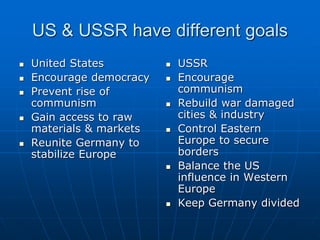
US & USSR have different goals
 United States
 Encourage democracy
 Prevent rise of
communism
 Gain access to raw
materials & markets
 Reunite Germany to
stabilize Europe
 USSR
 Encourage
communism
 Rebuild war damaged
cities & industry
 Control Eastern
Europe to secure
borders
 Balance the US
influence in Western
Europe
 Keep Germany divided
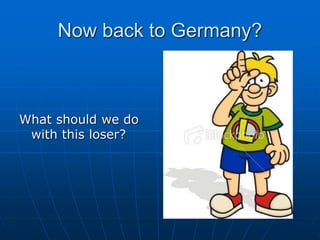
Now back to Germany?
What should we do
with this loser?
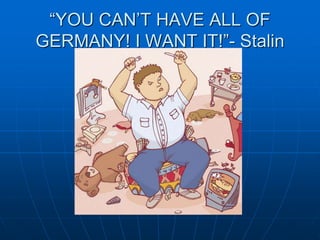
“YOU CAN’T HAVE ALL OF
GERMANY! I WANT IT!”- Stalin
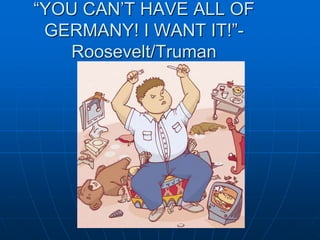
“YOU CAN’T HAVE ALL OF
GERMANY! I WANT IT!”-
Roosevelt/Truman
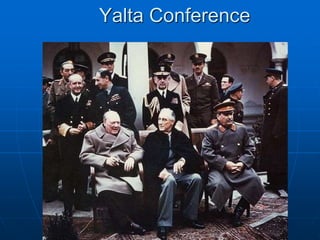
Yalta Conference
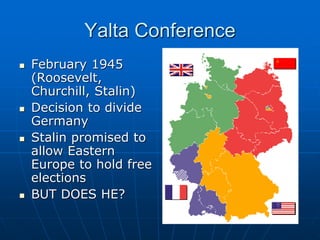
Yalta Conference
 February 1945
(Roosevelt,
Churchill, Stalin)
 Decision to divide
Germany
 Stalin promised to
allow Eastern
Europe to hold free
elections
 BUT DOES HE?
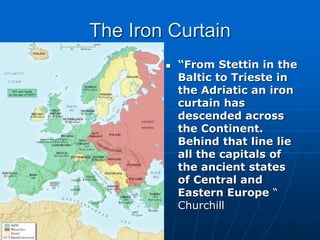
The Iron Curtain
 “From Stettin in the
Baltic to Trieste in
the Adriatic an iron
curtain has
descended across
the Continent.
Behind that line lie
all the capitals of
the ancient states
of Central and
Eastern Europe “
Churchill
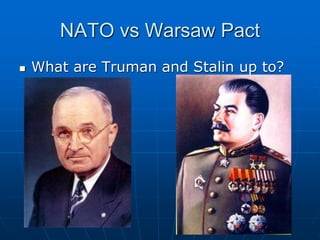
NATO vs Warsaw Pact
 What are Truman and Stalin up to?
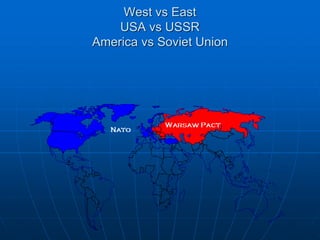
West vs East
USA vs USSR
America vs Soviet Union
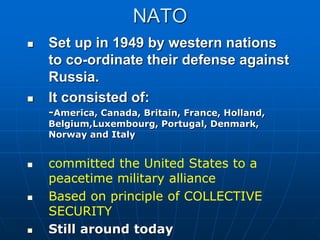
NATO
 Set up in 1949 by western nations
to co-ordinate their defense against
Russia.
 It consisted of:
-America, Canada, Britain, France, Holland,
Belgium,Luxembourg, Portugal, Denmark,
Norway and Italy
 committed the United States to a
peacetime military alliance
 Based on principle of COLLECTIVE
SECURITY
 Still around today
Warsaw pact
 Response to NATO (1949) and the re-
militarization of West Germany in 1954
[both were viewed as a threat to the
Eastern countries]
 Supposedly the pact was based on total
equality of member nations & mutual non-
interference in one another’s internal
affairs
 In reality—the Pact quickly became a
powerful political tool for the Soviet Union
to hold sway over its allies and harness
the powers of their combined military.
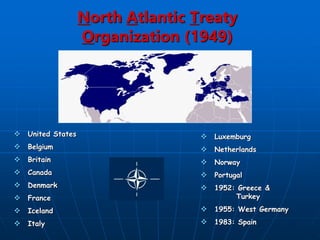
North Atlantic Treaty
Organization (1949)
 United States
 Belgium
 Britain
 Canada
 Denmark
 France
 Iceland
 Italy
 Luxemburg
 Netherlands
 Norway
 Portugal
 1952: Greece &
Turkey
 1955: West Germany
 1983: Spain
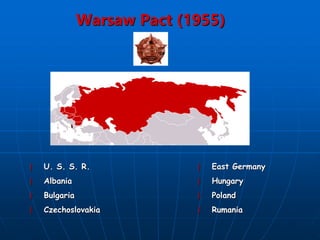
Warsaw Pact (1955)
} U. S. S. R.
} Albania
} Bulgaria
} Czechoslovakia
} East Germany
} Hungary
} Poland
} Rumania
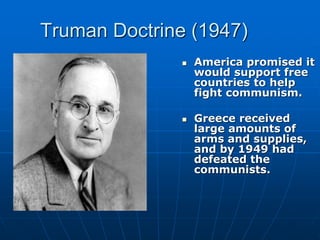
Truman Doctrine (1947)
 America promised it
would support free
countries to help
fight communism.
 Greece received
large amounts of
arms and supplies,
and by 1949 had
defeated the
communists.
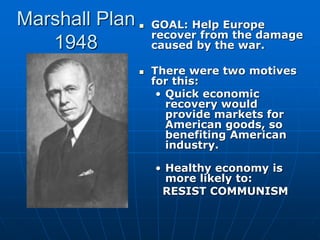
Marshall Plan
1948
 GOAL: Help Europe
recover from the damage
caused by the war.
 There were two motives
for this:
• Quick economic
recovery would
provide markets for
American goods, so
benefiting American
industry.
• Healthy economy is
more likely to:
RESIST COMMUNISM
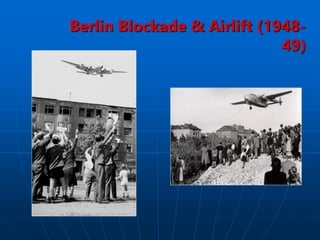
Berlin Blockade & Airlift (1948-
49)
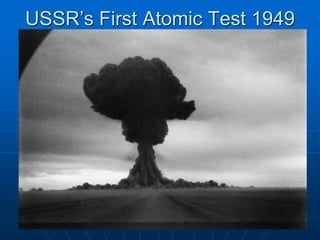
USSR’s First Atomic Test 1949
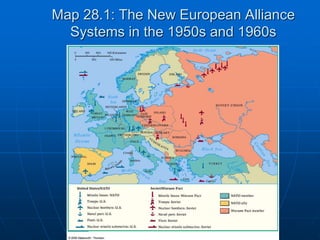
Map 28.1: The New European Alliance
Systems in the 1950s and 1960s
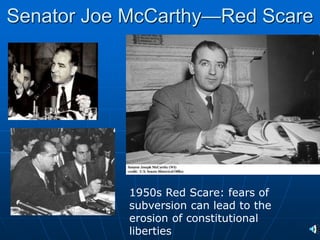
Senator Joe McCarthy—Red Scare

1950s Red Scare: fears of
subversion can lead to the
erosion of constitutional
liberties
 During this time one state required
pro wrestlers to take a loyalty oath
before stepping into the ring.
 In Indiana, a group of anti-
communists indicted Robin Hood
as communist literature and forced
librarians to pull the book from the
shelves.
 Baseball's Cincinnati Reds renamed
themselves the "Redlegs.“
 Participation, or even past
participation, in extremist movements
was viewed as un-American
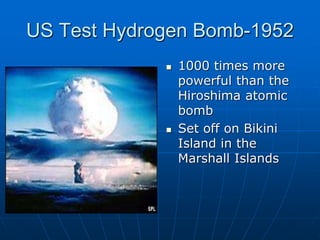
US Test Hydrogen Bomb-1952
 1000 times more
powerful than the
Hiroshima atomic
bomb
 Set off on Bikini
Island in the
Marshall Islands
United States Government supported
dictatorships in economically less developed
nations since World War II because they
were ANTI-COMMUNISTS!
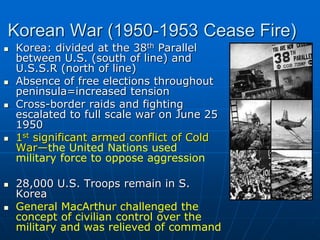
Korean War (1950-1953 Cease Fire)
 Korea: divided at the 38th Parallel
between U.S. (south of line) and
U.S.S.R (north of line)
 Absence of free elections throughout
peninsula=increased tension
 Cross-border raids and fighting
escalated to full scale war on June 25
1950
 1st significant armed conflict of Cold
War—the United Nations used
military force to oppose aggression
 28,000 U.S. Troops remain in S.
Korea
 General MacArthur challenged the
concept of civilian control over the
military and was relieved of command
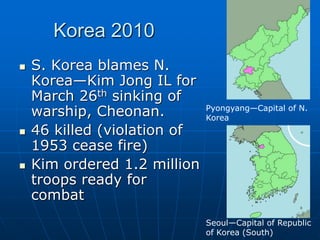
Korea 2010
 S. Korea blames N.
Korea—Kim Jong IL for
March 26th sinking of
warship, Cheonan.
 46 killed (violation of
1953 cease fire)
 Kim ordered 1.2 million
troops ready for
combat
Pyongyang—Capital of N.
Korea
Seoul—Capital of Republic
of Korea (South)
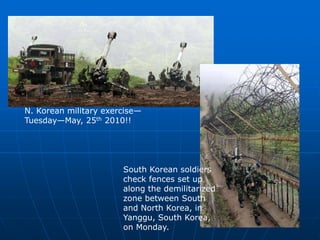
South Korean soldiers
check fences set up
along the demilitarized
zone between South
and North Korea, in
Yanggu, South Korea,
on Monday.
N. Korean military exercise—
Tuesday—May, 25th 2010!!
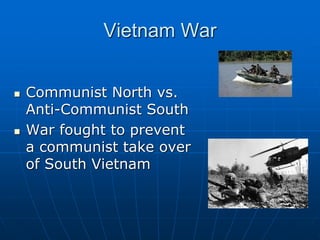
Vietnam War
 Communist North vs.
Anti-Communist South
 War fought to prevent
a communist take over
of South Vietnam
Hungarian Revolt 1956
 Imre Nagy—Nationalist & communist
• Ended 1 party rule
• Got rid of Soviet troops
• Withdrew Hungary from Warsaw Pact
• Soviet union sends troops & Tanks
• 1,000’s died
• Revolt suppressed
Czechoslovakia 1968
 Alexander Dubcek
• Calls for liberal reforms
• Eased censorship
• Plan for new constitution
• Troops sent in
• Gov’t overturned & communist
dictatorship set up
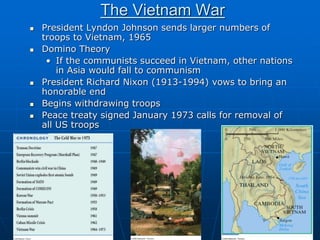
The Vietnam War
 President Lyndon Johnson sends larger numbers of
troops to Vietnam, 1965
 Domino Theory
• If the communists succeed in Vietnam, other nations
in Asia would fall to communism
 President Richard Nixon (1913-1994) vows to bring an
honorable end
 Begins withdrawing troops
 Peace treaty signed January 1973 calls for removal of
all US troops
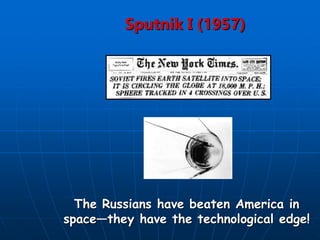
Sputnik I (1957)
The Russians have beaten America in
space—they have the technological edge!
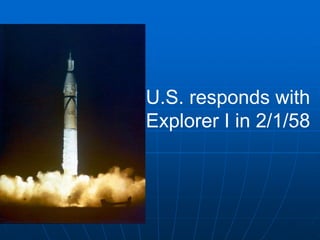
U.S. responds with
Explorer I in 2/1/58
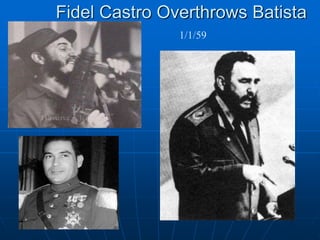
Fidel Castro Overthrows Batista
1/1/59
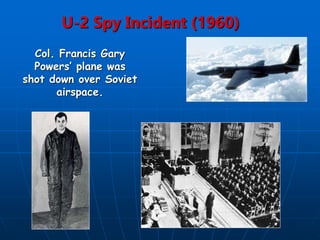
U-2 Spy Incident (1960)
Col. Francis Gary
Powers’ plane was
shot down over Soviet
airspace.
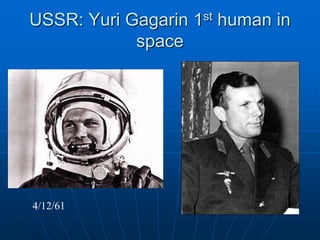
USSR: Yuri Gagarin 1st human in
space
4/12/61
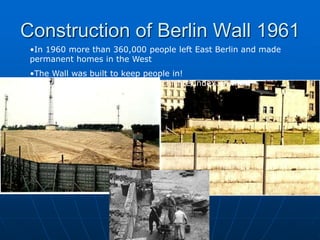
Construction of Berlin Wall 1961
•In 1960 more than 360,000 people left East Berlin and made
permanent homes in the West
•The Wall was built to keep people in!
http://www.berlin.de/mauer/geschichte/index.en.html
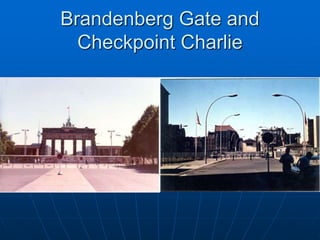
Brandenberg Gate and
Checkpoint Charlie
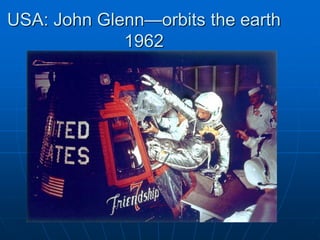
USA: John Glenn—orbits the earth
1962
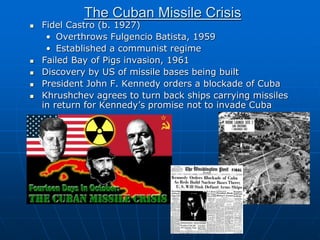
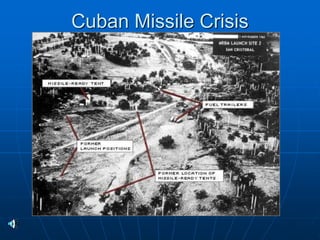
The Cuban Missile Crisis
 Fidel Castro (b. 1927)
• Overthrows Fulgencio Batista, 1959
• Established a communist regime
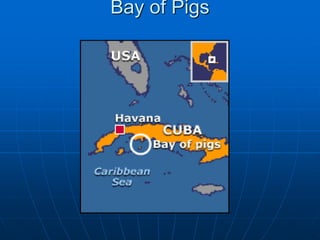
 Failed Bay of Pigs invasion, 1961
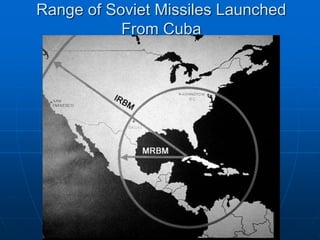
 Discovery by US of missile bases being built
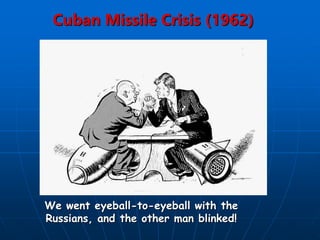
 President John F. Kennedy orders a blockade of Cuba
 Khrushchev agrees to turn back ships carrying missiles
in return for Kennedy’s promise not to invade Cuba
Bay of Pigs
Cuban Missile Crisis
Range of Soviet Missiles Launched
From Cuba
Cuban Missile Crisis (1962)
We went eyeball-to-eyeball with the
Russians, and the other man blinked!
Neil Armstrong
“That's one small step for [a] man, one giant leap for
mankind”
July 21, 1969
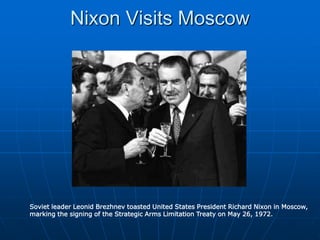
Nixon Visits Moscow
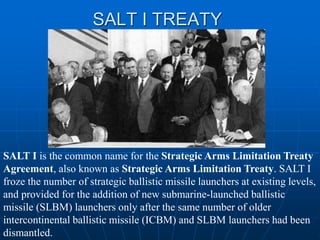
Soviet leader Leonid Brezhnev toasted United States President Richard Nixon in Moscow,
marking the signing of the Strategic Arms Limitation Treaty on May 26, 1972.
SALT I TREATY
SALT I is the common name for the Strategic Arms Limitation Treaty
Agreement, also known as Strategic Arms Limitation Treaty. SALT I
froze the number of strategic ballistic missile launchers at existing levels,
and provided for the addition of new submarine-launched ballistic
missile (SLBM) launchers only after the same number of older
intercontinental ballistic missile (ICBM) and SLBM launchers had been
dismantled.
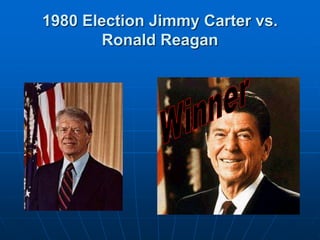
1980 Election Jimmy Carter vs.
Ronald Reagan
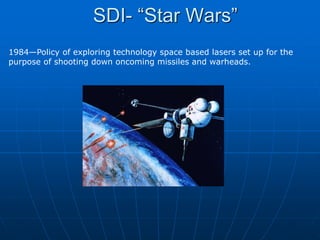
SDI- “Star Wars”
1984—Policy of exploring technology space based lasers set up for the
purpose of shooting down oncoming missiles and warheads.
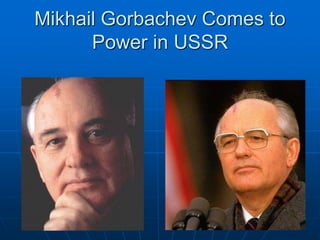
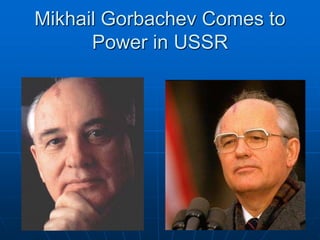
Mikhail Gorbachev Comes to
Power in USSR
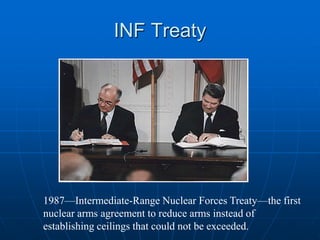
INF Treaty
1987—Intermediate-Range Nuclear Forces Treaty—the first
nuclear arms agreement to reduce arms instead of
establishing ceilings that could not be exceeded.
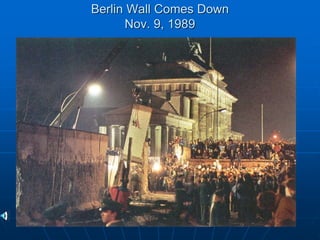
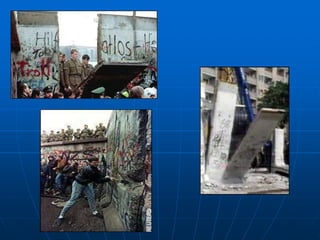
Berlin Wall Comes Down
Nov. 9, 1989
Discussion
 Why did the US win the Cold War?
 Why did the USSR lose the Cold
War?
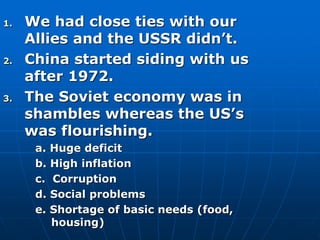
1. We had close ties with our
Allies and the USSR didn’t.
2. China started siding with us
after 1972.
3. The Soviet economy was in
shambles whereas the US’s
was flourishing.
a. Huge deficit
b. High inflation
c. Corruption
d. Social problems
e. Shortage of basic needs (food,
housing)
Mikhail Gorbachev Comes to
Power in USSR
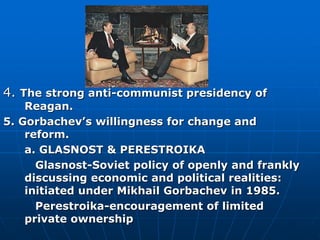
4. The strong anti-communist presidency of
Reagan.
5. Gorbachev’s willingness for change and
reform.
a. GLASNOST & PERESTROIKA
Glasnost-Soviet policy of openly and frankly
discussing economic and political realities:
initiated under Mikhail Gorbachev in 1985.
Perestroika-encouragement of limited
private ownership
b. admitted Soviet mistakes
c. communist system had
failed
6. Arms Reduction Talks
 SALT, INF, Reagan-Gorbachev
meetings
7. Soviet Mistakes
a. invasion of Afghanistan
b. ignoring social concerns
c. spent everything on military
Cold War Pop Culture in the 80’s
 Star Wars
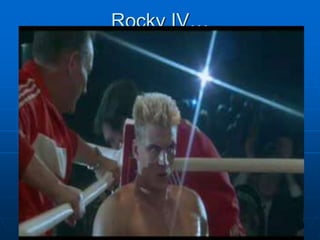
 Rocky IV
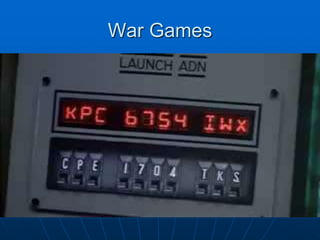
 War Games
 Red Dawn
 Miracle
 Spies Like Us
 James Bond
 99 Red Baloons
Rocky IV…
War Games
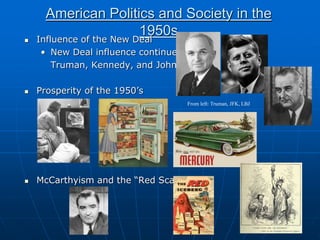
American Politics and Society in the
1950s
 Influence of the New Deal
• New Deal influence continued by
Truman, Kennedy, and Johnson
 Prosperity of the 1950’s
 McCarthyism and the “Red Scare”
From left: Truman, JFK, LBJ
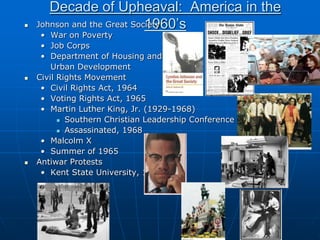
Decade of Upheaval: America in the
1960’s
 Johnson and the Great Society
• War on Poverty
• Job Corps
• Department of Housing and
Urban Development
 Civil Rights Movement
• Civil Rights Act, 1964
• Voting Rights Act, 1965
• Martin Luther King, Jr. (1929-1968)
 Southern Christian Leadership Conference
 Assassinated, 1968
• Malcolm X
• Summer of 1965
 Antiwar Protests
• Kent State University, 1970
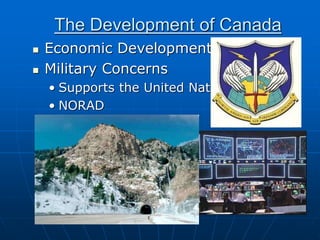
The Development of Canada
 Economic Development
 Military Concerns
• Supports the United Nations
• NORAD
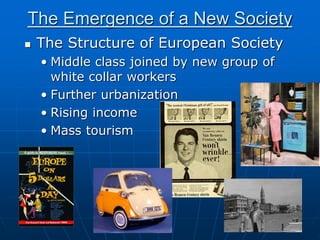
The Emergence of a New Society
 The Structure of European Society
• Middle class joined by new group of
white collar workers
• Further urbanization
• Rising income
• Mass tourism
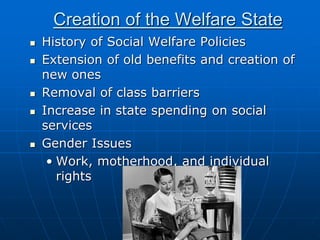
Creation of the Welfare State
 History of Social Welfare Policies
 Extension of old benefits and creation of
new ones
 Removal of class barriers
 Increase in state spending on social
services
 Gender Issues
• Work, motherhood, and individual
rights
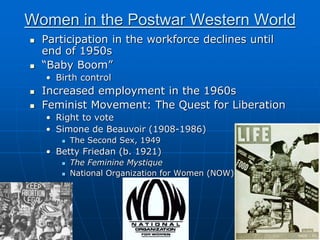
Women in the Postwar Western World
 Participation in the workforce declines until
end of 1950s
 “Baby Boom”
• Birth control
 Increased employment in the 1960s
 Feminist Movement: The Quest for Liberation
• Right to vote
• Simone de Beauvoir (1908-1986)
 The Second Sex, 1949
• Betty Friedan (b. 1921)
 The Feminine Mystique
 National Organization for Women (NOW)
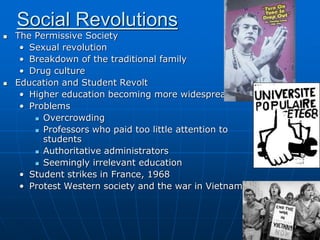
Social Revolutions
 The Permissive Society
• Sexual revolution
• Breakdown of the traditional family
• Drug culture
 Education and Student Revolt
• Higher education becoming more widespread
• Problems
 Overcrowding
 Professors who paid too little attention to
students
 Authoritative administrators
 Seemingly irrelevant education
• Student strikes in France, 1968
• Protest Western society and the war in Vietnam
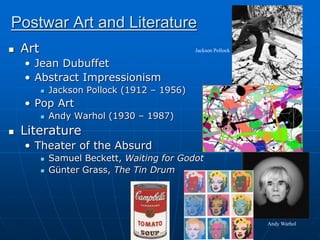
Postwar Art and Literature
 Art
• Jean Dubuffet
• Abstract Impressionism
 Jackson Pollock (1912 – 1956)
• Pop Art
 Andy Warhol (1930 – 1987)
 Literature
• Theater of the Absurd
 Samuel Beckett, Waiting for Godot
 Günter Grass, The Tin Drum
Andy Warhol
Jackson Pollock
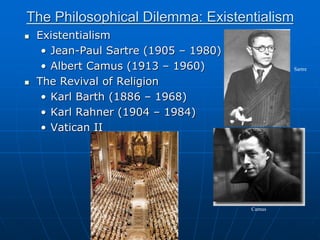
The Philosophical Dilemma: Existentialism
 Existentialism
• Jean-Paul Sartre (1905 – 1980)
• Albert Camus (1913 – 1960)
 The Revival of Religion
• Karl Barth (1886 – 1968)
• Karl Rahner (1904 – 1984)
• Vatican II
Camus
Sartre
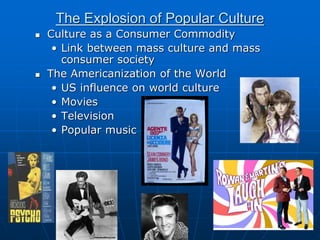
The Explosion of Popular Culture
 Culture as a Consumer Commodity
• Link between mass culture and mass
consumer society
 The Americanization of the World
• US influence on world culture
• Movies
• Television
• Popular music
AP Cold War 2014.ppt

AP Cold War 2014.ppt

  • 1.
    The Universal Declarationof Human Rights- 1948  Whereas recognition of the inherent dignity and of the equal and inalienable rights of all members of the human family is the foundation of freedom, justice and peace in the world,  Whereas disregard and contempt for human rights have resulted in barbarous acts which have outraged the conscience of mankind, and the advent of a world in which human beings shall enjoy freedom of speech and belief and freedom from fear and want has been proclaimed as the highest aspiration of the common people,
  • 2.
    The Universal Declarationof Human Rights- 1948  All human beings are born free and equal in dignity and rights. They are endowed with reason and conscience and should act towards one another in a spirit of brotherhood.  Everyone is entitled to all the rights and freedoms set forth in this Declaration, without distinction of any kind, such as race, colour, sex, language, religion, political or other opinion, national or social origin, property, birth or other status
  • 3.
  • 4.
    United Nations Created Peace keeping organization  General Assembly  Security Council- power to investigate and settle disputes • 5 permanent members (US, USSR, China, France, GB)- each has the veto power
  • 5.
    Was the UnitedNations able to keep the peace?
  • 6.
    IDK… There are lotsof rivalries today!
  • 7.
  • 8.
  • 9.
  • 13.
  • 14.
  • 15.
    LL Cool Jvs Kool Moe Dee
  • 16.
    But what wasthe greatest rivalry ever?
  • 17.
    The Cold WarBegins 1945-1991
  • 18.
    Cold War Characterisitcs A political, strategic and ideological struggle between the US and the USSR that spread throughout the world-Europe, Asia, Africa and Latin America.  Each side denied the others right to exist.  Each side used propaganda against the other.
  • 19.
    Why did alliesbecome enemies?  Allied powers: US, USSR, GB, F  But… U.S. and USSR not happy with one another… • U.S. mad at USSR Non-aggression pact with Hitler • Stalin was mad that the US hadn’t invaded Europe before 1944 • failure of the Soviet Union to withdraw from Eastern Europe Soviet dominance over Eastern
  • 20.
    Capitalism VS Communism (freemarket vs command)  All property, including the means of production are privately owned  Private businesses and individuals are free from public control- make own econ. Decisions  Prices are determined by supply and demand  Competition  Socio-economic classes  Gov’t owns means of production, distribution and exchange  Gov’t officials make all basic econ decisions  Gov’t plans the economy  Limited production of consumer goods- industrial growth is the target  Gov’t determines prices and wages  No Social Classes (supposedly)
  • 21.
    US & USSRhave different goals  United States  Encourage democracy  Prevent rise of communism  Gain access to raw materials & markets  Reunite Germany to stabilize Europe  USSR  Encourage communism  Rebuild war damaged cities & industry  Control Eastern Europe to secure borders  Balance the US influence in Western Europe  Keep Germany divided
  • 22.
    Now back toGermany? What should we do with this loser?
  • 23.
    “YOU CAN’T HAVEALL OF GERMANY! I WANT IT!”- Stalin
  • 24.
    “YOU CAN’T HAVEALL OF GERMANY! I WANT IT!”- Roosevelt/Truman
  • 25.
  • 26.
    Yalta Conference  February1945 (Roosevelt, Churchill, Stalin)  Decision to divide Germany  Stalin promised to allow Eastern Europe to hold free elections  BUT DOES HE?
  • 27.
    The Iron Curtain “From Stettin in the Baltic to Trieste in the Adriatic an iron curtain has descended across the Continent. Behind that line lie all the capitals of the ancient states of Central and Eastern Europe “ Churchill
  • 28.
    NATO vs WarsawPact  What are Truman and Stalin up to?
  • 29.
    West vs East USAvs USSR America vs Soviet Union
  • 30.
    NATO  Set upin 1949 by western nations to co-ordinate their defense against Russia.  It consisted of: -America, Canada, Britain, France, Holland, Belgium,Luxembourg, Portugal, Denmark, Norway and Italy  committed the United States to a peacetime military alliance  Based on principle of COLLECTIVE SECURITY  Still around today
  • 31.
    Warsaw pact  Responseto NATO (1949) and the re- militarization of West Germany in 1954 [both were viewed as a threat to the Eastern countries]  Supposedly the pact was based on total equality of member nations & mutual non- interference in one another’s internal affairs  In reality—the Pact quickly became a powerful political tool for the Soviet Union to hold sway over its allies and harness the powers of their combined military.
  • 32.
    North Atlantic Treaty Organization(1949)  United States  Belgium  Britain  Canada  Denmark  France  Iceland  Italy  Luxemburg  Netherlands  Norway  Portugal  1952: Greece & Turkey  1955: West Germany  1983: Spain
  • 33.
    Warsaw Pact (1955) }U. S. S. R. } Albania } Bulgaria } Czechoslovakia } East Germany } Hungary } Poland } Rumania
  • 34.
    Truman Doctrine (1947) America promised it would support free countries to help fight communism.  Greece received large amounts of arms and supplies, and by 1949 had defeated the communists.
  • 35.
    Marshall Plan 1948  GOAL:Help Europe recover from the damage caused by the war.  There were two motives for this: • Quick economic recovery would provide markets for American goods, so benefiting American industry. • Healthy economy is more likely to: RESIST COMMUNISM
  • 36.
    Berlin Blockade &Airlift (1948- 49)
  • 37.
  • 39.
    Map 28.1: TheNew European Alliance Systems in the 1950s and 1960s
  • 40.
    Senator Joe McCarthy—RedScare  1950s Red Scare: fears of subversion can lead to the erosion of constitutional liberties
  • 41.
     During thistime one state required pro wrestlers to take a loyalty oath before stepping into the ring.  In Indiana, a group of anti- communists indicted Robin Hood as communist literature and forced librarians to pull the book from the shelves.  Baseball's Cincinnati Reds renamed themselves the "Redlegs.“  Participation, or even past participation, in extremist movements was viewed as un-American
  • 42.
    US Test HydrogenBomb-1952  1000 times more powerful than the Hiroshima atomic bomb  Set off on Bikini Island in the Marshall Islands
  • 43.
    United States Governmentsupported dictatorships in economically less developed nations since World War II because they were ANTI-COMMUNISTS!
  • 44.
    Korean War (1950-1953Cease Fire)  Korea: divided at the 38th Parallel between U.S. (south of line) and U.S.S.R (north of line)  Absence of free elections throughout peninsula=increased tension  Cross-border raids and fighting escalated to full scale war on June 25 1950  1st significant armed conflict of Cold War—the United Nations used military force to oppose aggression  28,000 U.S. Troops remain in S. Korea  General MacArthur challenged the concept of civilian control over the military and was relieved of command
  • 45.
    Korea 2010  S.Korea blames N. Korea—Kim Jong IL for March 26th sinking of warship, Cheonan.  46 killed (violation of 1953 cease fire)  Kim ordered 1.2 million troops ready for combat Pyongyang—Capital of N. Korea Seoul—Capital of Republic of Korea (South)
  • 46.
    South Korean soldiers checkfences set up along the demilitarized zone between South and North Korea, in Yanggu, South Korea, on Monday. N. Korean military exercise— Tuesday—May, 25th 2010!!
  • 47.
    Vietnam War  CommunistNorth vs. Anti-Communist South  War fought to prevent a communist take over of South Vietnam
  • 48.
    Hungarian Revolt 1956 Imre Nagy—Nationalist & communist • Ended 1 party rule • Got rid of Soviet troops • Withdrew Hungary from Warsaw Pact • Soviet union sends troops & Tanks • 1,000’s died • Revolt suppressed
  • 49.
    Czechoslovakia 1968  AlexanderDubcek • Calls for liberal reforms • Eased censorship • Plan for new constitution • Troops sent in • Gov’t overturned & communist dictatorship set up
  • 50.
    The Vietnam War President Lyndon Johnson sends larger numbers of troops to Vietnam, 1965  Domino Theory • If the communists succeed in Vietnam, other nations in Asia would fall to communism  President Richard Nixon (1913-1994) vows to bring an honorable end  Begins withdrawing troops  Peace treaty signed January 1973 calls for removal of all US troops
  • 51.
    Sputnik I (1957) TheRussians have beaten America in space—they have the technological edge!
  • 52.
  • 53.
  • 54.
    U-2 Spy Incident(1960) Col. Francis Gary Powers’ plane was shot down over Soviet airspace.
  • 55.
    USSR: Yuri Gagarin1st human in space 4/12/61
  • 56.
    Construction of BerlinWall 1961 •In 1960 more than 360,000 people left East Berlin and made permanent homes in the West •The Wall was built to keep people in! http://www.berlin.de/mauer/geschichte/index.en.html
  • 57.
  • 58.
  • 59.
    The Cuban MissileCrisis  Fidel Castro (b. 1927) • Overthrows Fulgencio Batista, 1959 • Established a communist regime  Failed Bay of Pigs invasion, 1961  Discovery by US of missile bases being built  President John F. Kennedy orders a blockade of Cuba  Khrushchev agrees to turn back ships carrying missiles in return for Kennedy’s promise not to invade Cuba
  • 60.
  • 61.
  • 62.
    Range of SovietMissiles Launched From Cuba
  • 63.
    Cuban Missile Crisis(1962) We went eyeball-to-eyeball with the Russians, and the other man blinked!
  • 64.
    Neil Armstrong “That's onesmall step for [a] man, one giant leap for mankind” July 21, 1969
  • 65.
    Nixon Visits Moscow Sovietleader Leonid Brezhnev toasted United States President Richard Nixon in Moscow, marking the signing of the Strategic Arms Limitation Treaty on May 26, 1972.
  • 66.
    SALT I TREATY SALTI is the common name for the Strategic Arms Limitation Treaty Agreement, also known as Strategic Arms Limitation Treaty. SALT I froze the number of strategic ballistic missile launchers at existing levels, and provided for the addition of new submarine-launched ballistic missile (SLBM) launchers only after the same number of older intercontinental ballistic missile (ICBM) and SLBM launchers had been dismantled.
  • 67.
    1980 Election JimmyCarter vs. Ronald Reagan
  • 68.
    SDI- “Star Wars” 1984—Policyof exploring technology space based lasers set up for the purpose of shooting down oncoming missiles and warheads.
  • 69.
    Mikhail Gorbachev Comesto Power in USSR
  • 70.
    INF Treaty 1987—Intermediate-Range NuclearForces Treaty—the first nuclear arms agreement to reduce arms instead of establishing ceilings that could not be exceeded.
  • 71.
    Berlin Wall ComesDown Nov. 9, 1989
  • 73.
    Discussion  Why didthe US win the Cold War?  Why did the USSR lose the Cold War?
  • 74.
    1. We hadclose ties with our Allies and the USSR didn’t. 2. China started siding with us after 1972. 3. The Soviet economy was in shambles whereas the US’s was flourishing. a. Huge deficit b. High inflation c. Corruption d. Social problems e. Shortage of basic needs (food, housing)
  • 75.
    Mikhail Gorbachev Comesto Power in USSR
  • 76.
    4. The stronganti-communist presidency of Reagan. 5. Gorbachev’s willingness for change and reform. a. GLASNOST & PERESTROIKA Glasnost-Soviet policy of openly and frankly discussing economic and political realities: initiated under Mikhail Gorbachev in 1985. Perestroika-encouragement of limited private ownership
  • 77.
    b. admitted Sovietmistakes c. communist system had failed 6. Arms Reduction Talks  SALT, INF, Reagan-Gorbachev meetings
  • 78.
    7. Soviet Mistakes a.invasion of Afghanistan b. ignoring social concerns c. spent everything on military
  • 79.
    Cold War PopCulture in the 80’s  Star Wars  Rocky IV  War Games  Red Dawn  Miracle  Spies Like Us  James Bond  99 Red Baloons
  • 80.
  • 81.
  • 82.
    American Politics andSociety in the 1950s  Influence of the New Deal • New Deal influence continued by Truman, Kennedy, and Johnson  Prosperity of the 1950’s  McCarthyism and the “Red Scare” From left: Truman, JFK, LBJ
  • 83.
    Decade of Upheaval:America in the 1960’s  Johnson and the Great Society • War on Poverty • Job Corps • Department of Housing and Urban Development  Civil Rights Movement • Civil Rights Act, 1964 • Voting Rights Act, 1965 • Martin Luther King, Jr. (1929-1968)  Southern Christian Leadership Conference  Assassinated, 1968 • Malcolm X • Summer of 1965  Antiwar Protests • Kent State University, 1970
  • 84.
    The Development ofCanada  Economic Development  Military Concerns • Supports the United Nations • NORAD
  • 85.
    The Emergence ofa New Society  The Structure of European Society • Middle class joined by new group of white collar workers • Further urbanization • Rising income • Mass tourism
  • 86.
    Creation of theWelfare State  History of Social Welfare Policies  Extension of old benefits and creation of new ones  Removal of class barriers  Increase in state spending on social services  Gender Issues • Work, motherhood, and individual rights
  • 87.
    Women in thePostwar Western World  Participation in the workforce declines until end of 1950s  “Baby Boom” • Birth control  Increased employment in the 1960s  Feminist Movement: The Quest for Liberation • Right to vote • Simone de Beauvoir (1908-1986)  The Second Sex, 1949 • Betty Friedan (b. 1921)  The Feminine Mystique  National Organization for Women (NOW)
  • 88.
    Social Revolutions  ThePermissive Society • Sexual revolution • Breakdown of the traditional family • Drug culture  Education and Student Revolt • Higher education becoming more widespread • Problems  Overcrowding  Professors who paid too little attention to students  Authoritative administrators  Seemingly irrelevant education • Student strikes in France, 1968 • Protest Western society and the war in Vietnam
  • 89.
    Postwar Art andLiterature  Art • Jean Dubuffet • Abstract Impressionism  Jackson Pollock (1912 – 1956) • Pop Art  Andy Warhol (1930 – 1987)  Literature • Theater of the Absurd  Samuel Beckett, Waiting for Godot  Günter Grass, The Tin Drum Andy Warhol Jackson Pollock
  • 90.
    The Philosophical Dilemma:Existentialism  Existentialism • Jean-Paul Sartre (1905 – 1980) • Albert Camus (1913 – 1960)  The Revival of Religion • Karl Barth (1886 – 1968) • Karl Rahner (1904 – 1984) • Vatican II Camus Sartre
  • 91.
    The Explosion ofPopular Culture  Culture as a Consumer Commodity • Link between mass culture and mass consumer society  The Americanization of the World • US influence on world culture • Movies • Television • Popular music