PRESENTED BY,
MR. KAILASH NAGAR
ASSIST. PROF.
DEPT. OF COMMUNITY HEALTH NSG.
DINSHA PATEL COLLEGE OF NURSING, NADIAD
Background
 Immunization- well-known and effective methods of preventing
childhood diseases
 India has one of the largest UIP in the world
 Under UIP, all the children in the entire country are protected
against the 6 deadly Vaccine Preventable Diseases (VPD)
 Services provided district hospitals, community health centers
(CHC), primary health centres (PHC) and sub-centers.
 Important elements for improving the immunization is cold chain
and vaccine logistics management which is backbone of
immunization programme.
Cont…
It is a universal fact that all vaccines are
sensitive to heat & light and some are
sensitive to freezing
A vaccine must have two characteristics,
one is safety and other is potency
vaccines loose their potency if they are not
stored or transported at an appropriate
temperature and condition
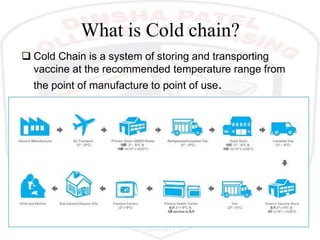
What is Cold chain?
 Cold Chain is a system of storing and transporting
vaccine at the recommended temperature range from
the point of manufacture to point of use.
Cont….
 Vaccines loose their potency due to either exposure to
Excessive heat or
Excessive cold (some vaccines like DPT, TT, Hep. B)
Light (some vaccines like BCG and measles)
Heat sensitive vaccines Freeze sensitive vaccines
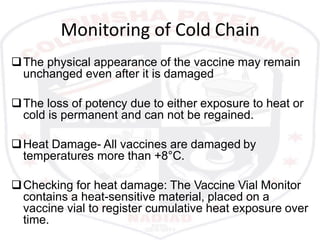
Monitoring of Cold Chain
The physical appearance of the vaccine may remain
unchanged even after it is damaged
The loss of potency due to either exposure to heat or
cold is permanent and can not be regained.
Heat Damage- All vaccines are damaged by
temperatures more than +8°C.
Checking for heat damage: The Vaccine Vial Monitor
contains a heat-sensitive material, placed on a
vaccine vial to register cumulative heat exposure over
time.
Vaccine vial monitor
Cold chain equipments
Walk-in-Freezers (WIF)
 Installed in all of the states and larger divisional head
quarters.
 They maintain a temperature around -20°C.
 bulk storage of OPV, and also to prepare frozen ice
packs at state stores.
Available in
sizes of 16.5 Cum.
and 32 Cum.
Walk-in-Coolers
 Established at regional levels, which store vaccines for about 4-5
districts
 Maintains temperature of +2°C to +8°C.
 Used for storage of large quantities of vaccines, like DPT, DT,TT,
Measles, BCG, Hepatitis B.
 WIC/WIF store vaccines of three months requirement and 25% buffer
stock for the districts they cater.
Available in
sizes of 16.5 Cum.
and 32 Cum.
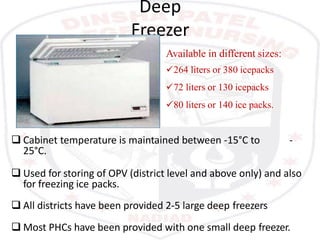
Deep
Freezer
Available in different sizes:
264 liters or 380 icepacks
72 liters or 130 icepacks
80 liters or 140 ice packs.
 Cabinet temperature is maintained between -15°C to -
25°C.
 Used for storing of OPV (district level and above only) and also
for freezing ice packs.
 All districts have been provided 2-5 large deep freezers
 Most PHCs have been provided with one small deep freezer.
Ice Lined Refrigerator
Available in different sizes:
108 liters or 26000 to 30000 doses
45 liters or 11000 to 13000 doses
100 liters or 24000 to 28000 doses
50 liters or 12000 to 14000 doses
 Larger ILR is supplied to district headquarters and PHC .
 Top opening because they can hold the cold air inside better than a
refrigerator with a front opening.
 There is a lining of water containers (Ice packs or tubes) fitted all around
the walls and held in place by frame.
 Keep vaccine safe with as little as 8 hours continuous electricity supply
in a 24-hour period.
Hold over time of
equipments
 Time taken by the equipment to raise inside vaccine
temperature at the time of power failure from its minimum
temperature to 10°C.
Hold over time depends on the following factors:
 Ambient temperature.
 Number of frozen Ice Packs inside the D/F.
 Frequency of opening of lid and use of basket.
 Quantity of vaccines kept inside with adequate space
between the containers.
 Condition of icepacks inside Non electrical cold chain
equipment
Storage of vaccine in
ILR
 The ILR has got two sections – the top and bottom.
 Bottom of the refrigerator is the coldest place and is
shown as section A.
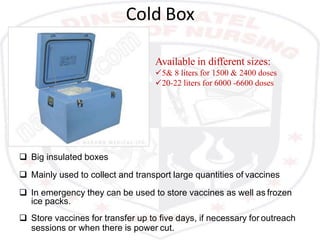
Cold Box
 Big insulated boxes
 Mainly used to collect and transport large quantities of vaccines
 In emergency they can be used to store vaccines as well as frozen
ice packs.
 Store vaccines for transfer up to five days, if necessary for outreach
sessions or when there is power cut.
Available in different sizes:
5& 8 liters for 1500 & 2400 doses
20-22 liters for 6000 -6600 doses
Vaccine Carriers
Vaccine carriers are made of insulated material.
Used for carrying small quantities of vaccines (16-
20 vials) to the sub-centers or session sites.
Preparation of vaccine
carriers
 Take out the required number of ice packs from the deep
freezer and wipe them dry.
 Keep them out side for conditioning.
 Place four conditioned ice packs in the carrier
 wait till temperature to fall to <8 ° C in the carrier
 Wrap vaccine vials and ampoules in thick paper before
putting in polythene bag so as to prevent them from
touching the ice packs.
Cont….
 Place some packing material between `T’ series vaccine and
the ice packs.
 Place foam pad at the top of ice packs
 Ensure that some ice is present in the ice packs while
conducting immunization sessions.
 Secure the lid tightly.
Packing a vaccine
carrier

Cold chain

  • 1.
    PRESENTED BY, MR. KAILASHNAGAR ASSIST. PROF. DEPT. OF COMMUNITY HEALTH NSG. DINSHA PATEL COLLEGE OF NURSING, NADIAD
  • 2.
    Background  Immunization- well-knownand effective methods of preventing childhood diseases  India has one of the largest UIP in the world  Under UIP, all the children in the entire country are protected against the 6 deadly Vaccine Preventable Diseases (VPD)  Services provided district hospitals, community health centers (CHC), primary health centres (PHC) and sub-centers.  Important elements for improving the immunization is cold chain and vaccine logistics management which is backbone of immunization programme.
  • 3.
    Cont… It is auniversal fact that all vaccines are sensitive to heat & light and some are sensitive to freezing A vaccine must have two characteristics, one is safety and other is potency vaccines loose their potency if they are not stored or transported at an appropriate temperature and condition
  • 4.
    What is Coldchain?  Cold Chain is a system of storing and transporting vaccine at the recommended temperature range from the point of manufacture to point of use.
  • 5.
    Cont….  Vaccines loosetheir potency due to either exposure to Excessive heat or Excessive cold (some vaccines like DPT, TT, Hep. B) Light (some vaccines like BCG and measles) Heat sensitive vaccines Freeze sensitive vaccines
  • 6.
    Monitoring of ColdChain The physical appearance of the vaccine may remain unchanged even after it is damaged The loss of potency due to either exposure to heat or cold is permanent and can not be regained. Heat Damage- All vaccines are damaged by temperatures more than +8°C. Checking for heat damage: The Vaccine Vial Monitor contains a heat-sensitive material, placed on a vaccine vial to register cumulative heat exposure over time.
  • 7.
  • 8.
  • 9.
    Walk-in-Freezers (WIF)  Installedin all of the states and larger divisional head quarters.  They maintain a temperature around -20°C.  bulk storage of OPV, and also to prepare frozen ice packs at state stores. Available in sizes of 16.5 Cum. and 32 Cum.
  • 10.
    Walk-in-Coolers  Established atregional levels, which store vaccines for about 4-5 districts  Maintains temperature of +2°C to +8°C.  Used for storage of large quantities of vaccines, like DPT, DT,TT, Measles, BCG, Hepatitis B.  WIC/WIF store vaccines of three months requirement and 25% buffer stock for the districts they cater. Available in sizes of 16.5 Cum. and 32 Cum.
  • 11.
    Deep Freezer Available in differentsizes: 264 liters or 380 icepacks 72 liters or 130 icepacks 80 liters or 140 ice packs.  Cabinet temperature is maintained between -15°C to - 25°C.  Used for storing of OPV (district level and above only) and also for freezing ice packs.  All districts have been provided 2-5 large deep freezers  Most PHCs have been provided with one small deep freezer.
  • 12.
    Ice Lined Refrigerator Availablein different sizes: 108 liters or 26000 to 30000 doses 45 liters or 11000 to 13000 doses 100 liters or 24000 to 28000 doses 50 liters or 12000 to 14000 doses  Larger ILR is supplied to district headquarters and PHC .  Top opening because they can hold the cold air inside better than a refrigerator with a front opening.  There is a lining of water containers (Ice packs or tubes) fitted all around the walls and held in place by frame.  Keep vaccine safe with as little as 8 hours continuous electricity supply in a 24-hour period.
  • 13.
    Hold over timeof equipments  Time taken by the equipment to raise inside vaccine temperature at the time of power failure from its minimum temperature to 10°C. Hold over time depends on the following factors:  Ambient temperature.  Number of frozen Ice Packs inside the D/F.  Frequency of opening of lid and use of basket.  Quantity of vaccines kept inside with adequate space between the containers.  Condition of icepacks inside Non electrical cold chain equipment
  • 14.
    Storage of vaccinein ILR  The ILR has got two sections – the top and bottom.  Bottom of the refrigerator is the coldest place and is shown as section A.
  • 15.
    Cold Box  Biginsulated boxes  Mainly used to collect and transport large quantities of vaccines  In emergency they can be used to store vaccines as well as frozen ice packs.  Store vaccines for transfer up to five days, if necessary for outreach sessions or when there is power cut. Available in different sizes: 5& 8 liters for 1500 & 2400 doses 20-22 liters for 6000 -6600 doses
  • 16.
    Vaccine Carriers Vaccine carriersare made of insulated material. Used for carrying small quantities of vaccines (16- 20 vials) to the sub-centers or session sites.
  • 17.
    Preparation of vaccine carriers Take out the required number of ice packs from the deep freezer and wipe them dry.  Keep them out side for conditioning.  Place four conditioned ice packs in the carrier  wait till temperature to fall to <8 ° C in the carrier  Wrap vaccine vials and ampoules in thick paper before putting in polythene bag so as to prevent them from touching the ice packs.
  • 18.
    Cont….  Place somepacking material between `T’ series vaccine and the ice packs.  Place foam pad at the top of ice packs  Ensure that some ice is present in the ice packs while conducting immunization sessions.  Secure the lid tightly.
  • 19.