INRODUCTION
A systemof storing and transporting the vaccine, at
a low temperature from place to place of
manufacture to the actual vaccination site is called
‘’cold chain’’.
Right from manufacturer of vaccine to health
workers at the grass root level, contribute
significantly in cold chain.
4.
Importance
Obtaining thevaccine from the manufacturers
Storing and transporting the vaccines
Maintaining the supply of vaccines.
Having information about essential equipments, supply of
electricity etc.
Keeping the vaccines at the temperature suggested by
manufacturer.
Protecting the vaccine from sunlight and anti-septic substances.
Maintaining the potency of vaccines by following all above-
mentioned points
APPARATUS/EQUIPMENTS
These canbe kept in 2 category
1st
category includes those equip. Which keep the
vaccine at 4-8 degree Celsius
2nd
category, which freezes the vaccine.
Size varries, from small to walk in coolers
8.
Supplies
Vaccine andsolvents are 2 main components of cold
chain supplies.
These are kept in the lowest temp.
Vaccines of polio,TB, measles can be kept in frozen
condition.
But vaccines of DPT,DT,TT loses their potency if kept
in frozen condition
9.
Manual efforts
Peoplewho are working with the
manufacturer ,health officers, health workers and
those storing and transporting the vaccine ,works
together to maintain the cold chain .
Ppl involved in this should be thoroughly trained
About equipments,supplies.transportation,storage,
preservation and communication
11.
Transportation
To maintainthe potency of vaccines,a rapid means
of transport should be used,
A specific temp. Should be maintained
Therefore heat resistant equipment should be used
in the journey.
Refrigerators should be arranged in the trucks.
Aeroplane are also used to save time.
12.
Communication
A reliableand effective communication system is
must for the cold chain .
All information and orders associated with cold
chain should be immediately and clearly, sent and
received.
14.
Equipments
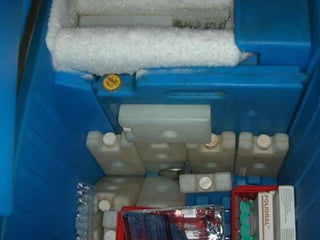
Vaccine carrier
Cold packs/ice packs
Day carriers
Cold boxes
Refrigerator
Deep freezers
Ice-lined refrigerators
Walk in coolers
15.
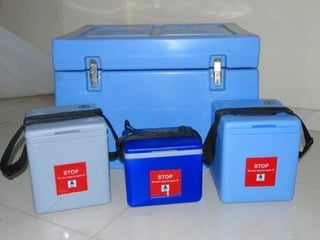
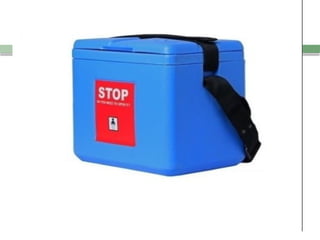
Vaccine carrier
Theseare suitable fro carrying small quantities of vaccine-
HSB,VILLAGES,SATELLITE &SMALL TOWN
Heat resistant material and light weight
Carried in one hand or shoulder easily
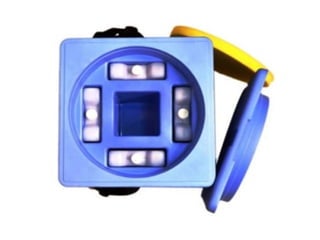
Four pack of ice are kept in four sides.
Ice completely frozen and lid of vaccine of lid should be tightly
closed.
2 day at tem of 32-43 degree celsius.
Properly clean from inside,withou cracks and lid hsould be
closed .
4 ice pack not 2.
18.
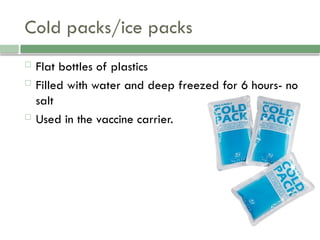
Cold packs/ice packs
Flat bottles of plastics
Filled with water and deep freezed for 6 hours- no
salt
Used in the vaccine carrier.
19.
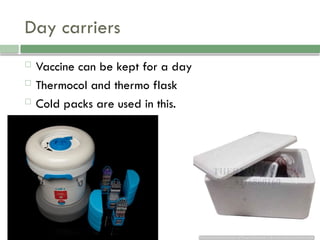
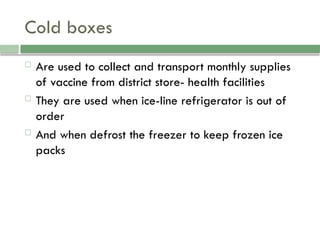
Day carriers
Vaccinecan be kept for a day
Thermocol and thermo flask
Cold packs are used in this.
20.
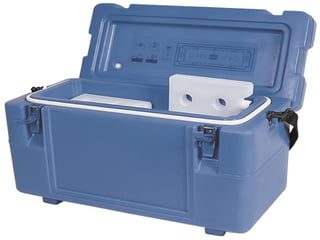
Cold boxes
Areused to collect and transport monthly supplies
of vaccine from district store- health facilities
They are used when ice-line refrigerator is out of
order
And when defrost the freezer to keep frozen ice
packs
22.
Refridgerator
This isimportant
Vaccines of polio,TB, measles can be kept in frozen
condition.
But vaccines of DPT,DT,TT typhoid etc-cold part.
24.
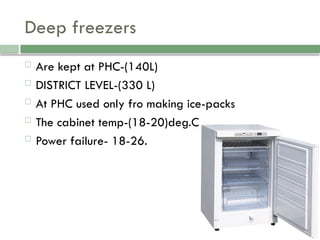
Deep freezers
Arekept at PHC-(140L)
DISTRICT LEVEL-(330 L)
At PHC used only fro making ice-packs
The cabinet temp-(18-20)deg.C
Power failure- 18-26.
25.
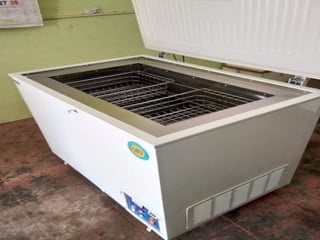
Ice lined refridgerator
Have a top opening and lines with the pipes of ice or ice packs
Which maintains temp, at time of power failure
Once the pipe is frozen, can work for 24 hours, with 8 hours of
supply
Used to store vaccine at PHC.
NO FREEZER COMPARTMENTS
HENCE CAN FREEZE ICE PACKS
All vacc. Is kept in the basket of ILR along with diluents.
A thermometer is placed in the basket along with vaccine-
correct temp.
27.
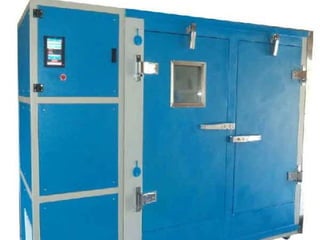
Walk in cooler
This is refridgetor of the size of a room (10x10) in
which all types of vacc. Can be kept safe.
At district health centr ,vaccine are stored in these
walk in coolers only.
Cooler have arrangement to keep the vaccine at
the appro. Temp for long hours, even if the supply
of electricity is interrupted
29.
Potency test
Theproceess ofinvestigating the effectiveness of
vacc. Is known as potency test
Should not loose its effectiveness,to ensure this
Essential to conduct potency test.
Lack of app potency- will not generate immunity.
30.
Methods of controllingcold chain
Keep the vaccine in appro condition, as sugg. By manufacturer
Follow the precautn while transporting the vacc.
Record the temp of storage place twice a day and preparing
the temp chart
Maintaining the equipment of cold chain and appr.
Functioning of its components, conducting potency test from
time to time
Keep communication system effective and latest.
Train all the ppl associated with vacc. about maintenance and
control of cold chain







![growthanddevelopment2-190402170040[1].pptx](https://cdn.slidesharecdn.com/ss_thumbnails/growthanddevelopment2-1904021700401-241125091944-49fc96da-thumbnail.jpg?width=640&height=640&fit=bounds)


![APPROACH TO FEVER IN PEDIATRICS[1].pptTT](https://cdn.slidesharecdn.com/ss_thumbnails/approachtofeverinpediatrics1-260125081456-d559e079-thumbnail.jpg?width=640&height=640&fit=bounds)


