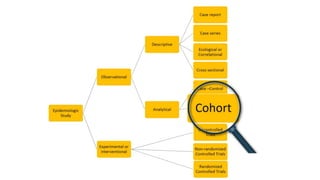
Cohort Study Design
Dr K.A Afolabi
Outline
 Overview
 Steps in conducting a cohort study
 Advantages
 Disadvantages
 Potential sources of bias
Overview
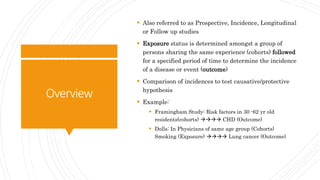
 Also referred to as Prospective, Incidence, Longitudinal
or Follow up studies
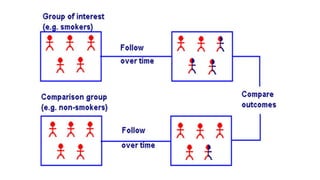
 Exposure status is determined amongst a group of
persons sharing the same experience (cohorts) followed
for a specified period of time to determine the incidence
of a disease or event (outcome)
 Comparison of incidences to test causative/protective
hypothesis
 Example:
 Framingham Study: Risk factors in 30 -62 yr old
residents(cohorts)  CHD (Outcome)
 Dolls: In Physicians of same age group (Cohorts)
Smoking (Exposure)  Lung cancer (Outcome)
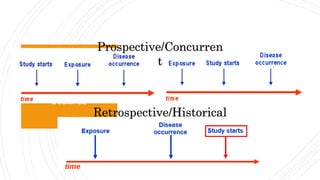
Typesof Cohort
Studies
Prospective/Concurren
t
Retrospective/Historical
StepsinaCohort
Study:
Selection ofstudy
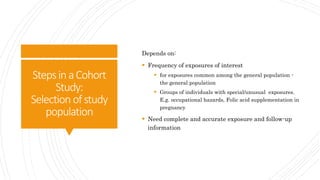
population
Depends on:
 Frequency of exposures of interest
 for exposures common among the general population -
the general population
 Groups of individuals with special/unusual exposures.
E.g. occupational hazards, Folic acid supplementation in
pregnancy
 Need complete and accurate exposure and follow-up
information
StepsinaCohort
Study:
Selection of
Exposed/Unexpos
edgroups
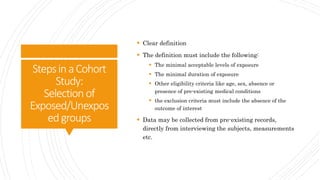
 Clear definition
 The definition must include the following:
 The minimal acceptable levels of exposure
 The minimal duration of exposure
 Other eligibility criteria like age, sex, absence or
presence of pre-existing medical conditions
 the exclusion criteria must include the absence of the
outcome of interest
 Data may be collected from pre-existing records,
directly from interviewing the subjects, measurements
etc.
StepsinaCohort
Study:
Determining
Outcome
Present/Absent
Groups
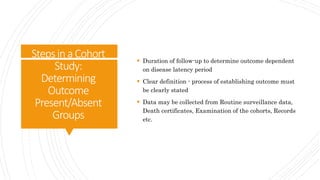
 Duration of follow-up to determine outcome dependent
on disease latency period
 Clear definition - process of establishing outcome must
be clearly stated
 Data may be collected from Routine surveillance data,
Death certificates, Examination of the cohorts, Records
etc.
Advantagesof
CohortStudies
 Measures incidence
 Gives a direct measurement of risk
 Dose effect can be determined
 Temporal relationship between exposure & disease is
clear
 Minimizes selection and information bias (especially
Prospective cohort studies)
 Well suited to rare exposures
 Several outcomes can be examined in one study
Disadvantages
ofCohort
Studies
 Often requires large sample size
 Latency period: long follow-up period or bias
 Attrition - loss to follow-up can affect validity of
findings
 Exposure can change over time
 Ineffective for rare diseases
 Difficult to assess multiple exposures
 Time consuming and expensive
 Some problems of bias may occur
 Ethical issues
PotentialBiases
inCohort
Studies
 Selection bias
– loss to follow-up
 Information bias
– from different quality and extent of
information obtained
 apply the same protocol for measuring or evaluating the
health outcomes in exposed and nonexposed individuals
 Blinding
Thank you for your time

Cohort study design

  • 1.
  • 2.
    Outline  Overview  Stepsin conducting a cohort study  Advantages  Disadvantages  Potential sources of bias
  • 4.
    Overview  Also referredto as Prospective, Incidence, Longitudinal or Follow up studies  Exposure status is determined amongst a group of persons sharing the same experience (cohorts) followed for a specified period of time to determine the incidence of a disease or event (outcome)  Comparison of incidences to test causative/protective hypothesis  Example:  Framingham Study: Risk factors in 30 -62 yr old residents(cohorts)  CHD (Outcome)  Dolls: In Physicians of same age group (Cohorts) Smoking (Exposure)  Lung cancer (Outcome)
  • 6.
  • 7.
    StepsinaCohort Study: Selection ofstudy population Depends on: Frequency of exposures of interest  for exposures common among the general population - the general population  Groups of individuals with special/unusual exposures. E.g. occupational hazards, Folic acid supplementation in pregnancy  Need complete and accurate exposure and follow-up information
  • 8.
    StepsinaCohort Study: Selection of Exposed/Unexpos edgroups  Cleardefinition  The definition must include the following:  The minimal acceptable levels of exposure  The minimal duration of exposure  Other eligibility criteria like age, sex, absence or presence of pre-existing medical conditions  the exclusion criteria must include the absence of the outcome of interest  Data may be collected from pre-existing records, directly from interviewing the subjects, measurements etc.
  • 9.
    StepsinaCohort Study: Determining Outcome Present/Absent Groups  Duration offollow-up to determine outcome dependent on disease latency period  Clear definition - process of establishing outcome must be clearly stated  Data may be collected from Routine surveillance data, Death certificates, Examination of the cohorts, Records etc.
  • 11.
    Advantagesof CohortStudies  Measures incidence Gives a direct measurement of risk  Dose effect can be determined  Temporal relationship between exposure & disease is clear  Minimizes selection and information bias (especially Prospective cohort studies)  Well suited to rare exposures  Several outcomes can be examined in one study
  • 12.
    Disadvantages ofCohort Studies  Often requireslarge sample size  Latency period: long follow-up period or bias  Attrition - loss to follow-up can affect validity of findings  Exposure can change over time  Ineffective for rare diseases  Difficult to assess multiple exposures  Time consuming and expensive  Some problems of bias may occur  Ethical issues
  • 13.
    PotentialBiases inCohort Studies  Selection bias –loss to follow-up  Information bias – from different quality and extent of information obtained  apply the same protocol for measuring or evaluating the health outcomes in exposed and nonexposed individuals  Blinding
  • 14.
    Thank you foryour time

Editor's Notes

  • #5 The cohorts are similar in all other experiences/factors except the exposure of interest.
  • #7 Open/Dynamic cohort – is one where people can enter or leave. Examples: A workforce study that is ongoing, A city or other geographic location. A closed cohort is where all persons in the cohort are defined at entry e.g UI medical school class of 2004
  • #8 Special group exposures: exposure to aniline (dye factory workers), Use of PPE or not (health workers) For accurate information, purposely selecting groups likely to give accurate and complete information or groups that have available record of the exposure
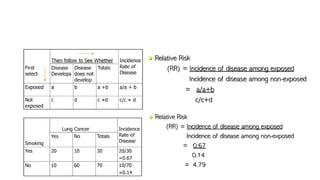
  • #11 RR=1 No association RR>1 Risk of outcome increased with exposure (causative) RR<1 Risk of outcome decreased (protective factor)
  • #14 Information bias: mostly from ‘over-searching’ for outcome in exposed Prevented by applying same protocol for both groups and by masking exposure status from the person who decides presence or absence of outcome Health worker effect Hawthorne effect – exposed changing to unexposed withou