The team building/cohesion
         relationship:
What every coach should know to
 get the most out of their team


     Stefanie A. Latham, Ph.D.
       Contact info and Bio on Last slide
“Naturally there are going to be some
ups and down, particularly if you have
individuals trying to achieve at a high
level…when a pressure situation
presented itself, we were plugged into
one another as a cohesive unit. That’s
why we were able to win, and that’s why
we were able to beat more talented
teams” (Michael Jordon, 1994, 23)
Why you need to increase
       cohesion on your team
 Teams do not succeed on talent alone!
 Success requires teamwork
   “You’re not going to win with kids
    who are just All-Americans. A team
    must have togetherness” (Pat Riley)
 Talent without teamwork=TROUBLE!
 Teamwork allows your talent to work
  together in harmony. (Cohesion)
Cohesion Defined
 Cohesion is the tendency of a group to stick
  together and remain united while pursuing
  goals and objectives (Carron et al., 1998).
 Two types of Cohesion:
    Social – relates to relationships

    Task – activities team engages in to

     accomplish goals
    Can be accomplished by team building
Team Building
 Effective means to increase cohesion
 Cohesion increases chances of success and
  satisfaction
 Successful coaches and athletes credit their
  success to cohesion
 Cohesion contributes to as much as 80-95%
  of team’s success (Yukelson, 1996; 2002)
Why Team-Building
 Enhances task and social cohesion
 Maximizes potential because the team is
  focused on common goals
 Enhances success by minimizing conflict
 Increases your odds of winning
 Make the season more enjoyable for you
  and your players!
 Important for team and individual sports
More on Team Building
 Coaches only devote 5-10% of practice
  time to developing team chemistry
 Team building can include games &
  activities
 But also drills to sharpen focus, set goals,
  clear communication, imagery, build
  motivation and confidence, etc
Cohesion is a product
          of team-building
    Conceptual Factors that increase cohesion:
2.   The Team’s Environment
3.   The Team’s Structure
4.   The Team’s Processes
    Each factor holds specific components
    Research says TB in each area increases
     cohesion but varies from team to team
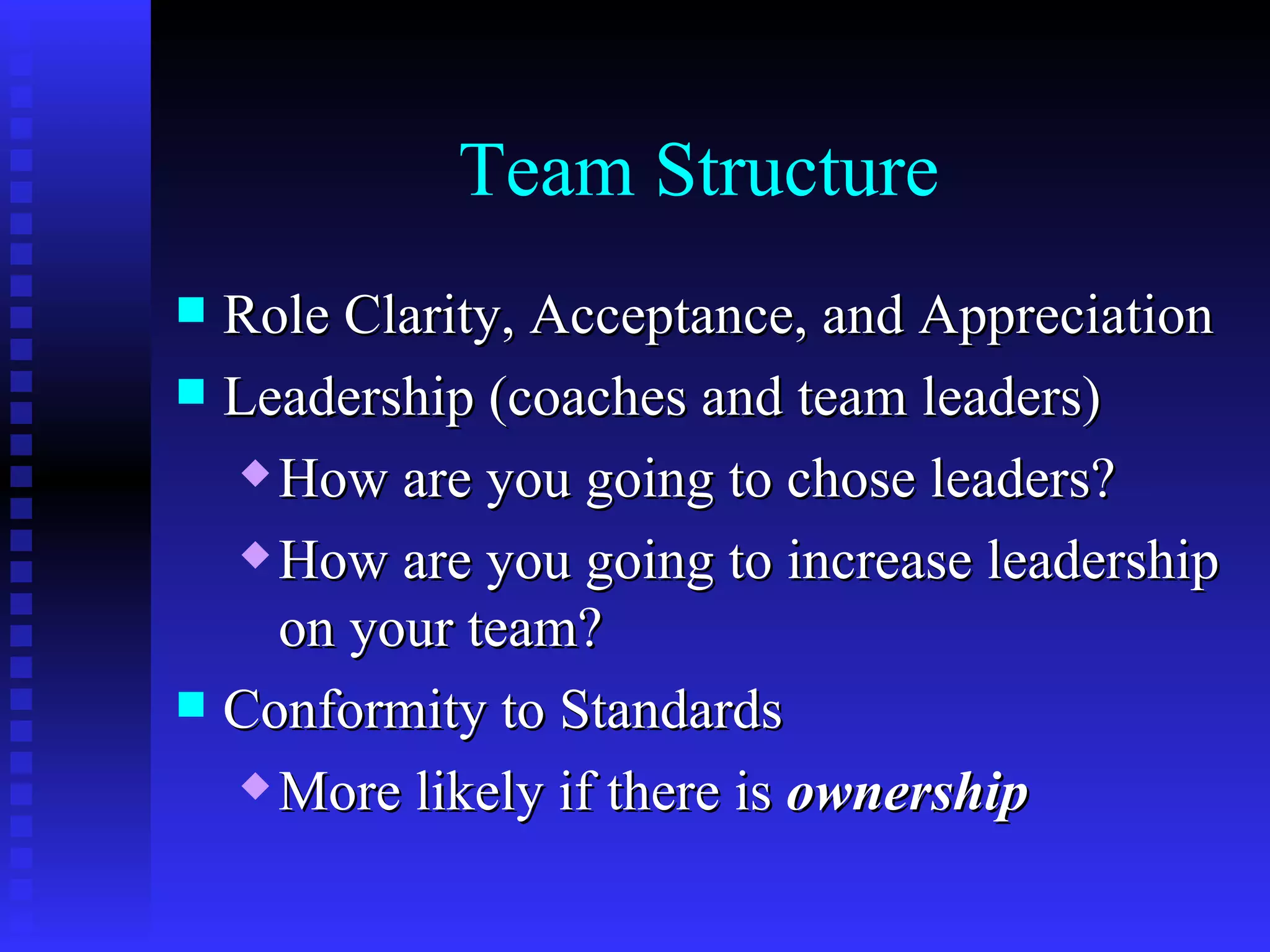
Team Structure
 Role Clarity, Acceptance, and Appreciation
 Leadership (coaches and team leaders)
   How are you going to chose leaders?

   How are you going to increase leadership

    on your team?
 Conformity to Standards
   More likely if there is ownership
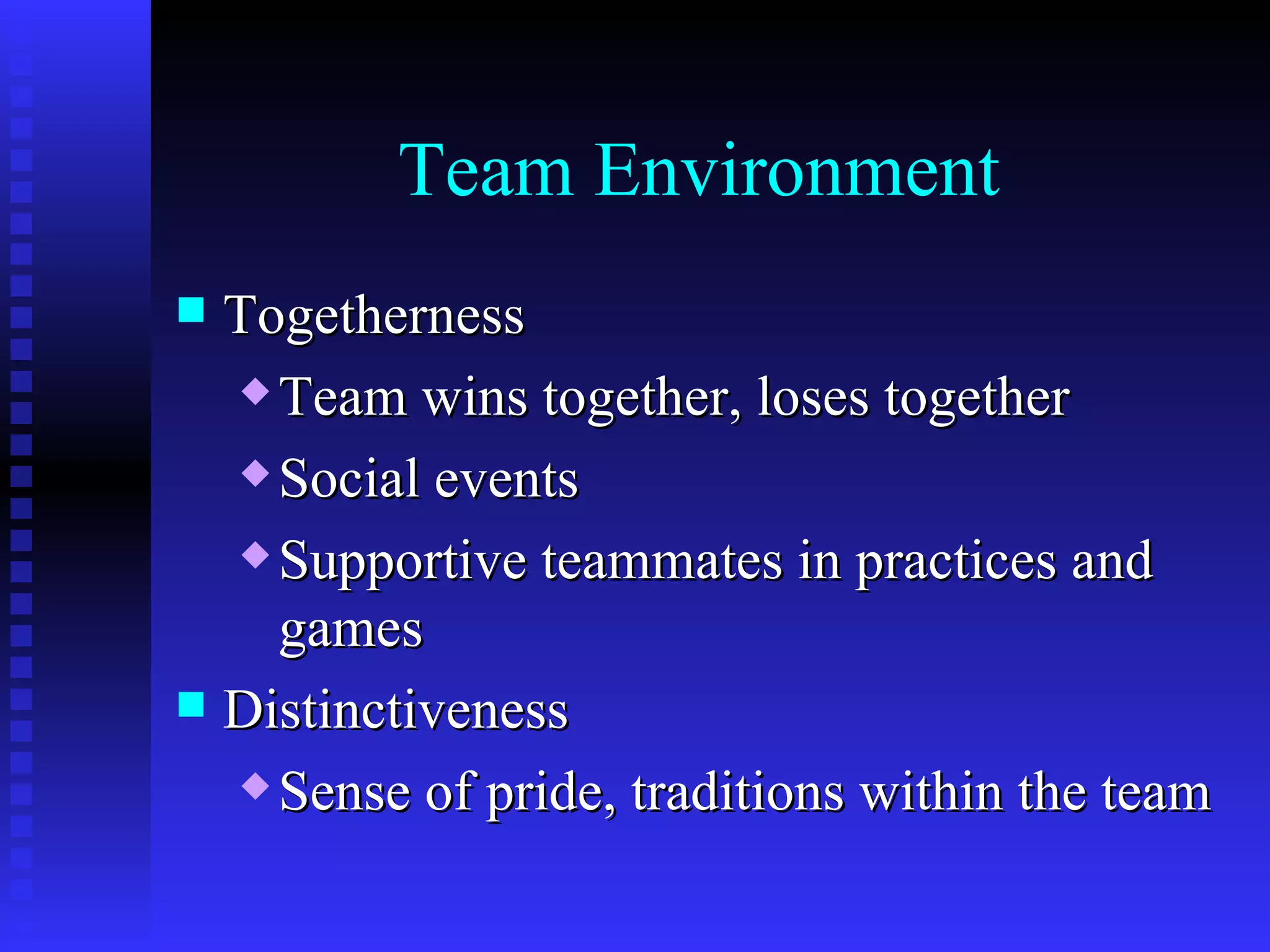
Team Environment
 Togetherness
   Team wins together, loses together

   Social events

   Supportive teammates in practices and

    games
 Distinctiveness
   Sense of pride, traditions within the team
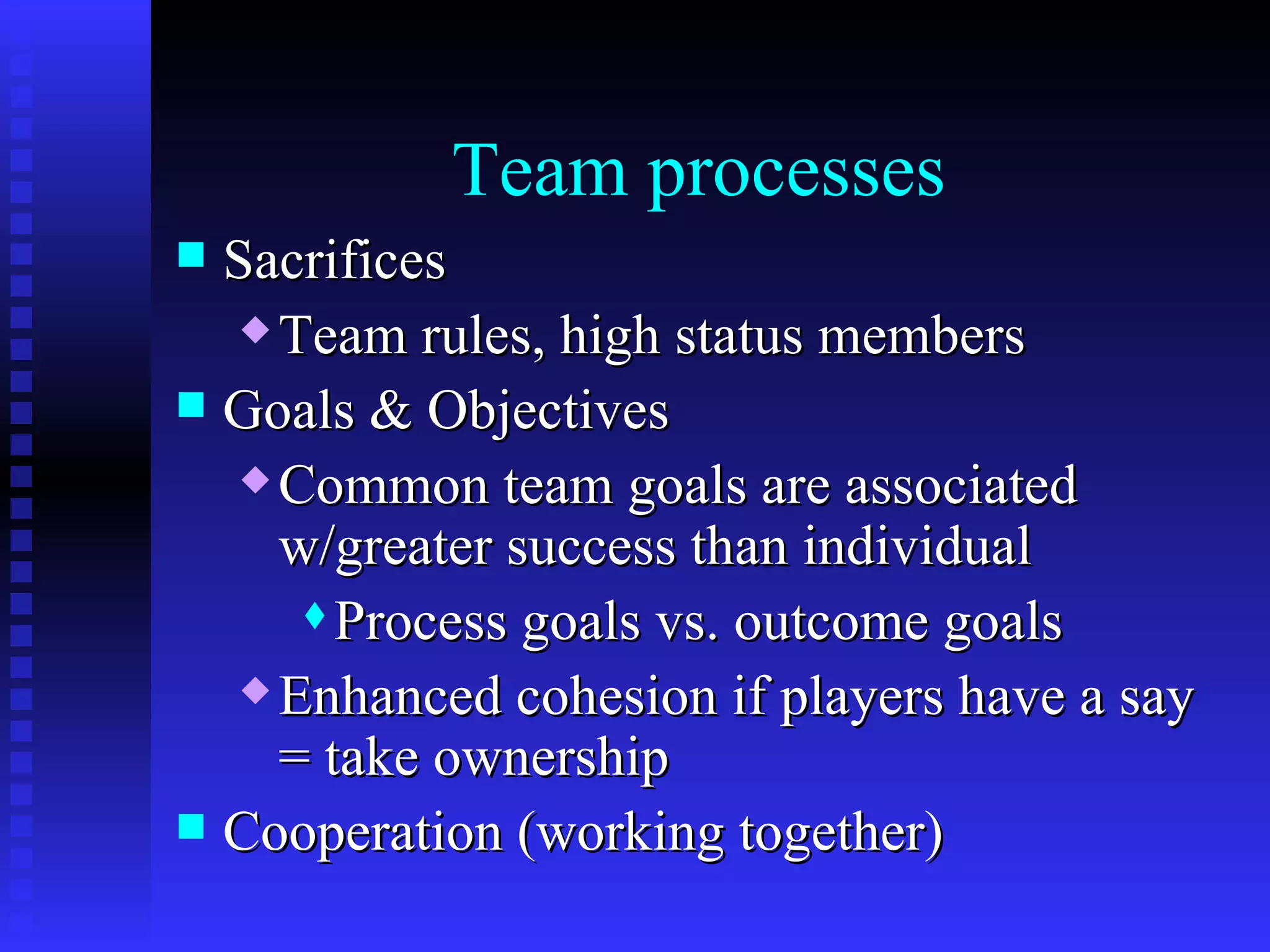
Team processes
 Sacrifices
    Team rules, high status members

 Goals & Objectives
    Common team goals are associated

     w/greater success than individual
       Process goals vs. outcome goals

    Enhanced cohesion if players have a say

     = take ownership
 Cooperation (working together)
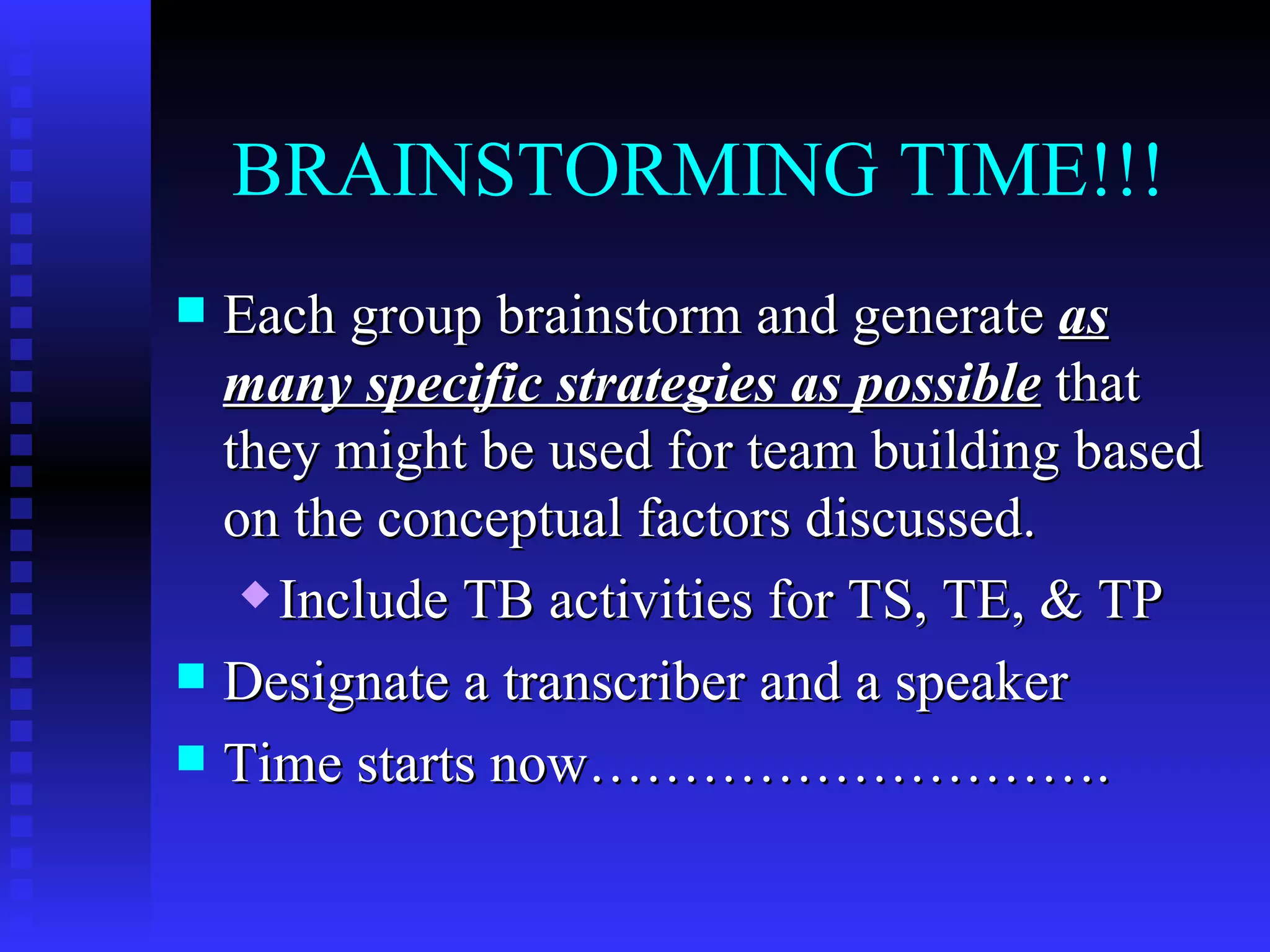
BRAINSTORMING TIME!!!
 Each group brainstorm and generate as
  many specific strategies as possible that
  they might be used for team building based
  on the conceptual factors discussed.
    Include TB activities for TS, TE, & TP

 Designate a transcriber and a speaker
 Time starts now……………………….
SHARE TIME!
 Speaker, quickly and briefly tell us
 using your GYM voice what Specific
 Strategies your group came up with
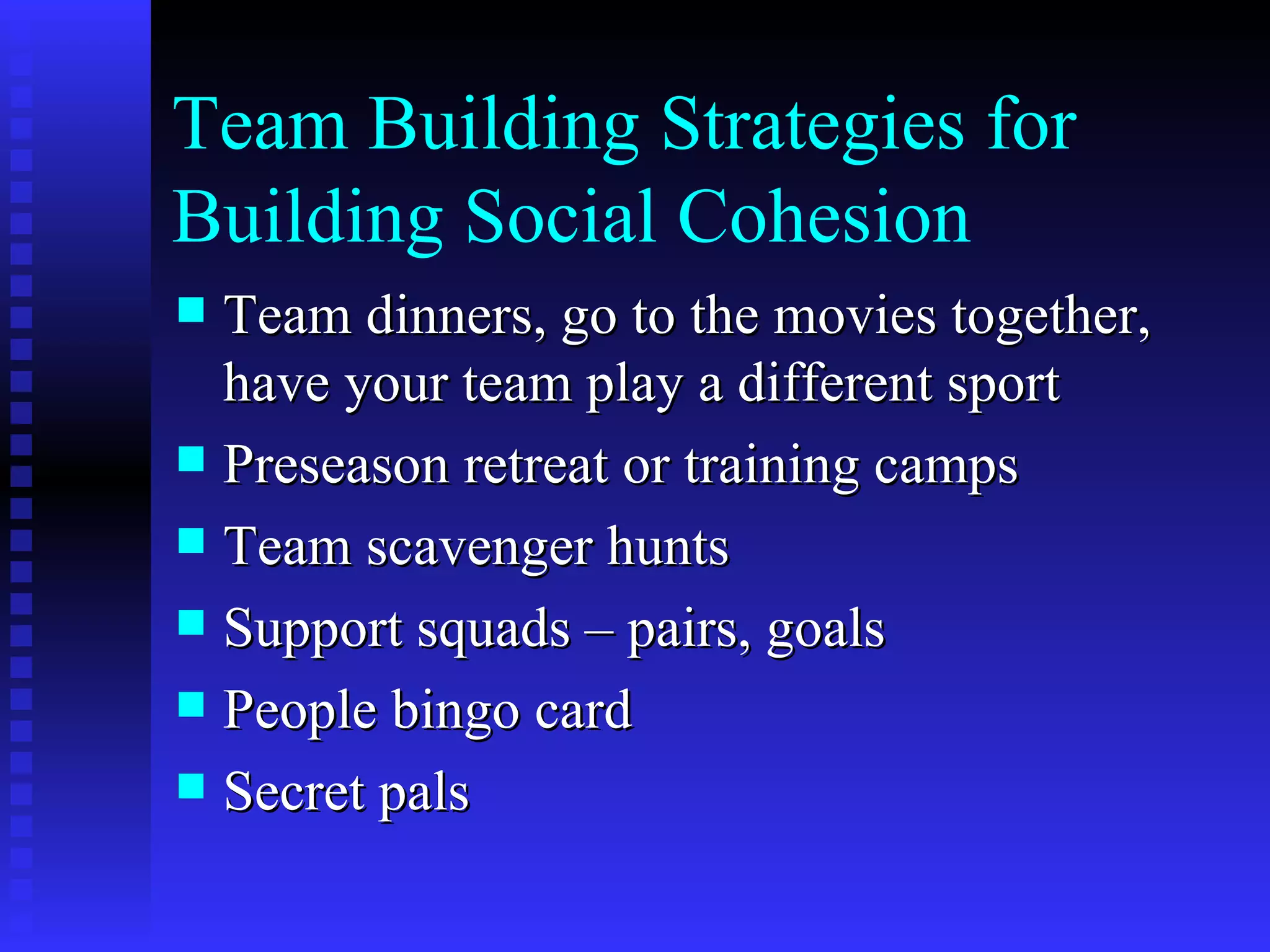
Team Building Strategies for
Building Social Cohesion
 Team dinners, go to the movies together,
  have your team play a different sport
 Preseason retreat or training camps
 Team scavenger hunts
 Support squads – pairs, goals
 People bingo card
 Secret pals
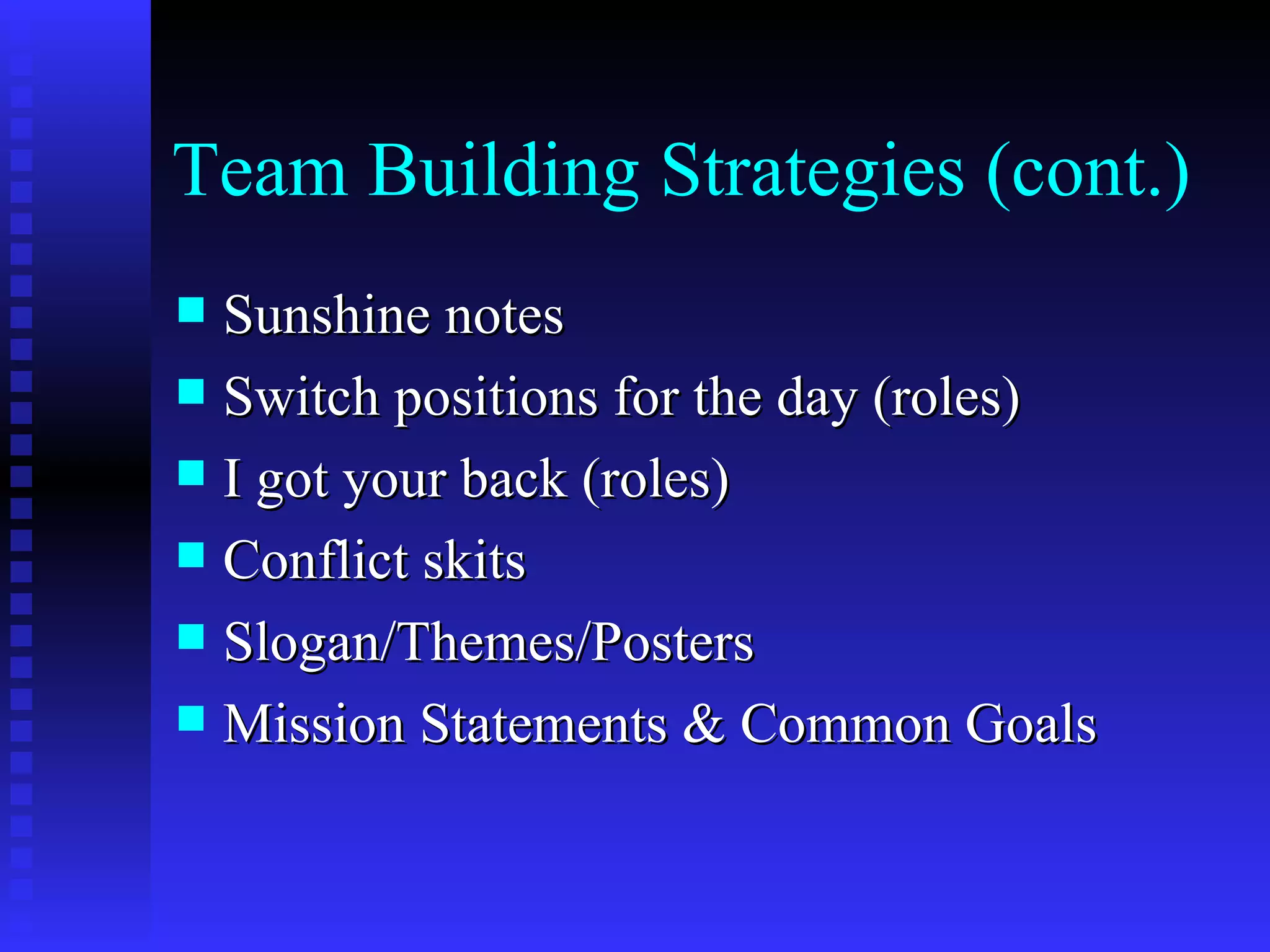
Team Building Strategies (cont.)
 Sunshine notes
 Switch positions for the day (roles)
 I got your back (roles)
 Conflict skits
 Slogan/Themes/Posters
 Mission Statements & Common Goals
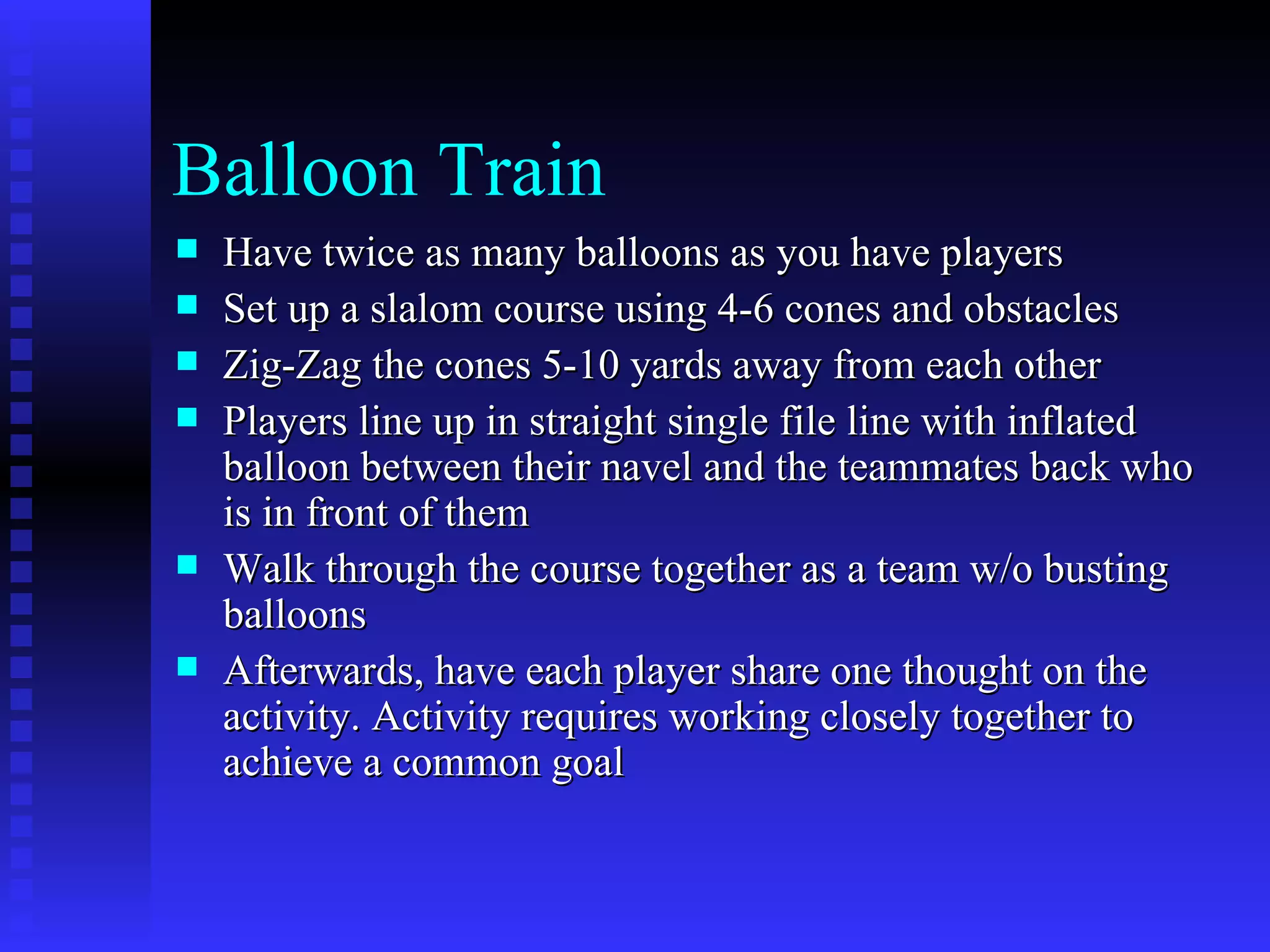
Balloon Train
   Have twice as many balloons as you have players
   Set up a slalom course using 4-6 cones and obstacles
   Zig-Zag the cones 5-10 yards away from each other
   Players line up in straight single file line with inflated
    balloon between their navel and the teammates back who
    is in front of them
   Walk through the course together as a team w/o busting
    balloons
   Afterwards, have each player share one thought on the
    activity. Activity requires working closely together to
    achieve a common goal
Strung Together
   Have a large ball of string
   Team members sit down in a big circle
   Hand the ball of string to one player and have her hold one
    end of it
   She tosses the ball of string to another teammate while
    holding the end of the string
   She will talk about all the things the team needs from the
    teammate she tossed the ball of string to in order for the
    team to be successful
   Encourage others to add to the statement
   That player then hangs onto part of the string then tosses
    the ball to another player
Strung together
   Once everyone is holding a piece of the string
    (including you) have players discuss their
    perceptions of what the activity means
   i.e. everyone is dependant on each other in some
    way because of the connections of the string
   Have them talk about what it means to be
    connected. How that relates to responsibility,
    accountability, and trust
   Have them discuss what happens if connections
    are cut or a person lets go of the string
FINAL THOUGHTS
 Do not try to intervene on every conceptual
  factor at once. Too much = overload = less
  cohesion
 Determine with your players which factors
  need attention for your team
 Remember a strategy that is effect with one
  team is not always effective with another
 TB activities should always have a purpose
More Final Thoughts
 Every activity should have an objective and
  end with discussion
 The most important part of team building
  activities occur after the exercise and
  depends upon how you relate the activity
  back to your team
 Allow each person to share their thoughts
Final, Final Thoughts
 The role of the coach/teacher is to facilitate
  discussion
    keep it on track!

    Keep it going!

 Focus on solutions not the problems!
 Any criticism should be presented
  constructively!
Final Quotes to Ponder
   “Talent wins games, but teamwork and
    intelligence win championships” (Michael Jordon)
   “A great collection of talent with unbalanced
    chemistry and inappropriate attitudes can get
    knocked over by teams of lesser talent” (John
    Wooden)
   “Teamwork is taught. You don’t just lump a
    group of people together in a room and call them a
    team and expect them to behave like one.” (Pat
    Summitt)
Stefanie A. Latham, Ph.D. (405-659-9770)
  Follow her on Twitter @stefanielatham
        StefanieLatham@yahoo.com
Stefanie has worked in and around athletics all of her life. She was a dual collegiate
     athlete in volleyball and track at Southern Nazarene University (1994-1997).
     Following her playing career she immediately began coaching volleyball as an
     Assistant Coach at the University of Central Oklahoma. She went on to the high
     school ranks establishing a winning record of 187-12 in seven short years. She was
     selected as the Oklahoma Coaches Association coach of the year for two years in
     2001 and 2002. She directed and coached a premiere United States Volleyball
     Association club for five years with teams advancing to nationals every year.
     Stefanie left the world of coaching in 2003 to finish her Ph.D. in Sport Psychology.
     She served as the Chairwoman and Professor of Sport Science at Oklahoma City
     University for five years. She currently consults privately with individual athletes
     /teams and does research analysis for the BBN Network. She has also contributed to
     the peak performance of numerous winning teams across a variety of sports at the
     collegiate and high school levels including Oklahoma State University, University of
     Central Oklahoma, West Texas A&M University, and Oklahoma City University.
     Stefanie is a frequent and popular motivational speaker at many schools, workshops,
     and professional conferences across the country. As a result of her work and
     experience with elite athletes and teams, Stefanie has authored and co-authored

Team building for coaches

  • 1.
    The team building/cohesion relationship: What every coach should know to get the most out of their team Stefanie A. Latham, Ph.D. Contact info and Bio on Last slide
  • 2.
    “Naturally there aregoing to be some ups and down, particularly if you have individuals trying to achieve at a high level…when a pressure situation presented itself, we were plugged into one another as a cohesive unit. That’s why we were able to win, and that’s why we were able to beat more talented teams” (Michael Jordon, 1994, 23)
  • 3.
    Why you needto increase cohesion on your team  Teams do not succeed on talent alone!  Success requires teamwork  “You’re not going to win with kids who are just All-Americans. A team must have togetherness” (Pat Riley)  Talent without teamwork=TROUBLE!  Teamwork allows your talent to work together in harmony. (Cohesion)
  • 4.
    Cohesion Defined  Cohesionis the tendency of a group to stick together and remain united while pursuing goals and objectives (Carron et al., 1998).  Two types of Cohesion:  Social – relates to relationships  Task – activities team engages in to accomplish goals  Can be accomplished by team building
  • 5.
    Team Building  Effectivemeans to increase cohesion  Cohesion increases chances of success and satisfaction  Successful coaches and athletes credit their success to cohesion  Cohesion contributes to as much as 80-95% of team’s success (Yukelson, 1996; 2002)
  • 6.
    Why Team-Building  Enhancestask and social cohesion  Maximizes potential because the team is focused on common goals  Enhances success by minimizing conflict  Increases your odds of winning  Make the season more enjoyable for you and your players!  Important for team and individual sports
  • 7.
    More on TeamBuilding  Coaches only devote 5-10% of practice time to developing team chemistry  Team building can include games & activities  But also drills to sharpen focus, set goals, clear communication, imagery, build motivation and confidence, etc
  • 8.
    Cohesion is aproduct of team-building  Conceptual Factors that increase cohesion: 2. The Team’s Environment 3. The Team’s Structure 4. The Team’s Processes  Each factor holds specific components  Research says TB in each area increases cohesion but varies from team to team
  • 9.
    Team Structure  RoleClarity, Acceptance, and Appreciation  Leadership (coaches and team leaders)  How are you going to chose leaders?  How are you going to increase leadership on your team?  Conformity to Standards  More likely if there is ownership
  • 10.
    Team Environment  Togetherness  Team wins together, loses together  Social events  Supportive teammates in practices and games  Distinctiveness  Sense of pride, traditions within the team
  • 11.
    Team processes  Sacrifices  Team rules, high status members  Goals & Objectives  Common team goals are associated w/greater success than individual  Process goals vs. outcome goals  Enhanced cohesion if players have a say = take ownership  Cooperation (working together)
  • 12.
    BRAINSTORMING TIME!!!  Eachgroup brainstorm and generate as many specific strategies as possible that they might be used for team building based on the conceptual factors discussed.  Include TB activities for TS, TE, & TP  Designate a transcriber and a speaker  Time starts now……………………….
  • 13.
    SHARE TIME!  Speaker,quickly and briefly tell us using your GYM voice what Specific Strategies your group came up with
  • 14.
    Team Building Strategiesfor Building Social Cohesion  Team dinners, go to the movies together, have your team play a different sport  Preseason retreat or training camps  Team scavenger hunts  Support squads – pairs, goals  People bingo card  Secret pals
  • 15.
    Team Building Strategies(cont.)  Sunshine notes  Switch positions for the day (roles)  I got your back (roles)  Conflict skits  Slogan/Themes/Posters  Mission Statements & Common Goals
  • 16.
    Balloon Train  Have twice as many balloons as you have players  Set up a slalom course using 4-6 cones and obstacles  Zig-Zag the cones 5-10 yards away from each other  Players line up in straight single file line with inflated balloon between their navel and the teammates back who is in front of them  Walk through the course together as a team w/o busting balloons  Afterwards, have each player share one thought on the activity. Activity requires working closely together to achieve a common goal
  • 17.
    Strung Together  Have a large ball of string  Team members sit down in a big circle  Hand the ball of string to one player and have her hold one end of it  She tosses the ball of string to another teammate while holding the end of the string  She will talk about all the things the team needs from the teammate she tossed the ball of string to in order for the team to be successful  Encourage others to add to the statement  That player then hangs onto part of the string then tosses the ball to another player
  • 18.
    Strung together  Once everyone is holding a piece of the string (including you) have players discuss their perceptions of what the activity means  i.e. everyone is dependant on each other in some way because of the connections of the string  Have them talk about what it means to be connected. How that relates to responsibility, accountability, and trust  Have them discuss what happens if connections are cut or a person lets go of the string
  • 19.
    FINAL THOUGHTS  Donot try to intervene on every conceptual factor at once. Too much = overload = less cohesion  Determine with your players which factors need attention for your team  Remember a strategy that is effect with one team is not always effective with another  TB activities should always have a purpose
  • 20.
    More Final Thoughts Every activity should have an objective and end with discussion  The most important part of team building activities occur after the exercise and depends upon how you relate the activity back to your team  Allow each person to share their thoughts
  • 21.
    Final, Final Thoughts The role of the coach/teacher is to facilitate discussion  keep it on track!  Keep it going!  Focus on solutions not the problems!  Any criticism should be presented constructively!
  • 22.
    Final Quotes toPonder  “Talent wins games, but teamwork and intelligence win championships” (Michael Jordon)  “A great collection of talent with unbalanced chemistry and inappropriate attitudes can get knocked over by teams of lesser talent” (John Wooden)  “Teamwork is taught. You don’t just lump a group of people together in a room and call them a team and expect them to behave like one.” (Pat Summitt)
  • 23.
    Stefanie A. Latham,Ph.D. (405-659-9770) Follow her on Twitter @stefanielatham StefanieLatham@yahoo.com Stefanie has worked in and around athletics all of her life. She was a dual collegiate athlete in volleyball and track at Southern Nazarene University (1994-1997). Following her playing career she immediately began coaching volleyball as an Assistant Coach at the University of Central Oklahoma. She went on to the high school ranks establishing a winning record of 187-12 in seven short years. She was selected as the Oklahoma Coaches Association coach of the year for two years in 2001 and 2002. She directed and coached a premiere United States Volleyball Association club for five years with teams advancing to nationals every year. Stefanie left the world of coaching in 2003 to finish her Ph.D. in Sport Psychology. She served as the Chairwoman and Professor of Sport Science at Oklahoma City University for five years. She currently consults privately with individual athletes /teams and does research analysis for the BBN Network. She has also contributed to the peak performance of numerous winning teams across a variety of sports at the collegiate and high school levels including Oklahoma State University, University of Central Oklahoma, West Texas A&M University, and Oklahoma City University. Stefanie is a frequent and popular motivational speaker at many schools, workshops, and professional conferences across the country. As a result of her work and experience with elite athletes and teams, Stefanie has authored and co-authored

Editor's Notes

  • #4 We spend a great deal of time as coaches developing physical talent. As a college coach, the number one thing we looked for when recruiting was talent and ability. Does the most talented team always win the championship?? If that were true we wouldn’t need state playoffs. We would just assign the championship to the team who on paper looks to have the most talent.