ITS 2011


Catheter Selection for Transradial
          Procedures

   Right Heart Catheterization


     Mauricio G. Cohen, MD, FACC, FSCAI
     Mauricio    Cohen, MD, FACC, FSCAI
     Director, Cardiac Catheterization Lab
               Cardiac Catheterization Lab
       Associate Professor of Medicine
       Associate Professor of Medicine
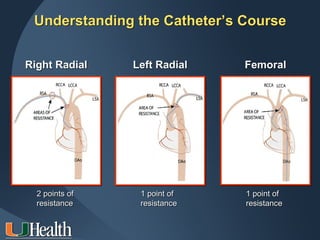
Understanding the Catheter’s Course


Right Radial    Left Radial   Femoral


  2 points of    1 point of   1 point of
  resistance     resistance   resistance
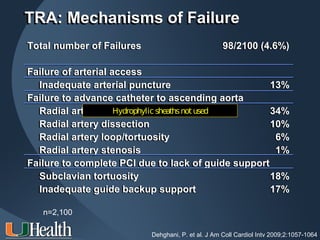
TRA: Mechanisms of Failure
Total number of Failures                           98/2100 (4.6%)

Failure of arterial access
  Inadequate arterial puncture                       13%
Failure to advance catheter to ascending aorta 
  Radial artery spasmHydrophylic sheaths not used    34%
  Radial artery dissection                           10%
   Radial artery loop/tortuosity                      6%
  Radial artery stenosis                              1%
Failure to complete PCI due to lack of guide support
   Subclavian tortuosity                             18%
  Inadequate guide backup support                    17%

   n=2,100

                           Dehghani, P. et al. J Am Coll Cardiol Intv 2009;2:1057-1064
Catheter selection – why
          Standard femoral Dx catheters may be used as
              well as several other universal curves

 Learning curve
 Single vs. Double catheter technique
    Judkins: JL3.5 and JR4 or 5
    Single catheters:
     – Jacky, Tiger, Sarah, Kimny, Fajadet
 TRA PCI
    Right: JR4 or 5 – Left: EBU 3.5
    Single Catheter Technique: Ikari L
ITS 2011
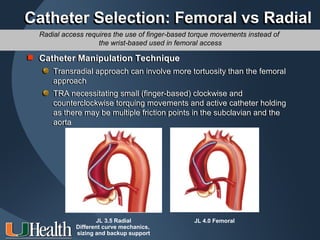
Catheter Selection: Femoral vs Radial
  Radial access requires the use of finger-based torque movements instead of
                    the wrist-based used in femoral access

 Catheter Manipulation
 Catheter Manipulation Technique
      Transradial approach can involve more tortuosity than the femoral
      Transradial approach can involve more tortuosity than the femoral
      approach
      approach
      TRA necessitating small (finger-based) clockwise and
      TRA necessitating small (finger-based) clockwise and
      counterclockwise torquing movements and active catheter holding
      counterclockwise torquing movements and active catheter holding
      as there may be multiple friction points in the subclavian and the
      as there may be multiple friction points in the subclavian and the
      aorta
      aorta


                    JL 3.5 Radial                JL 4.0 Femoral
             Different curve mechanics,
             sizing and backup support
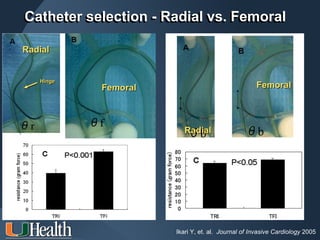
Catheter selection - Radial vs. Femoral

Radial


   Hinge
           Femoral                                 Femoral


                         Radial


                      Ikari Y, et. al. Journal of Invasive Cardiology 2005
ITS 2011
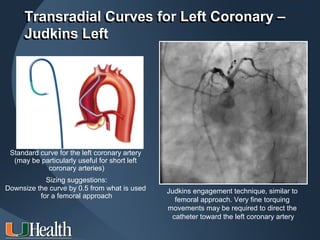
     Transradial Curves for Left Coronary –
     Judkins Left


 Standard curve for the left coronary artery
  (may be particularly useful for short left
            coronary arteries)
            Sizing suggestions:
Downsize the curve by 0.5 from what is used    Judkins engagement technique, similar to
          for a femoral approach
                                                  femoral approach. Very fine torquing
                                               movements may be required to direct the
                                                 catheter toward the left coronary artery
ITS 2011
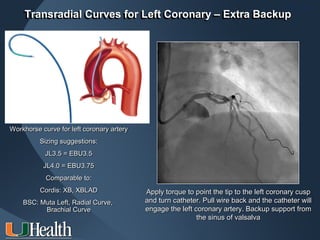
    Transradial Curves for Left Coronary – Extra Backup
    Transradial Curves for Left Coronary – Extra Backup


Workhorse curve for left coronary artery
          Sizing suggestions:
           JL3.5 = EBU3.5
           JL4.0 = EBU3.75
            Comparable to:
          Cordis: XB, XBLAD                Apply torque to point the tip to the left coronary cusp
    BSC: Muta Left, Radial Curve,          and turn catheter. Pull wire back and the catheter will
          Brachial Curve                   engage the left coronary artery. Backup support from
                                                            the sinus of valsalva
ITS 2011

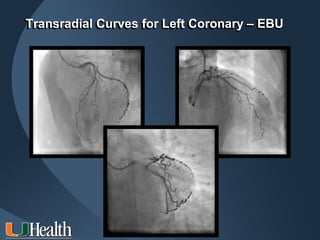
Transradial Curves for Left Coronary – EBU
ITS 2011
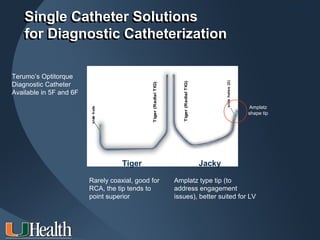
   Single Catheter Solutions
   for Diagnostic Catheterization

Terumo’s Optitorque
Diagnostic Catheter
Available in 5F and 6F

                                                                              Amplatz
                                                                              shape tip


                                    Tiger                   Jacky

                         Rarely coaxial, good for   Amplatz type tip (to
                         RCA, the tip tends to      address engagement
                         point superior             issues), better suited for LV
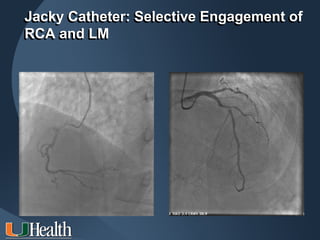
Jacky Catheter: Selective Engagement of
RCA and LM
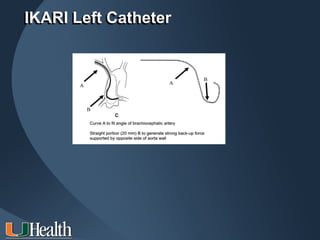
IKARI Left Catheter
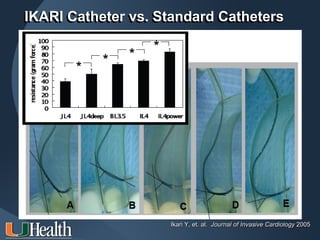
IKARI Catheter vs. Standard Catheters


                    Ikari Y, et. al. Journal of Invasive Cardiology 2005
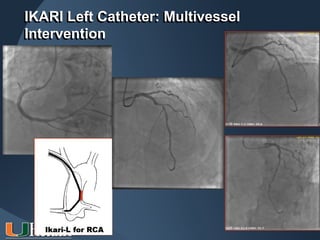
IKARI Left Catheter: Multivessel
Intervention
ITS 2011
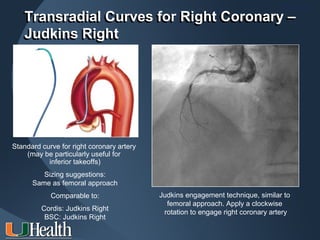
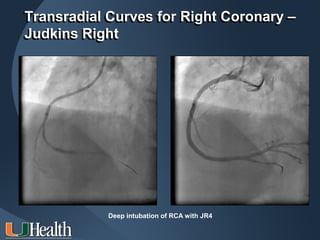
   Transradial Curves for Right Coronary –
   Judkins Right


Standard curve for right coronary artery
    (may be particularly useful for
           inferior takeoffs)
         Sizing suggestions:
      Same as femoral approach
            Comparable to:                 Judkins engagement technique, similar to
                                             femoral approach. Apply a clockwise
         Cordis: Judkins Right
                                            rotation to engage right coronary artery
          BSC: Judkins Right
ITS 2011
Transradial Curves for Right Coronary –
Judkins Right


            Deep intubation of RCA with JR4
ITS 2011
Universal Transradial Curve – MAC3030
ITS 2011
Considerations for Using 5F
Guide Catheters
    5F guide catheters offer several advantages in radial access procedures


 Miniaturization of products allow 5F use
 Small radial arteries may not be suited for
  6F guides
 Less spasm, less patient discomfort
 Lower incidence of radial vessel occlusion
 Less contrast/ injection = less nephrotoxicity
ITS 2011

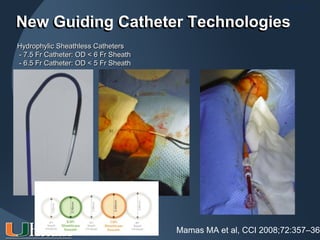
New Guiding Catheter Technologies
Hydrophylic Sheathless Catheters
- 7.5 Fr Catheter: OD < 6 Fr Sheath
- 6.5 Fr Catheter: OD < 5 Fr Sheath


                                      Mamas MA et al, CCI 2008;72:357–364
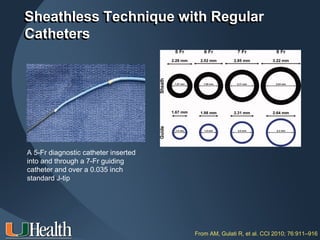
Sheathless Technique with Regular
Catheters


A 5-Fr diagnostic catheter inserted
into and through a 7-Fr guiding
catheter and over a 0.035 inch
standard J-tip


                                      From AM, Gulati R, et al. CCI 2010; 76:911–916
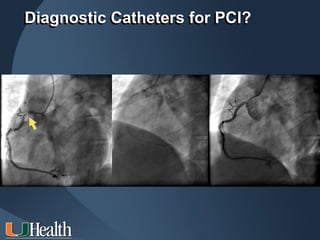
Diagnostic Catheters for PCI?
Conclusions
 Find the catheter that works best for you – Practice
  makes perfect
     Consider starting with Judkins and transition to single
     Consider starting with Judkins and transition to single
              technique once                confident.
     catheter technique once you feel more confident.
 Guiding catheter engagement and support represent
  significant barriers to transradial procedural success
                               catheter           cannulate
     Keep the guidewire in the catheter until you cannulate
 Knowledge of guide catheter selection and technique
  enable successful PCI
 Complex PCI is achievable with existing equipment
                                   ablation
     CTO, bifurcations, rotational ablation
 TR specific guiding catheters may offer advantages
 Dedicated sheathless guiding catheters available
  outside of US, but sheathless is possible with
  available equipment.
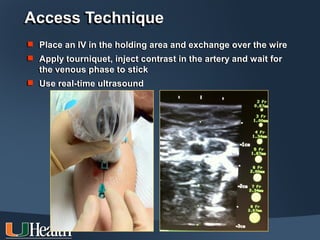
Access Technique

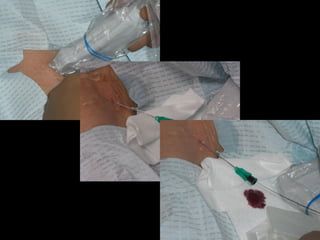
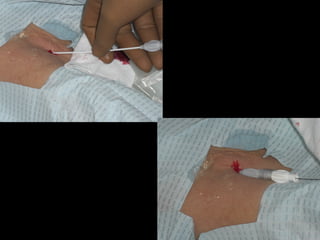
 Place an IV in the holding area and exchange over the wire
           IV                                           wire

 Apply tourniquet, inject contrast in the artery and wait for
                           contrast in the artery and wait for
  the venous phase to stick

 Use real-time ultrasound
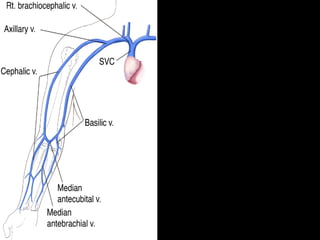
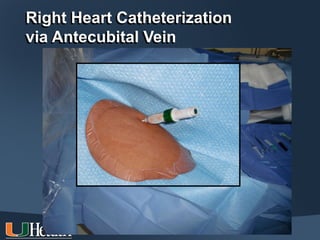
Right Heart Catheterization
via Antecubital Vein
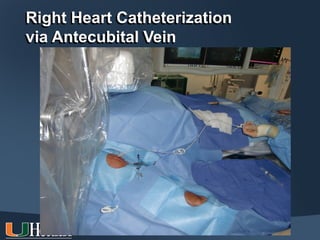
Right Heart Catheterization
via Antecubital Vein
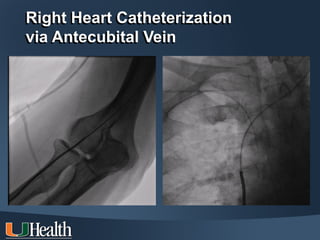
Right Heart Catheterization
via Antecubital Vein
ITS 2011
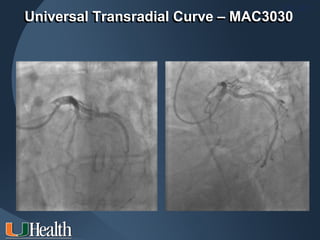
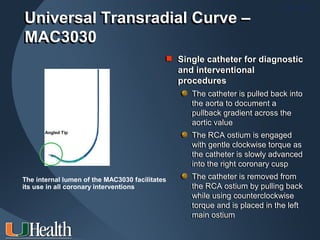
Universal Transradial Curve –
MAC3030
                                                             for
                                             Single catheter for diagnostic
                                                    interventional
                                                and interventional
                                                procedures
                                                   The catheter is pulled back into
                                                   The catheter is pulled back into
                                                   the aorta to document a
                                                   the aorta to document a
                                                   pullback gradient across the
                                                   pullback gradient across the
                                                   aortic value
                                                   aortic value
       Angled Tip
                                                    The RCA ostium is engaged
                                                   The RCA ostium is engaged
                                                    with gentle clockwise torque as
                                                   with gentle clockwise torque as
                                                    the catheter is slowly advanced
                                                   the catheter is slowly advanced
                                                    into the right coronary cusp
                                                   into the right coronary cusp
The internal lumen of the MAC3030 facilitates      The catheter is removed from
                                                   The catheter is removed from
its use in all coronary interventions              the RCA ostium by pulling back
                                                   the RCA ostium by pulling back
                                                   while using counterclockwise
                                                   while using counterclockwise
                                                   torque and is placed in the left
                                                   torque and is placed in the left
                                                   main ostium
                                                   main ostium
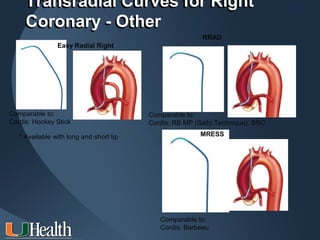
Transradial Curves for Right                                                ITS 2011

    Coronary - Other
                                                         RRAD
                Easy Radial Right


Comparable to:                           Comparable to:
Cordis: Hockey Stick                     Cordis: RB MP (Saito Technique), BRC

   * Available with long and short tip                  MRESS


                                            Comparable to:
                                            Cordis: Barbeau
ITS 2011

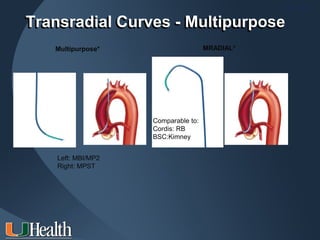
Transradial Curves - Multipurpose
   Multipurpose*                     MRADIAL*


                    Comparable to:
                    Cordis: RB
                    BSC:Kimney


    Left: MBI/MP2
    Right: MPST
ITS 2011
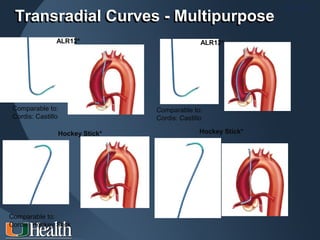
 Transradial Curves - Multipurpose
                ALR12*                         ALR12*


 Comparable to:                 Comparable to:
 Cordis: Castillo               Cordis: Castillo

                Hockey Stick*                 Hockey Stick*


Comparable to:
Cordis: Hockey Stick

Cohen MG

  • 1.
    ITS 2011 Catheter Selectionfor Transradial Procedures Right Heart Catheterization Mauricio G. Cohen, MD, FACC, FSCAI Mauricio Cohen, MD, FACC, FSCAI Director, Cardiac Catheterization Lab Cardiac Catheterization Lab Associate Professor of Medicine Associate Professor of Medicine
  • 2.
    Understanding the Catheter’sCourse Right Radial Left Radial Femoral 2 points of 1 point of 1 point of resistance resistance resistance
  • 3.
    TRA: Mechanisms ofFailure Total number of Failures 98/2100 (4.6%) Failure of arterial access Inadequate arterial puncture 13% Failure to advance catheter to ascending aorta  Radial artery spasmHydrophylic sheaths not used 34% Radial artery dissection 10% Radial artery loop/tortuosity 6% Radial artery stenosis 1% Failure to complete PCI due to lack of guide support Subclavian tortuosity 18% Inadequate guide backup support 17% n=2,100 Dehghani, P. et al. J Am Coll Cardiol Intv 2009;2:1057-1064
  • 4.
    Catheter selection –why Standard femoral Dx catheters may be used as well as several other universal curves  Learning curve  Single vs. Double catheter technique Judkins: JL3.5 and JR4 or 5 Single catheters: – Jacky, Tiger, Sarah, Kimny, Fajadet  TRA PCI Right: JR4 or 5 – Left: EBU 3.5 Single Catheter Technique: Ikari L
  • 5.
    ITS 2011 Catheter Selection:Femoral vs Radial Radial access requires the use of finger-based torque movements instead of the wrist-based used in femoral access  Catheter Manipulation  Catheter Manipulation Technique Transradial approach can involve more tortuosity than the femoral Transradial approach can involve more tortuosity than the femoral approach approach TRA necessitating small (finger-based) clockwise and TRA necessitating small (finger-based) clockwise and counterclockwise torquing movements and active catheter holding counterclockwise torquing movements and active catheter holding as there may be multiple friction points in the subclavian and the as there may be multiple friction points in the subclavian and the aorta aorta JL 3.5 Radial JL 4.0 Femoral Different curve mechanics, sizing and backup support
  • 6.
    Catheter selection -Radial vs. Femoral Radial Hinge Femoral Femoral Radial Ikari Y, et. al. Journal of Invasive Cardiology 2005
  • 7.
    ITS 2011 Transradial Curves for Left Coronary – Judkins Left Standard curve for the left coronary artery (may be particularly useful for short left coronary arteries) Sizing suggestions: Downsize the curve by 0.5 from what is used Judkins engagement technique, similar to for a femoral approach femoral approach. Very fine torquing movements may be required to direct the catheter toward the left coronary artery
  • 8.
    ITS 2011 Transradial Curves for Left Coronary – Extra Backup Transradial Curves for Left Coronary – Extra Backup Workhorse curve for left coronary artery Sizing suggestions: JL3.5 = EBU3.5 JL4.0 = EBU3.75 Comparable to: Cordis: XB, XBLAD Apply torque to point the tip to the left coronary cusp BSC: Muta Left, Radial Curve, and turn catheter. Pull wire back and the catheter will Brachial Curve engage the left coronary artery. Backup support from the sinus of valsalva
  • 9.
    ITS 2011 Transradial Curvesfor Left Coronary – EBU Transradial Curves for Left Coronary – EBU
  • 10.
    ITS 2011 Single Catheter Solutions for Diagnostic Catheterization Terumo’s Optitorque Diagnostic Catheter Available in 5F and 6F Amplatz shape tip Tiger Jacky Rarely coaxial, good for Amplatz type tip (to RCA, the tip tends to address engagement point superior issues), better suited for LV
  • 11.
    Jacky Catheter: SelectiveEngagement of RCA and LM
  • 12.
  • 13.
    IKARI Catheter vs.Standard Catheters Ikari Y, et. al. Journal of Invasive Cardiology 2005
  • 14.
    IKARI Left Catheter:Multivessel Intervention
  • 15.
    ITS 2011 Transradial Curves for Right Coronary – Judkins Right Standard curve for right coronary artery (may be particularly useful for inferior takeoffs) Sizing suggestions: Same as femoral approach Comparable to: Judkins engagement technique, similar to femoral approach. Apply a clockwise Cordis: Judkins Right rotation to engage right coronary artery BSC: Judkins Right
  • 16.
    ITS 2011 Transradial Curvesfor Right Coronary – Judkins Right Deep intubation of RCA with JR4
  • 17.
  • 18.
    ITS 2011 Considerations forUsing 5F Guide Catheters 5F guide catheters offer several advantages in radial access procedures  Miniaturization of products allow 5F use  Small radial arteries may not be suited for 6F guides  Less spasm, less patient discomfort  Lower incidence of radial vessel occlusion  Less contrast/ injection = less nephrotoxicity
  • 19.
    ITS 2011 New GuidingCatheter Technologies Hydrophylic Sheathless Catheters - 7.5 Fr Catheter: OD < 6 Fr Sheath - 6.5 Fr Catheter: OD < 5 Fr Sheath Mamas MA et al, CCI 2008;72:357–364
  • 20.
    Sheathless Technique withRegular Catheters A 5-Fr diagnostic catheter inserted into and through a 7-Fr guiding catheter and over a 0.035 inch standard J-tip From AM, Gulati R, et al. CCI 2010; 76:911–916
  • 22.
  • 23.
    Conclusions  Find thecatheter that works best for you – Practice makes perfect Consider starting with Judkins and transition to single Consider starting with Judkins and transition to single technique once confident. catheter technique once you feel more confident.  Guiding catheter engagement and support represent significant barriers to transradial procedural success catheter cannulate Keep the guidewire in the catheter until you cannulate  Knowledge of guide catheter selection and technique enable successful PCI  Complex PCI is achievable with existing equipment ablation CTO, bifurcations, rotational ablation  TR specific guiding catheters may offer advantages  Dedicated sheathless guiding catheters available outside of US, but sheathless is possible with available equipment.
  • 25.
    Access Technique   Placean IV in the holding area and exchange over the wire IV wire   Apply tourniquet, inject contrast in the artery and wait for contrast in the artery and wait for the venous phase to stick   Use real-time ultrasound
  • 28.
  • 29.
  • 30.
  • 31.
    ITS 2011 Universal TransradialCurve – MAC3030  for  Single catheter for diagnostic interventional and interventional procedures The catheter is pulled back into The catheter is pulled back into the aorta to document a the aorta to document a pullback gradient across the pullback gradient across the aortic value aortic value Angled Tip The RCA ostium is engaged The RCA ostium is engaged with gentle clockwise torque as with gentle clockwise torque as the catheter is slowly advanced the catheter is slowly advanced into the right coronary cusp into the right coronary cusp The internal lumen of the MAC3030 facilitates The catheter is removed from The catheter is removed from its use in all coronary interventions the RCA ostium by pulling back the RCA ostium by pulling back while using counterclockwise while using counterclockwise torque and is placed in the left torque and is placed in the left main ostium main ostium
  • 32.
    Transradial Curves forRight ITS 2011 Coronary - Other RRAD Easy Radial Right Comparable to: Comparable to: Cordis: Hockey Stick Cordis: RB MP (Saito Technique), BRC * Available with long and short tip MRESS Comparable to: Cordis: Barbeau
  • 33.
    ITS 2011 Transradial Curves- Multipurpose Multipurpose* MRADIAL* Comparable to: Cordis: RB BSC:Kimney Left: MBI/MP2 Right: MPST
  • 34.
    ITS 2011 TransradialCurves - Multipurpose ALR12* ALR12* Comparable to: Comparable to: Cordis: Castillo Cordis: Castillo Hockey Stick* Hockey Stick* Comparable to: Cordis: Hockey Stick