

Transradial Access and Intervention:
A Step-by-Step Approach
Mauricio G. Cohen, MD
Associate Professor of Medicine
Director, Cardiac Cath Lab
Disclosure Statement of Financial Interest
Within the past 12 months, I or my spouse/partner have had a financial
interest/arrangement or affiliation with the organization(s) listed below.
Affiliation/Financial Relationship Company
Grant/Research Support Astra Zeneca
Consulting Fees/Honoraria Abiomed / Terumo Medical / Medtronic /
Edwards Lifesciences / The Medicines
Company / Merit Medical / Daiichi Sankyio
Major Stock Shareholder/Equity Accumed Radial Systems
Royalty Income None
Ownership/Founder None
Intellectual Property Rights None
Other Financial Benefit None
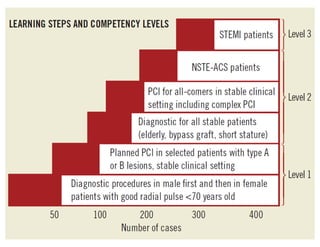
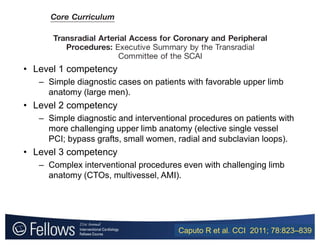
• Level 1 competency
– Simple diagnostic cases on patients with favorable upper limb
anatomy (large men).
• Level 2 competency
– Simple diagnostic and interventional procedures on patients with
more challenging upper limb anatomy (elective single vessel
PCI; bypass grafts, small women, radial and subclavian loops).
• Level 3 competency
– Complex interventional procedures even with challenging limb
anatomy (CTOs, multivessel, AMI).
Caputo R et al. CCI 2011; 78:823–839
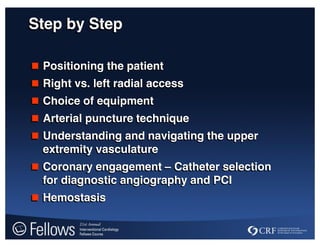
Step by Step
 Positioning the patient
 Right vs. left radial access
 Choice of equipment
 Arterial puncture technique
 Understanding and navigating the upper
extremity vasculature
 Coronary engagement – Catheter selection
for diagnostic angiography and PCI
 Hemostasis
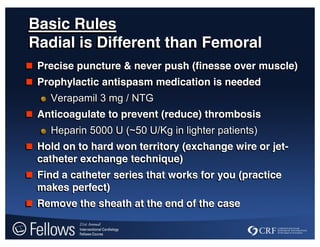
Basic Rules
Radial is Different than Femoral
 Precise puncture & never push (finesse over muscle)
 Prophylactic antispasm medication is needed
Verapamil 3 mg / NTG
 Anticoagulate to prevent (reduce) thrombosis
Heparin 5000 U (~50 U/Kg in lighter patients)
 Hold on to hard won territory (exchange wire or jet-
catheter exchange technique)
 Find a catheter series that works for you (practice
makes perfect)
 Remove the sheath at the end of the case
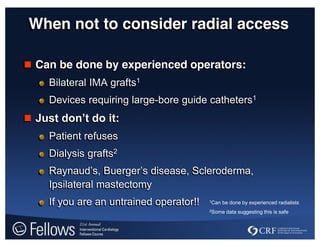
When not to consider radial access
 Can be done by experienced operators:
Bilateral IMA grafts1
Devices requiring large-bore guide catheters1
 Just  don’t  do  it:
Patient refuses
Dialysis grafts2
Raynaud’s,  Buerger’s disease, Scleroderma,
Ipsilateral mastectomy
If you are an untrained operator!! 1Can be done by experienced radialists
2Some data suggesting this is safe
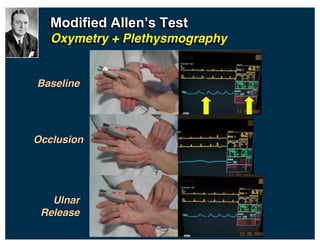
Modified  Allen’s  Test
Oxymetry + Plethysmography
Baseline
Occlusion
Ulnar
Release
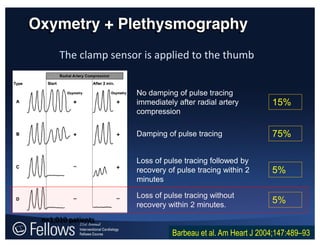
Oxymetry + Plethysmography
No damping of pulse tracing
immediately after radial artery
compression
Damping of pulse tracing
Loss of pulse tracing followed by
recovery of pulse tracing within 2
minutes
Loss of pulse tracing without
recovery within 2 minutes.
The clamp sensor is applied to the thumb
Barbeau et al. Am Heart J 2004;147:489–93
15%
75%
5%
5%
n=1,010 patients
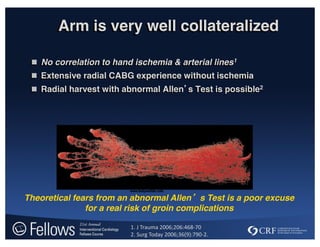
Arm is very well collateralized
 No correlation to hand ischemia & arterial lines1
 Extensive radial CABG experience without ischemia
 Radial harvest with abnormal Allen’s Test is possible2
Theoretical fears from an abnormal Allen’s Test is a poor excuse
for a real risk of groin complications
1. J Trauma 2006;206:468-70
2. Surg Today 2006;36(9):790-2.
Gunther von Hagens, Institute for Plastination, Heidelberg, Germany,
www.bodyworlds.com
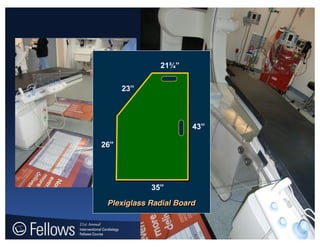
23”
26”
35”
43”
21¾”
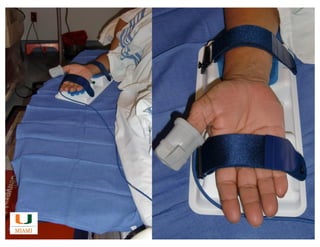
Plexiglass Radial Board
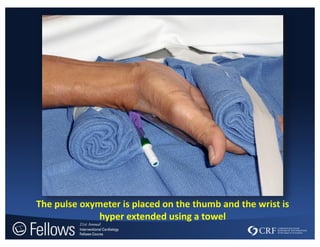
The pulse oxymeter is placed on the thumb and the wrist is
hyper extended using a towel
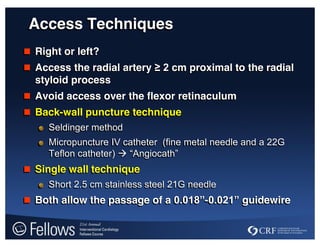
Access Techniques
 Right or left?
 Access the radial artery ≥  2  cm proximal to the radial
styloid process
 Avoid access over the flexor retinaculum
 Back-wall puncture technique
Seldinger method
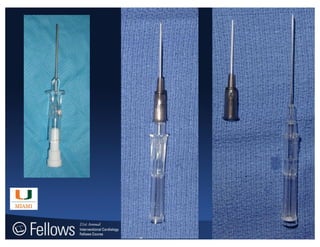
Micropuncture IV catheter (fine metal needle and a 22G
Teflon catheter)  “Angiocath”
 Single wall technique
Short 2.5 cm stainless steel 21G needle
 Both allow the passage of a 0.018”-0.021”  guidewire
Sheath Selection
Pts Undergoing Cath or PCI
via the Radial Artery
2x2 Factorial Randomization
R R
Long (23 cm)
n=396
Short (13 cm)
n=394
Coated
n=397
Uncoated
n=393
Operator
RAS
110 (27.9%) 120 (30.8%)* 75 (19.0%) 155 (39.9%)^
Patient
discomfort
85 (21.5%) 87 (22.2%)* 60 (15.1%) 112 (28.5%)^
Rathore S et al. JACC Interv, 2010; 3:475-483
*p=NS
^p<0.001
Young age, female sex, diabetes, and low BMI to
be independent predictors of RAS
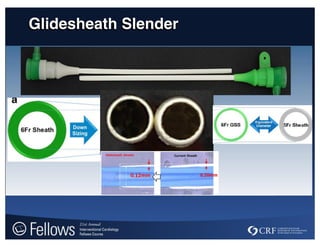
Tapered transition between
sheath and wire makes skin
nick unnecessary
Glidesheath Slender
Radial Artery Access Technique Evaluation Trial
Radial Catheterization
R
Seldinger
(n=210)
Modified Seldinger
(n=202)
Pancholy et al. CCI 2012
Procedural Characteristics
Complications
Two operators Anticoagulation: 50 U/Kg UFH
5F hydrophylic-coated sheaths Hemostasis: TR Band applied for 2 hs
Vasodilators: Diltiazem 5 mg + NTG 200 mcg
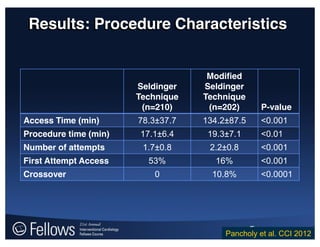
Results: Procedure Characteristics
Seldinger
Technique
(n=210)
Modified
Seldinger
Technique
(n=202) P-value
Access Time (min) 78.3±37.7 134.2±87.5 <0.001
Procedure time (min) 17.1±6.4 19.3±7.1 <0.01
Number of attempts 1.7±0.8 2.2±0.8 <0.001
First Attempt Access 53% 16% <0.001
Crossover 0 10.8% <0.0001
Pancholy et al. CCI 2012
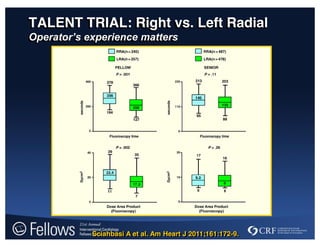
TALENT TRIAL: Right vs. Left Radial
Operator’s  experience  matters
Sciahbasi A et al. Am Heart J 2011;161:172-9.
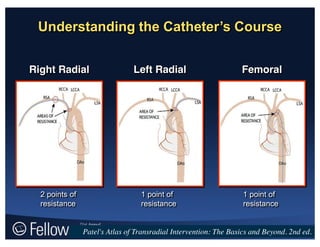
Understanding  the  Catheter’s  Course
2 points of
resistance
1 point of
resistance
1 point of
resistance
Right Radial Left Radial Femoral
Patel's Atlas of Transradial Intervention: The Basics and Beyond. 2nd ed.
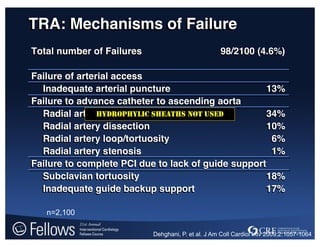
TRA: Mechanisms of Failure
Total number of Failures 98/2100 (4.6%)
Failure of arterial access
Inadequate arterial puncture 13%
Failure to advance catheter to ascending aorta
Radial artery spasm 34%
Radial artery dissection 10%
Radial artery loop/tortuosity 6%
Radial artery stenosis 1%
Failure to complete PCI due to lack of guide support
Subclavian tortuosity 18%
Inadequate guide backup support 17%
n=2,100
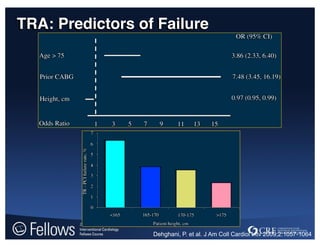
Dehghani, P. et al. J Am Coll Cardiol Intv 2009;2:1057-1064
hydrophylic sheaths not used
TRA: Predictors of Failure
Dehghani, P. et al. J Am Coll Cardiol Intv 2009;2:1057-1064
Radial Anomalies and Procedural Failure
5 13 7 5
103
22
23 34
0
20
40
60
80
100
120
High
Bifurcation
Radial Loop Tortuosity Others
Success
Failure
Lo TS, et al. Heart 2009;95:410–415
n=1540
7%
2.3%
2.0%
2.5%
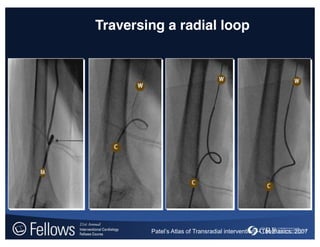
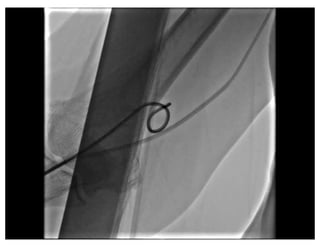
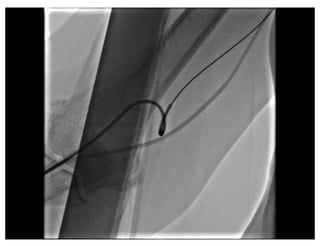
Radial Loop
Patel’s  Atlas  of  Transradial  intervention  – The Basics. 2007
Traversing a radial loop
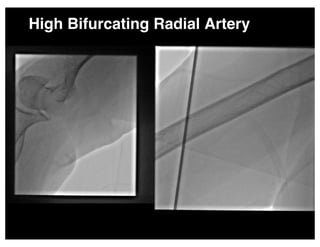
High Bifurcating Radial Artery
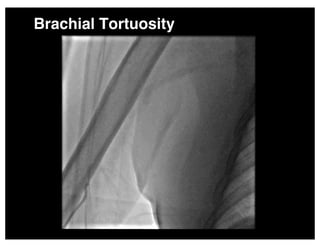
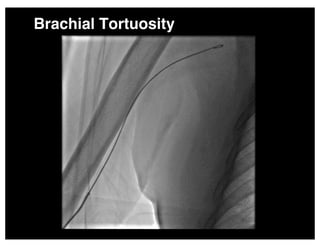
Brachial Tortuosity
Brachial Tortuosity
Brachial Tortuosity
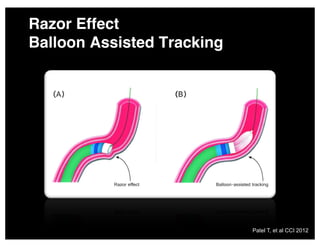
Balloon Assisted Tracking
Patel T, et al CCI 2012
Razor Effect
Balloon Assisted Tracking
Patel T, et al CCI 2012
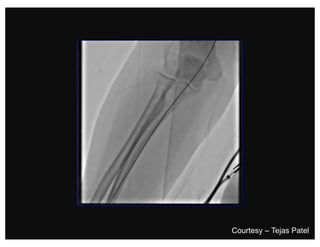
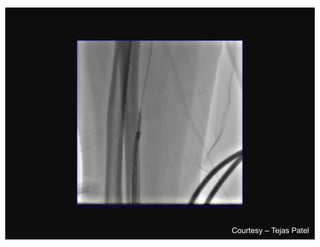
Courtesy – Tejas Patel
Negotiating Subclavian Tortuosity
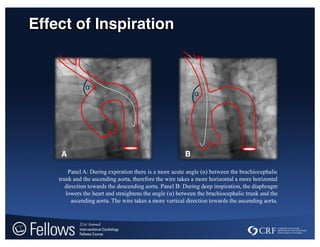
Effect of Inspiration
BA
α
α
Panel A: During expiration there is a more acute angle (α) between the brachiocephalic
trunk and the ascending aorta, therefore the wire takes a more horizontal a more horizontal
direction towards the descending aorta. Panel B: During deep inspiration, the diaphragm
lowers the heart and straightens the angle (α) between the brachiocephalic trunk and the
ascending aorta. The wire takes a more vertical direction towards the ascending aorta.
Most frequently used diagnostic coronary catheter shapes
LCB RCB
Amplatz LeftJackyTiger
Judins Right Multipurpose A2 IM IM VB-1Judkins Left 3D LIMA
ITS 2011
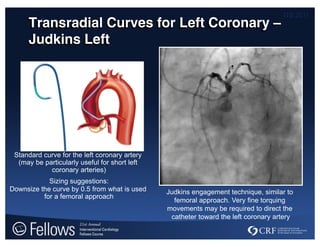
Transradial Curves for Left Coronary –
Judkins Left
Judkins engagement technique, similar to
femoral approach. Very fine torquing
movements may be required to direct the
catheter toward the left coronary artery
Standard curve for the left coronary artery
(may be particularly useful for short left
coronary arteries)
Sizing suggestions:
Downsize the curve by 0.5 from what is used
for a femoral approach
ITS 2011
Transradial Curves for Left Coronary – Extra Backup
Workhorse curve for left coronary artery
Sizing suggestions:
JL3.5 = EBU3.5
JL4.0 = EBU3.75
Comparable to:
Cordis: XB, XBLAD
BSC: Muta Left, Radial Curve,
Brachial Curve
Apply torque to point the tip to the left coronary cusp
and turn catheter. Pull wire back and the catheter will
engage the left coronary artery. Backup support from
the sinus of valsalva
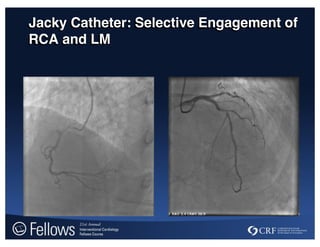
Jacky Catheter: Selective Engagement of
RCA and LM
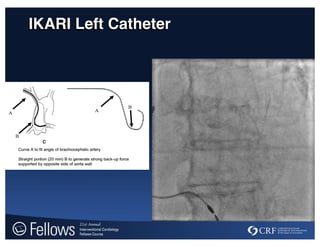
IKARI Left Catheter
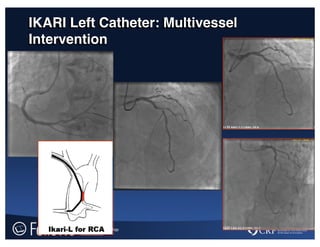
IKARI Left Catheter: Multivessel
Intervention
ITS 2011
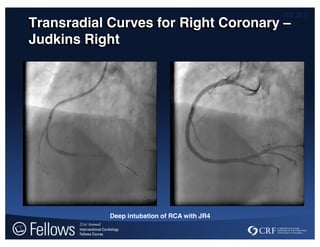
Transradial Curves for Right Coronary –
Judkins Right
Standard curve for right coronary artery
(may be particularly useful for
inferior takeoffs)
Sizing suggestions:
Same as femoral approach
Comparable to:
Cordis: Judkins Right
BSC: Judkins Right
Judkins engagement technique, similar to
femoral approach. Apply a clockwise
rotation to engage right coronary artery
ITS 2011
Transradial Curves for Right Coronary –
Judkins Right
Deep intubation of RCA with JR4
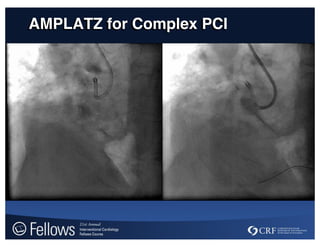
AMPLATZ for Complex PCI
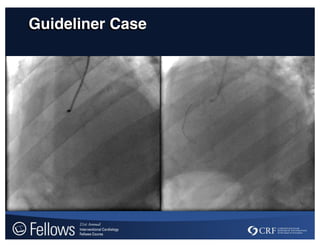
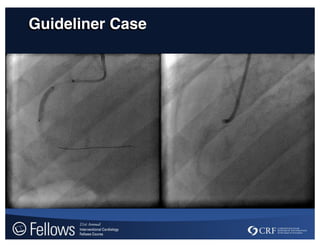
Guideliner Case
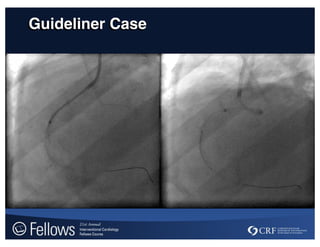
Guideliner Case
Guideliner Case
transradial-summit.org
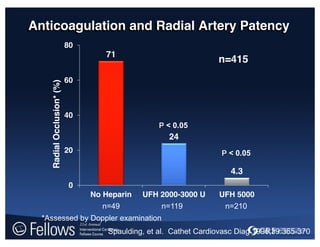
Anticoagulation and Radial Artery Patency
Spaulding, et al. Cathet Cardiovasc Diag 1996;39:365-370
71
24
4.3
0
20
40
60
80
No Heparin UFH 2000-3000 U UFH 5000
RadialOcclusion*(%)
n=49 n=119 n=210
P < 0.05
P < 0.05
*Assessed by Doppler examination
n=415
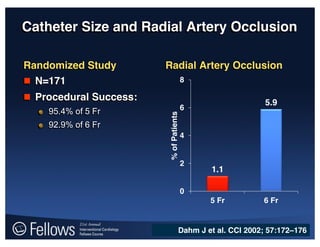
Catheter Size and Radial Artery Occlusion
Randomized Study
 N=171
 Procedural Success:
95.4% of 5 Fr
92.9% of 6 Fr
Radial Artery Occlusion
1.1
5.9
0
2
4
6
8
5 Fr 6 Fr
%ofPatients
Dahm J et al. CCI 2002; 57:172–176
Reverse  Allen’s  test  to  determine  
post-procedural radial patency
– Courtesy: Dr. Samir Pancholy
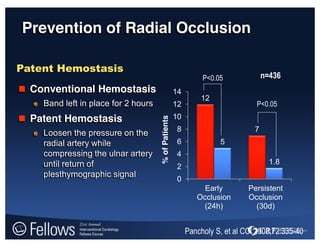
Prevention of Radial Occlusion
 Conventional Hemostasis
Band left in place for 2 hours
 Patent Hemostasis
Loosen the pressure on the
radial artery while
compressing the ulnar artery
until return of
plesthymographic signal
12
7
5
1.8
0
2
4
6
8
10
12
14
Early
Occlusion
(24h)
Persistent
Occlusion
(30d)
%ofPatients
P<0.05
P<0.05
Pancholy S, et al CCI 2008;72:335-40
n=436
Patent Hemostasis
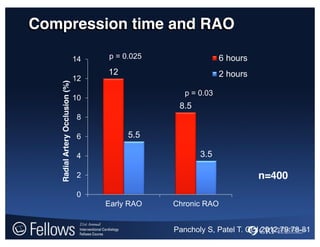
Compression time and RAO
12
8.5
5.5
3.5
0
2
4
6
8
10
12
14
Early RAO Chronic RAO
RadialArteryOcclusion(%)
6 hours
2 hours
n=400
Pancholy S, Patel T. CCI 2012;79:78-81
p = 0.025
p = 0.03
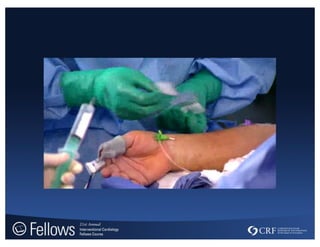
Hematoma or Swelling in Holding?
transradial-summit.org
Hematoma or Swelling in Holding?
your best friends
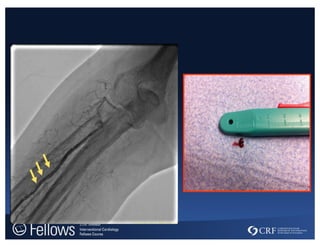
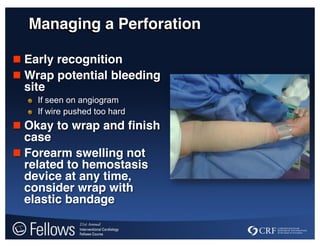
Managing a Perforation
 Early recognition
 Wrap potential bleeding
site
If seen on angiogram
If wire pushed too hard
 Okay to wrap and finish
case
 Forearm swelling not
related to hemostasis
device at any time,
consider wrap with
elastic bandage
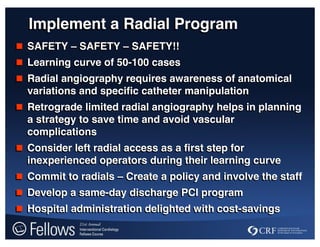
Implement a Radial Program
 SAFETY – SAFETY – SAFETY!!
 Learning curve of 50-100 cases
 Radial angiography requires awareness of anatomical
variations and specific catheter manipulation
 Retrograde limited radial angiography helps in planning
a strategy to save time and avoid vascular
complications
 Consider left radial access as a first step for
inexperienced operators during their learning curve
 Commit to radials – Create a policy and involve the staff
 Develop a same-day discharge PCI program
 Hospital administration delighted with cost-savings
Questions? Call me
Cell: 305-873-4513
Email: mgcohen@med.miami.edu
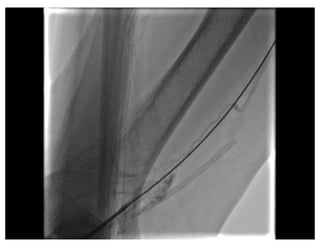
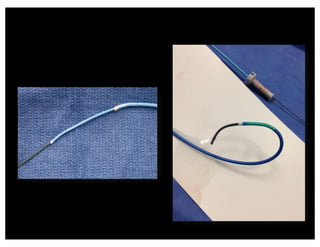
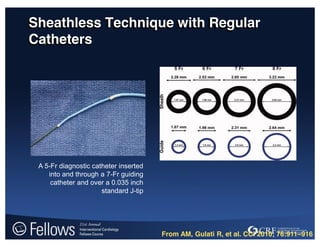
Sheathless Technique with Regular
Catheters
A 5-Fr diagnostic catheter inserted
into and through a 7-Fr guiding
catheter and over a 0.035 inch
standard J-tip
From AM, Gulati R, et al. CCI 2010; 76:911–916
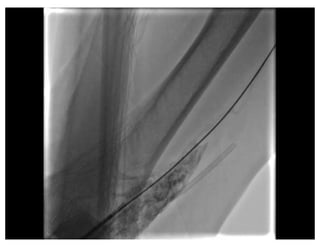
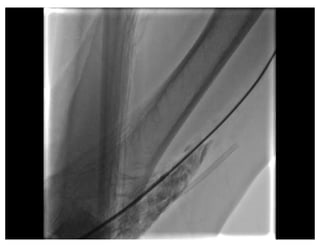
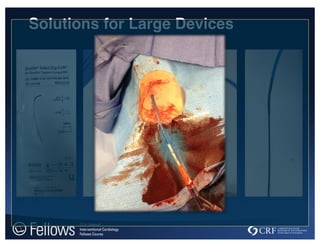
Solutions for Large Devices
Cohen MG - Transradial access - 201507

Cohen MG - Transradial access - 201507

  • 1.
    Transradial Access andIntervention: A Step-by-Step Approach Mauricio G. Cohen, MD Associate Professor of Medicine Director, Cardiac Cath Lab
  • 2.
    Disclosure Statement ofFinancial Interest Within the past 12 months, I or my spouse/partner have had a financial interest/arrangement or affiliation with the organization(s) listed below. Affiliation/Financial Relationship Company Grant/Research Support Astra Zeneca Consulting Fees/Honoraria Abiomed / Terumo Medical / Medtronic / Edwards Lifesciences / The Medicines Company / Merit Medical / Daiichi Sankyio Major Stock Shareholder/Equity Accumed Radial Systems Royalty Income None Ownership/Founder None Intellectual Property Rights None Other Financial Benefit None
  • 5.
    • Level 1competency – Simple diagnostic cases on patients with favorable upper limb anatomy (large men). • Level 2 competency – Simple diagnostic and interventional procedures on patients with more challenging upper limb anatomy (elective single vessel PCI; bypass grafts, small women, radial and subclavian loops). • Level 3 competency – Complex interventional procedures even with challenging limb anatomy (CTOs, multivessel, AMI). Caputo R et al. CCI 2011; 78:823–839
  • 6.
    Step by Step Positioning the patient  Right vs. left radial access  Choice of equipment  Arterial puncture technique  Understanding and navigating the upper extremity vasculature  Coronary engagement – Catheter selection for diagnostic angiography and PCI  Hemostasis
  • 7.
    Basic Rules Radial isDifferent than Femoral  Precise puncture & never push (finesse over muscle)  Prophylactic antispasm medication is needed Verapamil 3 mg / NTG  Anticoagulate to prevent (reduce) thrombosis Heparin 5000 U (~50 U/Kg in lighter patients)  Hold on to hard won territory (exchange wire or jet- catheter exchange technique)  Find a catheter series that works for you (practice makes perfect)  Remove the sheath at the end of the case
  • 8.
    When not toconsider radial access  Can be done by experienced operators: Bilateral IMA grafts1 Devices requiring large-bore guide catheters1  Just  don’t  do  it: Patient refuses Dialysis grafts2 Raynaud’s,  Buerger’s disease, Scleroderma, Ipsilateral mastectomy If you are an untrained operator!! 1Can be done by experienced radialists 2Some data suggesting this is safe
  • 9.
    Modified  Allen’s  Test Oxymetry+ Plethysmography Baseline Occlusion Ulnar Release
  • 10.
    Oxymetry + Plethysmography Nodamping of pulse tracing immediately after radial artery compression Damping of pulse tracing Loss of pulse tracing followed by recovery of pulse tracing within 2 minutes Loss of pulse tracing without recovery within 2 minutes. The clamp sensor is applied to the thumb Barbeau et al. Am Heart J 2004;147:489–93 15% 75% 5% 5% n=1,010 patients
  • 11.
    Arm is verywell collateralized  No correlation to hand ischemia & arterial lines1  Extensive radial CABG experience without ischemia  Radial harvest with abnormal Allen’s Test is possible2 Theoretical fears from an abnormal Allen’s Test is a poor excuse for a real risk of groin complications 1. J Trauma 2006;206:468-70 2. Surg Today 2006;36(9):790-2. Gunther von Hagens, Institute for Plastination, Heidelberg, Germany, www.bodyworlds.com
  • 12.
  • 13.
    The pulse oxymeteris placed on the thumb and the wrist is hyper extended using a towel
  • 16.
    Access Techniques  Rightor left?  Access the radial artery ≥  2  cm proximal to the radial styloid process  Avoid access over the flexor retinaculum  Back-wall puncture technique Seldinger method Micropuncture IV catheter (fine metal needle and a 22G Teflon catheter)  “Angiocath”  Single wall technique Short 2.5 cm stainless steel 21G needle  Both allow the passage of a 0.018”-0.021”  guidewire
  • 18.
    Sheath Selection Pts UndergoingCath or PCI via the Radial Artery 2x2 Factorial Randomization R R Long (23 cm) n=396 Short (13 cm) n=394 Coated n=397 Uncoated n=393 Operator RAS 110 (27.9%) 120 (30.8%)* 75 (19.0%) 155 (39.9%)^ Patient discomfort 85 (21.5%) 87 (22.2%)* 60 (15.1%) 112 (28.5%)^ Rathore S et al. JACC Interv, 2010; 3:475-483 *p=NS ^p<0.001 Young age, female sex, diabetes, and low BMI to be independent predictors of RAS
  • 19.
    Tapered transition between sheathand wire makes skin nick unnecessary
  • 20.
  • 24.
    Radial Artery AccessTechnique Evaluation Trial Radial Catheterization R Seldinger (n=210) Modified Seldinger (n=202) Pancholy et al. CCI 2012 Procedural Characteristics Complications Two operators Anticoagulation: 50 U/Kg UFH 5F hydrophylic-coated sheaths Hemostasis: TR Band applied for 2 hs Vasodilators: Diltiazem 5 mg + NTG 200 mcg
  • 25.
    Results: Procedure Characteristics Seldinger Technique (n=210) Modified Seldinger Technique (n=202)P-value Access Time (min) 78.3±37.7 134.2±87.5 <0.001 Procedure time (min) 17.1±6.4 19.3±7.1 <0.01 Number of attempts 1.7±0.8 2.2±0.8 <0.001 First Attempt Access 53% 16% <0.001 Crossover 0 10.8% <0.0001 Pancholy et al. CCI 2012
  • 26.
    TALENT TRIAL: Rightvs. Left Radial Operator’s  experience  matters Sciahbasi A et al. Am Heart J 2011;161:172-9.
  • 27.
    Understanding  the  Catheter’s Course 2 points of resistance 1 point of resistance 1 point of resistance Right Radial Left Radial Femoral Patel's Atlas of Transradial Intervention: The Basics and Beyond. 2nd ed.
  • 28.
    TRA: Mechanisms ofFailure Total number of Failures 98/2100 (4.6%) Failure of arterial access Inadequate arterial puncture 13% Failure to advance catheter to ascending aorta Radial artery spasm 34% Radial artery dissection 10% Radial artery loop/tortuosity 6% Radial artery stenosis 1% Failure to complete PCI due to lack of guide support Subclavian tortuosity 18% Inadequate guide backup support 17% n=2,100 Dehghani, P. et al. J Am Coll Cardiol Intv 2009;2:1057-1064 hydrophylic sheaths not used
  • 29.
    TRA: Predictors ofFailure Dehghani, P. et al. J Am Coll Cardiol Intv 2009;2:1057-1064
  • 30.
    Radial Anomalies andProcedural Failure 5 13 7 5 103 22 23 34 0 20 40 60 80 100 120 High Bifurcation Radial Loop Tortuosity Others Success Failure Lo TS, et al. Heart 2009;95:410–415 n=1540 7% 2.3% 2.0% 2.5%
  • 31.
  • 32.
    Patel’s  Atlas  of Transradial  intervention  – The Basics. 2007 Traversing a radial loop
  • 43.
  • 44.
  • 45.
  • 46.
  • 47.
  • 48.
    Razor Effect Balloon AssistedTracking Patel T, et al CCI 2012
  • 49.
  • 50.
  • 51.
  • 52.
    Effect of Inspiration BA α α PanelA: During expiration there is a more acute angle (α) between the brachiocephalic trunk and the ascending aorta, therefore the wire takes a more horizontal a more horizontal direction towards the descending aorta. Panel B: During deep inspiration, the diaphragm lowers the heart and straightens the angle (α) between the brachiocephalic trunk and the ascending aorta. The wire takes a more vertical direction towards the ascending aorta.
  • 53.
    Most frequently useddiagnostic coronary catheter shapes LCB RCB Amplatz LeftJackyTiger Judins Right Multipurpose A2 IM IM VB-1Judkins Left 3D LIMA
  • 54.
    ITS 2011 Transradial Curvesfor Left Coronary – Judkins Left Judkins engagement technique, similar to femoral approach. Very fine torquing movements may be required to direct the catheter toward the left coronary artery Standard curve for the left coronary artery (may be particularly useful for short left coronary arteries) Sizing suggestions: Downsize the curve by 0.5 from what is used for a femoral approach
  • 55.
    ITS 2011 Transradial Curvesfor Left Coronary – Extra Backup Workhorse curve for left coronary artery Sizing suggestions: JL3.5 = EBU3.5 JL4.0 = EBU3.75 Comparable to: Cordis: XB, XBLAD BSC: Muta Left, Radial Curve, Brachial Curve Apply torque to point the tip to the left coronary cusp and turn catheter. Pull wire back and the catheter will engage the left coronary artery. Backup support from the sinus of valsalva
  • 56.
    Jacky Catheter: SelectiveEngagement of RCA and LM
  • 57.
  • 58.
    IKARI Left Catheter:Multivessel Intervention
  • 59.
    ITS 2011 Transradial Curvesfor Right Coronary – Judkins Right Standard curve for right coronary artery (may be particularly useful for inferior takeoffs) Sizing suggestions: Same as femoral approach Comparable to: Cordis: Judkins Right BSC: Judkins Right Judkins engagement technique, similar to femoral approach. Apply a clockwise rotation to engage right coronary artery
  • 60.
    ITS 2011 Transradial Curvesfor Right Coronary – Judkins Right Deep intubation of RCA with JR4
  • 61.
  • 62.
  • 63.
  • 64.
  • 65.
  • 67.
    transradial-summit.org Anticoagulation and RadialArtery Patency Spaulding, et al. Cathet Cardiovasc Diag 1996;39:365-370 71 24 4.3 0 20 40 60 80 No Heparin UFH 2000-3000 U UFH 5000 RadialOcclusion*(%) n=49 n=119 n=210 P < 0.05 P < 0.05 *Assessed by Doppler examination n=415
  • 69.
    Catheter Size andRadial Artery Occlusion Randomized Study  N=171  Procedural Success: 95.4% of 5 Fr 92.9% of 6 Fr Radial Artery Occlusion 1.1 5.9 0 2 4 6 8 5 Fr 6 Fr %ofPatients Dahm J et al. CCI 2002; 57:172–176
  • 70.
    Reverse  Allen’s  test to  determine   post-procedural radial patency – Courtesy: Dr. Samir Pancholy
  • 71.
    Prevention of RadialOcclusion  Conventional Hemostasis Band left in place for 2 hours  Patent Hemostasis Loosen the pressure on the radial artery while compressing the ulnar artery until return of plesthymographic signal 12 7 5 1.8 0 2 4 6 8 10 12 14 Early Occlusion (24h) Persistent Occlusion (30d) %ofPatients P<0.05 P<0.05 Pancholy S, et al CCI 2008;72:335-40 n=436 Patent Hemostasis
  • 72.
    Compression time andRAO 12 8.5 5.5 3.5 0 2 4 6 8 10 12 14 Early RAO Chronic RAO RadialArteryOcclusion(%) 6 hours 2 hours n=400 Pancholy S, Patel T. CCI 2012;79:78-81 p = 0.025 p = 0.03
  • 73.
  • 74.
    transradial-summit.org Hematoma or Swellingin Holding? your best friends
  • 75.
    Managing a Perforation Early recognition  Wrap potential bleeding site If seen on angiogram If wire pushed too hard  Okay to wrap and finish case  Forearm swelling not related to hemostasis device at any time, consider wrap with elastic bandage
  • 76.
    Implement a RadialProgram  SAFETY – SAFETY – SAFETY!!  Learning curve of 50-100 cases  Radial angiography requires awareness of anatomical variations and specific catheter manipulation  Retrograde limited radial angiography helps in planning a strategy to save time and avoid vascular complications  Consider left radial access as a first step for inexperienced operators during their learning curve  Commit to radials – Create a policy and involve the staff  Develop a same-day discharge PCI program  Hospital administration delighted with cost-savings
  • 77.
    Questions? Call me Cell:305-873-4513 Email: mgcohen@med.miami.edu
  • 78.
    Sheathless Technique withRegular Catheters A 5-Fr diagnostic catheter inserted into and through a 7-Fr guiding catheter and over a 0.035 inch standard J-tip From AM, Gulati R, et al. CCI 2010; 76:911–916
  • 79.