Sarah Stevenson
   Key Points
   Notable Contributors
   Classroom Implications
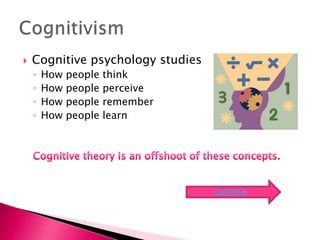
   Cognitive psychology studies
    ◦   How   people   think
    ◦   How   people   perceive
    ◦   How   people   remember
    ◦   How   people   learn


                                   continue
   Came as a reaction to behaviorist thinking.

        How does thinking, deciding, remembering, etc., underlie
        behavior?

   Learning is NOT a reactionary phenomenon.


                                                           Menu
   Allan Paivio (1925- )

   Robert Gagne (1916-2002)

   Howard Gardner (1943- )

   Benjamin Bloom (1913-1999)


                            More about Benjamin Bloom
   Bloom classified learning into three domains:
             1. Cognitive
             2. Affective
             3. Psychomotor
     He defined the cognitive domain as a student’s intellectual level.
                             -what students know
                             -how they organize ideas and thoughts


                                                      Continue
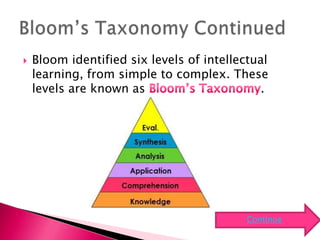
   Bloom identified six levels of intellectual
    learning, from simple to complex. These
    levels are known as                       .


                                           Continue
   Knowledge- recalling information

   Comprehension- explaining and predicting

   Application- solving and using

   Analysis- seeing, organizing, and recognizing

   Synthesis- creating and relating

   Evaluation- comparing and discriminating

                                                    Menu
   Teachers utilizing this theory may
        Use alternate methods of assessment, like a portfolio
         showing the students’ work. This allows room for higher
         order thinking than a typical multiple-choice test
        Incorporate technology into the classroom by having
         students do research on computers. This allows them to
         be fully immersed in the learning process, and in turn,
         they teach themselves.


                                             Continue
   Students utilizing this theory may
         Go more in depth with their learning. Rather than just
          recalling and remembering, practice critical thinking.
         Use technology to create (ex. Powerpoints). This applies the
          synthesis level of intellectual learning.


                                                          Menu

Cognitivism

  • 1.
  • 2.
    Key Points  Notable Contributors  Classroom Implications
  • 3.
    Cognitive psychology studies ◦ How people think ◦ How people perceive ◦ How people remember ◦ How people learn continue
  • 4.
    Came as a reaction to behaviorist thinking. How does thinking, deciding, remembering, etc., underlie behavior?  Learning is NOT a reactionary phenomenon. Menu
  • 5.
    Allan Paivio (1925- )  Robert Gagne (1916-2002)  Howard Gardner (1943- )  Benjamin Bloom (1913-1999) More about Benjamin Bloom
  • 6.
    Bloom classified learning into three domains: 1. Cognitive 2. Affective 3. Psychomotor He defined the cognitive domain as a student’s intellectual level. -what students know -how they organize ideas and thoughts Continue
  • 7.
    Bloom identified six levels of intellectual learning, from simple to complex. These levels are known as . Continue
  • 8.
    Knowledge- recalling information  Comprehension- explaining and predicting  Application- solving and using  Analysis- seeing, organizing, and recognizing  Synthesis- creating and relating  Evaluation- comparing and discriminating Menu
  • 9.
    Teachers utilizing this theory may  Use alternate methods of assessment, like a portfolio showing the students’ work. This allows room for higher order thinking than a typical multiple-choice test  Incorporate technology into the classroom by having students do research on computers. This allows them to be fully immersed in the learning process, and in turn, they teach themselves. Continue
  • 10.
    Students utilizing this theory may  Go more in depth with their learning. Rather than just recalling and remembering, practice critical thinking.  Use technology to create (ex. Powerpoints). This applies the synthesis level of intellectual learning. Menu